
Global USV (Unmanned Surface Vehicle) Market Outlook 2030
Region:Global
Author(s):Shivani Mehra
Product Code:KROD11401
December 2024
93
About the Report
Global USV (Unmanned Surface Vehicle) Market Overview
- The global Unmanned Surface Vehicle (USV) market is valued at approximately USD 0.8 billion, driven by increasing military investments and advancements in autonomous technologies. The demand for USVs in defense applications such as Intelligence, Surveillance, and Reconnaissance (ISR), as well as in commercial sectors for hydrographic surveys and environmental monitoring, is significantly boosting market growth. Additionally, the expansion of offshore oil and gas exploration activities has further propelled the adoption of USVs for data collection and operational efficiency.
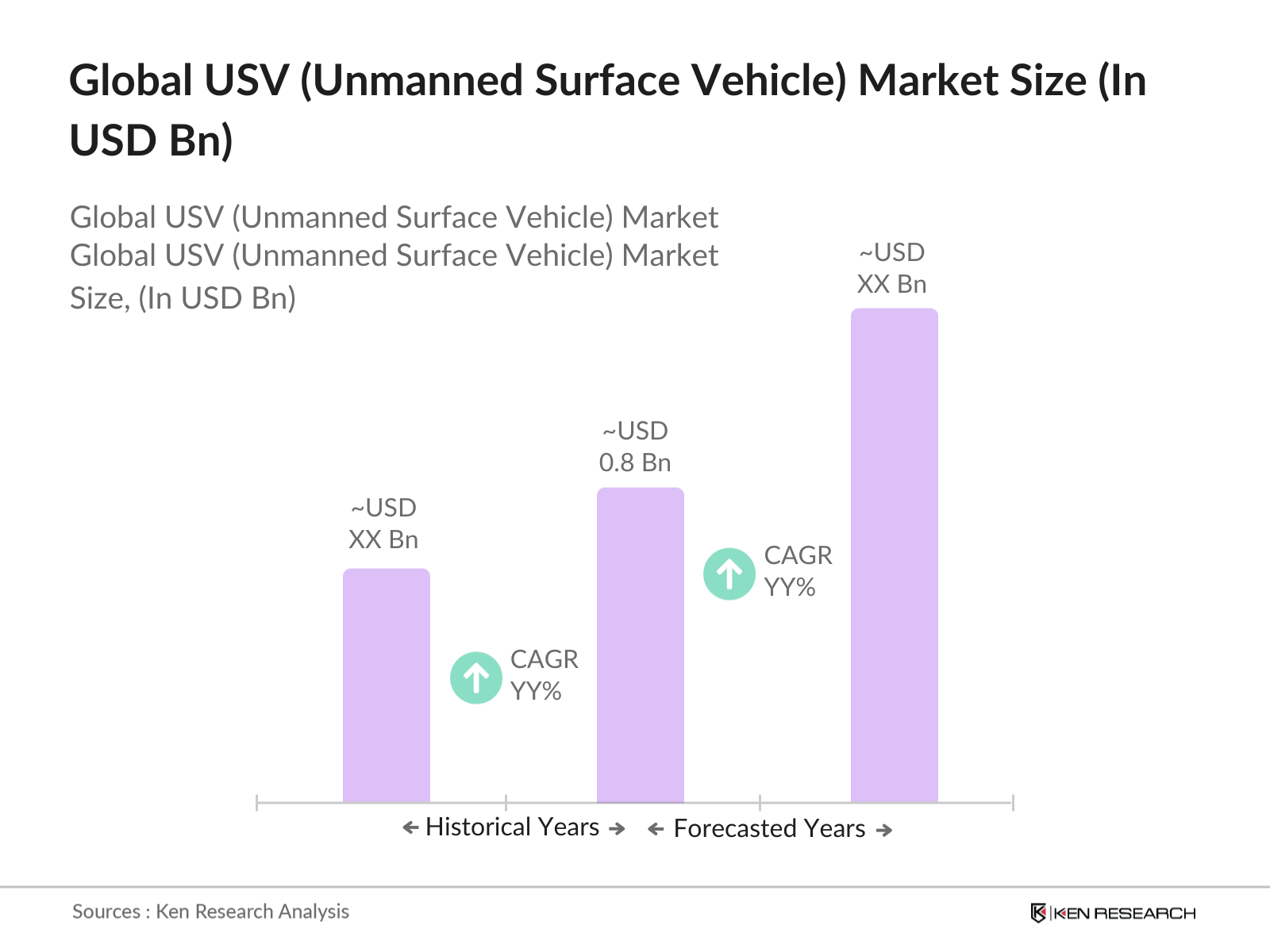
- The US market leads globally, driven by substantial defense budgets and a focus on autonomous systems for maritime operations, such as anti-submarine warfare and mine countermeasures. The U.S. Department of Defense continues to allocate significant resources to USV technologies, strengthening their maritime security and enhancing naval capabilities. Europe follows closely, with countries like the UK and Germany investing heavily in autonomous surface systems for both defense and commercial applications.
- The U.S. government has invested heavily in its Unmanned Maritime Systems program to enhance naval capabilities with autonomous USVs. In 2023, the U.S. Navy received a budget allocation of USD 1.5 billion specifically for the development and deployment of USVs. This program aims to increase the fleet size and operational capabilities of USVs in defense applications.
Global USV (Unmanned Surface Vehicle) Market Segmentation
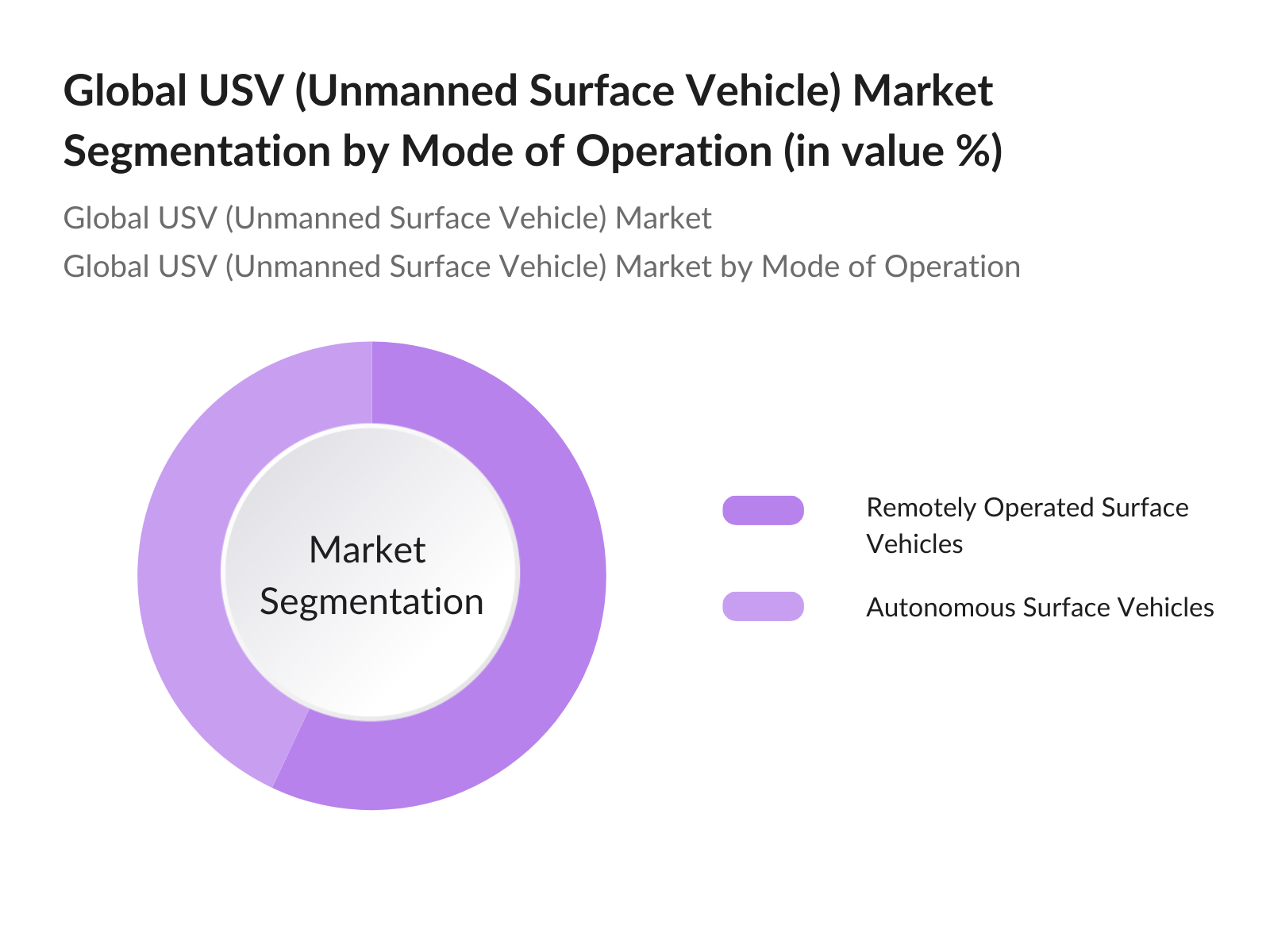
By Mode of Operation: The USV market is segmented by mode of operation into autonomous and remotely operated vehicles. Remotely operated USVs dominate the market, particularly in military and offshore industries, as they offer higher control and operational flexibility. These USVs are commonly used for inspection, maintenance, and repair tasks in offshore wind farms and oil and gas operations. This dominance is also driven by their ability to perform complex maneuvers while being operated from a remote location, offering a balance between operational control and safety.
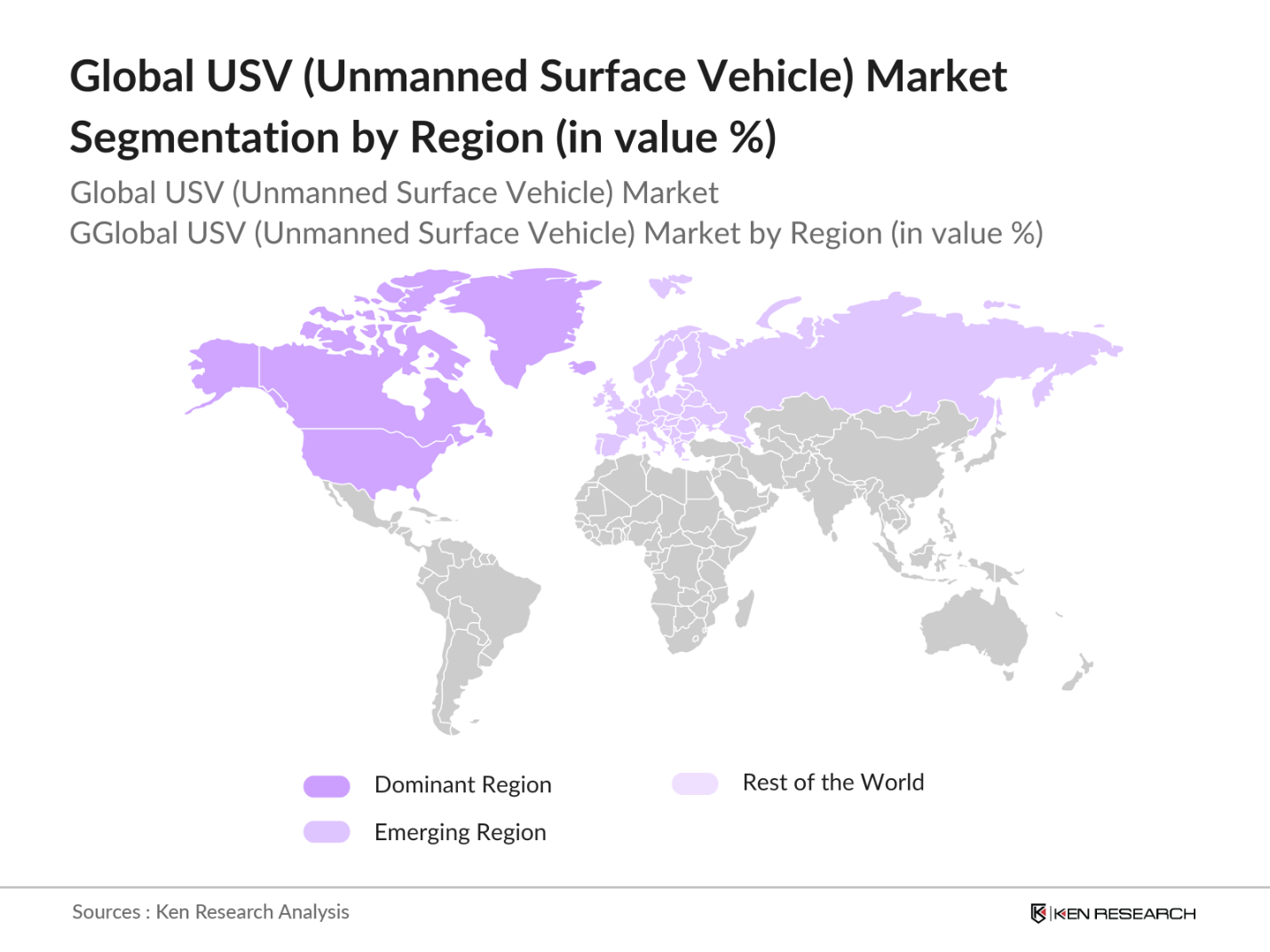
By Region: The global Unmanned Surface Vehicle (USV) market is segmented by region into North America, Europe, Asia-Pacific, and the Middle East & Africa. North America dominates the market, driven by the U.S. Department of Defense's substantial investment in USV technologies for naval operations such as anti-submarine warfare and coastal surveillance. Additionally, commercial applications in environmental monitoring and offshore oil exploration also contribute significantly to the market's growth.
Global USV (Unmanned Surface Vehicle) Market Competitive Landscape
The USV market is dominated by a few key players that have established themselves through technological advancements, large-scale operations, and strategic partnerships. Major players include L3Harris Technologies, Kongsberg Gruppen, and Teledyne Technologies. These companies focus on enhancing their product portfolios and expanding their reach through collaborations, acquisitions, and investments in research and development.
|
Company |
Established |
Headquarters |
Technology Focus |
Revenue (USD Billion) |
Key Clients |
Major Contracts |
R&D Investment |
|
L3Harris Technologies |
1895 |
Melbourne, Florida, USA |
Defense, ISR Systems |
- |
- |
- |
- |
|
Kongsberg Gruppen ASA |
1814 |
Kongsberg, Norway |
Maritime and Defense Tech |
- |
- |
- |
- |
|
Teledyne Technologies Inc. |
1960 |
Thousand Oaks, California, USA |
Autonomous Systems |
- |
- |
- |
- |
|
Liquid Robotics |
2007 |
Sunnyvale, California, USA |
Ocean Robots, Environmental Monitoring |
- |
- |
- |
- |
|
Textron Systems Corp. |
1923 |
Providence, Rhode Island, USA |
Defense, Aerospace |
- |
- |
- |
- |
Global USV (Unmanned Surface Vehicle) Market Analysis
Market Growth Drivers:
- Increased Defense Expenditure: In 2023, the U.S. defense budget exceeded USD 800 billion, with a substantial portion allocated to unmanned technologies, including USVs. The growing need for advanced maritime surveillance, coastal defense, and naval warfare solutions is driving demand for autonomous USVs. The U.S. Navy alone aims to deploy over 200 USVs by 2025 for defense applications. This increased focus on unmanned capabilities will support the growth of the USV market.
- Expansion of Offshore Oil and Gas Exploration: Global oil production reached over 90 million barrels per day in 2023, leading to heightened demand for USVs in offshore exploration and monitoring. USVs equipped with advanced sensors are used for subsea mapping and pipeline monitoring, reducing operational risks and costs. In the Gulf of Mexico alone, more than 100 USVs are currently being used for such operations. This trend is expected to continue as offshore oil exploration increases.
- Environmental Monitoring Initiatives: Government agencies and environmental organizations are increasingly using USVs for monitoring ocean pollution and climate change effects. In 2023, over 50 environmental research institutions in North America deployed USVs to track oceanic conditions, and initiatives like the U.S. National Oceanic and Atmospheric Administration’s (NOAA) programs for marine conservation are expected to increase the use of USVs in research applications.
Market Challenges:
- High Operational Costs and Technological Complexity: While USVs offer numerous advantages, their high operational and maintenance costs present significant challenges for small operators. The cost of maintaining advanced autonomous systems and integrating real-time communication tools can reach up to USD 200,000 per unit annually. This makes it difficult for smaller firms to adopt and deploy USVs on a large scale.
- Cybersecurity Threats: As USVs rely heavily on autonomous systems and remote operations, they are vulnerable to cyberattacks. In 2023, several incidents were reported where remotely operated USVs were targeted, compromising mission data and control systems. The lack of robust cybersecurity infrastructure for these vessels poses a significant challenge for their safe deployment in sensitive applications.
Global USV (Unmanned Surface Vehicle) Market Future Outlook
Over the next five years, the USV market is expected to witness robust growth, driven by technological innovations and increasing demand for autonomous solutions across military, commercial, and environmental applications. Autonomous systems are becoming more advanced, offering longer endurance, reduced operational costs, and enhanced capabilities in harsh maritime environments. As defense budgets increase, particularly in the U.S. and Asia-Pacific, investments in USV technology will surge, further driving market expansion?
Market Opportunities:
- Integration of AI and Machine Learning in USVs: Autonomous USVs equipped with AI are increasingly being used for decision-making processes in real-time, reducing the need for human intervention. AI-driven USVs are projected to perform complex tasks like underwater inspection and threat detection more efficiently. The U.S. Navy tested AI-integrated USVs in 2023, achieving enhanced accuracy in maritime surveillance operations.
- Advances in Swarm Technology: Swarm technology, where multiple USVs operate together to accomplish a mission, is becoming popular in defense and commercial sectors. In 2023, the U.S. Navy initiated trials for swarm USVs to conduct large-scale maritime defense operations. This technology enhances efficiency and reduces risks in high-stakes environments.
Scope of the Report
|
By Size |
Small Medium Large |
|
By Application |
Defense Commercial Environmental Monitoring Hydrographic Surveying |
|
By Mode of Operation |
Autonomous Surface Vehicles Remotely Operated Surface Vehicles |
|
By Endurance |
Short (<100 hours) Medium (100-500 hours) Long (500-1000 hours) |
|
By Region |
North America Europe Asia-Pacific Middle East & Africa |
Products
Key Target Audience
Defense Agencies (U.S. Department of Defense, NATO)
Maritime Security Firms
Offshore Oil & Gas Companies
Environmental Monitoring Organizations
Surveillance and Reconnaissance Firms
Technological Solution Providers for Autonomous Vehicles
Investments and Venture Capitalist Firms
Government and Regulatory Bodies (U.S. Coast Guard, European Maritime Safety Agency)
Companies
Players Mention in the Report
L3Harris Technologies Inc.
Kongsberg Gruppen ASA
Teledyne Technologies Inc.
Liquid Robotics
Textron Systems Corp.
Rafael Advanced Defense Systems Ltd.
Saildrone
ECA Group
ATLAS ELEKTRONIK GmbH
Maritime Tactical Systems, Inc.
Buffalo Automation Group
Fugro
Open Ocean Robotics
DeepOcean Group
Thales Group
Table of Contents
01. Global USV (Unmanned Surface Vehicle) Market Overview
1.1. Definition and Scope
1.2. Market Valuation and Historical Analysis
1.3. Key Market Developments and Milestones
02. Global USV Market Size (In USD Billion)
2.1. Historical Market Size
2.2. Year-On-Year Growth Analysis
2.3. Key Trends Impacting Market Growth
03. Global USV Market Analysis
3.1. Growth Drivers
3.1.1. Increased Defense Expenditure
3.1.2. Expansion of Offshore Oil and Gas Exploration
3.1.3. Environmental Monitoring Initiatives
3.2. Market Challenges
3.2.1. High Operational Costs and Technological Complexity
3.2.2. Cybersecurity Threats
3.3. Market Opportunities
3.3.1. Integration of AI and Machine Learning in USVs
3.3.2. Advances in Swarm Technology
3.4. Future Trends
3.4.1. Growth of Autonomous Systems
3.4.2. Increasing Defense Budgets
04. Global USV Market Segmentation
4.1. By Mode of Operation (In Value %)
4.1.1. Autonomous Vehicles
4.1.2. Remotely Operated Vehicles
4.2. By Size (In Value %)
4.2.1. Small
4.2.2. Medium
4.2.3. Large
4.3. By Application (In Value %)
4.3.1. Defense
4.3.2. Commercial
4.3.3. Environmental Monitoring
4.3.4. Hydrographic Surveying
4.4. By Endurance (In Value %)
4.4.1. Short (<100 hours)
4.4.2. Medium (100-500 hours)
4.4.3. Long (500-1000 hours)
4.5. By Region (In Value %)
4.5.1. North America
4.5.2. Europe
4.5.3. Asia-Pacific
4.5.4. Middle East & Africa
05. Global USV Market Competitive Analysis
5.1. Detailed Profiles of Major Companies
5.1.1. L3Harris Technologies
5.1.2. Kongsberg Gruppen
5.1.3. Teledyne Technologies
5.1.4. Liquid Robotics
5.1.5. Textron Systems
5.1.6. Rafael Advanced Defense Systems
5.1.7. Saildrone
5.1.8. ECA Group
5.1.9. ATLAS ELEKTRONIK GmbH
5.1.10. Maritime Tactical Systems, Inc.
5.1.11. Buffalo Automation Group
5.1.12. Fugro
5.1.13. Open Ocean Robotics
5.1.14. DeepOcean Group
5.1.15. Thales Group
5.2. Cross Comparison Parameters (Revenue, Technology Focus, Market Share)
5.3. Strategic Initiatives
5.4. Mergers and Acquisitions
06. Global USV Market Regulatory Framework
6.1. Compliance Standards and Certification
6.2. Defense Regulations
07. Global USV Market Future Outlook
7.1. Future Market Size Projections (In USD Billion)
7.2. Key Factors Driving Future Market Growth
08. Global USV Market Future Segmentation
8.1. By Mode of Operation (In Value %)
8.2. By Size (In Value %)
8.3. By Application (In Value %)
8.4. By Endurance (In Value %)
8.5. By Region (In Value %)
09. Global USV Market Analysts Recommendations
9.1. TAM/SAM/SOM Analysis
9.2. Market Entry Strategies
9.3. Key Marketing Initiatives
9.4. White Space Opportunity Analysis
Research Methodology
Step 1: Identification of Key Variables
The first phase involves constructing an ecosystem map that highlights all the critical stakeholders within the USV market, utilizing secondary research sources such as defense contracts and industry publications. The objective is to pinpoint key drivers, including defense spending trends and technological advancements.
Step 2: Market Analysis and Construction
Historical data for the USV market, such as sales and operational data from commercial and defense sectors, will be collected. This step includes compiling revenue figures from major industry players and analyzing market penetration based on system types, applications, and operational modes.
Step 3: Hypothesis Validation and Expert Consultation
Expert consultations are carried out with industry professionals from naval, commercial, and environmental organizations to validate market assumptions. These discussions provide insight into operational challenges, opportunities, and trends in unmanned surface vehicle applications.
Step 4: Research Synthesis and Final Output
After synthesizing the findings from desk research and expert consultations, a final report is compiled. This report offers a comprehensive analysis, covering market size, competitive landscapes, and future market projections for the global USV market.
Frequently Asked Questions
01. How big is the Global USV Market?
The global USV market is valued at USD 0.8 billion in 2023, driven by defense and commercial applications, including environmental monitoring and offshore oil and gas exploration.
02. What are the challenges in the USV Market?
Challenges in the USV market include limited endurance for long-range missions and the complexity of integrating collision detection systems, especially in autonomous operations.
03. Who are the major players in the Global USV Market?
Major players include L3Harris Technologies, Kongsberg Gruppen, Teledyne Technologies, Liquid Robotics, and Textron Systems, all focusing on autonomous maritime solutions for defense and commercial sectors.
04. What are the growth drivers of the USV Market?
Key growth drivers include increased defense spending, advancements in autonomous vehicle technology, and the growing need for efficient maritime surveillance and environmental monitoring systems.
Why Buy From Us?

What makes us stand out is that our consultants follows Robust, Refine and Result (RRR) methodology. i.e. Robust for clear definitions, approaches and sanity checking, Refine for differentiating respondents facts and opinions and Result for presenting data with story

We have set a benchmark in the industry by offering our clients with syndicated and customized market research reports featuring coverage of entire market as well as meticulous research and analyst insights.

While we don't replace traditional research, we flip the method upside down. Our dual approach of Top Bottom & Bottom Top ensures quality deliverable by not just verifying company fundamentals but also looking at the sector and macroeconomic factors.

With one step in the future, our research team constantly tries to show you the bigger picture. We help with some of the tough questions you may encounter along the way: How is the industry positioned? Best marketing channel? KPI's of competitors? By aligning every element, we help maximize success.

Our report gives you instant access to the answers and sources that other companies might choose to hide. We elaborate each steps of research methodology we have used and showcase you the sample size to earn your trust.

If you need any support, we are here! We pride ourselves on universe strength, data quality, and quick, friendly, and professional service.