
Global Virtual Events Market Outlook 2030
Region:Global
Author(s):Shivani Mehra
Product Code:KROD7790
Region:Global
Author(s):Shivani Mehra
Product Code:KROD7790
December 2024
89
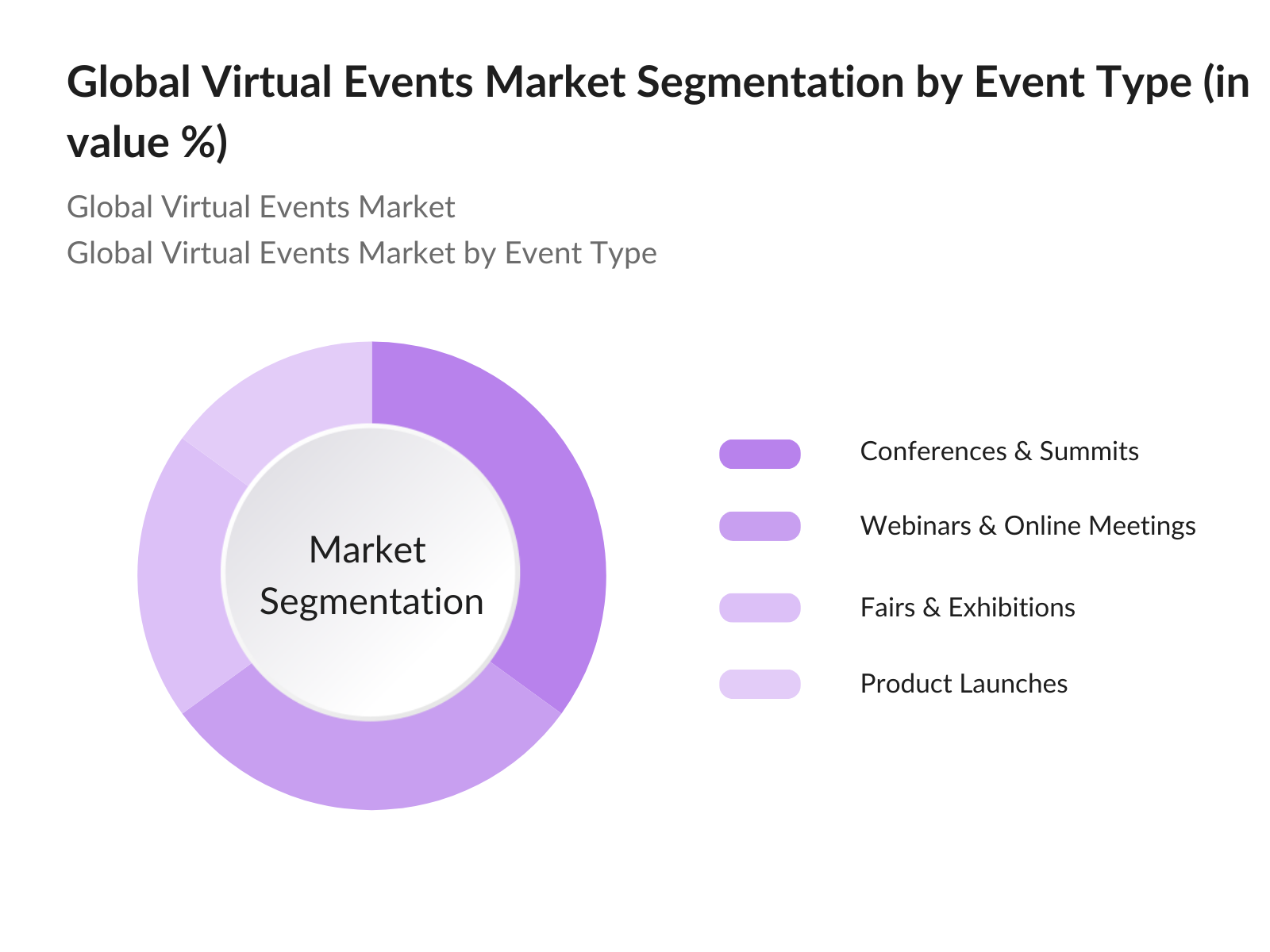
By Event Type: The global virtual events market is segmented by event type into conferences & summits, webinars & online meetings, fairs & exhibitions, and product launches. Conferences & summits hold the dominant market share due to the widespread use of virtual platforms by large corporations for international summits and conferences. The ease of global participation and cost reduction associated with travel and logistics are key factors that contribute to this segments dominance. Webinars and online meetings are also gaining momentum due to the increasing preference for remote communication and learning, particularly in educational institutions.
By Region: The segmentation includes North America, Europe, Asia-Pacific, Latin America, and the Middle East & Africa. North America holds the largest share due to its technological advancements and the early adoption of virtual event platforms. Asia-Pacific follows closely behind, driven by the growth of internet penetration, the widespread adoption of digital platforms, and increasing investments in virtual technologies by governments and corporations alike. The Middle East & Africa segment is projected to show future growth due to an increasing focus on digital transformation and virtual engagements in education and healthcare.

The global virtual events market is dominated by both global and regional players, with strong competition based on technological innovation, platform usability, and customization options. Key companies have been increasing investments in AI and VR technologies to enhance user experience and interactivity. The competition landscape includes major players who provide diverse solutions, from large-scale corporate events to niche virtual exhibitions.
|
Company |
Established Year |
Headquarters |
Technology Integration |
Platform Usability |
Client Base |
Customization Options |
Global Presence |
Revenue (USD) |
|
Cisco Webex |
1984 |
San Jose, USA |
AI, Cloud-based Solutions |
- |
- |
- |
- |
- |
|
Zoom Video Communications |
2011 |
San Jose, USA |
AR/VR, AI |
- |
- |
- |
- |
- |
|
Microsoft Teams |
2017 |
Redmond, USA |
Cloud-based Solutions |
- |
- |
- |
- |
- |
|
Adobe Connect |
2005 |
San Jose, USA |
AI, Cloud-based Solutions |
- |
- |
- |
- |
- |
|
On24 |
1998 |
San Francisco, USA |
AI, Customizable Features |
- |
- |
- |
- |
- |
Market Growth Drivers
Market Challenges:
Over the next five years, the global virtual events market is expected to experience significant growth, driven by increasing technological advancements, the shift toward hybrid events, and a continuous focus on enhancing remote engagement capabilities. AI and VR integrations are likely to transform the virtual event experience, making it more interactive and immersive. Furthermore, industries such as education, healthcare, and corporate training are expected to continue their heavy reliance on virtual platforms as an efficient and cost-effective means of engagement.
Market Opportunities:
|
By Event Type |
Conferences & Summits Webinars & Online Meetings Fairs & Exhibitions Product Launches |
|
By Platform Type |
Video Conferencing Platforms Live Streaming Platforms Custom Event Platforms |
|
By End-User Industry |
Corporate Education Healthcare Government Media & Entertainment |
|
By Technology |
AR/VR Integration AI-Powered Platforms Cloud-Based Solutions |
|
By Region |
North America Europe Asia Pacific Latin America Middle East & Africa |
1.1. Definition and Scope
1.2. Market Taxonomy
1.3. Key Market Growth Drivers (Technology Adoption, Remote Work Trends, Corporate Training Needs, etc.)
1.4. Market Segmentation Overview
2.1. Historical Market Size
2.2. Year-On-Year Growth Analysis
2.3. Key Market Developments and Milestones
3.1. Growth Drivers
3.1.1. Increasing Demand for Remote Events (Increased Corporate Virtual Events, Conferences, etc.)
3.1.2. Technological Advancements (AI, AR/VR Integration)
3.1.3. Expansion of Hybrid Events (Physical + Virtual)
3.2. Market Challenges
3.2.1. Bandwidth and Technological Limitations
3.2.2. High Initial Costs of Event Platforms
3.2.3. Engagement Retention in Virtual Environments
3.3. Opportunities
3.3.1. Growth in Virtual Event Platforms for Education and Training
3.3.2. Rise in Global Event Accessibility (Remote Participation)
3.3.3. Expansion of Metaverse for Virtual Events
3.4. Trends
3.4.1. AI Integration for Personalization and Analytics
3.4.2. Use of Virtual Reality (VR) and Augmented Reality (AR)
3.4.3. Customizable Platforms for Diverse Event Types (Webinars, Trade Shows, etc.)
3.5. Government Regulation
3.5.1. Data Privacy and Compliance for Virtual Platforms
3.5.2. Intellectual Property Protection in Virtual Events
3.5.3. Standardization of Virtual Event Practices
3.6. SWOT Analysis
3.7. Stake Ecosystem
3.8. Porters Five Forces
3.9. Competition Ecosystem
4.1. By Event Type
4.1.1. Conferences & Summits
4.1.2. Webinars & Online Meetings
4.1.3. Fairs & Exhibitions
4.1.4. Product Launches
4.2. By Platform Type
4.2.1. Video Conferencing Platforms
4.2.2. Live Streaming Platforms
4.2.3. Custom Event Platforms
4.3. By End-User Industry
4.3.1. Corporate
4.3.2. Education
4.3.3. Healthcare
4.3.4. Government
4.3.5. Media & Entertainment
4.4. By Technology
4.4.1. AR/VR Integration
4.4.2. AI-Powered Platforms
4.4.3. Cloud-Based Solutions
4.5. By Region
4.5.1. North America
4.5.2. Europe
4.5.3. Asia Pacific
4.5.4. Latin America
4.5.5. Middle East & Africa
5.1 Detailed Profiles of Major Companies
5.1.1. Cisco Webex
5.1.2. Zoom Video Communications
5.1.3. Microsoft Teams
5.1.4. Adobe Connect
5.1.5. On24
5.1.6. Hopin
5.1.7. Airmeet
5.1.8. BigMarker
5.1.9. EventMobi
5.1.10. Remo
5.1.11. vFairs
5.1.12. Whova
5.1.13. Bizzabo
5.1.14. Intrado
5.1.15. 6Connex
5.2 Cross Comparison Parameters (No. of Employees, Headquarters, Product Offerings, Annual Revenue, Global Presence, Event Types Supported, Pricing Model, User Reviews)
5.3. Market Share Analysis
5.4. Strategic Initiatives
5.5. Mergers And Acquisitions
5.6. Investment Analysis
5.7. Venture Capital Funding
5.8. Private Equity Investments
6.1. Data Security and Privacy Standards
6.2. Intellectual Property Rights for Virtual Content
6.3. International Compliance for Cross-border Events
7.1. Future Market Size Projections
7.2. Key Factors Driving Future Market Growth
8.1. By Event Type
8.2. By Platform Type
8.3. By End-User Industry
8.4. By Technology
8.5. By Region
9.1. TAM/SAM/SOM Analysis
9.2. Customer Cohort Analysis
9.3. Marketing Initiatives
9.4. White Space Opportunity Analysis
Disclaimer Contact UsThe first step involves creating an ecosystem map of key players and technologies in the global virtual events market. This includes extensive research from secondary and proprietary sources to capture market drivers, technological trends, and user behaviors.
Data from various reports, industry publications, and expert interviews were analyzed to create a model of market penetration and virtual platform adoption. Key data points include the number of participants, event types, and technological preferences, ensuring an accurate reflection of market dynamics.
Through consultations with experts and event organizers, market hypotheses were validated, and real-time data from both global and regional players was collected. This feedback from industry leaders helped refine and verify market projections.
The final output integrates insights from virtual event organizers and technology providers, ensuring that all market figures reflect actual industry trends. The data was thoroughly vetted for accuracy and reliability, ensuring that the final report offers a comprehensive market analysis.
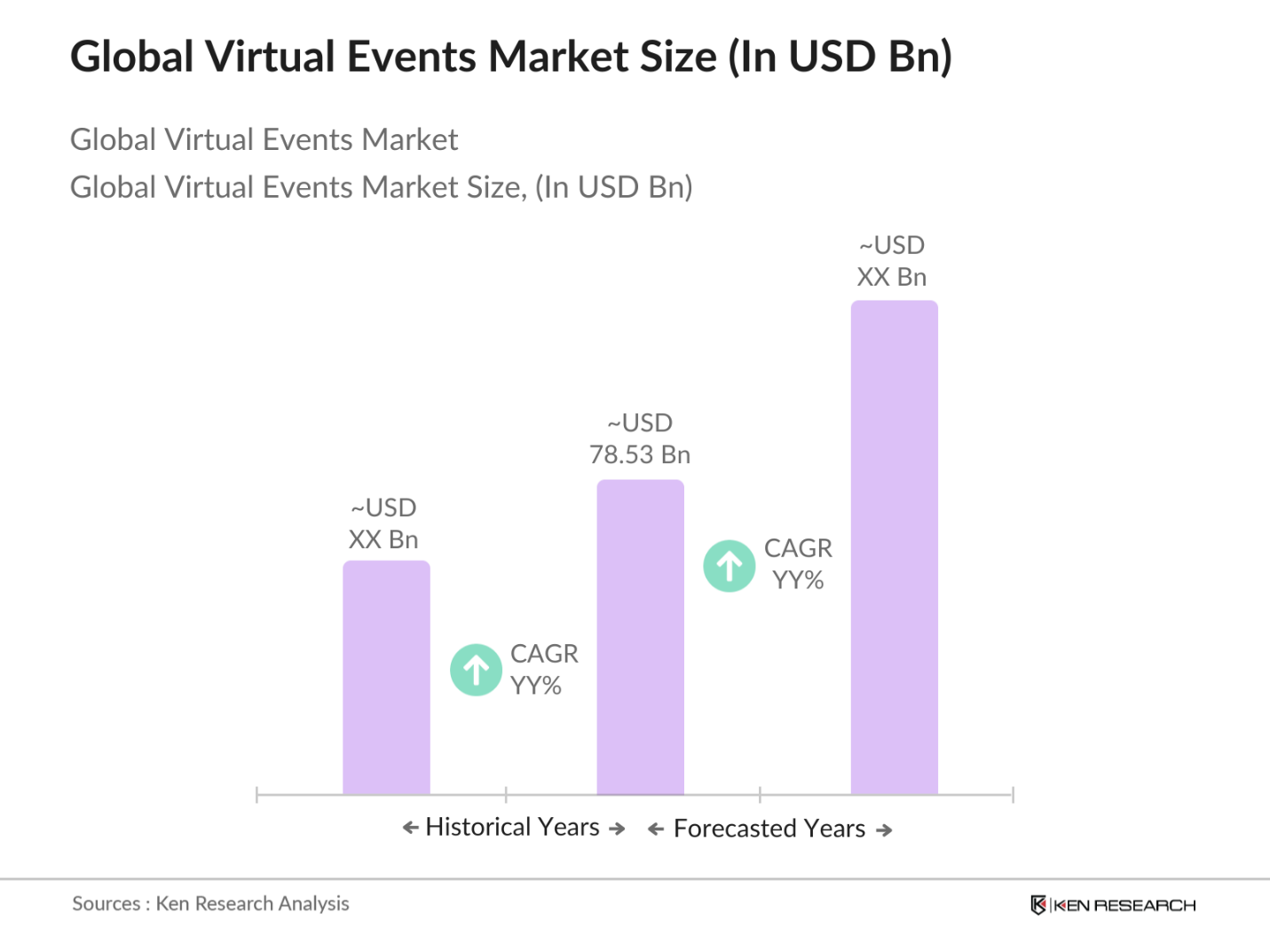
The global virtual events market is valued at USD 78.53 billion, driven by advancements in technology, increasing demand for remote interactions, and the rise of hybrid events.
Challenges include bandwidth and technological limitations in certain regions, the need for high initial costs for advanced platforms, and retaining audience engagement in virtual formats.
Major players include Cisco Webex, Zoom Video Communications, Microsoft Teams, Adobe Connect, and On24, each of which offers diverse solutions to meet the growing demand for virtual event platforms.
The key growth drivers include technological advancements such as AI and AR/VR integration, the rise of hybrid events, and the increasing demand for cost-effective, scalable event solutions across sectors like education and healthcare.

What makes us stand out is that our consultants follows Robust, Refine and Result (RRR) methodology. i.e. Robust for clear definitions, approaches and sanity checking, Refine for differentiating respondents facts and opinions and Result for presenting data with story

We have set a benchmark in the industry by offering our clients with syndicated and customized market research reports featuring coverage of entire market as well as meticulous research and analyst insights.

While we don't replace traditional research, we flip the method upside down. Our dual approach of Top Bottom & Bottom Top ensures quality deliverable by not just verifying company fundamentals but also looking at the sector and macroeconomic factors.

With one step in the future, our research team constantly tries to show you the bigger picture. We help with some of the tough questions you may encounter along the way: How is the industry positioned? Best marketing channel? KPI's of competitors? By aligning every element, we help maximize success.

Our report gives you instant access to the answers and sources that other companies might choose to hide. We elaborate each steps of research methodology we have used and showcase you the sample size to earn your trust.

If you need any support, we are here! We pride ourselves on universe strength, data quality, and quick, friendly, and professional service.