
Global Virtual Reality Devices Market Outlook to 2030
Region:Global
Author(s):Abhinav kumar
Product Code:KROD1991
December 2024
90
About the Report
Global Virtual Reality Devices Market Overview
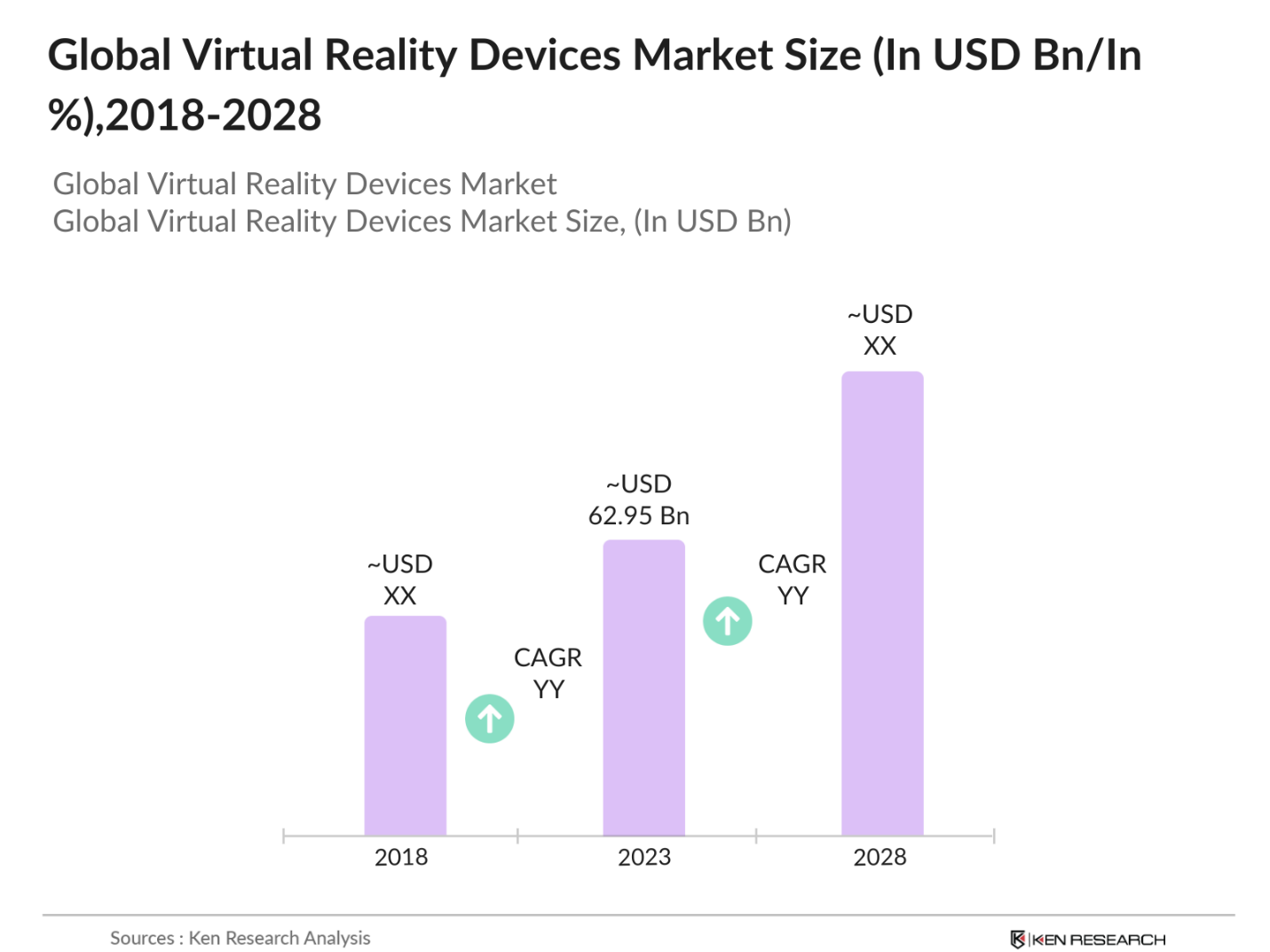
- The Global Virtual Reality (VR) Devices Market was valued at USD 62.95 billion in 2023. The market is primarily driven by the increasing demand for immersive experiences in gaming, healthcare, and corporate training. Advancements in VR hardware, including improved resolution and portability, along with the growing integration of AI into VR systems, further fuel the market's growth. The rise of the metaverse and virtual social platforms is also a significant contributor to the expanding use of VR devices across industries.
- The major players in the global VR devices market include Meta Platforms (Oculus), Sony Interactive Entertainment, HTC Corporation, Samsung Electronics, and Valve Corporation. These companies are driving innovation by developing more advanced and user-friendly VR headsets, integrating new technologies like eye-tracking, AI-enhanced interactions, and cross-platform compatibility, which are helping to shape the future of virtual experiences.
- In 2023, Meta launched its Meta Quest 3, a revolutionary standalone VR headset that incorporates mixed reality features and AI-driven analytics, allowing users to experience both physical and virtual worlds seamlessly. The headset's strong sales, around 320,583 units in its first quarter of 2024, underscore the growing consumer appetite for mixed-reality experiences, particularly in the gaming and social sectors.
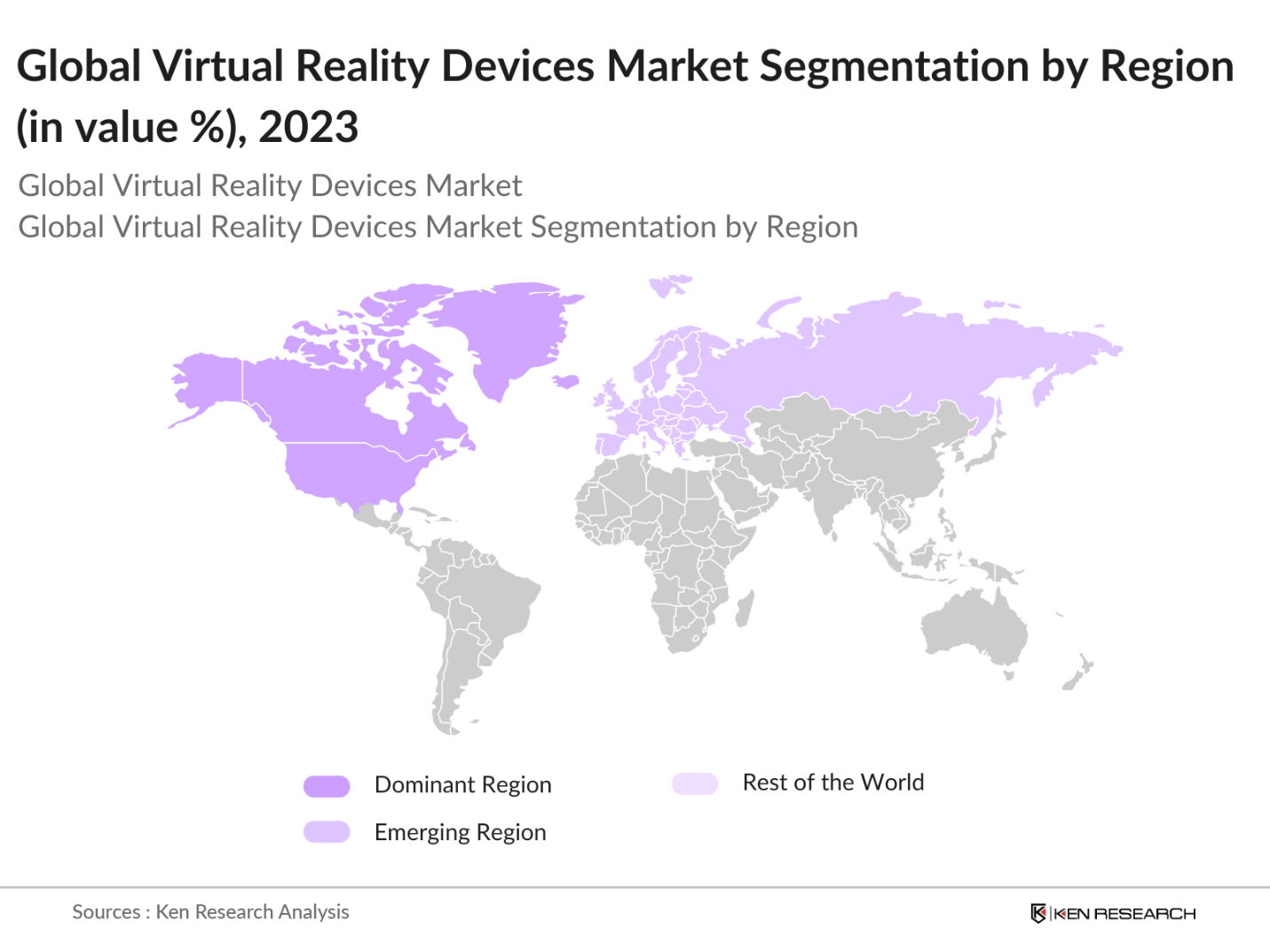
- North America dominated the global VR devices market due to widespread adoption in both consumer and enterprise applications. The region benefits from a strong technological infrastructure, significant investments in immersive technologies, and the presence of major VR device manufacturers. The regions gaming and healthcare industries have been particularly influential in driving market demand.
Global Virtual Reality Devices Market Segmentation
The global Virtual Reality Devices market is segmented by region, device type, and application,.
By Region: The global VR devices market is segmented into North America, Europe, Asia-Pacific (APAC), Latin America, and the Middle East & Africa (MEA). In 2023, North America dominated the market, followed by Europe and APAC. North America's leadership is attributed to advanced infrastructure, high consumer demand for gaming, and significant investments in VR for enterprise use.
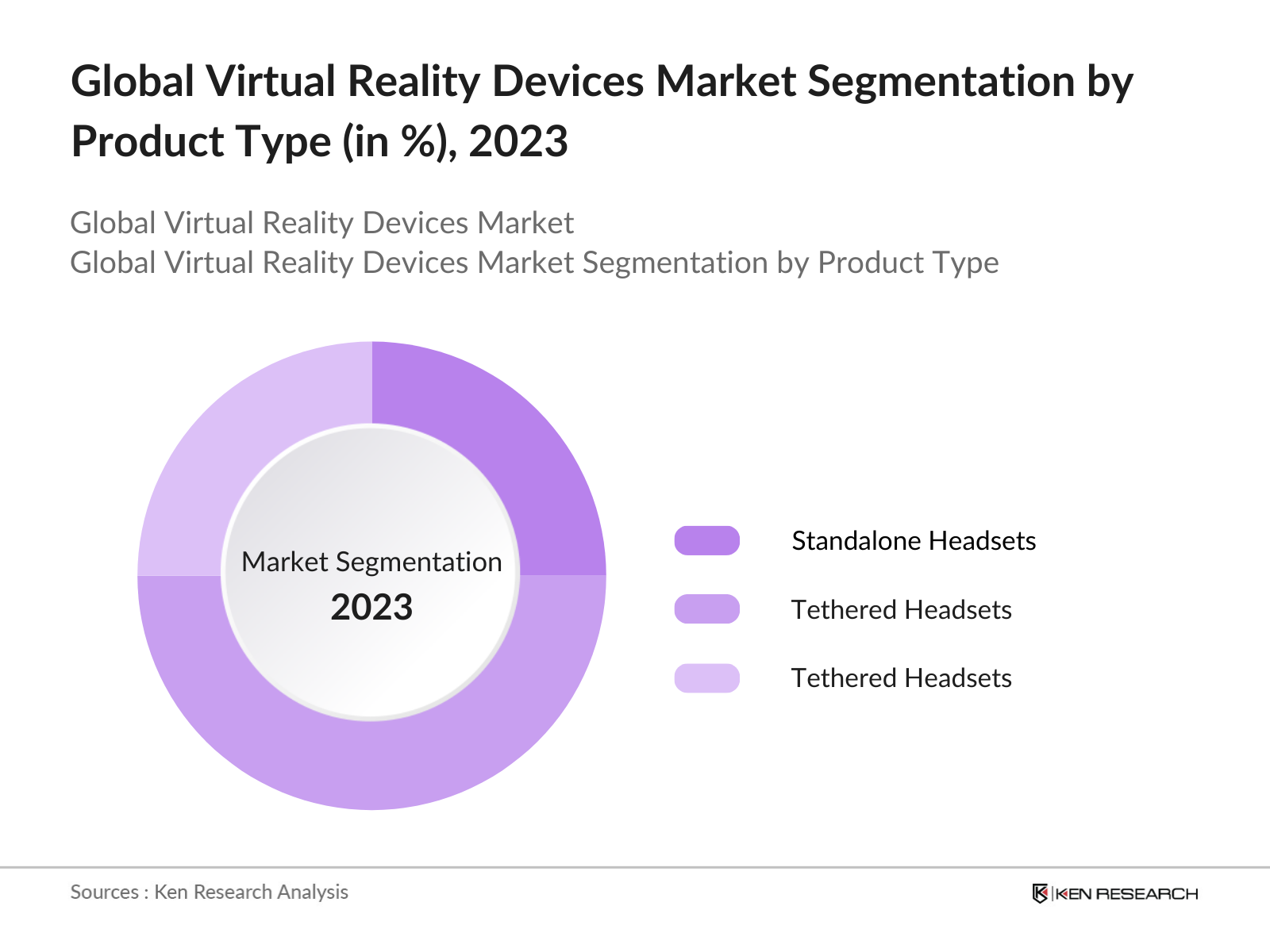
By Product Type: The market is segmented into tethered VR headsets, standalone VR headsets, and smartphone-based VR headsets. In 2023, standalone VR headsets held the largest market share due to their portability and affordability. Devices like Meta Quest 2 and Quest 3 have led the growth in this segment, with users preferring these headsets for gaming and social applications without needing external hardware like PCs or consoles.
By Application: The market is segmented into gaming, healthcare, education, and corporate training. In 2023, Gaming was the dominant application, with major releases like Sonys PlayStation VR2 driving consumer interest. Healthcare also witnessed rapid growth, with VR being used for surgical simulations and therapy programs, particularly in the United States and Europe.
Global Virtual Reality Devices Market Competitive Landscape
|
Company Name |
Established |
Headquarters |
|
Meta Platforms (Oculus) |
2004 |
Menlo Park, California, USA |
|
Sony Interactive Entertainment |
1993 |
Tokyo, Japan |
|
HTC Corporation |
1997 |
New Taipei, Taiwan |
|
Samsung Electronics |
1938 |
Suwon, South Korea |
|
Valve Corporation |
1996 |
Bellevue, Washington, USA |
- Sony Interactive Entertainment: In November 2023, SIE announced a strategic partnership with NCSOFT, which may enhance its capabilities in the online gaming and virtual reality sectors. Collaborations like these can foster innovation and expand the range of VR content available to consumers.
- HTC Corporation: In 2023, HTC released its Vive XR Elite headset, targeting the consumer and enterprise use. The device, equipped with spatial audio and hand-tracking features, has been adopted by firms in sectors like architecture and manufacturing for virtual simulations and remote training programs.
Global Virtual Reality Devices Market Analysis
Global Virtual Reality Devices Market Growth Drivers
- Rise of Virtual Social Platforms: In October 2022, Meta reported Horizon Worlds had an estimated 300,000 users, driving demand for devices that support immersive social interactions. As virtual spaces become integral to how people socialize and work, VR devices will play a central role in enabling these experiences.
- Increased Investment in Healthcare VR Solutions: By 2023, the U.S. healthcare industry invested in VR-assisted training programs, particularly for surgical procedures and patient therapy. The ability of VR to provide immersive, real-time simulations is driving this trend, with similar investments seen in Europe and APAC.
- Corporate Training and Education: In 2023, Accenture has invested in VR-based platforms, notably in diversity and inclusion training through its partnership with Praxis Labs. This investment reflects Accenture's commitment to enhancing employee engagement and improving training outcomes using immersive technologies.
Global Virtual Reality Devices Market Challenges
- High Initial Costs: The high cost of advanced VR systems, such as the Valve Index, poses a significant barrier to adoption for many consumers and enterprises. This challenge is particularly evident in developing markets, where affordability limits the penetration of VR technology.
- Health and Safety Concerns: Prolonged use of VR devices has raised concerns about eye strain, motion sickness, and psychological effects such as disassociation. In 2023, there were over 50,000 reported cases of VR-induced motion sickness in the U.S. alone. These concerns are likely to impact the rate of adoption, particularly among users new to VR technology.
Global Virtual Reality Devices Market Government Initiatives
- U.S. Technology Modernization Fund (2023): Both government and educational institutions are increasingly recognizing the value of VR technologies. This includes enhancing access to VR in public schools and hospitals, which aligns with the goals of improving educational and healthcare outcomes. This initiative aims to improve access to VR technologies in public schools and hospitals, driving market growth in these sectors.
- EU Digital Strategy (2023): The European Union launched an initiative as part of its Digital Strategy to support VR and AR adoption in education and training. The initiative focuses on providing funding to schools and universities across the EU to integrate VR-based learning modules, fostering growth in the educational VR market.
Global Virtual Reality Devices Market Future Outlook to 2028
The global VR devices market is expected to experience significant growth over the next five years, driven by advancements in VR hardware, increasing adoption across healthcare and corporate sectors, and the expansion of the metaverse.
Global Virtual Reality Devices Market Future Trends
- Expansion of VR in Corporate Training: By 2028, VR is expected to be a standard tool for corporate training programs worldwide. The adoption of VR training solutions in industries like healthcare, engineering, and manufacturing will increase due to its ability to provide immersive and cost-effective learning environments. Companies are likely to invest heavily in VR-based solutions to improve employee retention and operational efficiency.
- Rise of the Metaverse and Virtual Workspaces: As businesses continue to explore virtual workspaces, VR devices will play a crucial role in enabling remote collaboration and immersive virtual offices. By 2028, global enterprises are projected to use VR for virtual meetings and remote work, especially as companies move toward more flexible and decentralized work models.
Scope of the Report
|
By Device Type |
Tethered VR Headsets Standalone VR Headsets Smartphone-Based VR Headsets |
|
By Application |
Gaming Healthcare Education Corporate Training |
|
By End-Use Industry |
Entertainment Healthcare Education Manufacturing Retail |
|
By Deployment Mode |
Cloud-Based On-Premise |
|
By Region |
North America Europe Asia-Pacific (APAC) Middle East & Africa (MEA) Latin America |
Products
Key Target Audience Organizations and Entities Who Can Benefit by Subscribing to This Report:
Investments and Venture Capitalist Firms
Gaming and Entertainment Companies
Healthcare Companies
Education Technology Industries
Enterprise Training Firms
Media and Content Creation Industry
Automotive and Manufacturing Companies
Defense and Aerospace Companies
Retail and E-commerce Companies
Government and regulatory bodies (FDA, FTC)
Time Period Captured in the Report
Historical Period: 2018-2023
Base Year: 2023
Forecast Period: 2023-2028
Companies
Players Mentioned in the Report:
Meta Platforms (Oculus)
Sony Interactive Entertainment
HTC Corporation
Samsung Electronics
Valve Corporation
Microsoft Corporation
Google LLC
Qualcomm Technologies
NVIDIA Corporation
Pico Interactive
Table of Contents
1. Global Virtual Reality Devices Market Overview
1.1. Definition and Scope
1.2. Market Taxonomy
1.3. Market Growth Rate
1.4. Market Segmentation Overview
2. Global Virtual Reality Devices Market Size (in USD Bn), 2018-2023
2.1. Historical Market Size
2.2. Year-on-Year Growth Analysis
2.3. Key Market Developments and Milestones
3. Global Virtual Reality Devices Market Analysis
3.1. Growth Drivers
3.1.1. Rise of Virtual Social Platforms
3.1.2. Increased Investment in Healthcare VR Solutions
3.1.3. Corporate Training and Education
3.2. Restraints
3.2.1. High Initial Costs
3.2.2. Health and Safety Concerns
3.3. Opportunities
3.3.1. Expansion into Enterprise and Corporate Sectors
3.3.2. Increased Demand for Cloud-Based VR Solutions
3.4. Trends
3.4.1. Rise of the Metaverse
3.4.2. Integration with AI for Enhanced User Experience
3.4.3. Virtual Workspaces and Remote Collaboration
3.5. Government Regulation
3.5.1. U.S. Technology Modernization Fund
3.5.2. EU Digital Strategy
3.6. SWOT Analysis
3.7. Stake Ecosystem
3.8. Competition Ecosystem
4. Global Virtual Reality Devices Market Segmentation, 2023
4.1. By Device Type (in Value %)
4.1.1. Tethered VR Headsets
4.1.2. Standalone VR Headsets
4.1.3. Smartphone-Based VR Headsets
4.2. By Application (in Value %)
4.2.1. Gaming
4.2.2. Healthcare
4.2.3. Education
4.2.4. Corporate Training
4.3. By End-Use Industry (in Value %)
4.3.1. Entertainment
4.3.2. Healthcare
4.3.3. Manufacturing
4.3.4. Retail
4.4. By Deployment Mode (in Value %)
4.4.1. Cloud-Based
4.4.2. On-Premise
4.5. By Region (in Value %)
4.5.1. North America
4.5.2. Europe
4.5.3. Asia-Pacific (APAC)
4.5.4. Middle East & Africa (MEA)
4.5.5. Latin America
5. Global Virtual Reality Devices Market Cross Comparison
5.1. Detailed Profiles of Major Companies
5.1.1. Meta Platforms (Oculus)
5.1.2. Sony Interactive Entertainment
5.1.3. HTC Corporation
5.1.4. Samsung Electronics
5.1.5. Valve Corporation
5.1.6. Microsoft Corporation
5.1.7. Google LLC
5.1.8. Qualcomm Technologies
5.1.9. NVIDIA Corporation
5.1.10. Pico Interactive
5.1.11. Lenovo Group
5.1.12. Unity Technologies
5.1.13. Magic Leap
5.1.14. Vuzix Corporation
5.2. Cross Comparison Parameters (No. of Employees, Headquarters, Inception Year, Revenue)
6. Global Virtual Reality Devices Market Competitive Landscape
6.1. Market Share Analysis
6.2. Strategic Initiatives
6.3. Mergers and Acquisitions
6.4. Investment Analysis
6.4.1. Venture Capital Funding
6.4.2. Government Grants
6.4.3. Private Equity Investments
7. Global Virtual Reality Devices Market Regulatory Framework
7.1. Data Protection and Privacy Standards
7.2. Compliance Requirements
7.3. Certification Processes
8. Global Virtual Reality Devices Future Market Size (in USD Bn), 2023-2028
8.1. Future Market Size Projections
8.2. Key Factors Driving Future Market Growth
9. Global Virtual Reality Devices Market Future Segmentation, 2028
9.1. By Device Type (in Value %)
9.2. By Application (in Value %)
9.3. By End-Use Industry (in Value %)
9.4. By Deployment Mode (in Value %)
9.5. By Region (in Value %)
10. Global Virtual Reality Devices Market Analysts Recommendations
10.1. TAM/SAM/SOM Analysis
10.2. Customer Cohort Analysis
10.3. Marketing Initiatives
10.4. White Space Opportunity Analysis
Disclaimer
Contact Us
Research Methodology
Step: 1 Identifying Key Variables
Ecosystem creation for all the major entities and referring to multiple secondary and proprietary databases to perform desk research around the Market to collate Market-level information.
Step: 2 Market Building
Collating statistics on the global VR devices market over the years, and analyzing the penetration of Marketplaces as well as the ratio of service providers to compute the revenue generated for the market. We will also review service quality statistics to understand the revenue generated which can ensure accuracy behind the data points shared.
Step: 3 Validating and Finalizing
Building Market hypotheses and conducting CATIs with Market experts belonging to different companies to validate statistics and seek operational and financial information from company representatives.
Step: 4 Research Output
Our team will approach multiple VR devices companies to understand the nature of service segments, consumer preferences, and other parameters. This supports validating statistics derived through a bottom-to-top approach from these VR devices companies, ensuring accuracy and reliability in the report.
Frequently Asked Questions
01. How big is the Global Virtual Reality Devices Market?
The global virtual reality devices market was valued at $62.95 billion in 2023, driven by increasing demand for immersive experiences in sectors like gaming, healthcare, and education. The market is supported by technological advancements in VR hardware and widespread enterprise adoption.
02. What are the challenges in the Global Virtual Reality Devices Market?
Challenges include high initial costs of VR hardware, health and safety concerns like motion sickness, and a lack of standardization across platforms. Additionally, limited content and compatibility issues hinder mass adoption across various industries.
03. Who are the major players in the Global Virtual Reality Devices Market?
Key players include Meta Platforms (Oculus), Sony Interactive Entertainment, HTC Corporation, Samsung Electronics, and Valve Corporation. These companies lead the market with advanced VR hardware, software ecosystems, and strong brand recognition.
04. What are the growth drivers of the Global Virtual Reality Devices Market?
The market is driven by increasing demand for VR in healthcare training, corporate education, and gaming. Expanding investments in the metaverse and government-backed initiatives to integrate VR in public sectors also contribute significantly to growth.
Why Buy From Us?

What makes us stand out is that our consultants follows Robust, Refine and Result (RRR) methodology. i.e. Robust for clear definitions, approaches and sanity checking, Refine for differentiating respondents facts and opinions and Result for presenting data with story

We have set a benchmark in the industry by offering our clients with syndicated and customized market research reports featuring coverage of entire market as well as meticulous research and analyst insights.

While we don't replace traditional research, we flip the method upside down. Our dual approach of Top Bottom & Bottom Top ensures quality deliverable by not just verifying company fundamentals but also looking at the sector and macroeconomic factors.

With one step in the future, our research team constantly tries to show you the bigger picture. We help with some of the tough questions you may encounter along the way: How is the industry positioned? Best marketing channel? KPI's of competitors? By aligning every element, we help maximize success.

Our report gives you instant access to the answers and sources that other companies might choose to hide. We elaborate each steps of research methodology we have used and showcase you the sample size to earn your trust.

If you need any support, we are here! We pride ourselves on universe strength, data quality, and quick, friendly, and professional service.