















Global Waterborne Coatings Market Outlook to 2030
Region:Global
Author(s):Mukul
Product Code:KROD4630
December 2024
90
About the Report
Global Waterborne Coatings Market Overview
- The global waterborne coatings market is valued at USD 100 billion, driven primarily by increasing environmental regulations and demand for sustainable coatings solutions. These coatings, which use water as a solvent, are favored due to their low VOC (volatile organic compounds) emissions, making them eco-friendly and compliant with stringent environmental standards. Additionally, technological advancements in polymer chemistry are further enhancing the performance of waterborne coatings, leading to increased adoption across industries like automotive, construction, and general industrial sectors.
- Countries like China, the United States, and Germany are dominant in the waterborne coatings market due to their established industrial sectors and robust construction and automotive industries. China's dominance is attributed to its rapid industrialization, the U.S. benefits from technological advancements and a mature market for eco-friendly coatings, while Germany excels due to its automotive prowess and stringent environmental policies.
- Global regulations are increasingly mandating the use of low-VOC coatings in various industries. In 2024, countries like Japan and South Korea implemented national VOC reduction programs, requiring that all coatings used in construction and automotive sectors contain less than 50 grams per liter of VOCs. Non-compliance can result in hefty fines and market exclusion. These stringent regulations are creating growth opportunities for waterborne coatings manufacturers who can meet the low-VOC requirements.
Global Waterborne Coatings Market Segmentation
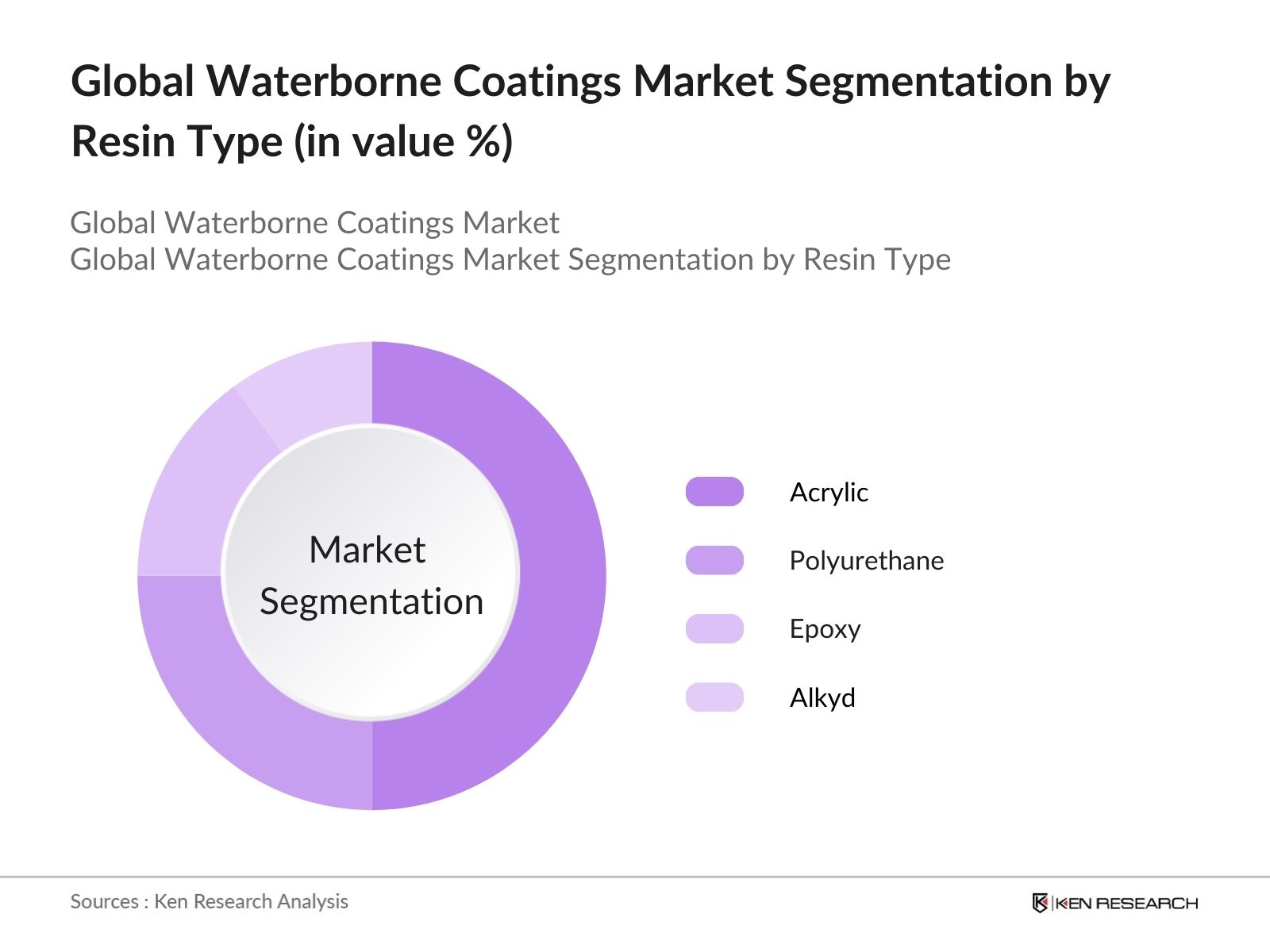
- By Resin Type: The global waterborne coatings market is segmented by resin type into acrylic, polyurethane, epoxy, alkyd, and others. Among these, acrylic resins dominate the market, largely due to their superior properties like quick drying times, UV resistance, and cost-effectiveness. The increased demand for high-performance coatings in the construction and automotive sectors has further accelerated the adoption of acrylic resins.
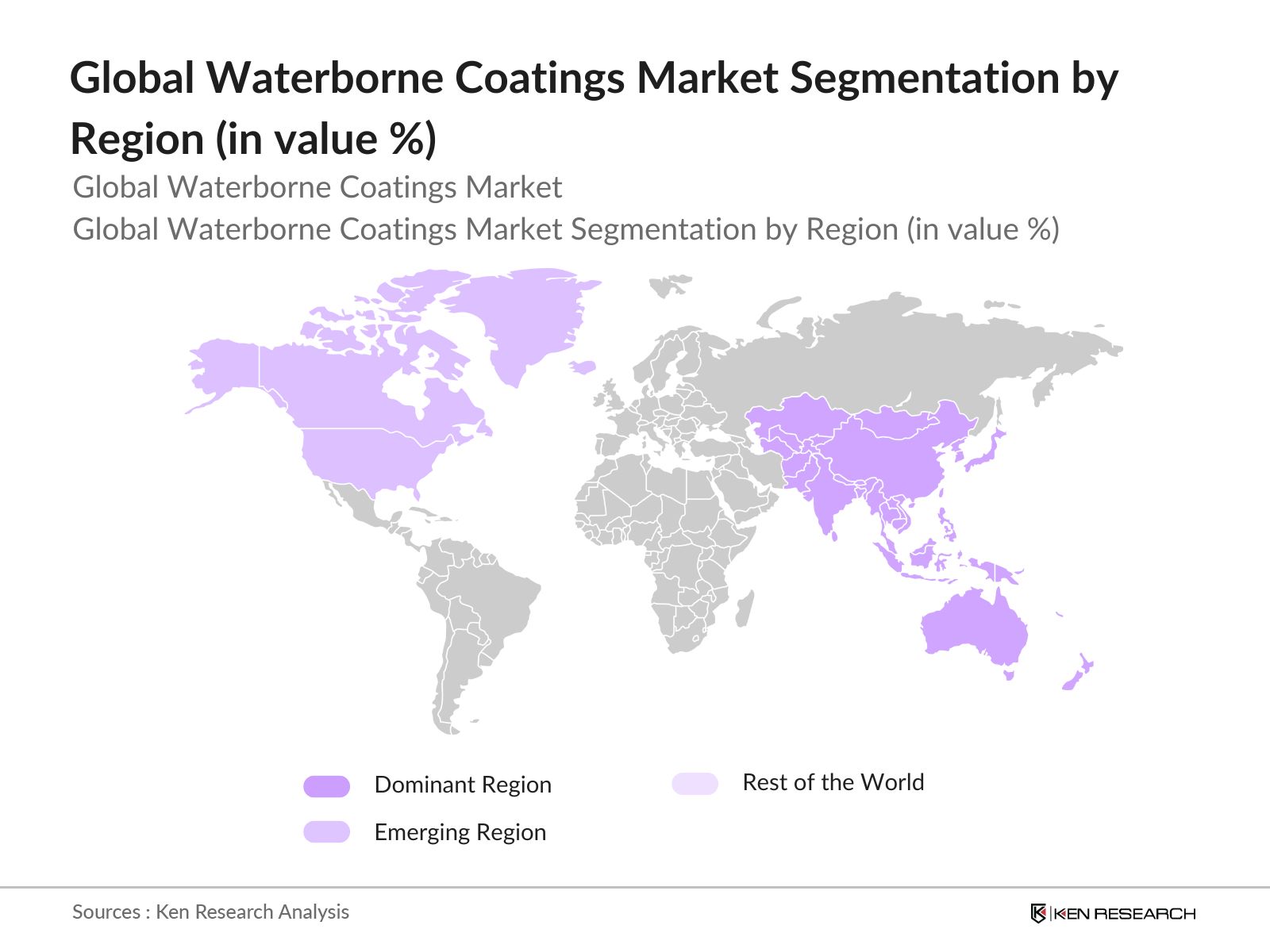
- By Region: The waterborne coatings market is segmented regionally into North America, Europe, Asia-Pacific, Latin America, and the Middle East & Africa. Asia-Pacific leads the market, with significant contributions from China and India. This dominance is driven by rapid urbanization, increased infrastructure investments, and a growing automotive sector in the region. Europe, with its stringent environmental regulations and high adoption of eco-friendly technologies, also holds a substantial market share.
- By Application: The market is segmented by application into architectural, automotive, industrial, marine, and others. Architectural applications lead the market due to increasing residential and commercial construction activities globally. Waterborne coatings are extensively used for their excellent durability and low environmental impact, making them ideal for both interior and exterior applications in the architectural segment.
Global Waterborne Coatings Market Competitive Landscape
The global waterborne coatings market is characterized by intense competition, with key players focusing on innovations in low-VOC technologies, sustainability initiatives, and expanding their market presence through mergers and acquisitions. The competition is primarily driven by stringent environmental regulations and the growing demand for eco-friendly solutions across industries.
|
Company |
Year Established |
Headquarters |
Market Penetration |
Product Portfolio |
Sustainability Initiatives |
R&D Spending |
Geographic Presence |
Innovation Capabilities |
|
Akzo Nobel N.V. |
1792 |
Amsterdam, NL |
- |
- |
- |
- |
- |
- |
|
PPG Industries, Inc. |
1883 |
Pittsburgh, USA |
- |
- |
- |
- |
- |
- |
|
Sherwin-Williams |
1866 |
Cleveland, USA |
- |
- |
- |
- |
- |
- |
|
BASF SE |
1865 |
Ludwigshafen, GER |
- |
- |
- |
- |
- |
- |
|
Nippon Paint Holdings |
1881 |
Tokyo, JP |
- |
- |
- |
- |
- |
- |
Global Waterborne Coatings Industry Analysis
Growth Drivers
- Increasing Environmental Regulations (VOC emissions reduction): The global focus on reducing Volatile Organic Compound (VOC) emissions has become a critical growth driver for the waterborne coatings market. Regulatory bodies such as the U.S. Environmental Protection Agency (EPA) and the European Chemicals Agency (ECHA) have imposed stringent limits on VOC content in paints and coatings. As of 2024, over 150 million metric tons of VOC emissions have been reported globally, with regulatory frameworks pushing industries to adopt eco-friendly alternatives like waterborne coatings to mitigate pollution levels. This shift has accelerated demand for low-VOC coatings, aligning with climate change mitigation goals under agreements such as the Paris Agreement.
- Advancements in Polymer Technology (waterborne resins): Recent advancements in polymer technology, particularly in the development of waterborne resins, have significantly bolstered the adoption of waterborne coatings. Waterborne polymers, which provide superior adhesion and resistance, are now used in various sectors like automotive and construction. The market saw innovations in polyurethane dispersions and acrylic emulsions, which are key components of waterborne coatings. These advancements have reduced drying times and improved durability, enhancing their applicability across industries. Currently, global production capacity of waterborne resins has exceeded 80 million metric tons annually.
- Rise in Automotive and Construction Sectors (coating applications): The automotive and construction sectors have been pivotal in driving the waterborne coatings market. In 2023, global vehicle production reached 70 million units, and the demand for eco-friendly coatings in automotive refinishing and OEM applications has soared. Similarly, the construction industry is experiencing a surge, with an annual infrastructure investment exceeding $2 trillion worldwide. This expansion has increased the use of waterborne coatings for architectural and protective purposes, particularly in regions like North America and Europe, where green building certifications such as LEED have become the norm.
Market Restraints
- Technical Performance vs. Solvent-based Coatings (durability, drying time): One of the major challenges for waterborne coatings is their performance compared to solvent-based alternatives. While waterborne coatings have made significant advancements, their durability and drying times still lag behind solvent-based coatings, particularly in high-performance applications such as industrial equipment. For instance, solvent-based coatings have a drying time of about 2 hours, whereas waterborne variants may require up to 6 hours under similar conditions. These technical limitations remain a hurdle in expanding their adoption in sectors requiring quick turnarounds, such as heavy machinery manufacturing.
- Higher Cost of Raw Materials (waterborne additives, binders): The cost of raw materials for waterborne coatings, including additives and binders, is higher compared to traditional solvent-based coatings. In 2024, the price of waterborne additives increased by 5-10% due to supply chain disruptions and the higher complexity of manufacturing. Additionally, bio-based raw materials, which are increasingly used in waterborne formulations, tend to be more expensive than their petroleum-based counterparts. These increased costs can translate into higher prices for end users, potentially limiting the widespread adoption of waterborne coatings, particularly in cost-sensitive markets.
Global Waterborne Coatings Market Future Outlook
Over the next five years, the global waterborne coatings market is expected to experience significant growth. This growth will be driven by a combination of factors including increasing government regulations on VOC emissions, advancements in eco-friendly coating technologies, and a surge in demand from key end-use industries such as construction and automotive. With major players continuing to innovate and focus on sustainable solutions, the market is poised for expansion, particularly in emerging economies.
Market Opportunities
- Innovation in Nanotechnology (enhanced corrosion resistance): Nanotechnology offers tremendous opportunities for enhancing the performance of waterborne coatings. In 2024, research into nano-coatings has led to breakthroughs in corrosion resistance, particularly for metal substrates used in the automotive and aerospace industries. Nanoparticles improve the barrier properties of waterborne coatings, extending their lifespan in harsh environments. This innovation is expected to revolutionize sectors like marine coatings, where corrosion is a major concern, and lead to higher adoption rates of waterborne technologies. Currently, over 300 nanotechnology patents related to coatings have been filed worldwide.
- Growing Demand in Emerging Economies (Asia-Pacific, Latin America): Emerging economies, particularly in Asia-Pacific and Latin America, represent significant growth opportunities for the waterborne coatings market. In 2024, these regions accounted for 40% of the global coatings demand, driven by rapid urbanization, industrialization, and construction activities. Countries like China and India have seen massive infrastructure investments, with China alone investing over $1 trillion in construction projects. The increasing focus on sustainability and the enforcement of stricter environmental regulations are also pushing manufacturers in these regions to adopt waterborne coatings.
Scope of the Report
|
Resin Type |
Acrylic Polyurethane Epoxy Alkyd Others |
|
Application |
Architectural Automotive Industrial Marine Others |
|
Technology |
Waterborne UV-cured Powder Coatings |
|
End-User Industry |
Construction Automotive Aerospace Marine Consumer Goods |
|
Region |
North America Europe Asia-Pacific Latin America Middle East & Africa |
Products
Key Target Audience
Waterborne Coating Manufacturers
Automotive OEMs and Suppliers
Construction Companies and Developers
Industrial Equipment Manufacturers
Marine Coating Providers
Government and Regulatory Bodies (EPA, EU Regulators)
Investors and Venture Capitalist Firms
Sustainability and Green Building Certifications (LEED)
Companies
Players Mentioned in the Report:
Akzo Nobel N.V.
PPG Industries, Inc.
Sherwin-Williams Company
BASF SE
Nippon Paint Holdings Co., Ltd.
Axalta Coating Systems
RPM International Inc.
Kansai Paint Co., Ltd.
Hempel A/S
Jotun Group
Asian Paints Limited
Tikkurila Oyj
Masco Corporation
DAW SE
Benjamin Moore & Co.
Table of Contents
1. Global Waterborne Coatings Market Overview
1.1. Definition and Scope
1.2. Market Taxonomy
1.3. Market Growth Rate
1.4. Market Segmentation Overview
2. Global Waterborne Coatings Market Size (In USD Mn)
2.1. Historical Market Size
2.2. Year-On-Year Growth Analysis
2.3. Key Market Developments and Milestones
3. Global Waterborne Coatings Market Analysis
3.1. Growth Drivers
3.1.1. Increasing Environmental Regulations (VOC emissions reduction)
3.1.2. Advancements in Polymer Technology (waterborne resins)
3.1.3. Rise in Automotive and Construction Sectors (coating applications)
3.1.4. Adoption of Sustainable Products (eco-friendly coatings)
3.2. Market Challenges
3.2.1. Technical Performance vs. Solvent-based Coatings (durability, drying time)
3.2.2. Higher Cost of Raw Materials (waterborne additives, binders)
3.2.3. Stringent Regulations in Developing Regions (compliance hurdles)
3.3. Opportunities
3.3.1. Innovation in Nanotechnology (enhanced corrosion resistance)
3.3.2. Growing Demand in Emerging Economies (Asia-Pacific, Latin America)
3.3.3. Expansion of Bio-based Coatings (natural resins, binders)
3.4. Trends
3.4.1. Smart Coating Solutions (self-healing, anti-corrosion)
3.4.2. Increased Use of Low-VOC Technologies (regulatory compliance)
3.4.3. Growth in UV-cured Waterborne Coatings (industrial applications)
3.5. Government Regulations
3.5.1. VOC Emission Standards (EPA, REACH)
3.5.2. Green Certifications (LEED, Eco-labels)
3.5.3. Mandatory Compliance on Low-VOC Coatings (global regulations)
3.5.4. Public-Private Sustainability Initiatives (environment-friendly practices)
3.6. SWOT Analysis
3.7. Stakeholder Ecosystem (suppliers, manufacturers, distributors, end-users)
3.8. Porters Five Forces
3.8.1. Bargaining Power of Suppliers (raw material fluctuations)
3.8.2. Bargaining Power of Buyers (customer-driven pricing)
3.8.3. Threat of Substitutes (solvent-based coatings)
3.8.4. Threat of New Entrants (innovation-driven players)
3.8.5. Competitive Rivalry (price competition, product innovation)
3.9. Competition Ecosystem
4. Global Waterborne Coatings Market Segmentation
4.1. By Resin Type (In Value %)
4.1.1. Acrylic
4.1.2. Polyurethane
4.1.3. Epoxy
4.1.4. Alkyd
4.1.5. Others
4.2. By Application (In Value %)
4.2.1. Architectural
4.2.2. Automotive
4.2.3. Industrial
4.2.4. Marine
4.2.5. Others
4.3. By Technology (In Value %)
4.3.1. Waterborne
4.3.2. UV-cured
4.3.3. Powder Coatings
4.4. By End-User Industry (In Value %)
4.4.1. Construction
4.4.2. Automotive
4.4.3. Aerospace
4.4.4. Marine
4.4.5. Consumer Goods
4.5. By Region (In Value %)
4.5.1. North America
4.5.2. Europe
4.5.3. Asia-Pacific
4.5.4. Latin America
4.5.5. Middle East & Africa
5. Global Waterborne Coatings Market Competitive Analysis
5.1. Detailed Profiles of Major Companies
5.1.1. Akzo Nobel N.V.
5.1.2. PPG Industries, Inc.
5.1.3. Sherwin-Williams Company
5.1.4. BASF SE
5.1.5. Axalta Coating Systems
5.1.6. RPM International Inc.
5.1.7. Nippon Paint Holdings Co., Ltd.
5.1.8. Jotun Group
5.1.9. Kansai Paint Co., Ltd.
5.1.10. Hempel A/S
5.1.11. Asian Paints Limited
5.1.12. Tikkurila Oyj
5.1.13. DAW SE
5.1.14. Masco Corporation
5.1.15. Benjamin Moore & Co.
5.2. Cross Comparison Parameters (Market Share, R&D Spend, Distribution Channels, Sustainability Initiatives, Innovation Capabilities, Production Capacities, Regional Presence, Product Portfolio)
5.3. Market Share Analysis
5.4. Strategic Initiatives
5.5. Mergers and Acquisitions
5.6. Investment Analysis
5.7. Venture Capital Funding
5.8. Government Grants
5.9. Private Equity Investments
6. Global Waterborne Coatings Market Regulatory Framework
6.1. VOC Emission Standards (EPA, EU Regulations)
6.2. Compliance Requirements (International Standards, Certifications)
6.3. Certification Processes (Eco-friendly Labels, LEED Certification)
7. Global Waterborne Coatings Future Market Size (In USD Mn)
7.1. Future Market Size Projections
7.2. Key Factors Driving Future Market Growth
8. Global Waterborne Coatings Future Market Segmentation
8.1. By Resin Type (In Value %)
8.2. By Application (In Value %)
8.3. By Technology (In Value %)
8.4. By End-User Industry (In Value %)
8.5. By Region (In Value %)
9. Global Waterborne Coatings Market Analysts Recommendations
9.1. TAM/SAM/SOM Analysis
9.2. Customer Cohort Analysis
9.3. Marketing Initiatives
9.4. White Space Opportunity Analysis
Disclaimer Contact UsResearch Methodology
Step 1: Identification of Key Variables
The initial phase involves identifying the major stakeholders in the global waterborne coatings market, including manufacturers, suppliers, and end-users. This step is executed through extensive desk research, using secondary databases to gather relevant market-level information, focusing on key factors such as VOC regulations, product innovations, and sustainability trends.
Step 2: Market Analysis and Construction
This phase compiles historical data for waterborne coatings market segments. It involves analyzing market penetration in end-use industries like automotive, construction, and marine, along with the revenue generated from each segment. Statistical models are used to calculate growth rates and assess the correlation between environmental regulations and market expansion.
Step 3: Hypothesis Validation and Expert Consultation
The hypotheses formed in the second step are validated by conducting in-depth interviews with industry experts, coating manufacturers, and industry associations. Their insights help refine the data and confirm the impact of recent market developments, technological innovations, and regulatory frameworks on the waterborne coatings market.
Step 4: Research Synthesis and Final Output
In the final step, data from the top-down and bottom-up approaches are synthesized. This includes detailed insights from manufacturers on product performance, sales trends, and market-specific challenges. These insights are then integrated into a final, comprehensive market report, ensuring accuracy and validation of all findings.
Frequently Asked Questions
01. How big is the global waterborne coatings market?
The global waterborne coatings market is valued at USD 100 billion, driven by increasing demand from industries like automotive, construction, and industrial sectors. The markets growth is further fueled by stringent environmental regulations aimed at reducing VOC emissions.
02. What are the challenges in the global waterborne coatings market?
Challenges include higher production costs compared to solvent-based coatings, performance issues such as slower drying times in humid environments, and the technical limitations of waterborne technologies in certain applications.
03. Who are the major players in the global waterborne coatings market?
Key players include Akzo Nobel N.V., PPG Industries, Sherwin-Williams, BASF SE, and Nippon Paint Holdings. These companies dominate due to their strong market presence, focus on sustainability, and continuous investment in R&D.
04. What are the growth drivers of the global waterborne coatings market?
Growth drivers include increasing regulations aimed at reducing VOC emissions, advancements in eco-friendly coating technologies, and rising demand from industries like automotive, construction, and industrial machinery.
Why Buy From Us?

What makes us stand out is that our consultants follows Robust, Refine and Result (RRR) methodology. i.e. Robust for clear definitions, approaches and sanity checking, Refine for differentiating respondents facts and opinions and Result for presenting data with story

We have set a benchmark in the industry by offering our clients with syndicated and customized market research reports featuring coverage of entire market as well as meticulous research and analyst insights.

While we don't replace traditional research, we flip the method upside down. Our dual approach of Top Bottom & Bottom Top ensures quality deliverable by not just verifying company fundamentals but also looking at the sector and macroeconomic factors.

With one step in the future, our research team constantly tries to show you the bigger picture. We help with some of the tough questions you may encounter along the way: How is the industry positioned? Best marketing channel? KPI's of competitors? By aligning every element, we help maximize success.

Our report gives you instant access to the answers and sources that other companies might choose to hide. We elaborate each steps of research methodology we have used and showcase you the sample size to earn your trust.

If you need any support, we are here! We pride ourselves on universe strength, data quality, and quick, friendly, and professional service.