















Global Window Covering Market Outlook to 2030
Region:Global
Author(s):Shubham
Product Code:KROD4859
October 2024
90
About the Report
Global Window Covering Market Overview
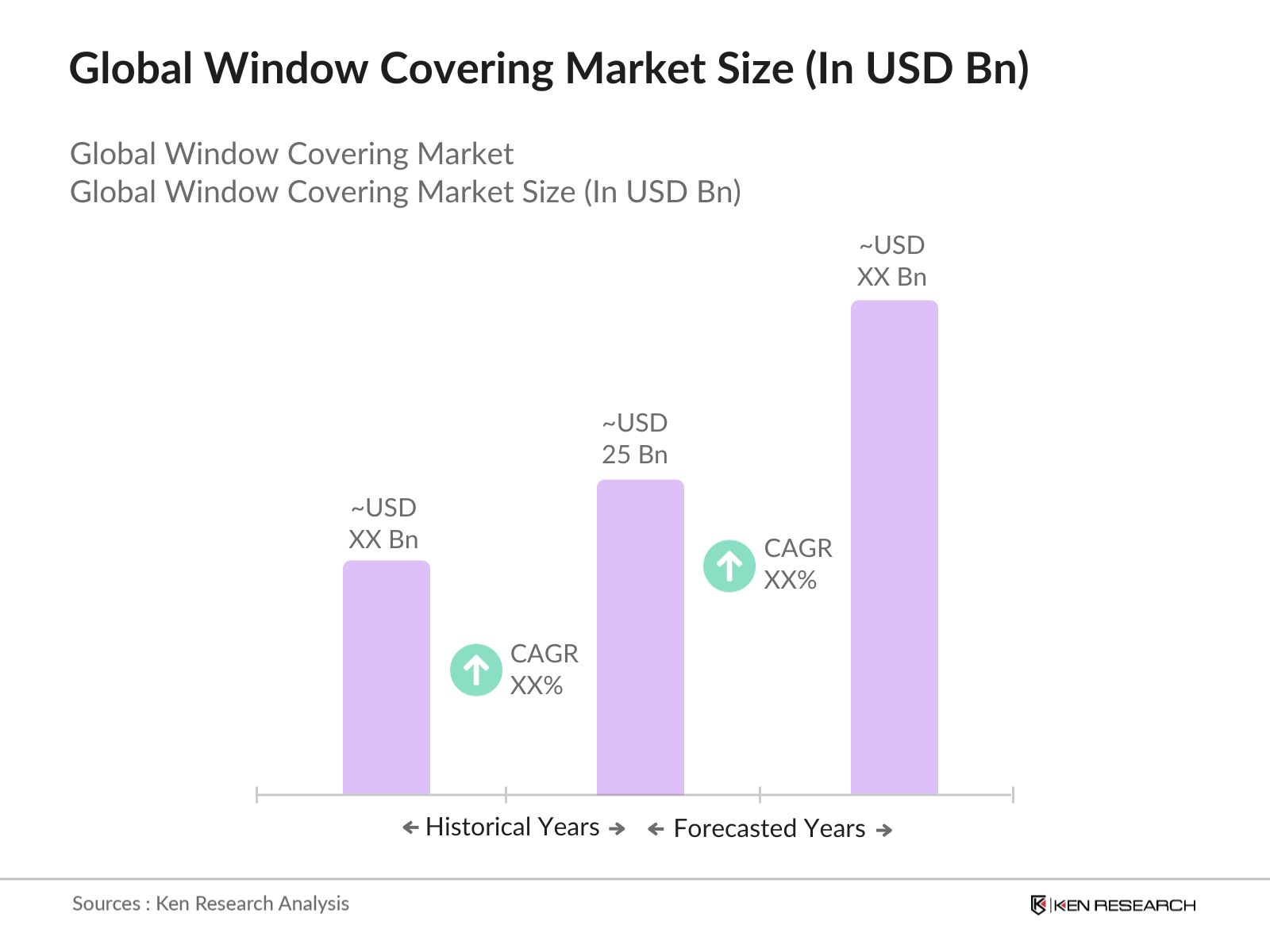
- The global window covering market has seen substantial growth, currently valued at USD 25 Bn, driven by factors such as increased demand for energy efficiency, privacy concerns, and aesthetic improvements in residential and commercial properties. The rising trend of home automation has also contributed to the demand for smart window coverings that can be integrated with home control systems. As of 2023, the market is supported by advancements in motorized and smart window coverings, which offer consumers convenience and enhanced functionality.
- Key regions leading in the adoption of advanced window covering solutions include North America, Europe, and Asia Pacific. North America, particularly the U.S., dominates the market, benefiting from high disposable income levels, a strong construction sector, and increasing awareness of energy-saving products. Europe follows closely, with countries like Germany, France, and the U.K. focusing on eco-friendly window treatments that meet stringent energy efficiency standards. In the Asia Pacific region, the rising urbanization and growing middle-class populations in countries like China and India are driving the market forward, with significant investments in smart home solutions.
- Global regulatory efforts are playing a key role in shaping the window covering market. Governments in regions such as Europe and North America have implemented stringent energy efficiency regulations that encourage the use of window coverings to reduce heat gain or loss. For instance, the European Unions Energy Performance of Buildings Directive (EPBD) aims to make buildings more energy-efficient, indirectly boosting the demand for energy-saving window coverings like blinds and shades. Furthermore, rising environmental concerns are prompting the introduction of eco-friendly and sustainable materials in the production of window coverings.
Global Window Covering Market Segmentation
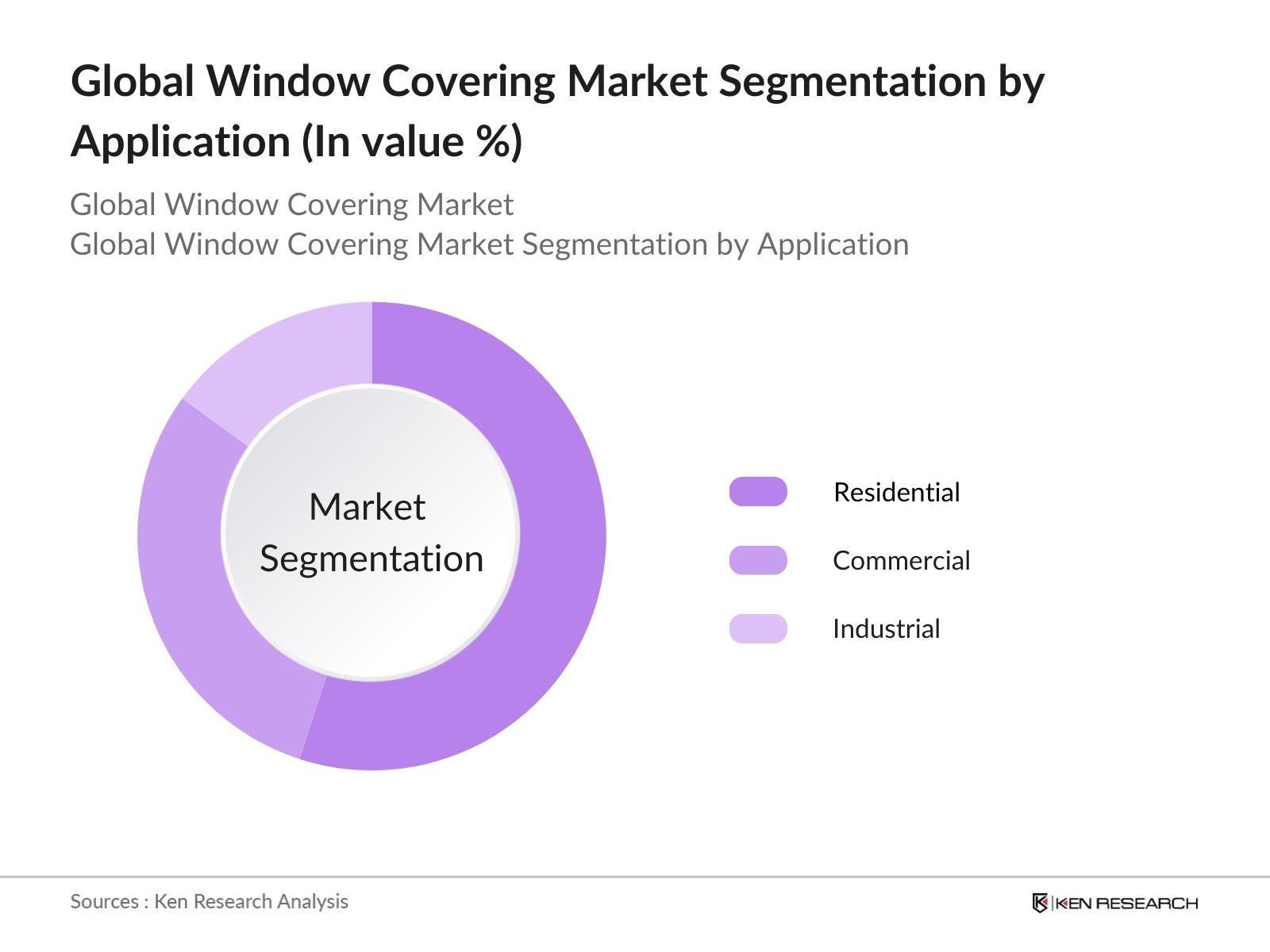 By Application: The market is also segmented by application into residential, commercial, and industrial. The residential sector dominates the global window covering market, driven by growing urbanization and the increasing adoption of energy-efficient window treatments in new home constructions. Residential consumers are particularly focused on solutions that provide both privacy and energy savings, with smart and motorized options growing in demand. The rising trend of home automation is further fueling the adoption of smart window coverings in this segment.
- By Product Type: The market is segmented into blinds, shades, shutters, curtains, and others. Blinds dominate the market, driven by their ability to provide both privacy and light control in residential and commercial spaces. The growing adoption of motorized blinds is further propelling this segment, with consumers seeking remote-controlled and automated options for enhanced convenience. Shades are also experiencing growth, particularly in the residential sector, where energy-efficient cellular shades are gaining popularity for their insulating properties. Shutters and curtains are seeing a steady demand, with the latter being favored for their aesthetic appeal and versatility in home dcor. Additionally, innovative materials such as eco-friendly fabrics and synthetic fibers are being increasingly used in window coverings, appealing to environmentally-conscious consumers.
- By Region: The global window covering market is segmented by region into North America, Europe, Asia Pacific, Latin America, and Middle East & Africa. North America dominates the market due to high consumer demand for energy-efficient and smart window coverings, particularly in the U.S., where the real estate and smart home markets are rapidly expanding. Europe is another significant market, driven by stringent energy-saving regulations and a strong focus on eco-friendly materials. In Asia Pacific, rising urbanization and disposable incomes are propelling market growth, with countries like China and India seeing increasing adoption of window coverings in both residential and commercial sectors.

Global Window Covering Market Competitive Landscape
The global window covering market is characterized by the presence of several key players who are investing heavily in research and development to create innovative, energy-efficient, and smart window covering solutions. These companies are focused on meeting the growing consumer demand for products that enhance privacy, improve energy efficiency, and provide ease of use through automation. The market is moderately concentrated, with established players maintaining a strong presence, but smaller companies are also entering the market with niche and eco-friendly product offerings.
|
Company Name |
Establishment Year |
Headquarters |
Product Portfolio |
Global Reach |
Sustainability Initiatives |
R&D Investment |
Smart Technology Integration |
Energy-Efficient Solutions |
|
Hunter Douglas |
1919 |
Rotterdam, Netherlands |
||||||
|
Springs Window Fashions |
1939 |
Wisconsin, USA |
||||||
|
Somfy |
1969 |
Cluses, France |
||||||
|
The Shade Store |
1946 |
New York, USA |
||||||
|
Hillarys |
1971 |
Nottingham, UK |
Global Window Covering Market Analysis
Growth Drivers
- Aesthetic Improvements for Commercial and Residential Spaces: Aesthetic appeal is becoming a significant driver in both residential and commercial sectors. In 2024, interior designers report that majority of commercial buildings prioritize aesthetically pleasing window coverings, as they are integrated into the architectural design of office spaces. These coverings, such as wooden blinds and textured fabrics, are not just functional but enhance the visual appeal, which is essential in hospitality and luxury residential markets. Furthermore, new construction projects in countries like China and India are incorporating designer window coverings in both commercial and residential sectors, aligning with aesthetic trends.
- Increased Focus on Energy Efficiency: The growing emphasis on energy efficiency in buildings has driven demand for energy-saving window coverings. In 2024, energy efficiency standards set by governments in regions like the USA and the European Union are expected to reduce heating and cooling costs substantially through the use of insulated blinds and shades. This is backed by the US Department of Energy, which reported savings of for households using energy-efficient window treatments. Regulatory incentives for green buildings further bolster this demand, especially in commercial and residential spaces.
- Integration of Smart Technology in Window Coverings: The growing adoption of smart home systems has led to a surge in demand for smart window coverings. In 2024, millions of smart homes globally are expected to integrate motorized or automated blinds and shades, offering features like voice control and automation. These systems, linked to IoT platforms, enhance convenience and energy efficiency by automatically adjusting to environmental changes. The integration of these systems is prevalent in North America and Europe, where smart home penetration rates are high, and governments incentivize smart home infrastructure to promote energy efficiency.
Market Challenges
- High Initial Investment for Smart Window Coverings: Smart window coverings require substantial initial investment, which is a barrier for widespread adoption, particularly in emerging markets. The upfront costs remain a deterrent for consumers in regions like Southeast Asia and Africa, where GDP per capita is significantly lower than in developed markets, limiting adoption. Although smart window coverings offer long-term energy savings, their high initial expense makes them less accessible to lower-income households and small businesses. Governments in these regions have not yet introduced subsidies or incentives for adopting these technologies, further challenging market penetration.
- Regulatory Compliance for Sustainable Materials: Manufacturers face challenges in meeting regulatory standards for sustainable materials. The EUs circular economy regulations mandate that a significant portion of materials used in window coverings must be recyclable or sustainably sourced, putting pressure on companies to innovate. This transition to eco-friendly fabrics and materials like bamboo or recycled polyester increases manufacturing costs. Non-compliance with these standards can lead to fines or restrictions on market entry, making regulatory hurdles a significant barrier for manufacturers, especially for small and medium enterprises (SMEs) seeking to enter or expand in the market.
Global Window Covering Market Future Outlook
The global window covering market is expected to experience significant growth, driven by increasing demand for smart home solutions, energy-efficient products, and eco-friendly materials. Companies are likely to focus on expanding their product portfolios to include more motorized and automated options, as well as eco-friendly alternatives to traditional window coverings.
Future Market Opportunities
- Integration with IoT and Smart Home Systems: Smart homes are a significant trend in 2024, with more than 309 million homes worldwide equipped with IoT-enabled systems. Window coverings are increasingly being integrated into these smart systems, allowing for automated control through smartphones and voice assistants. This trend is particularly strong in regions like North America and Europe, where government incentives for smart homes are prevalent. Window coverings that integrate with smart home systems not only enhance convenience but also contribute to energy conservation, further driving demand for these advanced solutions.
- Growing Demand for Sustainable Products: With increasing environmental awareness, there is a growing demand for window coverings made from sustainable and eco-friendly materials. Manufacturers are exploring the use of recycled and biodegradable materials to meet consumer preferences for green products. This trend is expected to gain momentum, particularly in Europe and North America, where regulations on sustainable construction and home products are becoming more stringent.
Scope of the Report
|
By Product Type |
Blinds Shades Shutters Curtains Others |
|
By Technology |
Motorized Window Coverings Manual Window Coverings |
|
By Material |
Wood Metal Fabric Plastic |
|
By Application |
Residential Commercial Industrial |
|
By Region |
North America Europe Asia Pacific Latin America Middle East & Africa |
Products
Key Target Audience
Manufacturers and Suppliers of Window Coverings
Investors and Venture Capitalist Firms
Smart Home System Integrators
Residential and Commercial Property Developers
Government and Regulatory Bodies (Energy Efficiency Regulatory Bodies)
Sustainability and Eco-Friendly Product Advocacy Groups
Retailers and E-commerce Platforms
Smart Technology Providers
Banks and Financial Institutions
Companies
Players Mentioned in the Report
Hunter Douglas
Springs Window Fashions
Somfy
The Shade Store
Hillarys
Levolor
Lutron Electronics
Norman Window Fashions
Graber
Bali Blinds
SelectBlinds
Insolroll Window Systems
Comfortex Window Fashions
Blindster
Budget Blinds
Table of Contents
1. Global Window Covering Market Overview
1.1. Definition and Scope
1.2. Market Taxonomy
1.3. Market Growth Rate (CAGR, Y-o-Y Growth)
1.4. Market Segmentation Overview
2. Global Window Covering Market Size (In USD Bn)
2.1. Historical Market Size (In USD Bn)
2.2. Year-On-Year Growth Analysis
2.3. Key Market Developments and Milestones
3. Global Window Covering Market Analysis
3.1. Growth Drivers (Energy Efficiency, Privacy Demand, Aesthetic Enhancements, Smart Home Integration)
3.1.1. Energy Efficiency Standards
3.1.2. Rising Demand for Privacy Solutions
3.1.3. Aesthetic Improvements for Commercial and Residential Spaces
3.1.4. Integration of Smart Technology in Window Coverings
3.2. Market Challenges (High Costs, Regulatory Requirements, Consumer Awareness)
3.2.1. High Initial Investment for Smart Window Coverings
3.2.2. Regulatory Compliance for Sustainable Materials
3.2.3. Consumer Awareness About Technological Benefits
3.2.4. Low Adoption in Emerging Economies
3.3. Opportunities (Emerging Markets, Eco-Friendly Solutions, Automation Trends)
3.3.1. Expansion in Emerging Markets (APAC, LATAM)
3.3.2. Eco-Friendly and Sustainable Material Usage
3.3.3. Rising Demand for Motorized Window Coverings
3.3.4. Customization in Window Covering Solutions
3.4. Trends (Smart Homes, Energy Conservation, Material Innovation)
3.4.1. Integration with IoT and Smart Home Systems
3.4.2. Energy Conservation Trends Through Window Coverings
3.4.3. Adoption of New Materials (Bamboo, Recyclable Fabrics)
3.4.4. Modular and Multifunctional Designs
3.5. Government Regulation (Energy Efficiency Standards, Sustainability Mandates, Import Tariffs)
3.5.1. Regulatory Frameworks for Energy-Saving Products
3.5.2. Sustainability Mandates for Materials and Manufacturing Processes
3.5.3. Import Tariffs Impacting Window Covering Materials
3.5.4. Certifications for Eco-Friendly Products
3.6. SWOT Analysis (Energy Efficiency, Smart Technology Adoption, Material Challenges, Regulatory Impact)
3.7. Stakeholder Ecosystem (Manufacturers, Distributors, Designers, Installers)
3.8. Porters Five Forces (Supply Chain, Buyer Power, Competition Intensity)
3.9. Competition Ecosystem (Manufacturing Clusters, Technological Differentiation)
4. Global Window Covering Market Segmentation
4.1. By Product Type (In Value %)
4.1.1. Blinds
4.1.2. Shades
4.1.3. Shutters
4.1.4. Curtains
4.1.5. Others
4.2. By Technology (In Value %)
4.2.1. Motorized Window Coverings
4.2.2. Manual Window Coverings
4.3. By Material (In Value %)
4.3.1. Wood
4.3.2. Metal
4.3.3. Fabric
4.3.4. Plastic
4.4. By Application (In Value %)
4.4.1. Residential
4.4.2. Commercial
4.4.3. Industrial
4.5. By Region (In Value %)
4.5.1. North America
4.5.2. Europe
4.5.3. Asia Pacific
4.5.4. Latin America
4.5.5. Middle East & Africa
5. Global Window Covering Market Competitive Analysis
5.1 Detailed Profiles of Major Companies
5.1.1. Hunter Douglas
5.1.2. Springs Window Fashions
5.1.3. Somfy
5.1.4. The Shade Store
5.1.5. Hillarys
5.1.6. Levolor
5.1.7. Lutron Electronics
5.1.8. Norman Window Fashions
5.1.9. Graber
5.1.10. Bali Blinds
5.1.11. SelectBlinds
5.1.12. Insolroll Window Systems
5.1.13. Comfortex Window Fashions
5.1.14. Blindster
5.1.15. Budget Blinds
5.2 Cross Comparison Parameters (Headquarters, Revenue, Market Presence, R&D Investments, Product Portfolio, Global Reach, Sustainability Initiatives, Smart Technology Integration)
5.3 Market Share Analysis (By Region and Company)
5.4 Strategic Initiatives (Product Innovations, Technological Partnerships, Sustainability Goals)
5.5 Mergers and Acquisitions
5.6 Investment Analysis (Capex Plans, Facility Expansions)
5.7 Venture Capital Funding
5.8 Government Grants
5.9 Private Equity Investments
6. Global Window Covering Market Regulatory Framework
6.1 Energy Efficiency Standards
6.2 Material Compliance and Sustainability Requirements
6.3 Certification Processes (Eco-Labels, LEED, Energy Star)
7. Global Window Covering Future Market Size (In USD Bn)
7.1 Future Market Size Projections
7.2 Key Factors Driving Future Market Growth
8. Global Window Covering Market Future Segmentation
8.1 By Product Type (In Value %)
8.2 By Technology (In Value %)
8.3 By Material (In Value %)
8.4 By Application (In Value %)
8.5 By Region (In Value %)
9. Global Window Covering Market Analysts Recommendations
9.1 TAM/SAM/SOM Analysis
9.2 Customer Cohort Analysis
9.3 Marketing Initiatives
9.4 White Space Opportunity Analysis
Research Methodology
Step 1: Identification of Key Variables
The first step involves the identification of key variables influencing the global window covering market. This phase includes mapping out all stakeholders, including manufacturers, distributors, and end-users, through comprehensive desk research. The aim is to establish the major factors driving market demand, such as energy efficiency, consumer preferences for privacy, and smart technology adoption.
Step 2: Market Analysis and Construction
This phase focuses on compiling historical data and conducting a thorough analysis of the window covering market. Key metrics such as market size, market growth rate, and penetration rates in different regions are assessed to provide an accurate picture of market dynamics. Additionally, technology adoption and material innovations are evaluated to project future market trends.
Step 3: Hypothesis Validation and Expert Consultation
Market hypotheses are validated through interviews and consultations with industry experts, including manufacturers, suppliers, and distributors. These interviews are conducted to gain firsthand insights into the current market landscape, competitive dynamics, and potential challenges. The information gathered will also be used to refine market forecasts and segment analysis.
Step 4: Research Synthesis and Final Output
In this final phase, all data collected is synthesized to generate a comprehensive analysis of the global window covering market. The report is validated through a combination of top-down and bottom-up approaches to ensure accuracy. Key insights from industry experts are also incorporated to finalize the market projections and growth drivers.
Frequently Asked Questions
01. How big is the Global Window Covering Market?
The global window covering market is valued at USD 25 billion, driven by rising demand for energy-efficient solutions, privacy features, and the adoption of smart home technologies.
02. What are the challenges in the Global Window Covering Market?
Challenges in the global window covering market is include high costs associated with motorized window coverings, regulatory compliance for sustainable materials, and low consumer awareness in emerging markets. These factors pose hurdles for widespread adoption.
03. Who are the major players in the Global Window Covering Market?
Key players in the global window covering market is include Hunter Douglas, Springs Window Fashions, Somfy, The Shade Store, and Hillarys. These companies lead the market with a focus on innovation, sustainability, and smart technology integration.
04. What are the growth drivers of the Global Window Covering Market?
The global window covering market is is propelled by the rise of smart home technologies, increasing demand for energy-efficient solutions, and the growing popularity of automated window coverings in both residential and commercial settings.
Why Buy From Us?

What makes us stand out is that our consultants follows Robust, Refine and Result (RRR) methodology. i.e. Robust for clear definitions, approaches and sanity checking, Refine for differentiating respondents facts and opinions and Result for presenting data with story

We have set a benchmark in the industry by offering our clients with syndicated and customized market research reports featuring coverage of entire market as well as meticulous research and analyst insights.

While we don't replace traditional research, we flip the method upside down. Our dual approach of Top Bottom & Bottom Top ensures quality deliverable by not just verifying company fundamentals but also looking at the sector and macroeconomic factors.

With one step in the future, our research team constantly tries to show you the bigger picture. We help with some of the tough questions you may encounter along the way: How is the industry positioned? Best marketing channel? KPI's of competitors? By aligning every element, we help maximize success.

Our report gives you instant access to the answers and sources that other companies might choose to hide. We elaborate each steps of research methodology we have used and showcase you the sample size to earn your trust.

If you need any support, we are here! We pride ourselves on universe strength, data quality, and quick, friendly, and professional service.