
India 3D Printing Market Outlook 2030
Region:Global
Author(s):Shivani Mehra
Product Code:KROD5985
December 2024
92
About the Report
India 3D Printing Market Overview
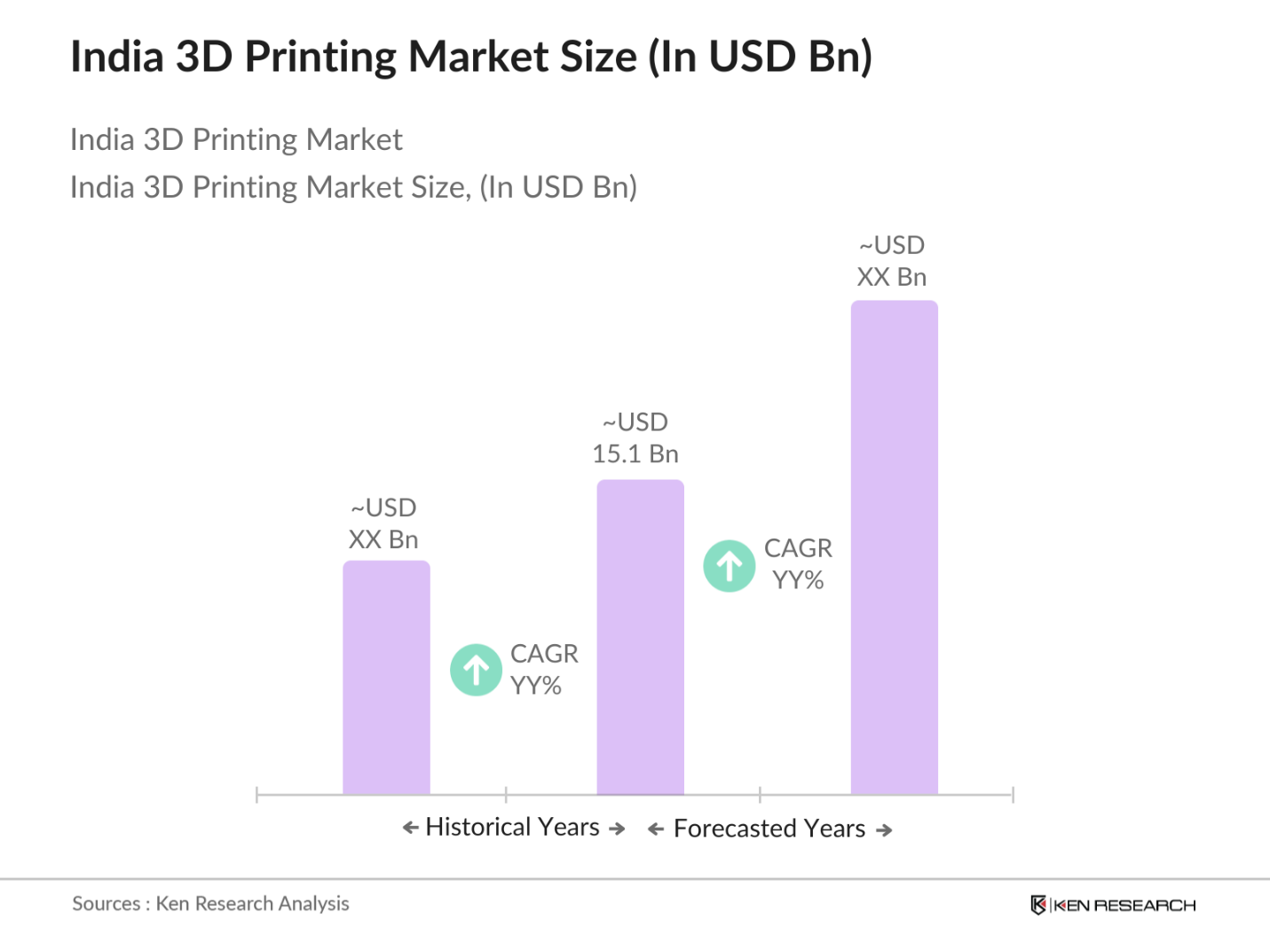
- The India 3D Printing market is valued at USD 15.1 billion, driven by rapid industrial adoption across sectors such as aerospace, healthcare, and automotive. The rise of customized manufacturing solutions and the government's initiatives like "Make in India" are major driving forces. Technological advancements, coupled with a growing focus on sustainable production practices, are further propelling market growth. The expanding use of 3D printing in prototyping and rapid manufacturing is also contributing to the increasing market size.
- The major cities dominating the Indian 3D printing market include Bengaluru, Pune, and Chennai. Bengaluru leads due to its status as a technology hub, boasting advanced R&D centers and a thriving aerospace sector. Pune has become a key player with a strong manufacturing base, while Chennai excels in automotive and healthcare applications, driven by an advanced industrial ecosystem. The geographical concentration of talent, infrastructure, and investment fosters these cities' dominance in the 3D printing industry.
- The Indian government has introduced several policies to encourage the adoption of advanced manufacturing technologies like 3D printing. In 2022, the Ministry of Electronics and Information Technology launched the National Strategy on Additive Manufacturing, aiming to promote the widespread adoption of 3D printing across industrial sectors. This strategy emphasizes the need for India to develop an indigenous 3D printing ecosystem, and aims to reduce the dependency on imported technologies.
India 3D Printing Market Segmentation
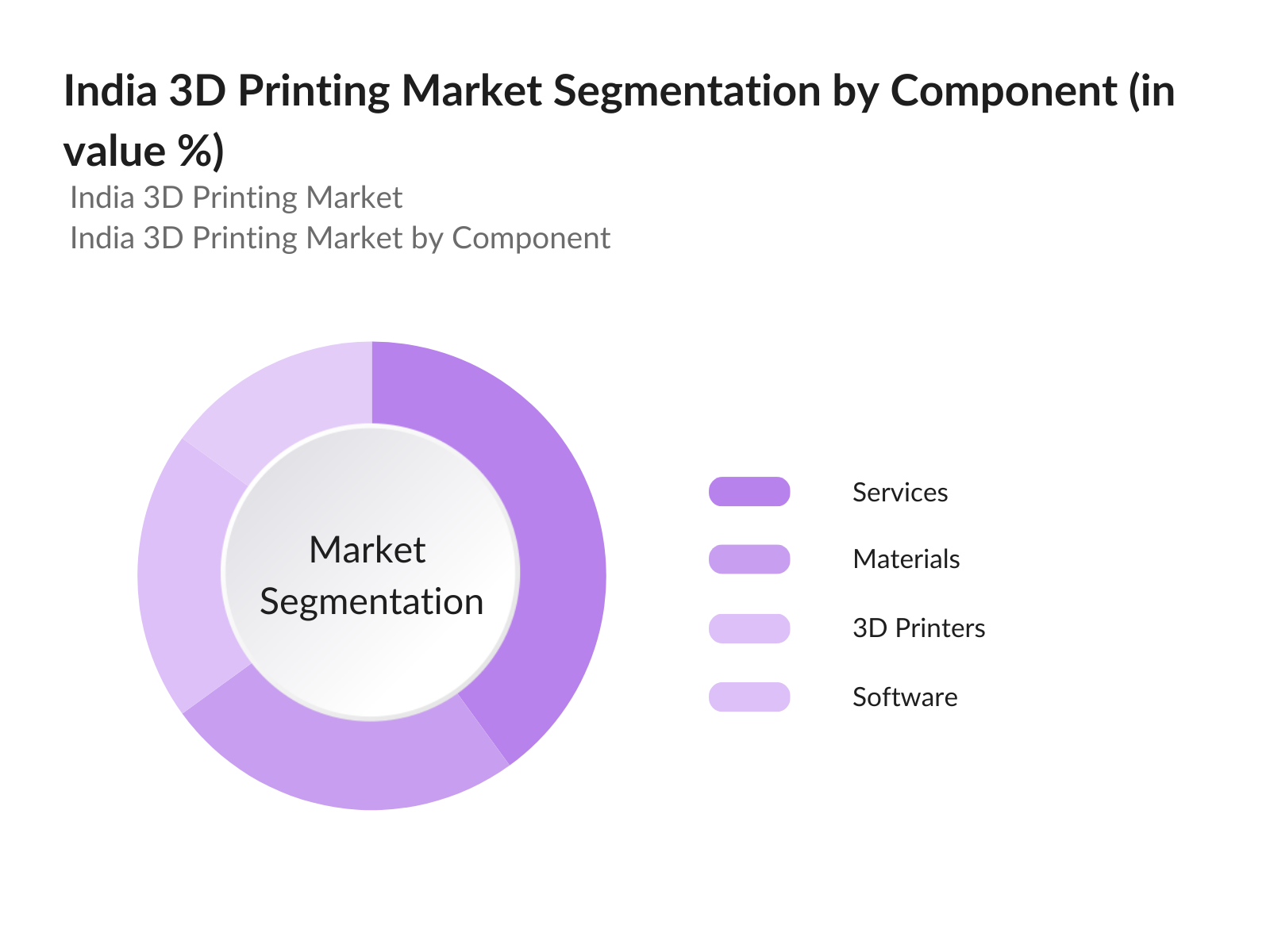
By Component: Indias 3D Printing market is segmented by component into 3D printers, materials, software, and services. Services hold the dominant share in this segment due to increasing demand for maintenance, customization, and post-production services. Businesses often outsource these services to specialized providers to avoid large capital investments in-house. The flexibility offered by service providers, coupled with technological expertise, makes this the most sought-after segment.
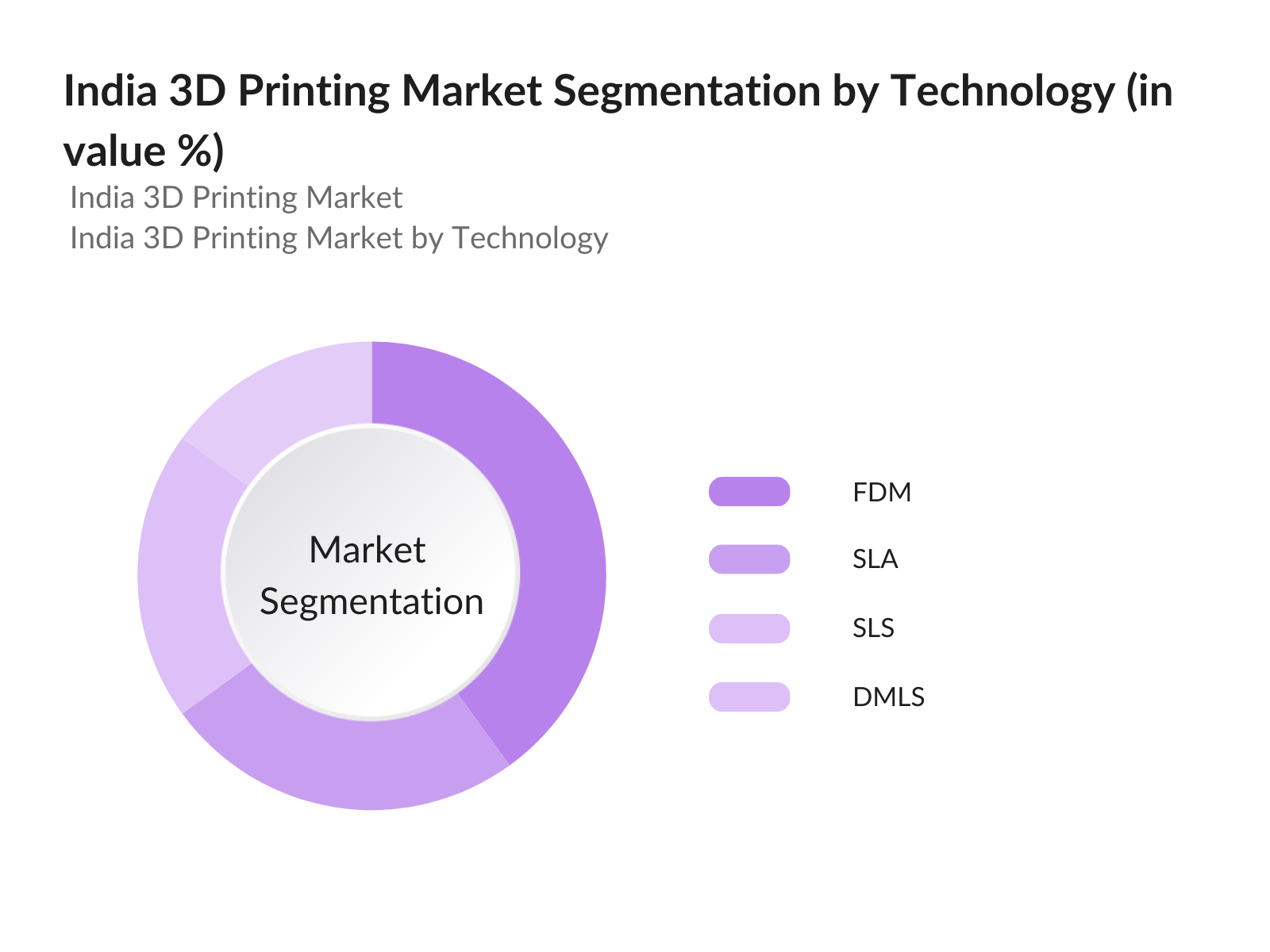
By Technology: Indias 3D Printing market is further divided by technology into Fused Deposition Modeling (FDM), Stereolithography (SLA), Selective Laser Sintering (SLS), and Direct Metal Laser Sintering (DMLS). FDM dominates this segment, accounting for a substantial share, as it is widely used for both prototyping and end-use part manufacturing across industries. Its affordability and ease of use make it the preferred choice for businesses and educational institutions alike.
India 3D Printing Market Competitive Landscape
The India 3D Printing market is dominated by both domestic and international players, providing diverse solutions across industries. Major players are focusing on expanding their service offerings, R&D investments, and strategic partnerships to strengthen their market positions.
|
Company Name |
Establishment Year |
Headquarters |
No. of Employees |
Product Portfolio |
R&D Investments |
Customer Base |
Regional Presence |
Innovation Capability |
|
Wipro 3D |
1945 |
Bengaluru, India |
- |
- |
- |
- |
- |
- |
|
Adroitec Information |
1988 |
New Delhi, India |
- |
- |
- |
- |
- |
- |
|
Intech Additive Solutions |
2012 |
Bengaluru, India |
- |
- |
- |
- |
- |
- |
|
Think3D |
2014 |
Hyderabad, India |
- |
- |
- |
- |
- |
- |
|
Objectify Technologies |
2013 |
Noida, India |
- |
- |
- |
- |
- |
- |
India 3D Printing Market Analysis
Market Growth Drivers
- Government Initiatives in Digital Manufacturing: The Indian government has been a strong advocate for digital manufacturing, particularly under its flagship "Make in India" initiative. In 2022, the Indian Ministry of Electronics and Information Technology launched the National Strategy on Additive Manufacturing, aiming to position India as a global hub for 3D printing. The government plans to achieve this by establishing over 50 additive manufacturing (AM) tech centers across the country. These initiatives directly support the adoption of 3D printing technology across industries like aerospace, defense, and automotive.
- Rising Adoption in Aerospace and Defense: Indias aerospace and defense sectors are increasingly integrating 3D printing technology for complex part manufacturing and prototyping. For instance, the Indian Space Research Organization (ISRO) has utilized 3D printing for manufacturing lightweight components for satellite missions. In 2023, the Defense Research and Development Organisation (DRDO) increased its investments in 3D printing technology, emphasizing its use in creating lightweight materials for unmanned aerial vehicles (UAVs). The adoption is driven by the cost-effectiveness and precision that 3D printing offers in producing critical parts.
- Healthcare and Medical Device Applications: India's healthcare sector is leveraging 3D printing for customized implants, prosthetics, and medical devices. In 2023, the All India Institute of Medical Sciences (AIIMS) reported a significant rise in 3D-printed medical devices, with over 5,000 customized implants produced annually. The availability of biocompatible materials and the growing number of collaborations between medical institutions and tech companies are driving this growth. 3D printing is particularly beneficial in orthopedics and dental surgeries, improving patient outcomes through customized solutions.
Market Challenges
- High Material Costs (Material Specific): While 3D printing is becoming more accessible, the high cost of materials remains a significant challenge in India. In 2023, the average cost of metal powders used in 3D printing was approximately INR 4,500 per kilogram, which is notably higher than traditional manufacturing materials. For industries like automotive and aerospace, the high cost of materials such as titanium and aluminum alloys limits the widespread adoption of metal 3D printing.
- Lack of Skilled Workforce (Skill Gap): The 3D printing industry in India is facing a skills shortage, particularly in advanced areas like design for additive manufacturing (DfAM) and material science. A 2023 report by the Ministry of Skill Development revealed that fewer than 25,000 engineers were adequately trained in 3D printing technologies, compared to over 1 million engineers in the broader mechanical engineering sector. This gap has slowed the integration of 3D printing into mainstream manufacturing.
India 3D Printing Market Future Outlook
Over the next five years, the India 3D Printing market is expected to witness robust growth driven by continued government support under initiatives like "Make in India" and "Digital India." The increasing adoption of 3D printing in aerospace, healthcare, and automotive industries will further fuel demand. Furthermore, advancements in materials, improved production speeds, and cost efficiencies are likely to expand the scope of 3D printing applications across multiple sectors, thereby driving market expansion.
Market Opportunities:
- Expansion of 3D Printing for Consumer Goods (Consumer Applications): The consumer goods sector is increasingly adopting 3D printing for personalized and limited-edition products. In 2023, 3D-printed products such as customized footwear, eyewear, and home decor items accounted for over INR 500 crore in sales. This trend is driven by the growing consumer demand for unique and personalized products that reflect individual tastes, as well as the ability of 3D printing to offer small-batch production runs at relatively low costs.
- Advancements in Multi-Material Printing: Multi-material 3D printing, which allows the use of multiple materials in a single print job, is seeing rapid advancements in India. By 2024, the technology had matured to the point where industries like healthcare and automotive could produce components with different mechanical properties within a single product. This trend is particularly relevant in medical device manufacturing, where components with varying flexibility and strength are required for implants.
Scope of the Report
|
By Component |
3D Printers Materials Software Services |
|
By Technology |
FDM SLA SLS DMLS |
|
By Application |
Aerospace and Defense Healthcare Automotive Consumer Goods |
|
By End-User |
Manufacturing Industry Service Providers Research Institutions |
|
By Region |
North-East Midwest West Coast Southern States |
Products
Key Target Audience
3D Printing Service Providers
Manufacturing Industry Stakeholders
Aerospace and Defense Companies
Automotive Manufacturers
Healthcare Providers
Investments and Venture Capitalist Firms
Government Agencies (Ministry of Electronics and IT, Department of Science and Technology)
R&D Institutes Focusing on Digital Manufacturing
Companies
Players Mention in the Report
Wipro 3D
Adroitec Information Systems
Intech Additive Solutions
Think3D
Objectify Technologies
Imaginarium
Sahas Softech
Fractal Works
3Ding
Scantech Solutions
Boson Machines
Divide By Zero Technologies
Novabeans Prototyping Labs
Voxeljet India Pvt Ltd
J Group Robotics
Table of Contents
01. India 3D Printing Market Overview
1.1. Definition and Scope
1.2. Market Taxonomy
1.3. Market Growth Rate
1.4. Market Segmentation Overview
02. India 3D Printing Market Size (In USD Bn)
2.1. Historical Market Size
2.2. Year-On-Year Growth Analysis
2.3. Key Market Developments and Milestones
03. India 3D Printing Market Analysis
3.1. Growth Drivers
3.1.1. Government Initiatives in Digital Manufacturing
3.1.2. Rising Adoption in Aerospace and Defense
3.1.3. Healthcare and Medical Device Applications
3.1.4. Expansion in Automotive Sector
3.2. Market Challenges
3.2.1. High Material Costs (Material Specific)
3.2.2. Lack of Skilled Workforce (Skill Gap)
3.2.3. Technical Challenges in Metal 3D Printing (Technology Limitations)
3.3. Opportunities
3.3.1. Growth in Customized Manufacturing
3.3.2. Expansion of 3D Printing Ecosystem (Supply Chain)
3.3.3. Increasing Government R&D Support
3.4. Trends
3.4.1. Rising Demand for Industrial Prototypes (Industrial Applications)
3.4.2. Expansion of 3D Printing for Consumer Goods (Consumer Applications)
3.4.3. Advancements in Multi-Material Printing
3.5. Regulatory Landscape
3.5.1. Government Policies on Manufacturing
3.5.2. Intellectual Property and Licensing Laws
3.6. SWOT Analysis
3.7. Porters Five Forces
3.8. Stake Ecosystem
3.9. Competition Ecosystem
04. India 3D Printing Market Segmentation
4.1. By Component (In Value %)
4.1.1. 3D Printers
4.1.2. Materials
4.1.3. Software
4.1.4. Services
4.2. By Technology (In Value %)
4.2.1. Fused Deposition Modeling (FDM)
4.2.2. Stereolithography (SLA)
4.2.3. Selective Laser Sintering (SLS)
4.2.4. Direct Metal Laser Sintering (DMLS)
4.3. By Application (In Value %)
4.3.1. Aerospace and Defense
4.3.2. Healthcare and Medical Devices
4.3.3. Automotive
4.3.4. Consumer Goods
4.4. By End-User (In Value %)
4.4.1. Manufacturing Industry
4.4.2. Service Providers
4.4.3. Research Institutions
4.5. By Region (In Value %)
4.5.1. North India
4.5.2. South India
4.5.3. East India
4.5.4. West India
05. India 3D Printing Market Competitive Analysis
5.1. Detailed Profiles of Major Companies
5.1.1. Wipro 3D
5.1.2. Adroitec Information Systems
5.1.3. Intech Additive Solutions
5.1.4. Think3D
5.1.5. 3Ding
5.1.6. Sahas Softech
5.1.7. Imaginarium
5.1.8. Objectify Technologies
5.1.9. Boson Machines
5.1.10. Fractal Works
5.1.11. Scantech Solutions
5.1.12. Divide By Zero Technologies
5.1.13. Novabeans Prototyping Labs
5.1.14. J Group Robotics
5.1.15. Voxeljet India Pvt Ltd
5.2. Cross Comparison Parameters (No. of Employees, Headquarters, Revenue, Product Portfolio, R&D Investments, Regional Presence, Customer Base, Product Innovation)
5.3. Market Share Analysis
5.4. Strategic Initiatives
5.5. Mergers And Acquisitions
5.6. Investment Analysis
5.7. Venture Capital Funding
5.8. Government Grants
5.9. Private Equity Investments
06. India 3D Printing Market Regulatory Framework
6.1. Certification Requirements
6.2. Environmental Standards and Compliance
6.3. Government Funding Programs
07. India 3D Printing Future Market Size (In USD Bn)
7.1. Future Market Size Projections
7.2. Key Factors Driving Future Market Growth
08. India 3D Printing Future Market Segmentation
8.1. By Component (In Value %)
8.2. By Technology (In Value %)
8.3. By Application (In Value %)
8.4. By End-User (In Value %)
8.5. By Region (In Value %)
09. India 3D Printing Market Analysts Recommendations
9.1. TAM/SAM/SOM Analysis
9.2. Customer Cohort Analysis
9.3. Marketing Initiatives
9.4. White Space Opportunity Analysis
Disclaimer Contact UsResearch Methodology
Step 1: Identification of Key Variables
The first phase of research involves mapping the key stakeholders within the 3D Printing industry in India. This process involves gathering data from government reports, industrial studies, and proprietary databases to identify variables like market drivers, technology adoption, and regulatory frameworks. The primary objective is to define the critical parameters that influence market dynamics.
Step 2: Market Analysis and Construction
This stage involves compiling and analyzing historical data to assess the market penetration and growth of the 3D Printing industry in India. Key metrics such as the adoption rate of various technologies and the ratio of service providers to end-users will be considered to estimate market revenues accurately.
Step 3: Hypothesis Validation and Expert Consultation
The next step involves validating market assumptions through interviews with industry experts. Feedback is gathered through structured surveys, focusing on operational efficiency, market demand, and financial performance. These expert insights play a crucial role in refining the analysis.
Step 4: Research Synthesis and Final Output
The final phase of research involves synthesizing data from primary and secondary sources to generate a comprehensive market report. This involves cross-verifying data points with 3D Printing manufacturers and service providers to ensure accurate market projections and trends.
Frequently Asked Questions
01. How big is the India 3D Printing Market?
The India 3D Printing market is valued at USD 15.1 billion, driven by industrial applications in aerospace, healthcare, and automotive sectors.
02. What are the challenges in the India 3D Printing Market?
Challenges include the high cost of materials, a lack of skilled labor, and regulatory hurdles related to intellectual property rights.
03. Who are the major players in the India 3D Printing Market?
Key players include Wipro 3D, Intech Additive Solutions, Think3D, and Objectify Technologies, all of which are driving technological advancements.
04. What are the growth drivers of the India 3D Printing Market?
The market is propelled by factors such as government initiatives like "Make in India," increasing adoption in healthcare, and the rise of customized manufacturing.
Why Buy From Us?

What makes us stand out is that our consultants follows Robust, Refine and Result (RRR) methodology. i.e. Robust for clear definitions, approaches and sanity checking, Refine for differentiating respondents facts and opinions and Result for presenting data with story

We have set a benchmark in the industry by offering our clients with syndicated and customized market research reports featuring coverage of entire market as well as meticulous research and analyst insights.

While we don't replace traditional research, we flip the method upside down. Our dual approach of Top Bottom & Bottom Top ensures quality deliverable by not just verifying company fundamentals but also looking at the sector and macroeconomic factors.

With one step in the future, our research team constantly tries to show you the bigger picture. We help with some of the tough questions you may encounter along the way: How is the industry positioned? Best marketing channel? KPI's of competitors? By aligning every element, we help maximize success.

Our report gives you instant access to the answers and sources that other companies might choose to hide. We elaborate each steps of research methodology we have used and showcase you the sample size to earn your trust.

If you need any support, we are here! We pride ourselves on universe strength, data quality, and quick, friendly, and professional service.