
India Basalt Fiber Market Outlook to 2030
Region:Asia
Author(s):Paribhasha Tiwari
Product Code:KROD3089
December 2024
90
About the Report
India Basalt Fiber Market Overview
- The India Basalt Fiber Market is valued at USD 122 million, based on a five-year historical analysis. This market is driven primarily by the rapid expansion of the construction and infrastructure sector, where basalt fiber is increasingly preferred due to its strength, lightweight nature, and environmental benefits over traditional materials like glass and carbon fibers. Additionally, the growth of the automotive industry is further propelling demand for basalt fiber, especially in lightweight composite manufacturing, which enhances vehicle fuel efficiency.
- In terms of regional dominance, cities like Mumbai, Chennai, and Pune, as well as regions like Gujarat, have emerged as key hubs for basalt fiber usage. These areas are characterized by large-scale industrial activities, including automotive manufacturing and construction, which require strong, corrosion-resistant materials like basalt fiber. Gujarat, in particular, stands out due to its robust infrastructure development projects and proximity to manufacturing facilities.
- In 2024, Chongqing Ruimai Basalt Fiber Technology Co., Ltd. is set to establish a new production facility in India, reflecting the growing demand for basalt fiber in the country. This expansion aims to cater to the increasing needs of various sectors, including automotive and construction, which are increasingly adopting basalt fiber for its lightweight and durable properties. The investment signifies a strategic move to enhance local production capabilities and strengthen market presence in the Indian basalt fiber landscape.

India Basalt Fiber Market Segmentation
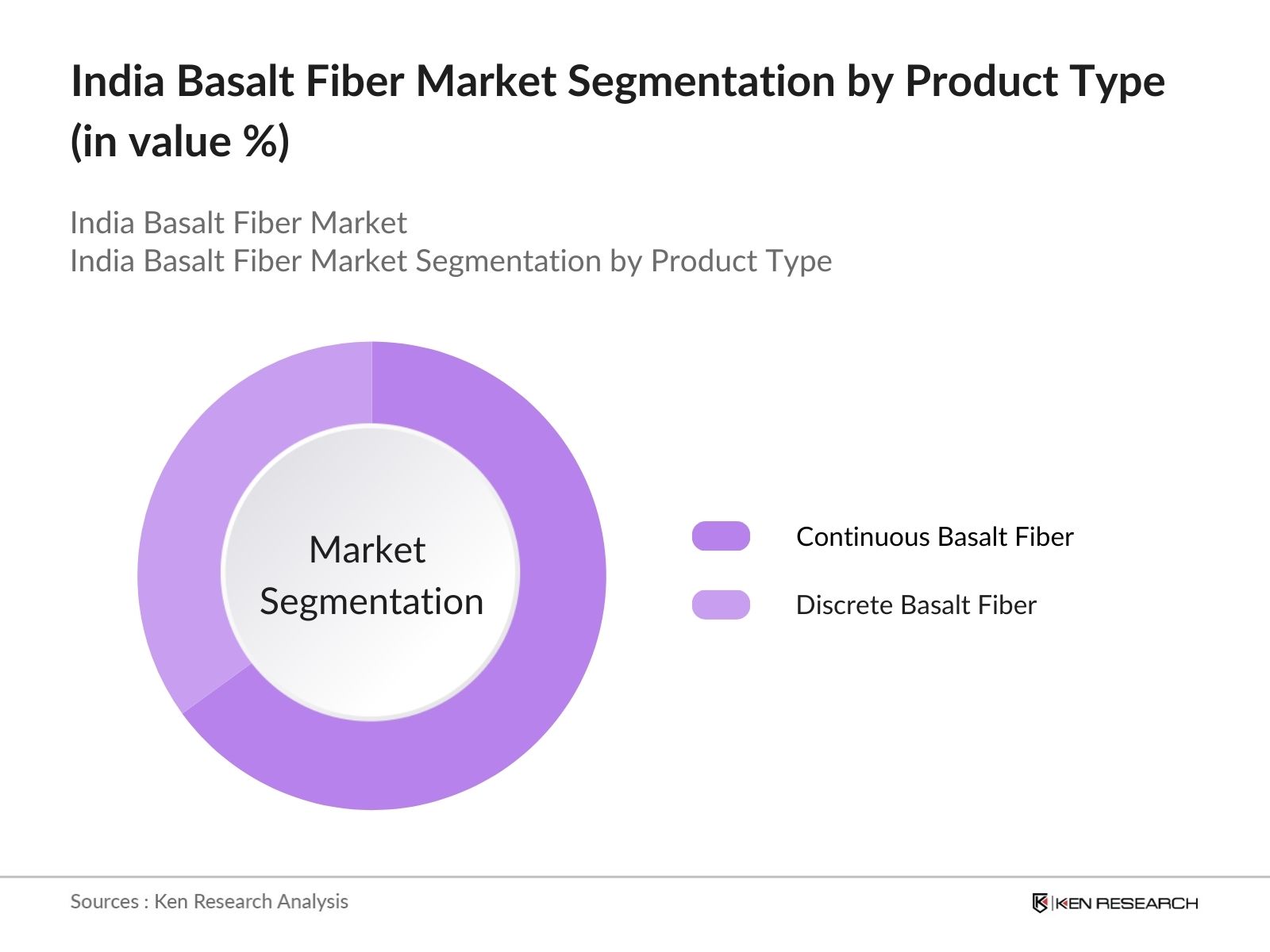
By Product Type: The India Basalt Fiber Market is segmented by product type into continuous basalt fiber and discrete basalt fiber. Continuous basalt fiber holds a dominant market share due to its extensive usage in construction and industrial applications. Its properties of high tensile strength, thermal insulation, and resistance to corrosion make it highly suitable for reinforced concrete and composite applications, especially in sectors like construction and automotive, where durability and lightweight materials are crucial.
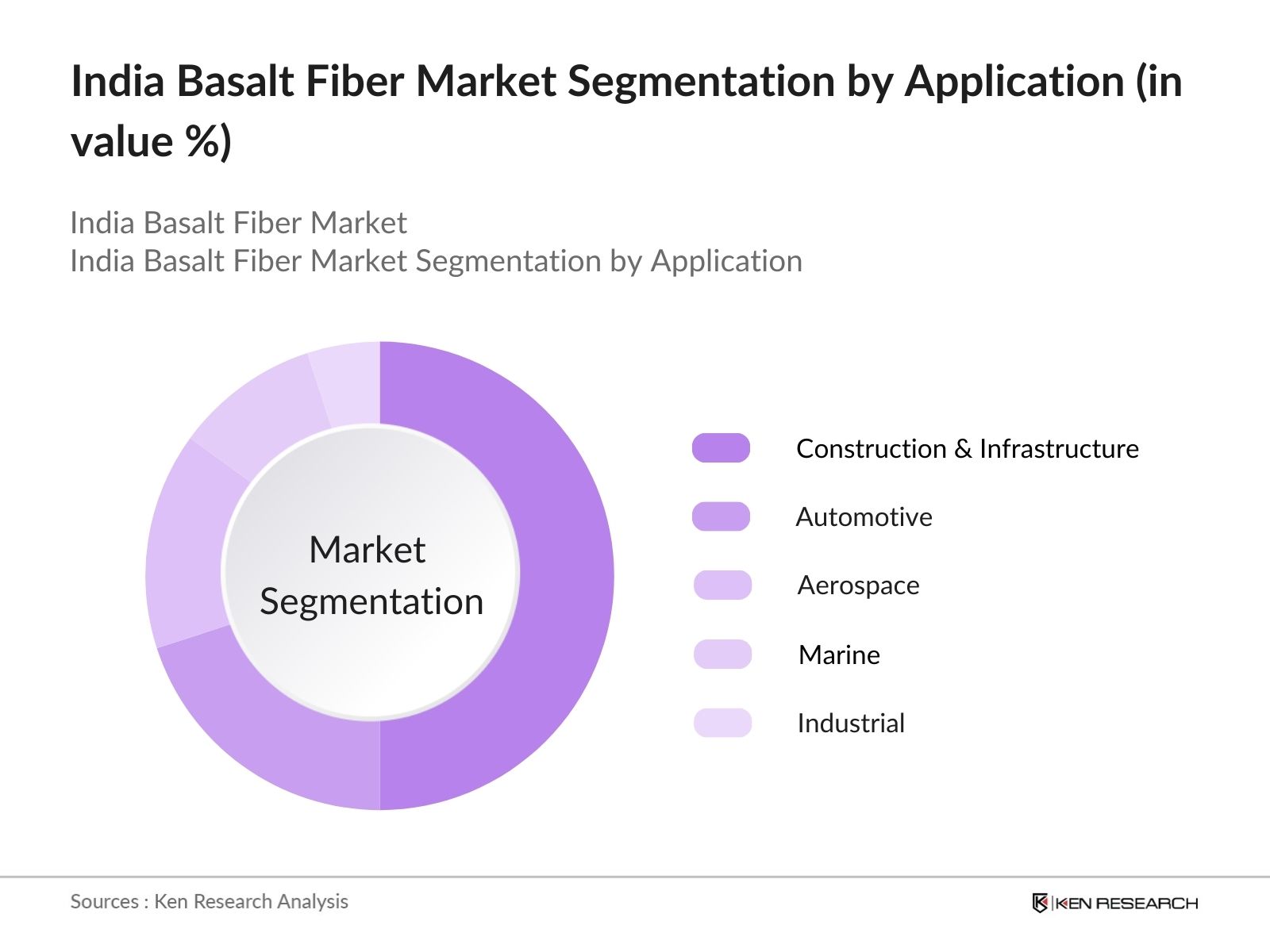
By Application: India's basalt fiber market is further segmented by application into construction & infrastructure, automotive, aerospace, marine, and industrial. Among these, the construction & infrastructure segment has a dominant market share due to the increasing need for durable, corrosion-resistant materials in large infrastructure projects such as bridges, highways, and high-rise buildings. The preference for basalt fiber over conventional steel reinforcements, which are prone to corrosion, is driving this segments prominence in the market.
India Basalt Fiber Market Competitive Landscape
The India Basalt Fiber Market is dominated by a few key players who account for a significant share of the market. This competitive landscape highlights the importance of technological advancements, partnerships, and innovations in production to maintain market dominance. Major players like Basaltex NV and Kamenny Vek are leading in innovation, while domestic manufacturers focus on cost-effective production.
|
Company Name |
Establishment Year |
Headquarters |
Production Capacity |
Revenue (USD Mn) |
Number of Employees |
R&D Investment (USD Mn) |
Product Portfolio |
Key Partnerships |
|
Basaltex NV |
1999 |
Belgium |
- | - | - | - | - | - |
|
Kamenny Vek |
2002 |
Russia |
- | - | - | - | - | - |
|
Mafic SA |
2013 |
United States |
- | - | - | - | - | - |
|
Sudaglass Fiber Tech |
2001 |
United States |
- | - | - | - | - | - |
|
Shanxi Basalt Fiber Co. |
2007 |
China |
- | - | - | - | - | - |
India Basalt Fiber Market Analysis
Growth Drivers
- Infrastructure Development: Indias infrastructure sector is growing rapidly, with the government investing over 5.54 trillion ($74 billion) in the fiscal year 2023-24 through the National Infrastructure Pipeline (NIP) projects. Basalt fiber, known for its strength and resistance to wear, is gaining traction in civil engineering projects, including road construction and building reinforcements. In particular, basalt fiber-reinforced polymers (BFRPs) are being utilized to enhance structural durability and reduce maintenance costs. The Indian Ministry of Road Transport has been advocating the use of basalt fibers in public works due to its environmental and economic benefits.
- Increased Demand for Lightweight, Corrosion-resistant Materials: The demand for lightweight, corrosion-resistant materials in India's automotive and construction sectors has surged as manufacturers aim to reduce vehicle weight and increase fuel efficiency. The automotive sector in India produced 25.9 million vehicles in 2022, making it one of the largest in the world, and basalt fiber composites are increasingly being used for their strength-to-weight ratio. This trend is further bolstered by construction sector growth, with India's government targeting over 100 new smart cities by 2025, where corrosion-resistant materials like basalt fibers are crucial.
- Rising Environmental Concerns: As environmental concerns intensify, basalt fiber has emerged as a sustainable alternative to traditional fibers like glass and carbon. Basalt production emits fewer greenhouse gases, aligning with India's commitment to reduce carbon emissions by 45% by 2030, as stipulated under the Paris Agreement. The fiber is made from natural volcanic rock, making it non-toxic and recyclable, unlike carbon or glass fibers. This green profile has spurred interest in the material, particularly within Indias Green Building movement, which has been allocated 500 billion in incentives in the 2024 Union Budget.
Market Challenges
- High Initial Production Costs: The high initial costs of basalt fiber production, primarily due to the required technological investments in melting volcanic rock, remain a key challenge for widespread adoption in India. According to the Ministry of Micro, Small, and Medium Enterprises, India still lacks sufficient production infrastructure, leading to reliance on imports. Establishing basalt fiber plants requires substantial capital investment, often ranging between 300-400 million for a medium-scale unit. This high capital expenditure has limited the deployment of basalt fiber technology, particularly for small and mid-sized construction firms.
- Lack of Awareness Among End-users: Despite its numerous advantages, basalt fiber remains relatively unknown among many end-users in Indias construction and automotive sectors. A survey conducted by the Ministry of Commerce in 2023 found that 60% of civil engineers were unfamiliar with basalt fibers potential applications. Similarly, automotive manufacturers have been slow to adopt the material due to insufficient education about its benefits over conventional fibers. Without targeted outreach and education campaigns, this lack of awareness could hind er market expansion, especially in rural and less developed regions.
India Basalt Fiber Market Future Outlook
The India Basalt Fiber Market is projected to show strong growth in the coming years, driven by rapid industrialization, infrastructure development, and increasing demand for eco-friendly, durable materials. As government initiatives continue to promote sustainable building materials and lightweight automotive components, the market is expected to benefit from the growing trend of green construction. Additionally, advancements in basalt fiber production technology and its expanding use in various sectors such as marine and aerospace will further enhance market growth.
Market Opportunities
- Technological Advancements (Innovations in Basalt Fiber Production): Technological advancements in basalt fiber production are driving down costs and improving material properties. Innovations such as advanced melting techniques and the development of hybrid basalt fibers are increasing the competitiveness of this material. Indian research institutes, in collaboration with private firms, are investing 1 billion in R&D for basalt fiber by 2025, aiming to improve its strength and heat resistance. This investment is creating opportunities for expanding basalt fiber applications in aerospace and automotive sectors, where heat and stress resistance are critical.
- Export Potential (Increased Demand in APAC and Europe): India has significant export potential for basalt fiber, particularly in the APAC and European markets. With Europe tightening regulations on carbon emissions and banning certain environmentally harmful materials, basalt fiber is emerging as a preferred eco-friendly alternative. India's export value for basalt fiber in 2023 was estimated at 12 billion, with demand increasing in countries like Germany and South Korea. India's strategic location and the governments push to expand manufacturing capacity through schemes like "Make in India" further strengthen its position as an export hub.
Scope of the Report
|
By Product Type |
Continuous Basalt Fiber Discrete Basalt Fiber |
|
By Application |
Construction Automotive Aerospace Marine Industrial |
|
By Form |
Rebars Fabrics Mesh Chopped Strands |
|
By Usage |
Structural Applications Non-structural Applications |
|
By Region |
North South West East |
Products
Key Target Audience:
Construction and Infrastructure Companies
Automotive Manufacturers
Aerospace & Marine Industry Players
Industrial and Manufacturing Firms
Sustainability and Green Construction Initiatives
Environmental and Regulatory Agencies (Central Pollution Control Board)
Government Bodies (Bureau of Indian Standards, Ministry of Road Transport and Highways)
Investments and Venture Capitalist Firms
Companies
Players Mentioned in the Report:
Basaltex NV
Kamenny Vek
Mafic SA
Sudaglass Fiber Technology
Shanxi Basalt Fiber Technology Co., Ltd.
HG GBF Basalt Fiber Co. Ltd.
Zhejiang GBF Basalt Fiber Co., Ltd.
Fiberbas Construction and Building Technologies
GMV Basalt Fiber Technologies
Basalt Engineering LLC
Table of Contents
1. India Basalt Fiber Market Overview
1.1. Definition and Scope
1.2. Market Taxonomy
1.3. Market Growth Rate
1.4. Market Segmentation Overview
2.India Basalt Fiber Market Size (In USD Bn)
2.1. Historical Market Size
2.2. Year-On-Year Growth Analysis
2.3. Key Market Developments and Milestones
3.India Basalt Fiber Market Analysis
3.1. Growth Drivers
3.1.1. Infrastructure Development (Basalt Fiber Application in Civil Engineering)
3.1.2. Increased Demand for Lightweight, Corrosion-resistant Materials (Construction and Automotive Sectors)
3.1.3. Rising Environmental Concerns (Basalt Fiber as a Sustainable Alternative)
3.1.4. Government Initiatives and Incentives (India's Focus on Eco-friendly Materials)
3.2. Market Challenges
3.2.1. High Initial Production Costs (Technology Investment)
3.2.2. Lack of Awareness Among End-users (Construction, Automotive Sectors)
3.2.3. Competitive Pressure from Traditional Fibers (Glass and Carbon Fiber Alternatives)
3.3. Opportunities
3.3.1. Technological Advancements (Innovations in Basalt Fiber Production)
3.3.2. Export Potential (Increased Demand in APAC and Europe)
3.3.3. Expansion into Niche Applications (Aerospace, Marine)
3.4. Trends
3.4.1. Increased Adoption in Automotive Components
3.4.2. Rising Interest in Green Construction Materials
3.4.3. Use in Reinforcement of Concrete Structures
3.5. Government Regulation
3.5.1. Standards for Fiber Reinforcement in Infrastructure
3.5.2. Sustainability and Environmental Policies
3.6. SWOT Analysis
3.7. Stakeholder Ecosystem (Manufacturers, Distributors, End-Users)
3.8. Porters Five Forces
3.9. Competitive Landscape and Ecosystem
4. India Basalt Fiber Market Segmentation
4.1. By Product Type (In Value %)
4.1.1. Continuous Basalt Fiber
4.1.2. Discrete Basalt Fiber
4.2. By Application (In Value %)
4.2.1. Construction & Infrastructure
4.2.2. Automotive
4.2.3. Aerospace
4.2.4. Marine
4.2.5. Industrial
4.3. By Form (In Value %)
4.3.1. Basalt Fiber Rebars
4.3.2. Basalt Fiber Fabrics
4.3.3. Basalt Fiber Mesh
4.3.4. Chopped Strands
4.4. By Usage (In Value %)
4.4.1. Structural Applications
4.4.2. Non-structural Applications
4.5. By Region (In Value %)
4.5.1. North
4.5.2. South
4.5.3. West
4.5.4. East
5. India Basalt Fiber Market Competitive Analysis
5.1. Detailed Profiles of Major Companies
5.1.1. Basaltex NV
5.1.2. Kamenny Vek
5.1.3. Technobasalt-Invest
5.1.4. Mafic SA
5.1.5. Shanxi Basalt Fiber Technology Co., Ltd.
5.1.6. Sudaglass Fiber Technology
5.1.7. HG GBF Basalt Fiber Co. Ltd.
5.1.8. Zhejiang GBF Basalt Fiber Co., Ltd.
5.1.9. Mudanjiang Jinshi Basalt Fiber Co., Ltd.
5.1.10. Fiberbas Construction and Building Technologies
5.1.11. GMV Basalt Fiber Technologies
5.1.12. Basalt Engineering LLC
5.1.13. BASTECH LLC
5.1.14. Nippon Electric Glass Co., Ltd.
5.1.15. Jiangsu Green Materials Vally New Material Co., Ltd.
5.2. Cross Comparison Parameters (No. of Employees, Headquarters, Production Capacity, Key Partnerships, Market Share, Revenue, Product Portfolio, R&D Investments)
5.3. Market Share Analysis
5.4. Strategic Initiatives
5.5. Mergers And Acquisitions
5.6. Investment Analysis
5.7. Venture Capital Funding
5.8. Government Grants
5.9. Private Equity Investments
6. India Basalt Fiber Market Regulatory Framework
6.1. Environmental Standards for Basalt Fiber Production
6.2. Compliance with Construction Material Standards
6.3. Certification Processes for Infrastructure Applications
7. India Basalt Fiber Future Market Size (In USD Bn)
7.1. Future Market Size Projections
7.2. Key Factors Driving Future Market Growth
8. India Basalt Fiber Future Market Segmentation
8.1. By Product Type (In Value %)
8.2. By Application (In Value %)
8.3. By Form (In Value %)
8.4. By Usage (In Value %)
8.5. By Region (In Value %)
9. India Basalt Fiber Market Analysts Recommendations
9.1. TAM/SAM/SOM Analysis
9.2. Customer Cohort Analysis
9.3. Marketing Initiatives
9.4. White Space Opportunity Analysis
Disclaimer Contact UsResearch Methodology
Step 1: Identification of Key Variables
In this phase, a comprehensive market ecosystem map of the India Basalt Fiber Market is constructed, encompassing manufacturers, distributors, and end-users. Extensive desk research and proprietary databases are utilized to collect industry-level information, identifying the critical variables driving market dynamics, including product types, applications, and technological advancements.
Step 2: Market Analysis and Construction
This step involves collecting and analyzing historical data on market penetration, industry segmentation, and the revenue generated by key players. Basalt fiber demand in various sectors such as construction and automotive is assessed, as well as the geographical distribution of demand across India.
Step 3: Hypothesis Validation and Expert Consultation
Industry hypotheses are validated through interviews with key market players, including basalt fiber manufacturers and distributors. Expert insights are gathered through CATIS (computer-assisted telephone interviews) to understand real-time market trends and operational challenges.
Step 4: Research Synthesis and Final Output
The final phase synthesizes all data from the market, cross-referencing insights from manufacturers and end-users. This ensures a reliable, accurate forecast for the India Basalt Fiber Market, supported by both top-down and bottom-up approaches.
Frequently Asked Questions
01. How big is the India Basalt Fiber Market?
The India Basalt Fiber Market is valued at USD 122 million, driven by increased demand from the construction, automotive, and industrial sectors. Basalt fiber's strength, lightweight nature, and corrosion resistance make it highly sought after in these industries.
02. What are the challenges in the India Basalt Fiber Market?
Challenges in the India Basalt Fiber Market include high production costs and limited awareness among end-users, particularly in regions where traditional materials like glass fiber dominate. Overcoming these challenges will require extensive marketing and education on the benefits of basalt fiber.
03. Who are the major players in the India Basalt Fiber Market?
Key players in the India Basalt Fiber Market include Basaltex NV, Kamenny Vek, Mafic SA, Sudaglass Fiber Technology, and Shanxi Basalt Fiber Technology Co. Ltd. These companies lead the market due to their innovations and partnerships in construction and automotive applications.
04. What are the growth drivers of the India Basalt Fiber Market?
The India Basalt Fiber Market is propelled by the increasing demand for eco-friendly construction materials, the growth of the automotive industry, and rising infrastructure projects across the country, particularly in metropolitan cities.
Why Buy From Us?

What makes us stand out is that our consultants follows Robust, Refine and Result (RRR) methodology. i.e. Robust for clear definitions, approaches and sanity checking, Refine for differentiating respondents facts and opinions and Result for presenting data with story

We have set a benchmark in the industry by offering our clients with syndicated and customized market research reports featuring coverage of entire market as well as meticulous research and analyst insights.

While we don't replace traditional research, we flip the method upside down. Our dual approach of Top Bottom & Bottom Top ensures quality deliverable by not just verifying company fundamentals but also looking at the sector and macroeconomic factors.

With one step in the future, our research team constantly tries to show you the bigger picture. We help with some of the tough questions you may encounter along the way: How is the industry positioned? Best marketing channel? KPI's of competitors? By aligning every element, we help maximize success.

Our report gives you instant access to the answers and sources that other companies might choose to hide. We elaborate each steps of research methodology we have used and showcase you the sample size to earn your trust.

If you need any support, we are here! We pride ourselves on universe strength, data quality, and quick, friendly, and professional service.