
India Bread Market Outlook to 2030
Region:Asia
Author(s):Yogita Sahu
Product Code:KROD8989
November 2024
94
About the Report
India Bread Market Overview
- The India Bread Market, valued at USD 57.9 billion, is driven by evolving consumer preferences, urbanization, and the expansion of organized retail. Bread consumption in India has surged due to an increased preference for convenience foods and changing dietary habits. Health-conscious consumers are leaning towards variants like multigrain and whole-wheat bread, boosting growth in the specialty bread segment.
- Metropolitan areas such as Mumbai, Delhi, and Bengaluru lead the bread market due to dense populations, high demand for convenient food options, and greater access to supermarkets and hypermarkets. These cities have a large working population that values quick and healthy meal options, contributing to the demand for ready-to-eat bread products.
- In 2024, the Indian government allocated INR 15 billion in subsidies for domestic wheat farmers, aiming to stabilize wheat prices and support bread manufacturers with a steady supply of raw materials. These subsidies are intended to mitigate cost volatility and promote local wheat production, indirectly benefiting the bread industry by keeping ingredient costs lower and more predictable.
India Bread Market Segmentation
By Product Type: The market is segmented by product type into White Bread, Brown Bread, Multigrain Bread, and Specialty Breads. Specialty breads have a dominant market share due to their appeal to health-conscious consumers who seek high-fiber and nutrient-dense options. The increasing focus on wellness has boosted the demand for breads enriched with grains, seeds, and alternative flours, making specialty breads popular in urban areas.
By Distribution Channel: The market is segmented by distribution channels into Supermarkets/Hypermarkets, Online Retail, Convenience Stores, and Bakeries. Supermarkets and hypermarkets lead the distribution channel, owing to their extensive reach and ability to offer a broad selection of bread varieties under one roof. Consumers prefer these channels for their convenience, accessibility, and frequent promotional offers, which has contributed to their high market share.
India Bread Market Competitive Landscape
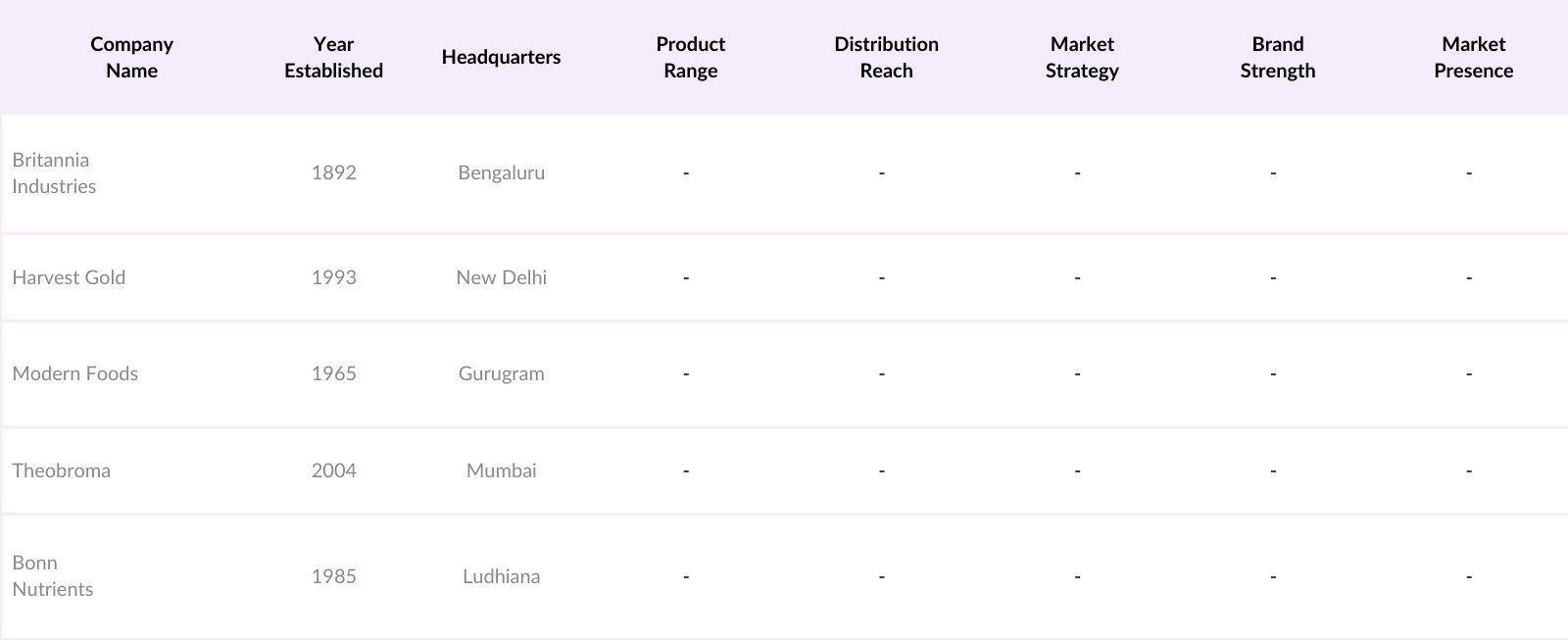
The market is dominated by key players who have established strong distribution networks, innovative product offerings, and brand loyalty.
India Bread Market Analysis
Market Growth Drivers
- Growing Demand from Metropolitan Cities: In 2024, metropolitan cities like Mumbai, Delhi, and Bengaluru are seeing increased demand for baked goods, with bread as a staple. For instance, Mumbai alone witnessed consumption of nearly 230 million loaves in the first half of 2024. This surge is driven by urban lifestyles that emphasize convenience foods, especially among the younger population.
- Rise in Organized Retail Penetration: With more than 22,000 supermarkets and hypermarkets across India in 2024, organized retail is providing greater visibility and accessibility to bread products. Such stores are projected to add nearly 5,000 new outlets by 2025, particularly in Tier 2 and Tier 3 cities, thus driving broader distribution.
- Increased Health-Conscious Consumer Base: In response to health trends, the Indian bread market is seeing increased demand for healthier bread variants. Sales of whole-grain and multigrain bread reached 160 million loaves in 2024. This growth is attributed to a shift towards low-calorie, fiber-rich diets, especially among the working-class population in urban regions.
Market Challenges
- Price Volatility of Key Ingredients: The prices of wheat and other raw materials essential for bread manufacturing experienced a 20% hike in 2024, making production costs volatile. For example, wheat prices in New Delhi hit INR 2,800 per quintal in Q3 2024, impacting manufacturers' profit margins and raising final product costs for consumers.
- High Competition from Unorganized Sector: The unorganized bread sector, with around 80,000 small bakeries operating across India, continues to dominate, presenting a substantial challenge to branded bread companies. These local players have lower overhead costs, allowing them to offer bread at competitive prices.
India Bread Market Future Outlook
Over the next five years, the India Bread industry is expected to experience steady growth, driven by increasing consumer awareness about health benefits associated with various bread types, innovations in bread production, and the shift towards specialty products.
Future Market Opportunities
- Increase in Plant-Based and Vegan Bread Alternatives: Consumer demand for plant-based and vegan foods is projected to expand, with bread manufacturers anticipated to introduce more egg-free and dairy-free options by 2025. This trend aligns with the growing vegan movement in India, especially in metropolitan cities, where plant-based diets are gaining popularity.
- Advancements in Sustainable Packaging Solutions: With environmental consciousness on the rise, bread manufacturers are expected to invest in sustainable packaging. By 2026, nearly half of the industry is likely to adopt recyclable or biodegradable packaging solutions, in line with environmental policies and consumer demand.
Scope of the Report
Product Type | White Bread Brown Bread Multigrain Bread Specialty Breads |
Distribution Channel | Supermarkets/Hypermarkets Online Retail Convenience Stores Bakeries |
Application | Household Foodservice Industry |
Packaging Type | Plastic Wrap Paper Packaging Others |
Region | North India South India East India West India |
Products
Key Target Audience Organizations and Entities Who Can Benefit by Subscribing This Report:
Banks and Financial Institution
Private Equity Firms
Foodservice Industry Professionals
Consumer Goods Companies
Government and Regulatory Bodies (FSSAI)
Investors and Venture Capitalist Firms
Bread Manufacturers and Suppliers
Companies
Players Mentioned in the Report:
Britannia Industries
Harvest Gold
Modern Foods
Theobroma
Bakers Dozen
Bonn Nutrients
ITC Limited
Warburtons India
Parle Products
Anmol Industries
Table of Contents
1. India Bread Market Overview
- 1.1. Definition and Scope
- 1.2. Market Taxonomy
- 1.3. Bread Consumption Patterns
- 1.4. Market Segmentation Overview
2. India Bread Market Size (in USD Bn)
- 2.1. Historical Market Size
- 2.2. Year-On-Year Growth Analysis
- 2.3. Key Market Developments and Milestones
3. India Bread Market Analysis
- 3.1. Growth Drivers
- 3.1.1. Rising Health Consciousness
- 3.1.2. Urbanization and Changing Lifestyles
- 3.1.3. Expansion of Organized Retail
- 3.1.4. Growth of E-commerce
- 3.2. Market Challenges
- 3.2.1. Price Sensitivity
- 3.2.2. Supply Chain Issues
- 3.2.3. Fluctuating Raw Material Prices
- 3.3. Opportunities
- 3.3.1. Niche Product Segmentation (Gluten-free, Vegan)
- 3.3.2. Entry of Multinational Players
- 3.3.3. Strategic Partnerships in E-commerce
- 3.4. Trends
- 3.4.1. Rise of Functional Breads (e.g., High-fiber, Low-carb)
- 3.4.2. Growing Demand for Frozen Breads
- 3.4.3. Popularity of Artisanal and Freshly Baked Options
- 3.5. Government Regulations
- 3.5.1. Food Safety Standards (FSSAI Regulations)
- 3.5.2. Labeling Requirements
- 3.5.3. Subsidies for Small-scale Bakeries
- 3.6. SWOT Analysis
- 3.7. Stakeholder Ecosystem
- 3.8. Porters Five Forces Analysis
- 3.9. Competition Ecosystem
4. India Bread Market Segmentation
- 4.1. By Product Type (in Value %)
- 4.1.1. White Bread
- 4.1.2. Brown Bread
- 4.1.3. Multigrain Bread
- 4.1.4. Specialty Breads (Artisanal, Organic)
- 4.2. By Distribution Channel (in Value %)
- 4.2.1. Supermarkets/Hypermarkets
- 4.2.2. Online Retail
- 4.2.3. Convenience Stores
- 4.2.4. Bakeries
- 4.3. By Application (in Value %)
- 4.3.1. Household
- 4.3.2. Foodservice Industry
- 4.4. By Packaging Type (in Value %)
- 4.4.1. Plastic Wrap
- 4.4.2. Paper Packaging
- 4.4.3. Others (Reusable Packaging)
- 4.5. By Region (in Value %)
- 4.5.1. North India
- 4.5.2. South India
- 4.5.3. East India
- 4.5.4. West India
5. India Bread Market Competitive Analysis
- 5.1. Detailed Profiles of Major Companies
- 5.1.1. Britannia Industries
- 5.1.2. Harvest Gold
- 5.1.3. Modern Foods
- 5.1.4. Theobroma
- 5.1.5. Bakers Dozen
- 5.1.6. Bonn Nutrients
- 5.1.7. ITC Limited
- 5.1.8. Warburtons India
- 5.1.9. Parle Products
- 5.1.10. Anmol Industries
- 5.1.11. Richs India
- 5.1.12. Grain Basket Foods
- 5.1.13. Aaryan Foods
- 5.1.14. Just Bake
- 5.1.15. Poona Bakery
- 5.2. Cross Comparison Parameters (Number of Outlets, Revenue, Product Range, Sustainability Practices, Ingredient Sourcing, Branding Strategy, Growth Rate, Market Reach)
- 5.3. Market Share Analysis
- 5.4. Strategic Initiatives
- 5.5. Mergers and Acquisitions
- 5.6. Investment Analysis
- 5.7. Government Grants and Support
- 5.8. Private Equity Investments
6. India Bread Market Regulatory Framework
- 6.1. Food and Safety Standards
- 6.2. Compliance Requirements
- 6.3. Certification Processes
7. India Bread Market Future Size (in USD Bn)
- 7.1. Future Market Size Projections
- 7.2. Key Factors Driving Future Growth
8. India Bread Market Future Segmentation
- 8.1. By Product Type (in Value %)
- 8.2. By Distribution Channel (in Value %)
- 8.3. By Application (in Value %)
- 8.4. By Packaging Type (in Value %)
- 8.5. By Region (in Value %)
9. India Bread Market Analysts Recommendations
- 9.1. Total Addressable Market (TAM) Analysis
- 9.2. Consumer Cohort Analysis
- 9.3. Suggested Market Positioning Strategies
- 9.4. Unmet Demand and White Space Opportunities
DisclaimerContact Us
Research Methodology
Step 1: Identification of Key Variables
The research begins with mapping major stakeholders in the India Bread Market, incorporating inputs from food manufacturers, retailers, and regulatory bodies. This step focuses on defining variables such as market drivers, customer preferences, and regulatory impacts.Step 2: Market Analysis and Construction
This phase involves analyzing historical data for bread market segments, including revenue generation and consumption patterns. Data is compiled from reliable databases and validated through retailer reports to ensure accuracy.Step 3: Hypothesis Validation and Expert Consultation
To refine the market data, hypotheses are validated through expert interviews, offering insights into bread manufacturing trends, consumer preferences, and operational efficiencies directly from industry professionals.Step 4: Research Synthesis and Final Output
The final phase synthesizes all data points and incorporates input from manufacturers to finalize insights on product performance, segment growth, and consumer trends, ensuring a precise and credible analysis of the India Bread Market.
Frequently Asked Questions
How big is the India Bread Market?
The India Bread Market is valued at USD 57.9 billion, driven by increasing urbanization, changing dietary habits, and the rise of organized retail channels offering a variety of bread options.What are the challenges in the India Bread Market?
Challenges in the India Bread Market include high raw material costs, fluctuations in wheat prices, and intense competition among established brands and local bakeries.Who are the major players in the India Bread Market?
Key players in the India Bread Market include Britannia, Harvest Gold, Modern Foods, and ITC, each dominating with strong distribution networks and extensive product ranges.What drives the India Bread Market's growth?
The India Bread Market is propelled by factors such as urbanization, a shift toward convenience foods, and increasing health awareness driving demand for specialty and whole-wheat breads.
Why Buy From Us?

What makes us stand out is that our consultants follows Robust, Refine and Result (RRR) methodology. i.e. Robust for clear definitions, approaches and sanity checking, Refine for differentiating respondents facts and opinions and Result for presenting data with story

We have set a benchmark in the industry by offering our clients with syndicated and customized market research reports featuring coverage of entire market as well as meticulous research and analyst insights.

While we don't replace traditional research, we flip the method upside down. Our dual approach of Top Bottom & Bottom Top ensures quality deliverable by not just verifying company fundamentals but also looking at the sector and macroeconomic factors.

With one step in the future, our research team constantly tries to show you the bigger picture. We help with some of the tough questions you may encounter along the way: How is the industry positioned? Best marketing channel? KPI's of competitors? By aligning every element, we help maximize success.

Our report gives you instant access to the answers and sources that other companies might choose to hide. We elaborate each steps of research methodology we have used and showcase you the sample size to earn your trust.

If you need any support, we are here! We pride ourselves on universe strength, data quality, and quick, friendly, and professional service.