
India Business Process Management (BPM) Market Outlook to 2030
Region:Asia
Author(s):Shambhavi
Product Code:KROD4815
December 2024
93
About the Report
India BPM Market Overview
- The India Business Process Management (BPM) market is valued at USA 16 Billion, driven primarily by the rapid adoption of digital transformation initiatives across various sectors, including BFSI, healthcare, and IT. The demand for process automation and enhanced workflow management has led companies to invest significantly in BPM solutions. As companies aim to optimize their operational processes, BPM services have emerged as a crucial factor in improving efficiency and reducing operational costs. The growth in digital banking services and e-commerce platforms has further accelerated the adoption of BPM solutions.
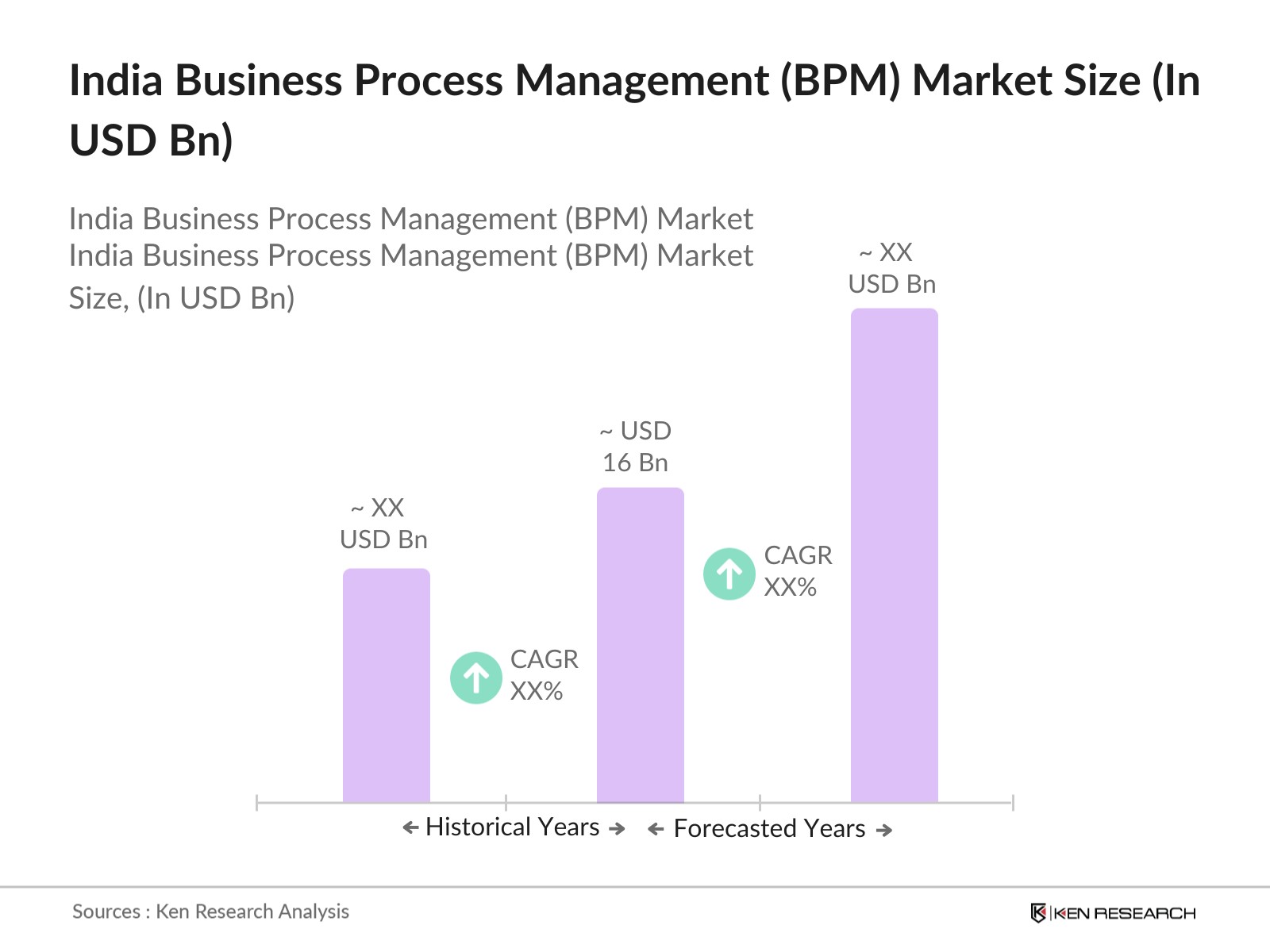
- Bangalore, Mumbai, and Pune are dominant cities in the India BPM market due to their well-established IT infrastructure, a high concentration of skilled professionals, and the presence of numerous global and domestic IT service providers. These cities also have a rich ecosystem of technology hubs, favorable government policies, and a growing number of startups, all of which make them attractive locations for BPM service providers.
- The Indian governments Digital India initiative plays a key role in supporting BPM adoption. The initiative, which has received INR 400 billion in investments as of 2023, focuses on digitalizing government services, infrastructure, and financial inclusion. With over 1 billion mobile connections and widespread broadband access, Indias BPM market is benefiting from improved connectivity and digital literacy. The initiatives focus on public sector digitalization is encouraging private businesses to adopt BPM solutions to keep pace with government reforms.
India BPM Market Segmentation
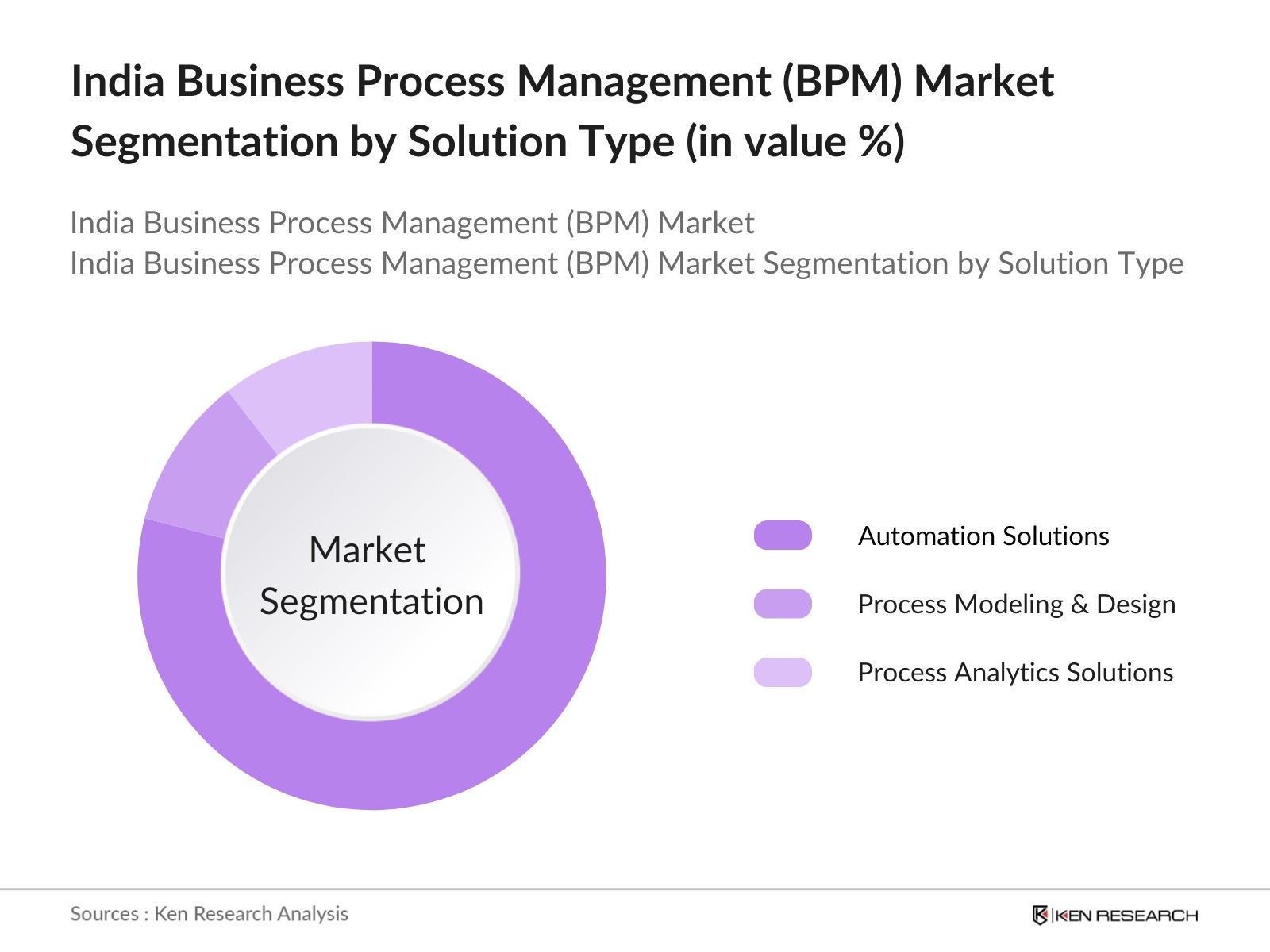
By Solution Type: Indias BPM market is segmented by solution type into Automation Solutions, Process Modeling & Design Solutions, and Process Analytics Solutions. Currently, Automation Solutions hold the dominant market share. This dominance is largely driven by the increasing adoption of robotic process automation (RPA) and artificial intelligence (AI) across sectors. Automation solutions have helped organizations reduce human errors, improve compliance, and enhance productivity, making them essential in highly regulated industries like BFSI and healthcare.
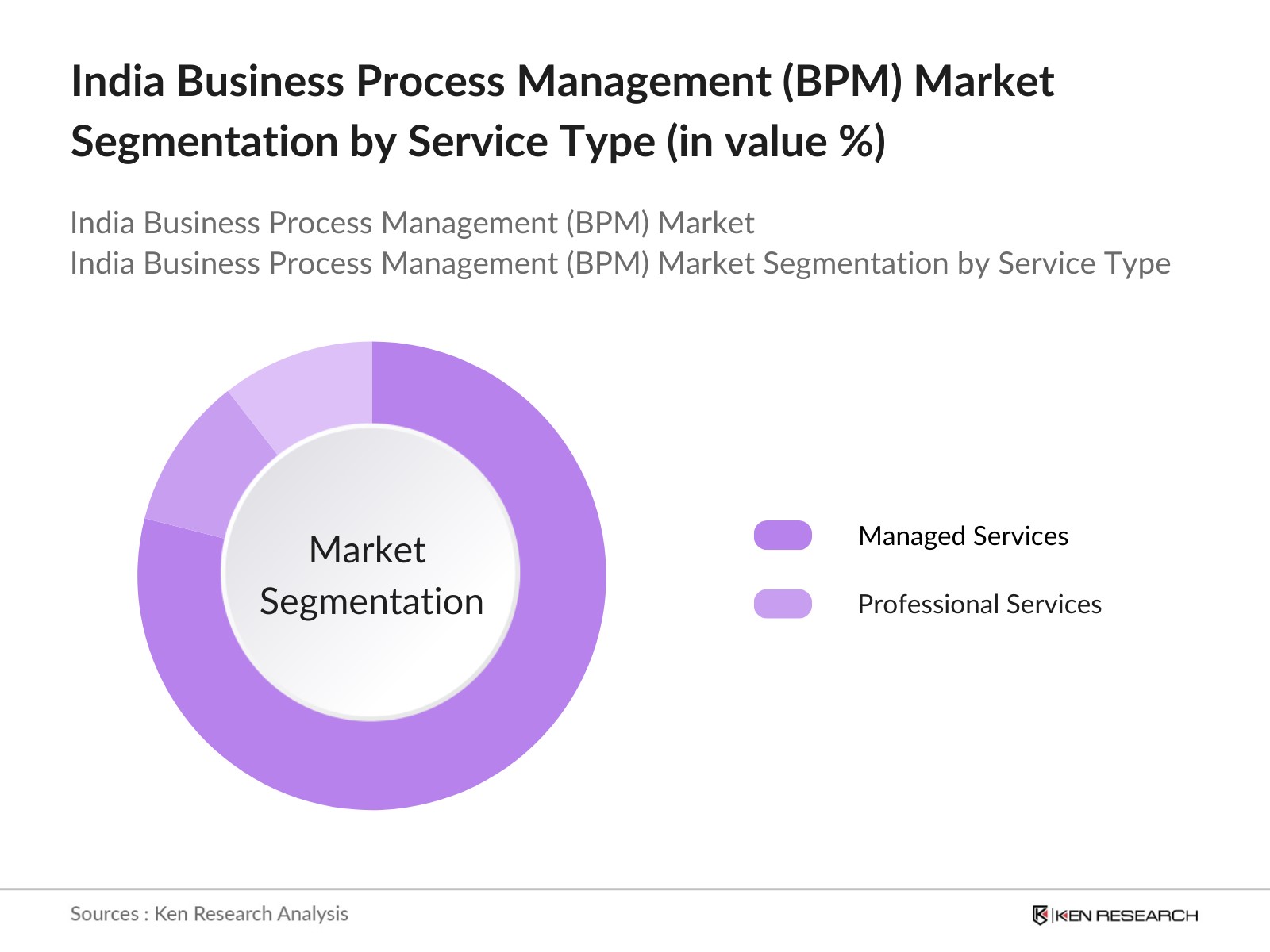
By Service Type: Indias BPM market is also segmented by service type into Managed Services and Professional Services. Managed Services dominate this segmentation due to the increasing reliance of businesses on third-party service providers to manage their BPM operations. The complexity of implementing BPM solutions in-house, coupled with the need for continuous process improvement, has led companies to outsource BPM services to specialized providers. This allows them to focus on their core competencies while improving efficiency and reducing costs.
India BPM Market Competitive Landscape
The India BPM market is dominated by a mix of domestic and global players, offering a range of solutions from traditional process management to advanced automation services. These companies are focused on expanding their service portfolios, adopting new technologies, and forming strategic alliances to maintain a competitive edge in the market.
|
Company Name |
Establishment Year |
Headquarters |
Revenue (INR Bn) |
BPM Solutions Portfolio |
Client Retention Rate |
R&D Investments |
Geographical Presence |
Partnership Networks |
|
Tata Consultancy Services |
1968 |
Mumbai, India |
- |
- |
- |
- |
- |
- |
|
Wipro Ltd. |
1945 |
Bangalore, India |
- |
- |
- |
- |
- |
- |
|
Infosys Ltd. |
1981 |
Bangalore, India |
- |
- |
- |
- |
- |
- |
|
Tech Mahindra |
1986 |
Pune, India |
- |
- |
- |
- |
- |
- |
|
Genpact |
1997 |
New York, USA |
- |
- |
- |
- |
- |
- |
India BPM Industry Analysis
Growth Drivers
- Digital Transformation Initiatives: India's focus on digital transformation is driving the growth of the BPM market. As of 2024, India's Digital India campaign has resulted in over 1.2 billion digital identities (Aadhaar), enabling seamless integration of BPM solutions across industries. The government aims to digitalize key sectors like healthcare and finance, creating increased demand for efficient business processes. Moreover, India ranks 63rd in the World Bank's "Ease of Doing Business" index, which reflects improvements in process efficiency. The growing demand for automation in public and private sectors makes BPM an essential tool for operational optimization.
- Increasing Demand for Process Optimization: The need for process optimization in Indian industries is rapidly growing, especially in sectors like manufacturing, banking, and IT. In 2023, India's manufacturing sector saw a 6.5% increase in production output, driven by better supply chain management and streamlined operations. Process optimization tools like BPM are crucial for improving efficiency and reducing operational bottlenecks. The countrys booming IT sector, which contributes over 8% to the GDP, is also adopting BPM solutions to enhance workflow and customer service processes. The integration of BPM in these sectors ensures enhanced productivity and cost reduction.
- Adoption of Cloud-based BPM Solutions: Cloud-based BPM solutions are becoming increasingly popular in India due to their scalability and flexibility. According to the National Institute of Electronics and Information Technology (NIELIT), cloud adoption in India increased by 30% in 2023, supported by government initiatives like the "MeghRaj" cloud project. The Indian government is investing heavily in cloud infrastructure, which allows enterprises to implement BPM solutions with minimal capital expenditure. Cloud-based BPM reduces the need for on-premise infrastructure, enabling businesses, especially SMEs, to optimize processes remotely and cost-effectively.
Market Challenges
- High Implementation Costs: One of the primary challenges facing the BPM market in India is the high cost of implementation, particularly for small and medium-sized enterprises (SMEs). A 2022 report by the Ministry of Micro, Small & Medium Enterprises (MSME) noted that while larger companies are rapidly adopting BPM solutions, the initial setup cost, which can exceed INR 50 lakhs for comprehensive solutions, is a barrier for smaller firms. Although government incentives for digital transformation exist, more support is needed to make BPM solutions accessible to all businesses, regardless of size.
- Data Security Concerns: Data security is a significant concern for BPM adoption in India, especially given the increasing number of cyberattacks. In 2023, India reported over 1.5 million cybersecurity incidents, as per CERT-In (Indian Computer Emergency Response Team). The rising adoption of cloud-based BPM solutions has intensified concerns regarding data privacy, with industries like finance and healthcare particularly vulnerable. Data localization laws, such as the Personal Data Protection Bill, mandate stricter security protocols, but businesses face challenges in maintaining compliance without inflating operational costs.
India BPM Market Future Outlook
Over the next five years, the India BPM market is poised for significant growth, driven by increasing automation, the rise of AI-powered BPM solutions, and the digitalization of business processes. Companies are expected to focus on integrating AI and machine learning capabilities into BPM platforms, enabling more efficient decision-making processes. Additionally, growing investments in cloud-based BPM services and expanding adoption in emerging sectors like healthcare, logistics, and manufacturing will create new opportunities for market players.
Market Opportunities
- Growing Demand for Workflow Automation: India's demand for workflow automation is accelerating, with businesses seeking efficiency improvements across all sectors. A 2023 report from NASSCOM highlights that automation has led to a 25% reduction in processing times for large enterprises. This trend is gaining traction in industries such as banking, manufacturing, and retail, where automating repetitive tasks significantly improves operational efficiency. India's expanding IT sector, which contributed over $194 billion to the economy in 2023, presents immense opportunities for BPM vendors focusing on automation.
- Expansion into Tier 2 and Tier 3 Cities: The BPM market in India is poised for growth beyond metropolitan hubs, with increasing adoption in Tier 2 and Tier 3 cities. Government programs like "Startup India" and "Digital India" have extended support to smaller cities, promoting the development of IT infrastructure. In 2023, the number of registered startups in Tier 2 and Tier 3 cities rose by 30%, creating a new customer base for BPM solutions. These cities also present opportunities for cost-efficient labor and expanding market reach for BPM service providers.
Scope of the Report
|
Segments |
Sub-Segments |
|
Solution Type |
Automation Solutions Process Modeling & Design Solutions Process Analytics Solutions |
|
Service Type |
Managed Services Professional Services |
|
Deployment Type |
On-Premise Cloud-Based Hybrid |
|
Industry Vertical |
BFSI IT & Telecommunications Healthcare Retail & Consumer Goods Manufacturing |
|
Organization Size |
Large Enterprises SMEs |
Products
Key Target Audience
BFSI Companies
IT and Telecommunication Service Providers
Healthcare Providers
Retail and E-Commerce Companies
Manufacturing Companies
Investor and Venture Capitalist Firms
Government and Regulatory Bodies (e.g., Ministry of Electronics and IT, Reserve Bank of India)
Business Process Outsourcing Companies
Companies
Major Players in the India BPM Market
Tata Consultancy Services (TCS)
Wipro Ltd.
Infosys Ltd.
Tech Mahindra
Genpact
IBM India
Accenture India
Capgemini India
HCL Technologies
Cognizant India
DXC Technology
Oracle India
Pegasystems India
Newgen Software
KPMG India
Table of Contents
1. India BPM Market Overview
1.1. Definition and Scope
1.2. Market Taxonomy
1.3. Market Growth Rate (In Value %)
1.4. Market Segmentation Overview
2. India BPM Market Size (In USD Mn)
2.1. Historical Market Size
2.2. Year-On-Year Growth Analysis
2.3. Key Market Developments and Milestones
3. India BPM Market Analysis
3.1. Growth Drivers
3.1.1. Digital Transformation Initiatives
3.1.2. Increasing Demand for Process Optimization
3.1.3. Adoption of Cloud-based BPM Solutions
3.1.4. Expansion of Automation and AI in BPM
3.2. Market Challenges
3.2.1. High Implementation Costs
3.2.2. Data Security Concerns
3.2.3. Resistance to Change in Traditional Workflows
3.3. Opportunities
3.3.1. Growing Demand for Workflow Automation
3.3.2. Expansion into Tier 2 and Tier 3 Cities
3.3.3. Integration of BPM with AI and Analytics
3.4. Trends
3.4.1. Emergence of Robotic Process Automation (RPA)
3.4.2. Shift Toward Hybrid BPM Solutions
3.4.3. Growth in Cloud-Based BPM Platforms
3.5. Government Regulations
3.5.1. Digital India Initiatives
3.5.2. Compliance with Data Protection Laws
3.5.3. Industry-Specific Regulatory Frameworks (Financial, Healthcare, etc.)
3.6. SWOT Analysis
3.7. Stake Ecosystem
3.8. Porters Five Forces Analysis
3.9. Competition Ecosystem
4. India BPM Market Segmentation
4.1. By Solution Type (In Value %)
4.1.1. Automation Solutions
4.1.2. Process Modeling & Design Solutions
4.1.3. Process Analytics Solutions
4.2. By Service Type (In Value %)
4.2.1. Managed Services
4.2.2. Professional Services
4.3. By Deployment Type (In Value %)
4.3.1. On-Premise
4.3.2. Cloud-Based
4.3.3. Hybrid
4.4. By Industry Vertical (In Value %)
4.4.1. Banking, Financial Services & Insurance (BFSI)
4.4.2. IT & Telecommunications
4.4.3. Healthcare
4.4.4. Retail & Consumer Goods
4.4.5. Manufacturing
4.5. By Organization Size (In Value %)
4.5.1. Large Enterprises
4.5.2. Small & Medium Enterprises (SMEs)
5. India BPM Market Competitive Analysis
5.1. Detailed Profiles of Major Companies
5.1.1. Tata Consultancy Services (TCS)
5.1.2. Wipro Ltd.
5.1.3. Infosys Ltd.
5.1.4. Tech Mahindra
5.1.5. Genpact
5.1.6. IBM India
5.1.7. Accenture India
5.1.8. Capgemini India
5.1.9. HCL Technologies
5.1.10. Cognizant India
5.1.11. DXC Technology
5.1.12. Oracle India
5.1.13. Pegasystems India
5.1.14. Newgen Software
5.1.15. KPMG India
5.2. Cross Comparison Parameters (Revenue, Market Share, Innovation, Customer Base, BPM Solutions Portfolio, Geographical Presence, Client Retention, Partnership Networks)
5.3. Market Share Analysis
5.4. Strategic Initiatives
5.5. Mergers And Acquisitions
5.6. Investment Analysis
5.7. Venture Capital Funding
5.8. Government Grants
5.9. Private Equity Investments
6. India BPM Market Regulatory Framework
6.1. Compliance with IT Act
6.2. Data Security and Privacy Laws (e.g., Data Localization)
6.3. Certification Processes (ISO Standards for BPM)
7. India BPM Market Analysts Recommendations
7.1. TAM/SAM/SOM Analysis
7.2. Customer Cohort Analysis
7.3. Marketing Initiatives
7.4. White Space Opportunity Analysis
Research Methodology
Step 1: Identification of Key Variables
The research process begins with identifying and mapping the critical variables that influence the India BPM market. This involves analyzing stakeholder roles, from BPM solution providers to end-users. Data from proprietary databases and secondary sources are used to define these variables.
Step 2: Market Analysis and Construction
This phase includes a deep analysis of historical BPM market data to assess key trends, growth drivers, and challenges. A thorough evaluation of technology adoption and market penetration helps create a robust model of the current BPM landscape.
Step 3: Hypothesis Validation and Expert Consultation
Insights from industry experts are used to validate our hypotheses through interviews and consultations. This step ensures the accuracy of our analysis and helps refine market insights for revenue generation and strategic recommendations.
Step 4: Research Synthesis and Final Output
All data and insights are synthesized to form a comprehensive report. Additional inputs from leading BPM providers help enhance the credibility of our final analysis, ensuring that the report offers actionable insights for industry stakeholders.
Frequently Asked Questions
01. How big is the India BPM Market?
The India BPM market is valued at USA 245 Billion, driven by digital transformation efforts and the need for process optimization across various sectors such as BFSI, healthcare, and IT.
02. What are the challenges in the India BPM Market?
Key challenges include high implementation costs, data security concerns, and resistance to the adoption of automated workflows, especially in sectors where traditional processes dominate.
03. Who are the major players in the India BPM Market?
Major players in the market include Tata Consultancy Services, Wipro Ltd., Infosys Ltd., Tech Mahindra, and Genpact, each leveraging their comprehensive portfolios to dominate the market.
04. What are the growth drivers of the India BPM Market?
Growth is driven by the increasing demand for automation solutions, digital transformation initiatives, and the integration of AI and machine learning technologies in BPM solutions.
05. Which cities dominate the India BPM Market?
Bangalore, Mumbai, and Pune dominate the BPM market due to their robust IT infrastructure, skilled labor force, and government policies that favor technology-driven growth.
Why Buy From Us?

What makes us stand out is that our consultants follows Robust, Refine and Result (RRR) methodology. i.e. Robust for clear definitions, approaches and sanity checking, Refine for differentiating respondents facts and opinions and Result for presenting data with story

We have set a benchmark in the industry by offering our clients with syndicated and customized market research reports featuring coverage of entire market as well as meticulous research and analyst insights.

While we don't replace traditional research, we flip the method upside down. Our dual approach of Top Bottom & Bottom Top ensures quality deliverable by not just verifying company fundamentals but also looking at the sector and macroeconomic factors.

With one step in the future, our research team constantly tries to show you the bigger picture. We help with some of the tough questions you may encounter along the way: How is the industry positioned? Best marketing channel? KPI's of competitors? By aligning every element, we help maximize success.

Our report gives you instant access to the answers and sources that other companies might choose to hide. We elaborate each steps of research methodology we have used and showcase you the sample size to earn your trust.

If you need any support, we are here! We pride ourselves on universe strength, data quality, and quick, friendly, and professional service.