
India Contact Lens Market Outlook to 2030
Region:India
Author(s):Shambhavi
Product Code:KROD2631
Region:India
Author(s):Shambhavi
Product Code:KROD2631
December 2024
87

By Product Type: The India Contact Lens market is segmented by product type into Soft Contact Lenses, Rigid Gas Permeable (RGP) Lenses, Hybrid Contact Lenses, and Scleral Lenses. Soft contact lenses dominate the market due to their comfort, flexibility, and widespread usage for correcting common vision problems such as myopia, hyperopia, and astigmatism. Soft lenses are preferred by a large segment of the population due to their ease of use and adaptability for various conditions. Major manufacturers such as Johnson & Johnson Vision Care and Bausch + Lomb focus heavily on this category, increasing their market penetration through innovative daily disposable lenses and extended-wear options.

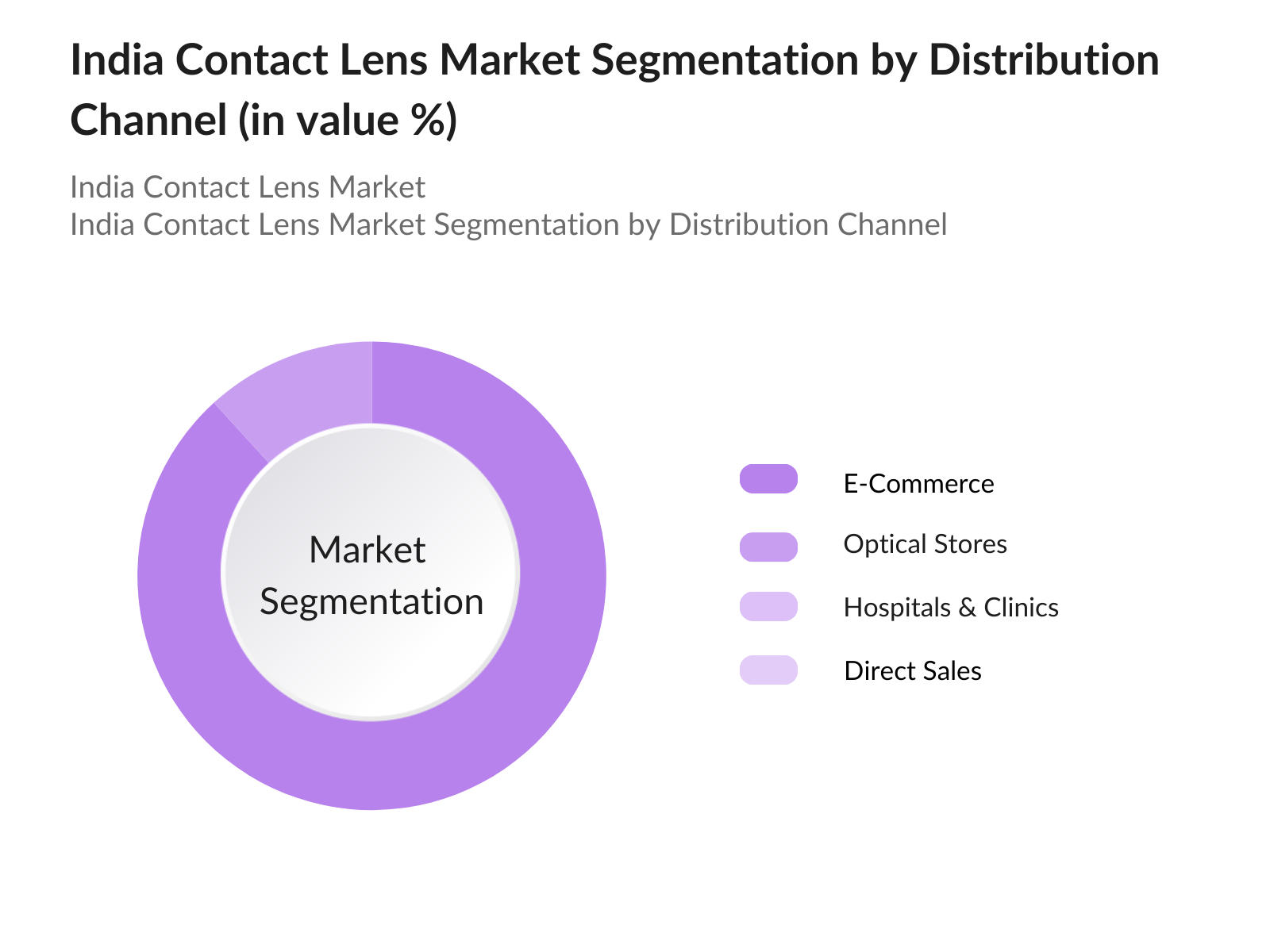
By Distribution Channel: The market is segmented by distribution channels into E-Commerce, Optical Stores, Hospitals & Clinics, and Direct Sales. E-commerce has emerged as the dominant distribution channel due to the convenience it offers, especially in a post-pandemic world where online shopping has seen a significant surge. The ease of access to a variety of brands, combined with discounts and home delivery services, has made online platforms such as Lenskart the preferred choice for many consumers. Additionally, subscription services for regular delivery of disposable lenses have further boosted the share of this segment.
The India Contact Lens market is concentrated among a few key players, with global giants and local manufacturers competing for dominance. Major brands such as Johnson & Johnson Vision Care, Alcon, and CooperVision are leaders due to their advanced research and development, strong marketing strategies, and extensive distribution networks. Local companies such as Titan Eye+ have carved a niche by catering to the Indian market with customized offerings and affordability.
|
Company Name |
Establishment Year |
Headquarters |
Product Portfolio |
R&D Investment |
Regional Presence |
Distribution Network |
Key Brands |
Market Position |
Strategic Initiatives |
|
Johnson & Johnson Vision Care |
1959 |
New Brunswick, USA |
|||||||
|
Alcon (Novartis) |
1945 |
Geneva, Switzerland |
|||||||
|
CooperVision |
1980 |
Pleasanton, USA |
|||||||
|
Bausch + Lomb |
1853 |
Rochester, USA |
|||||||
|
Titan Eye+ |
2007 |
Bengaluru, India |
Over the next five years, the India Contact Lens market is expected to experience steady growth, driven by increasing consumer awareness of eye health, advances in lens technology, and the growing preference for aesthetically pleasing and convenient alternatives to eyeglasses. Government support for healthcare and the expansion of optical healthcare services into rural areas are also likely to play a significant role in the market's growth trajectory. Additionally, the development of innovative products like UV-protective lenses and lenses for specific eye conditions will further enhance market demand.
1.1. Definition and Scope
1.2. Market Taxonomy
1.3. Market Growth Rate
1.4. Market Segmentation Overview
2.1. Historical Market Size
2.2. Year-On-Year Growth Analysis
2.3. Key Market Developments and Milestones
3.1. Growth Drivers
3.1.1. Rising Prevalence of Myopia and Astigmatism
3.1.2. Increasing Disposable Income and Urbanization
3.1.3. Growing E-commerce and Subscription-based Models
3.2. Market Challenges
3.2.1. High Cost of Premium Lenses
3.2.2. Regulatory and Safety Concerns
3.2.3. Low Adoption in Rural Areas
3.3. Opportunities
3.3.1. Expansion into Tier-2 and Tier-3 Cities
3.3.2. Advancements in Lens Technology (UV Protection, Smart Lenses)
3.3.3. Growth of Customized and Cosmetic Lenses
3.4. Trends
3.4.1. Preference for Daily Disposable Lenses
3.4.2. Increasing Demand for Multifocal and Astigmatism Lenses
3.4.3. Rising Adoption of Sustainable and Biodegradable Contact Lenses
3.5. Government Regulations
3.5.1. Quality and Safety Standards for Contact Lenses
3.5.2. Consumer Protection Laws for E-commerce Sales
3.5.3. Environmental and Packaging Waste Reduction Policies
3.6. SWOT Analysis
3.7. Stakeholder Ecosystem
3.8. Porter’s Five Forces Analysis
3.9. Competitive Landscape
4.1. By Product Type (Market Share in %)
4.1.1. Soft Contact Lenses
4.1.2. Rigid Gas Permeable (RGP) Lenses
4.1.3. Hybrid Contact Lenses
4.1.4. Scleral Lenses
4.2. By Distribution Channel (Market Share in %)
4.2.1. E-Commerce
4.2.2. Optical Stores
4.2.3. Hospitals & Clinics
4.2.4. Direct Sales
5.1. Detailed Profiles of Major Companies
5.1.1. Johnson & Johnson Vision Care
5.1.2. Alcon (Novartis)
5.1.3. CooperVision
5.1.4. Bausch + Lomb
5.1.5. Titan Eye+
5.2. Cross Comparison Parameters (Product Portfolio, R&D Investments, Regional Presence, Distribution Network, Market Position, Strategic Initiatives)
5.3. Market Share Analysis
5.4. Strategic Initiatives
5.5. Mergers and Acquisitions
5.6. Investment Analysis
5.7. Government Regulations and Compliance
5.8. Private Equity Investments
6.1. Compliance Requirements and Safety Standards
6.2. Certification Processes and Quality Control Measures
6.3. Packaging Waste and Environmental Policies
7.1. Future Market Size Projections
7.2. Key Factors Driving Future Market Growth
8.1. By Product Type
8.2. By Distribution Channel
8.3. By End-User
8.4. By Region
9.1. Total Addressable Market (TAM), Serviceable Available Market (SAM), and Serviceable Obtainable Market (SOM) Analysis
9.2. Consumer Cohort Analysis
9.3. Marketing Initiatives and Distribution Strategies
9.4. White Space Opportunity Analysis
DisclaimerThe initial phase involves mapping the contact lens market ecosystem, identifying all major stakeholders including manufacturers, distributors, and healthcare providers. Secondary research using reliable databases is conducted to gather industry-specific information and define the market's critical variables.
In this phase, historical data on market size, revenue generation, and product distribution is compiled. The penetration of different contact lens types and their performance is analyzed to ensure accurate market estimates.
Consultations with industry experts are conducted to validate research findings. These include interviews with key executives and optometrists to obtain insights on product trends, consumer preferences, and technological advancements.
The final phase involves direct consultations with contact lens manufacturers to gather data on product performance and customer feedback, ensuring a well-rounded analysis. The synthesis of this data provides the foundation for the report's conclusions.
The India Contact Lens market was valued at USD 165 million. Its growth is driven by increasing demand for corrective vision solutions, rising disposable incomes, and greater consumer awareness regarding eye health.
Challenges include high costs associated with premium contact lenses, lack of awareness in rural areas, and competition from affordable eyeglasses. Additionally, the need for regular maintenance and the higher price of daily disposable lenses poses challenges for widespread adoption.
Key players in the India Contact Lens market include Johnson & Johnson Vision Care, Alcon, CooperVision, Titan Eye+, and Bausch + Lomb. These companies lead the market through extensive distribution networks, innovative product offerings, and strategic partnerships.
Growth drivers include increasing urbanization, rising income levels, and the expanding middle-class population. The growing demand for cosmetic lenses and the convenience offered by disposable lenses further boost the market.

What makes us stand out is that our consultants follows Robust, Refine and Result (RRR) methodology. i.e. Robust for clear definitions, approaches and sanity checking, Refine for differentiating respondents facts and opinions and Result for presenting data with story

We have set a benchmark in the industry by offering our clients with syndicated and customized market research reports featuring coverage of entire market as well as meticulous research and analyst insights.

While we don't replace traditional research, we flip the method upside down. Our dual approach of Top Bottom & Bottom Top ensures quality deliverable by not just verifying company fundamentals but also looking at the sector and macroeconomic factors.

With one step in the future, our research team constantly tries to show you the bigger picture. We help with some of the tough questions you may encounter along the way: How is the industry positioned? Best marketing channel? KPI's of competitors? By aligning every element, we help maximize success.

Our report gives you instant access to the answers and sources that other companies might choose to hide. We elaborate each steps of research methodology we have used and showcase you the sample size to earn your trust.

If you need any support, we are here! We pride ourselves on universe strength, data quality, and quick, friendly, and professional service.