
India Diaper Market Outlook to 2030
Region:India
Author(s):Sanjeev
Product Code:KROD10406
Region:India
Author(s):Sanjeev
Product Code:KROD10406
November 2024
93
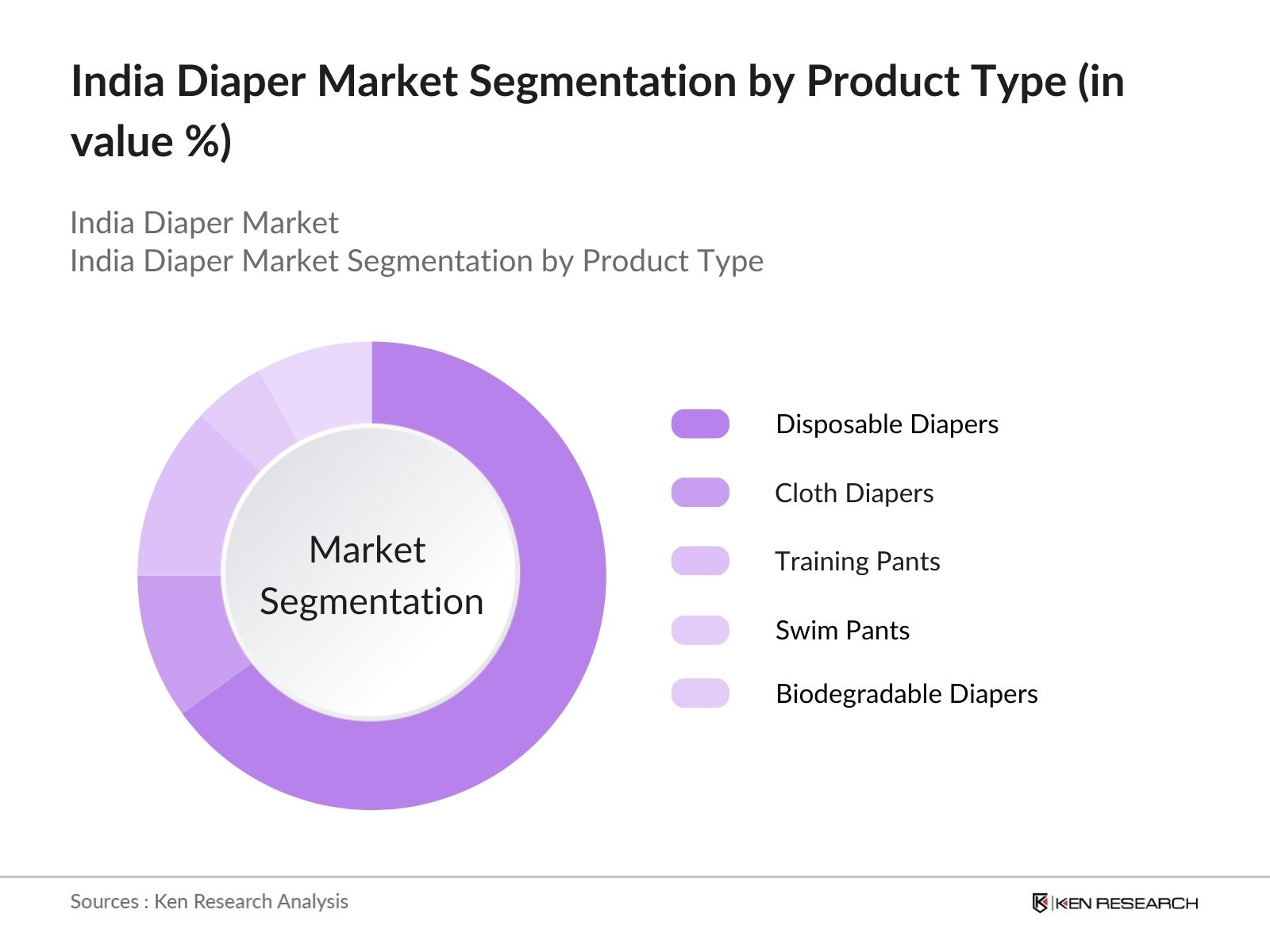
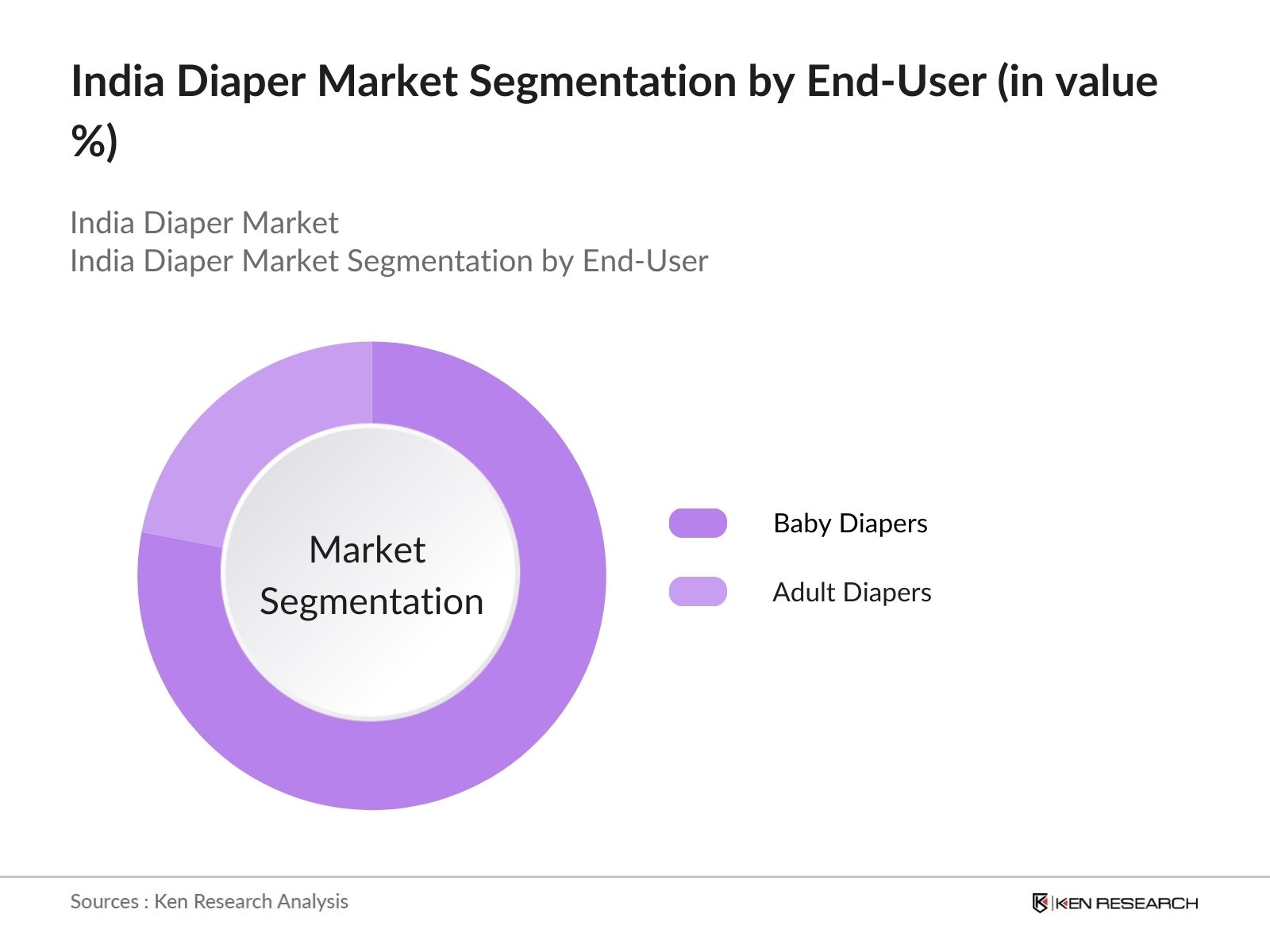
The India diaper market is segmented by product type and by end-user.
The India diaper market is dominated by both global and domestic players. The top five players control a significant portion of the market, with established brand names and extensive distribution networks across the country. These companies are not only competitive in terms of pricing but are also constantly innovating with new product lines, focusing on premium, eco-friendly, and skin-sensitive variants to meet diverse consumer demands. The consolidation of major players such as Procter & Gamble (Pampers) and Kimberly-Clark (Huggies) showcases their market influence through large-scale distribution and brand loyalty, bolstered by continuous product innovation.
|
Company Name |
Establishment Year |
Headquarters |
Revenue (INR Mn) |
Product Range |
Distribution Reach |
Marketing Spend |
Sustainability Initiatives |
R&D Investment |
Customer Retention Rate |
|
Procter & Gamble Co. |
1837 |
Cincinnati, USA |
|||||||
|
Kimberly-Clark Corporation |
1872 |
Texas, USA |
|||||||
|
Unicharm Corporation |
1961 |
Tokyo, Japan |
|||||||
|
Nobel Hygiene Pvt Ltd |
2000 |
Mumbai, India |
|||||||
|
The Himalaya Drug Company |
1930 |
Bengaluru, India |
Growth Drivers
Market Challenges
Over the next five years, the India diaper market is expected to witness considerable growth, driven by increasing urbanization, rising disposable incomes, and a growing awareness of hygiene practices across both baby and adult diaper segments. With an expanding elderly population, the demand for adult diapers is also expected to rise, creating a new avenue for growth. Additionally, advancements in eco-friendly diaper technologies and biodegradable products are likely to cater to the rising demand for sustainable and environmentally conscious products, enhancing market expansion.
Market Opportunities
|
|||
|
By End-User |
Baby Diapers Adult Diapers |
||
|
By Distribution Channel |
Supermarkets/Hypermarkets Online Retailers Specialty Stores Pharmacies/Drugstores |
||
|
By Absorbency Level |
High Absorbency Standard Absorbency |
||
|
By Region |
North East West South |
1.1. Definition and Scope
1.2. Market Taxonomy
1.3. Market Growth Rate (Market Penetration Rate, Urbanization Impact, Birth Rate Dynamics)
1.4. Market Segmentation Overview
2.1. Historical Market Size
2.2. Year-On-Year Growth Analysis (Y-o-Y Consumption Increase, Regional Demand Variation, Price Trends)
2.3. Key Market Developments and Milestones (Entry of International Players, Government Initiatives, Private Sector Engagement)
3.1. Growth Drivers
3.1.1. Rising Urbanization
3.1.2. Increased Disposable Income
3.1.3. Changing Consumer Preferences
3.1.4. Growing Awareness on Hygiene (Child and Adult Diapers)
3.2. Market Challenges
3.2.1. Environmental Impact and Sustainability Concerns
3.2.2. Pricing Pressure on Domestic Brands
3.2.3. Distribution Channel Constraints in Rural Areas
3.2.4. Competition from Traditional Methods (Cloth Diapers)
3.3. Opportunities
3.3.1. Expansion in Tier II & III Cities
3.3.2. Technological Innovations (Biodegradable Diapers, Smart Diapers)
3.3.3. Growth in the Adult Diaper Segment
3.3.4. E-commerce Penetration
3.4. Trends
3.4.1. Shift to Eco-Friendly Diapers
3.4.2. Increase in Subscription-Based Models
3.4.3. Adoption of Premium and Niche Products (Organic Diapers, Diapers for Sensitive Skin)
3.5. Government Regulations
3.5.1. Plastic Ban Regulations (Impact on Disposable Diapers)
3.5.2. Import Tariffs on Diaper Products
3.5.3. Subsidies for Domestic Manufacturers (Incentives for Eco-Friendly Products)
3.6. SWOT Analysis
3.7. Stakeholder Ecosystem (Retailers, Manufacturers, Distributors, NGOs)
3.8. Porters Five Forces
3.9. Competition Ecosystem
4.1. By Product Type (In Value %)
4.1.1. Disposable Diapers
4.1.2. Cloth Diapers
4.1.3. Training Pants
4.1.4. Swim Pants
4.1.5. Biodegradable Diapers
4.2. By End-User (In Value %)
4.2.1. Baby Diapers
4.2.2. Adult Diapers
4.3. By Distribution Channel (In Value %)
4.3.1. Supermarkets/Hypermarkets
4.3.2. Online Retailers
4.3.3. Specialty Stores
4.3.4. Pharmacies/Drugstores
4.4. By Absorbency Level (In Value %)
4.4.1. High Absorbency
4.4.2. Standard Absorbency
4.5. By Region (In Value %)
4.5.1. North India
4.5.2. South India
4.5.3. East India
4.5.4. West India
5.1. Detailed Profiles of Major Companies
5.1.1. Procter & Gamble Co. (Pampers)
5.1.2. Kimberly-Clark Corporation (Huggies)
5.1.3. Unicharm Corporation (MamyPoko)
5.1.4. Johnson & Johnson (Johnsons Baby)
5.1.5. Nobel Hygiene Pvt Ltd (Teddy, Friends)
5.1.6. The Himalaya Drug Company
5.1.7. Me N Moms Pvt Ltd (MeeMee)
5.1.8. FirstCry
5.1.9. Patanjali Ayurved (Patanjali Diapers)
5.1.10. Bella India Healthcare (Bella Baby Happy)
5.1.11. Wipro Enterprises (Wipro Baby Soft)
5.1.12. Domtar Corporation (Attends)
5.1.13. Svenska Cellulosa Aktiebolaget (SCA)
5.1.14. Essity (Tena)
5.1.15. Drylock Technologies
5.2. Cross Comparison Parameters (Market Share, Annual Revenue, Product Range, Distribution Reach, Environmental Initiatives, R&D Investment, Marketing Spend, Customer Retention Rate)
5.3. Market Share Analysis (Key Players, Local vs Global Brands)
5.4. Strategic Initiatives (Product Launches, Expansion Plans, Partnerships)
5.5. Mergers and Acquisitions
5.6. Investment Analysis
5.7. Venture Capital Funding
5.8. Government Grants
5.9. Private Equity Investments
6.1. Environmental Standards
6.2. Compliance Requirements (Labeling, Safety Standards)
6.3. Certification Processes (Eco-Friendly Certifications, Health & Hygiene Certifications)
7.1. Future Market Size Projections
7.2. Key Factors Driving Future Market Growth
8.1. By Product Type (In Value %)
8.2. By End-User (In Value %)
8.3. By Distribution Channel (In Value %)
8.4. By Absorbency Level (In Value %)
8.5. By Region (In Value %)
9.1. TAM/SAM/SOM Analysis
9.2. Customer Cohort Analysis
9.3. Marketing Initiatives
9.4. White Space Opportunity Analysis
The research begins with mapping the ecosystem of the India Diaper Market, focusing on primary stakeholders such as manufacturers, distributors, and retailers. Desk research involves reviewing proprietary databases, industry reports, and trade publications to identify the main variables influencing market growth, such as consumer preferences and distribution channel developments.
In this phase, historical market data is analyzed to assess trends in diaper usage, pricing, and geographical distribution. Additionally, we evaluate the performance of both global and local brands to gauge market competition and profitability.
To validate market hypotheses, industry experts are consulted through CATI interviews, providing first-hand insights into manufacturing processes, distribution strategies, and consumer preferences. These expert opinions are crucial for confirming the findings and making market predictions.
The final stage involves combining data from multiple sources, including direct interviews with key manufacturers. This step ensures a comprehensive understanding of product segments, market challenges, and future opportunities. The findings are synthesized to provide an accurate and validated analysis of the India Diaper Market.
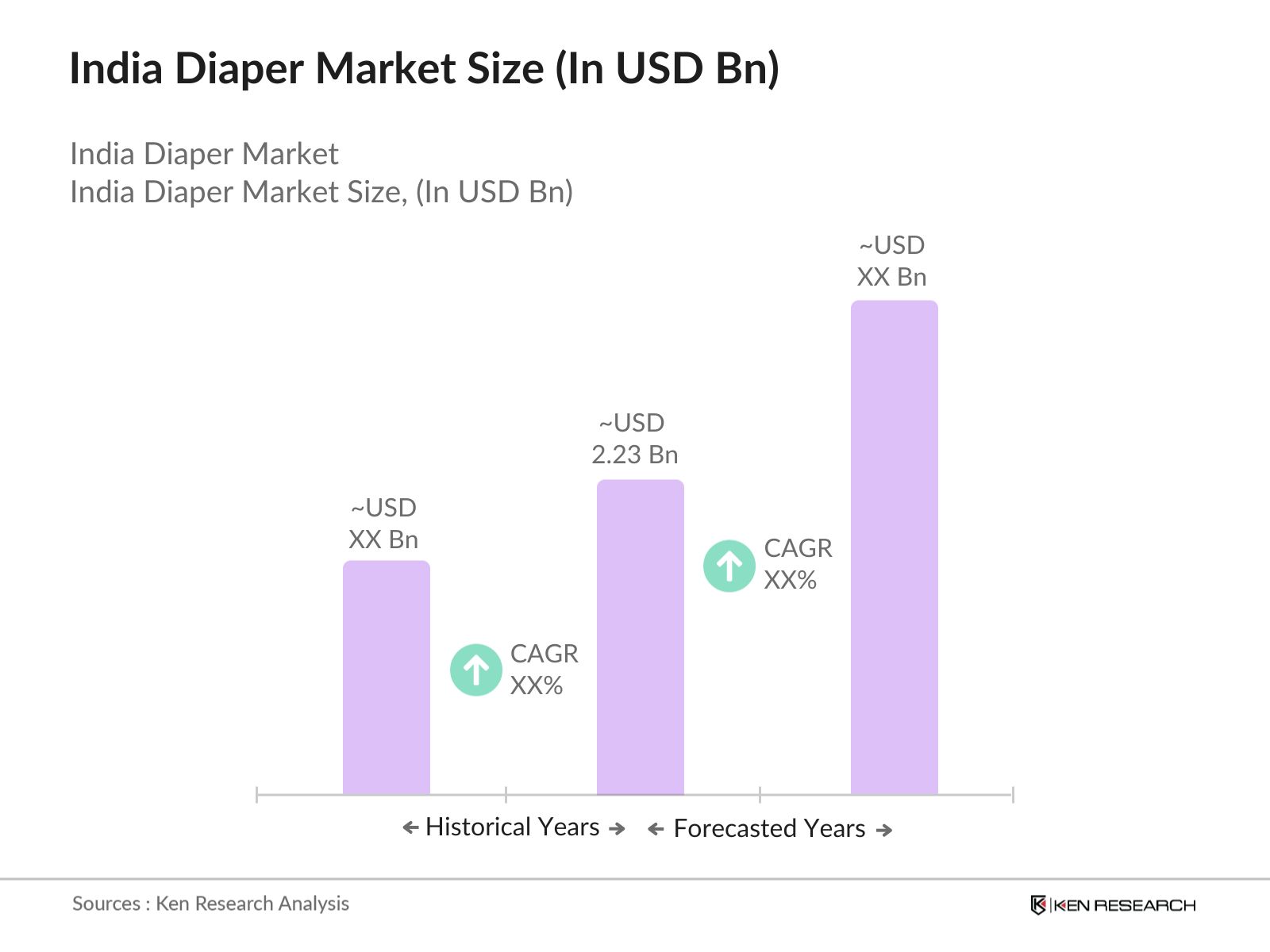
The India diaper market is valued at INR 1.6 billion, driven by rising birth rates, increasing awareness of hygiene, and a growing preference for disposable diapers among urban families.
Challenges in the India diaper market include environmental concerns due to the use of plastic in disposable diapers, pricing competition from local brands, and logistical hurdles in reaching rural areas.
Key players in India diaper market include Procter & Gamble (Pampers), Kimberly-Clark (Huggies), Unicharm (MamyPoko), Nobel Hygiene (Teddy, Friends), and The Himalaya Drug Company.
The India diaper market is driven by increasing disposable income, urbanization, and growing awareness about the importance of hygiene for infants and elderly populations, which is pushing demand for both baby and adult diapers.
Sustainability is becoming a key focus, with consumers increasingly seeking biodegradable and eco-friendly diaper options. Brands are responding by investing in R&D to produce more environmentally conscious products.

What makes us stand out is that our consultants follows Robust, Refine and Result (RRR) methodology. i.e. Robust for clear definitions, approaches and sanity checking, Refine for differentiating respondents facts and opinions and Result for presenting data with story

We have set a benchmark in the industry by offering our clients with syndicated and customized market research reports featuring coverage of entire market as well as meticulous research and analyst insights.

While we don't replace traditional research, we flip the method upside down. Our dual approach of Top Bottom & Bottom Top ensures quality deliverable by not just verifying company fundamentals but also looking at the sector and macroeconomic factors.

With one step in the future, our research team constantly tries to show you the bigger picture. We help with some of the tough questions you may encounter along the way: How is the industry positioned? Best marketing channel? KPI's of competitors? By aligning every element, we help maximize success.

Our report gives you instant access to the answers and sources that other companies might choose to hide. We elaborate each steps of research methodology we have used and showcase you the sample size to earn your trust.

If you need any support, we are here! We pride ourselves on universe strength, data quality, and quick, friendly, and professional service.