
India E-Commerce Market Outlook to 2030
Region:India
Author(s):Yogita Sahu
Product Code:KROD10066
Region:India
Author(s):Yogita Sahu
Product Code:KROD10066
December 2024
89
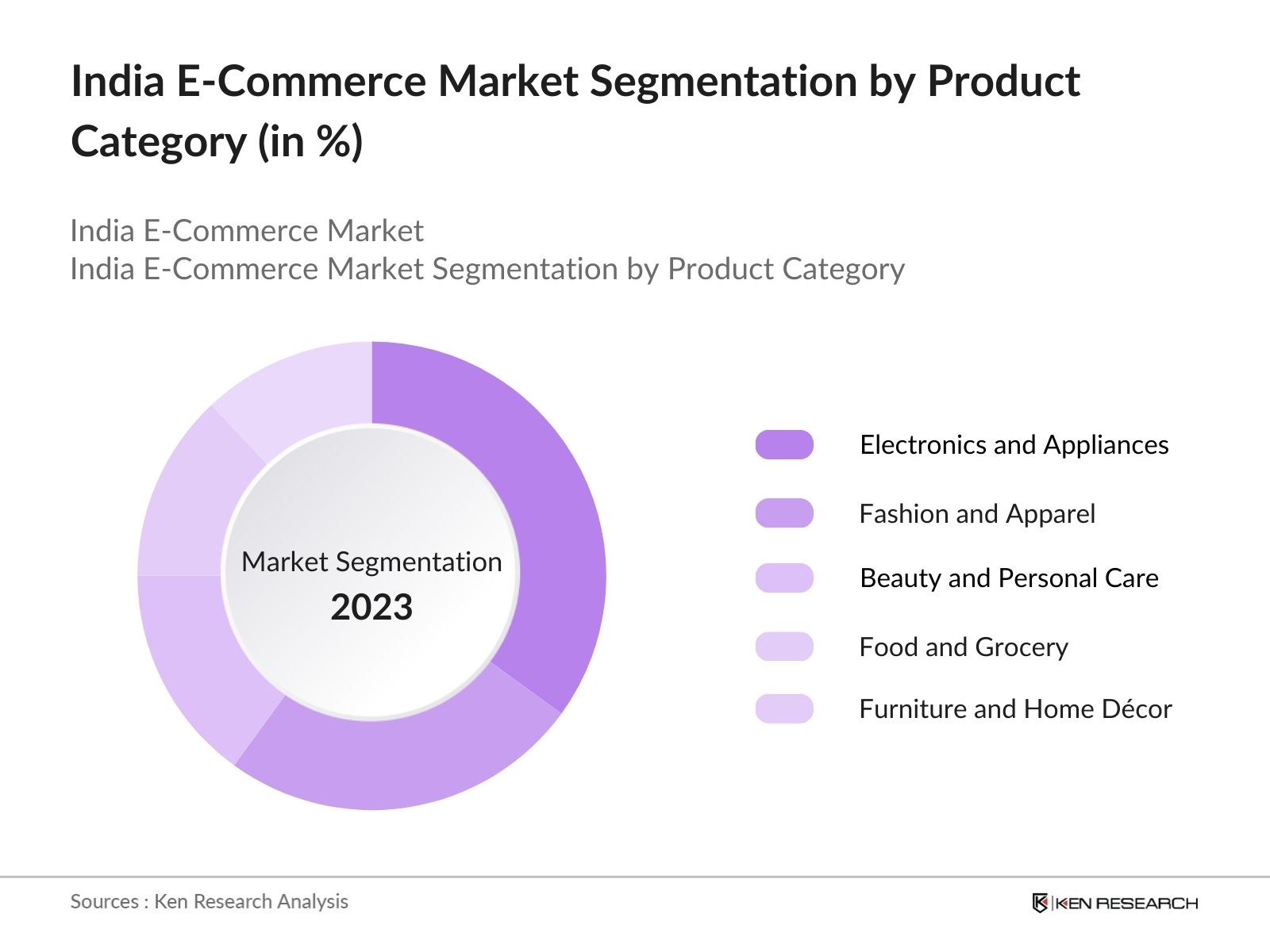
By Product Category: The market is segmented into Electronics and Appliances, Fashion and Apparel, Beauty and Personal Care, Food and Grocery, and Furniture and Home Dcor. Among these, Electronics and Appliances holds the dominant share, driven by consumer demand for smartphones, laptops, and home appliances. The increasing trend of consumers comparing products and prices online, coupled with substantial discounts during festive sales, has fueled this segment's growth.
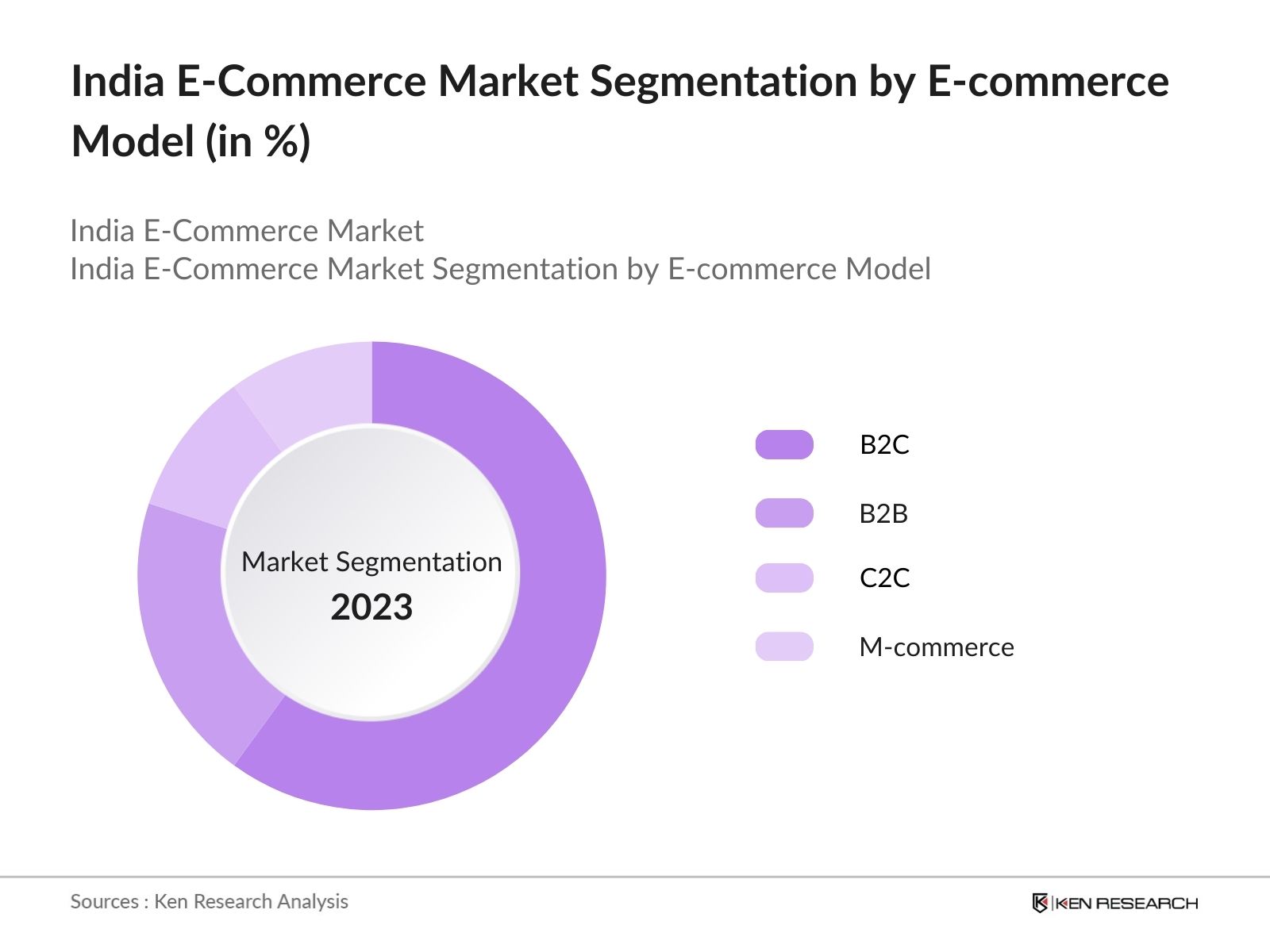
By E-commerce Model: The E-commerce model is divided into Business-to-Consumer (B2C), Business-to-Business (B2B), Consumer-to-Consumer (C2C), and Mobile Commerce (M-commerce). The B2C segment dominates, primarily due to the growth of platforms like Amazon and Flipkart. The B2C models dominance stems from its ability to reach a wide audience, offering varied product choices, and ensuring ease of transactions.
The market is highly competitive, with key players like Amazon, Flipkart, Nykaa, and BigBasket leading the charge. These companies dominate through their extensive product offerings, competitive pricing, strong logistics networks, and innovative customer engagement strategies.
|
Company |
Establishment Year |
Headquarters |
Logistics Network |
Product Range |
Customer Base |
Revenue |
Technology Adoption |
Strategic Initiatives |
|
Amazon |
1994 |
Seattle, USA |
||||||
|
Flipkart |
2007 |
Bangalore, India |
||||||
|
Nykaa |
2012 |
Mumbai, India |
||||||
|
BigBasket |
2011 |
Bangalore, India |
||||||
|
Meesho |
2015 |
Bangalore, India |
Over the next five years, the Indian E-commerce industry is expected to witness robust growth due to continued internet penetration, the rise of digital payments, and government support for small businesses entering the online space.
|
Product Category |
Electronics Fashion Beauty Food Furniture |
|
Transaction Mode |
Cash Cards Digital Wallets Bank Transfer |
|
E-commerce Model |
B2C B2B C2C M-commerce |
|
Region |
North India South India East India West India |
|
Consumer Segment |
Urban Semi-Urban Rural |
1.1 Definition and Scope
1.2 Market Taxonomy
1.3 Market Growth Rate
1.4 Market Segmentation Overview
2.1 Historical Market Size
2.2 Year-On-Year Growth Analysis
2.3 Key Market Developments and Milestones
3.1 Growth Drivers
Internet Penetration and Smartphone Adoption
Government Initiatives (Atmanirbhar Bharat, ONDC)
Rising Consumer Awareness and Digital Literacy
Expanding Rural and Tier 2/3 Markets
3.2 Market Challenges
High Rate of Product Returns (B2C)
Regulatory Complexities
Logistical Barriers (Geographical Disparities)
Cybersecurity Threats
3.3 Opportunities
Expansion of Quick Commerce
Hyper-local Deliveries
Innovations in Payment Systems (UPI Growth)
Cross-border E-Commerce Growth
3.4 Trends
Rise of Personalization through AI/ML
Omnichannel Retail Integration
Growth in Fashion and Beauty E-Commerce
Increasing Adoption of AR/VR in Online Shopping
3.5 Government Regulation
Government e-Marketplace (GeM) Expansion
Data Privacy Laws and Consumer Protection
Simplification of E-commerce Norms
MSME Inclusion Initiatives
3.6 SWOT Analysis
3.7 Stake Ecosystem
3.8 Porters Five Forces
3.9 Competition Ecosystem
4.1 By Product Category (In Value %)
4.1.1 Electronics and Appliances
4.1.2 Fashion and Apparel
4.1.3 Beauty and Personal Care
4.1.4 Food and Grocery
4.1.5 Furniture and Home Dcor
4.2 By Transaction Mode (In Value %)
4.2.1 Cash
4.2.2 Cards
4.2.3 Digital Wallets
4.2.4 Bank Transfer
4.3 By E-commerce Model (In Value %)
4.3.1 Business to Consumer (B2C)
4.3.2 Business to Business (B2B)
4.3.3 Consumer to Consumer (C2C)
4.3.4 Mobile Commerce (M-Commerce)
4.4 By Region (In Value %)
4.4.1 North India
4.4.2 South India
4.4.3 East India
4.4.4 West India
4.5 By Consumer Segment (In Value %)
4.5.1 Urban
4.5.2 Semi-urban
4.5.3 Rural
5.1 Detailed Profiles of Major Companies
5.1.1 Amazon India
5.1.2 Flipkart
5.1.3 Nykaa
5.1.4 Paytm Mall
5.1.5 Snapdeal
5.1.6 Ajio
5.1.7 Meesho
5.1.8 BigBasket
5.1.9 Myntra
5.1.10 Pepperfry
5.1.11 Lenskart
5.1.12 FirstCry
5.1.13 Grofers
5.1.14 Tata Cliq
5.1.15 Zomato
5.2 Cross Comparison Parameters (Revenue, Market Share, Logistics Infrastructure, Consumer Reach, Technology Adoption, Product Offerings, Strategic Initiatives, Investment)
5.3 Market Share Analysis
5.4 Strategic Initiatives
5.5 Mergers and Acquisitions
5.6 Investment Analysis
5.7 Venture Capital Funding
5.8 Government Grants
5.9 Private Equity Investments
6.1 Data Privacy Regulations
6.2 E-commerce Consumer Protection Rules
6.3 Certification Processes
6.4 Compliance with MSME Policies
7.1 Future Market Size Projections
7.2 Key Factors Driving Future Market Growth
8.1 By Product Category (In Value %)
8.2 By Transaction Mode (In Value %)
8.3 By E-commerce Model (In Value %)
8.4 By Region (In Value %)
8.5 By Consumer Segment (In Value %)
9.1 TAM/SAM/SOM Analysis
9.2 Customer Cohort Analysis
9.3 Marketing Initiatives
9.4 White Space Opportunity Analysis
Disclaimer Contact UsThe research process begins with constructing an ecosystem map that includes all major stakeholders in the Indian E-commerce market. Extensive desk research, supported by proprietary databases, is employed to identify the key variables that impact market dynamics.
Historical data is compiled and analyzed, focusing on market penetration and revenue generation. The analysis includes examining consumer behavior, regional growth patterns, and transaction modes to generate accurate market insights.
Market hypotheses are developed and validated through interviews with industry experts and key players. These consultations provide valuable insights that refine the data collected from secondary research.
Finally, the data collected is synthesized to create a comprehensive, validated market report. Insights from primary and secondary sources are merged to ensure the accuracy of market projections and trends.
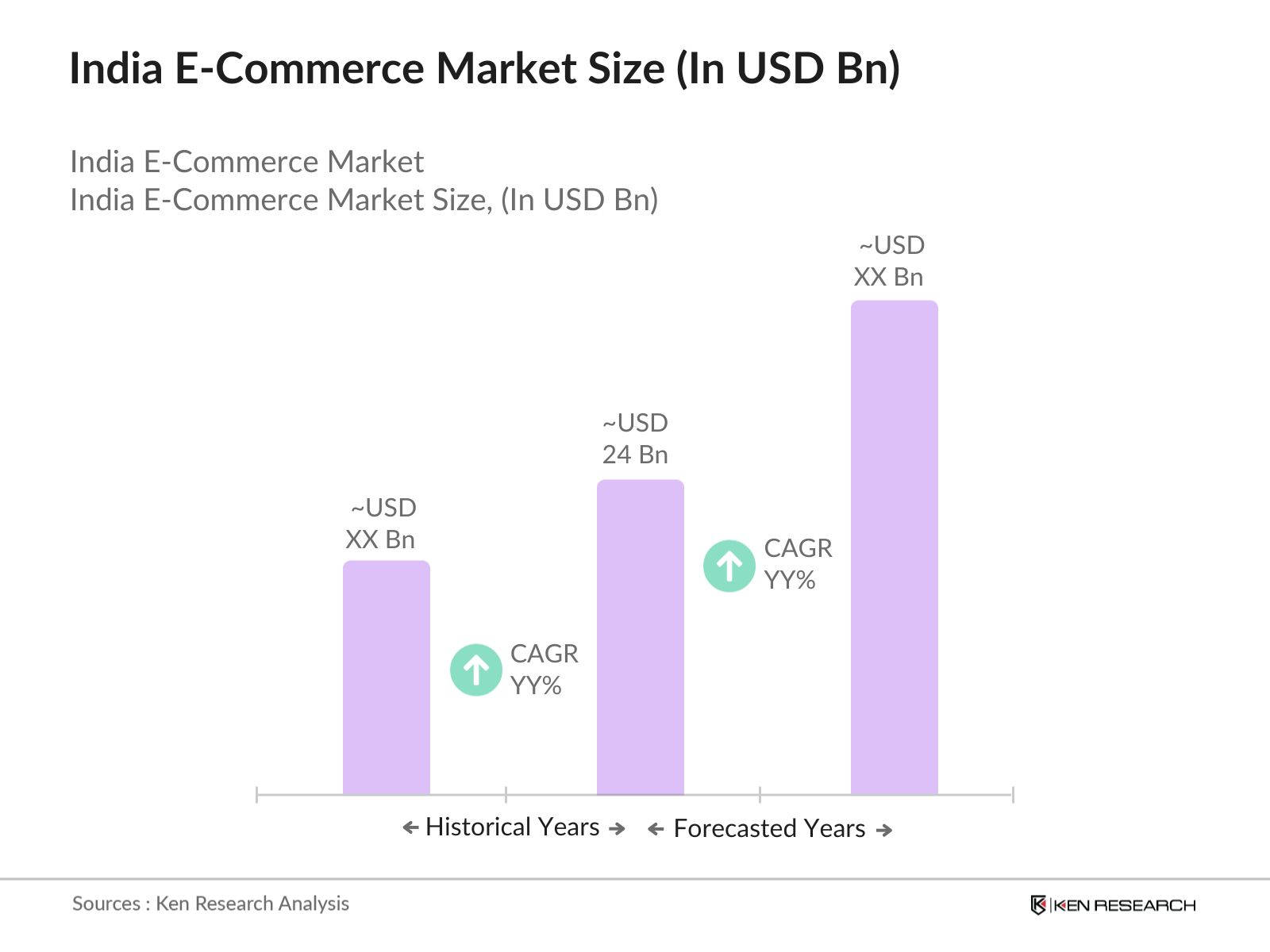
The India E-commerce market is valued at USD 24 billion, driven by increasing internet penetration, smartphone adoption, and the rise of digital payment systems like UPI.
Key challenges in the India E-commerce market include high return rates, especially in the B2C segment, logistical barriers in rural areas, cybersecurity threats, and regulatory complexities.
Major players in the India E-commerce market include Amazon India, Flipkart, Nykaa, Paytm Mall, and Snapdeal, all of which dominate due to their product variety, strong logistics, and innovative marketing strategies.
The India E-commerce market is driven by factors such as the growing penetration of the internet and smartphones, government initiatives supporting digital growth, and increasing consumer confidence in online shopping.
Opportunities in the India E-commerce market include the expansion of quick commerce, the growth of hyper-local deliveries, innovations in payment systems, and the rising popularity of social commerce in rural areas.

What makes us stand out is that our consultants follows Robust, Refine and Result (RRR) methodology. i.e. Robust for clear definitions, approaches and sanity checking, Refine for differentiating respondents facts and opinions and Result for presenting data with story

We have set a benchmark in the industry by offering our clients with syndicated and customized market research reports featuring coverage of entire market as well as meticulous research and analyst insights.

While we don't replace traditional research, we flip the method upside down. Our dual approach of Top Bottom & Bottom Top ensures quality deliverable by not just verifying company fundamentals but also looking at the sector and macroeconomic factors.

With one step in the future, our research team constantly tries to show you the bigger picture. We help with some of the tough questions you may encounter along the way: How is the industry positioned? Best marketing channel? KPI's of competitors? By aligning every element, we help maximize success.

Our report gives you instant access to the answers and sources that other companies might choose to hide. We elaborate each steps of research methodology we have used and showcase you the sample size to earn your trust.

If you need any support, we are here! We pride ourselves on universe strength, data quality, and quick, friendly, and professional service.