
India Ethylene Propylene Diene Monomer Market Outlook to 2030
Region:India
Author(s):Paribhasha Tiwari
Product Code:KROD6190
Region:India
Author(s):Paribhasha Tiwari
Product Code:KROD6190
November 2024
90
By Application: Indias EPDM market is segmented by application into automotive, construction and roofing, electrical and electronics, and plastic modification. The automotive sector is the largest consumer of EPDM, primarily due to the extensive use of the material in weatherstripping, seals, hoses, and belts. The flexibility, durability, and resistance to environmental factors make EPDM an ideal material for automotive components, which are subject to constant stress and wear.

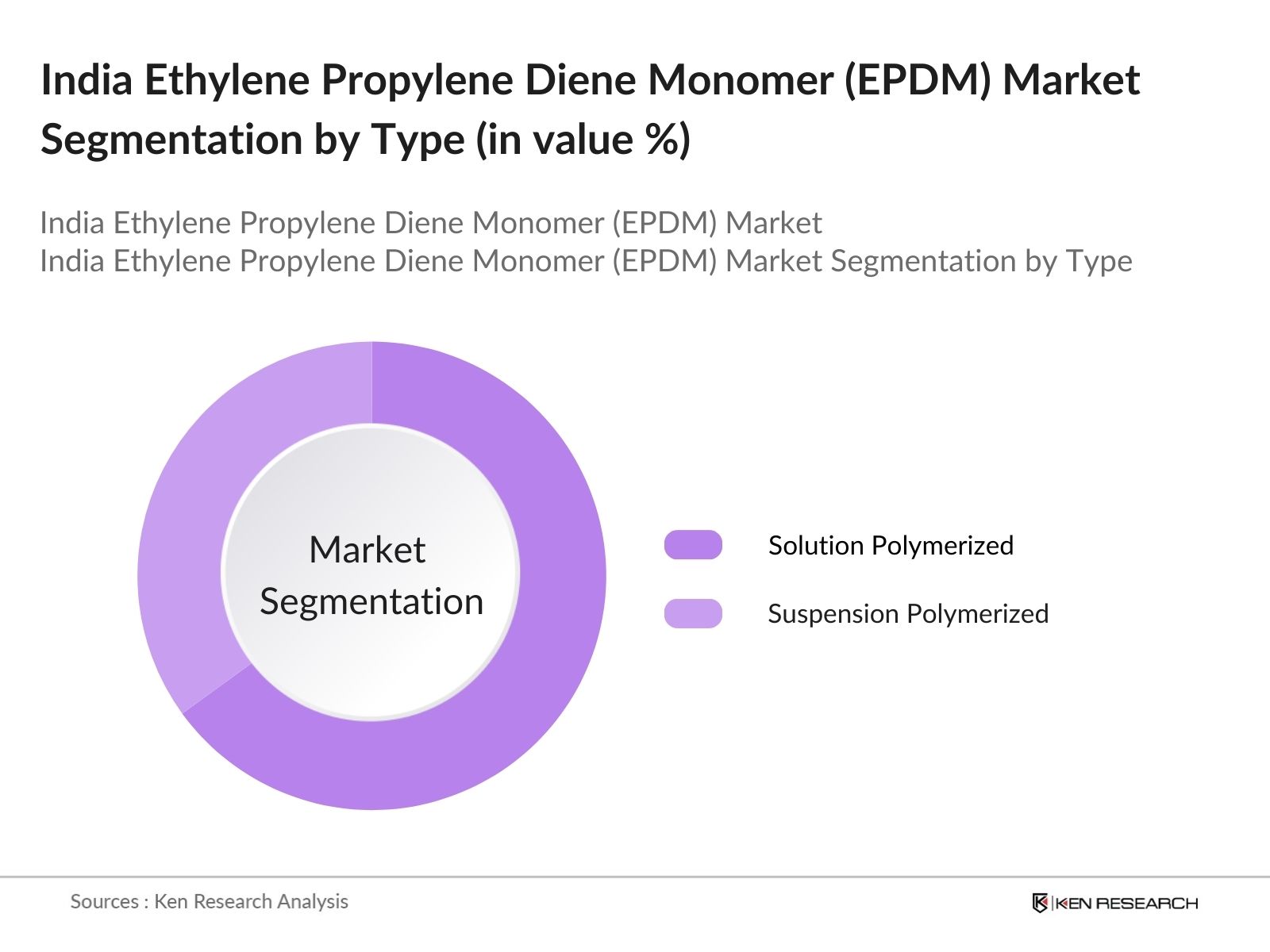
By Type: The EPDM market is segmented into solution polymerized and suspension polymerized types. Solution polymerized EPDM dominates the market due to its superior performance characteristics, such as enhanced resistance to aging, ozone, and temperature variations. The demand for this type is further driven by its use in high-performance applications in the automotive and industrial sectors, where durability and longevity are critical.
The India EPDM market is characterized by the presence of major global and domestic players. These companies are engaged in strategic partnerships, expansions, and product innovations to strengthen their market positions. Key players include Reliance Industries Limited and Indian Oil Corporation, which dominate the market due to their integrated supply chains and large production capacities.
|
Company |
Establishment Year |
Headquarters |
Production Capacity (MT) |
R&D Investment |
Revenue (USD Bn) |
Global Presence |
Product Portfolio |
Strategic Initiatives |
|---|---|---|---|---|---|---|---|---|
|
Reliance Industries Ltd |
1973 |
Mumbai, India |
- | - | - | - | - | - |
|
Indian Oil Corporation Ltd |
1959 |
New Delhi, India |
- | - | - | - | - | - |
|
Mitsui Chemicals |
1912 |
Tokyo, Japan |
- | - | - | - | - | - |
|
SABIC |
1976 |
Riyadh, Saudi Arabia |
- | - | - | - | - | - |
|
Dow Chemical Company |
1897 |
Midland, USA |
- | - | - | - | - | - |
Over the next five years, the India EPDM market is expected to experience steady growth, driven by the increasing use of EPDM in various industrial applications, especially in the automotive and construction sectors. The push toward sustainability, coupled with technological advancements in EPDM production, will likely fuel the market's expansion. Furthermore, initiatives to develop bio-based EPDM products are expected to create new growth avenues for manufacturers.
|
By Application |
Automotive Construction & Roofing Wire & Cable Plastic Modification Others |
|
By Type |
Solution Polymerized Suspension Polymerized |
|
By End-use Industry |
Automotive Electrical & Electronics Construction Consumer Goods |
|
By Region |
North South East West |
|
By Manufacturing Process |
Ziegler-Natta Catalysts Metallocene Catalysts |
1.1. Definition and Scope
1.2. Market Taxonomy
1.3. Market Growth Rate
1.4. Market Segmentation Overview
2.1. Historical Market Size
2.2. Year-On-Year Growth Analysis
2.3. Key Market Developments and Milestones
3.1. Growth Drivers (Capacity Expansion, Increased Industrial Usage, Raw Material Availability, Process Optimization)
3.1.1. Increasing Demand from Automotive Sector
3.1.2. Expansion of Construction and Roofing Applications
3.1.3. Rising Investments in Polymer-based Manufacturing
3.1.4. Advancements in EPDM Processing Technology
3.2. Market Challenges (Cost Fluctuations, Regulatory Constraints, Competition from Substitutes, Supply Chain Disruptions)
3.2.1. Volatility in Raw Material Prices
3.2.2. Stringent Environmental Regulations
3.2.3. Availability of Alternative Elastomers
3.2.4. Transportation and Logistics Issues
3.3. Opportunities (Sustainability, Emerging Markets, Bio-based EPDM, R&D Investment)
3.3.1. Development of Bio-based EPDM
3.3.2. Expansion into Southeast Asian Markets
3.3.3. Growing Adoption in Solar and Energy Sector
3.3.4. Increasing R&D for EPDM Applications
3.4. Trends (Sustainability Initiatives, Energy Efficiency, High-performance Polymers, Globalization of Supply Chain)
3.4.1. Focus on Sustainable Manufacturing Practices
3.4.2. Introduction of High-performance EPDM Grades
3.4.3. Expansion of Global Supply Chain Network
3.4.4. Increasing Demand for Lightweight Materials in Automotive
3.5. Government Regulation (Environmental Standards, Export-Import Policies, Manufacturing Guidelines, Safety Norms)
3.5.1. Impact of BIS Standards on EPDM Production
3.5.2. Compliance with Environmental Protection Guidelines
3.5.3. Government Incentives for Polymer Industries
3.5.4. Import Duties and Tax Structures
4.1. By Application (In Value %)
4.1.1. Automotive
4.1.2. Construction and Roofing
4.1.3. Wire & Cable
4.1.4. Plastic Modification
4.1.5. Others
4.2. By Type (In Value %)
4.2.1. Solution Polymerized
4.2.2. Suspension Polymerized
4.3. By End-use Industry (In Value %)
4.3.1. Automotive
4.3.2. Electrical & Electronics
4.3.3. Construction
4.3.4. Consumer Goods
4.4. By Region (In Value %)
4.4.1. North India
4.4.2. South India
4.4.3. East India
4.4.4. West India
4.5. By Manufacturing Process (In Value %)
4.5.1. Ziegler-Natta Catalysts
4.5.2. Metallocene Catalysts
5.1. Detailed Profiles of Major Companies
5.1.1. Reliance Industries Limited
5.1.2. Indian Oil Corporation Ltd.
5.1.3. Mitsui Chemicals
5.1.4. Dow Chemical Company
5.1.5. SABIC
5.1.6. Arlanxeo
5.1.7. ExxonMobil Chemical
5.1.8. Sumitomo Chemical
5.1.9. Kumho Polychem
5.1.10. Versalis S.p.A.
5.1.11. SK Global Chemical
5.1.12. JSR Corporation
5.1.13. Lanxess AG
5.1.14. Lion Elastomers
5.1.15. LG Chem
5.2. Cross Comparison Parameters (Revenue, Market Share, Product Portfolio, Manufacturing Capacity, Global Presence, No. of Employees, R&D Investments, Headquarters)
5.3. Market Share Analysis
5.4. Strategic Initiatives
5.5. Mergers and Acquisitions
5.6. Investment Analysis
5.7. Joint Ventures
5.8. Government Collaborations
6.1. Environmental Standards
6.2. Compliance Requirements
6.3. Import-Export Regulations
6.4. Certification Processes
7.1. Future Market Size Projections
7.2. Key Factors Driving Future Market Growth
8.1. By Application (In Value %)
8.2. By Type (In Value %)
8.3. By End-use Industry (In Value %)
8.4. By Region (In Value %)
8.5. By Manufacturing Process (In Value %)
9.1. TAM/SAM/SOM Analysis
9.2. Key Strategic Initiatives for Companies
9.3. Market Entry Strategies
9.4. White Space Opportunities
Disclaimer Contact UsThe initial phase focuses on identifying the primary variables influencing the India EPDM market. This includes understanding key stakeholders such as manufacturers, suppliers, and end-users. Desk research is conducted using proprietary databases and secondary sources to gather comprehensive industry-level information.
This phase involves collecting and analyzing historical data on EPDM market penetration, production volumes, and revenue generation. Data from both primary and secondary sources are used to assess current market dynamics and develop reliable estimates for market size.
Market hypotheses are tested through consultations with industry experts, using computer-assisted telephone interviews (CATI) with key stakeholders. Their insights help refine our data and provide a clearer understanding of the operational and financial environment of the EPDM market.
In the final phase, EPDM manufacturers are consulted to acquire detailed information on production processes, product performance, and consumer demand trends. These inputs help verify and complement data collected through the bottom-up approach, ensuring a comprehensive analysis of the EPDM market.
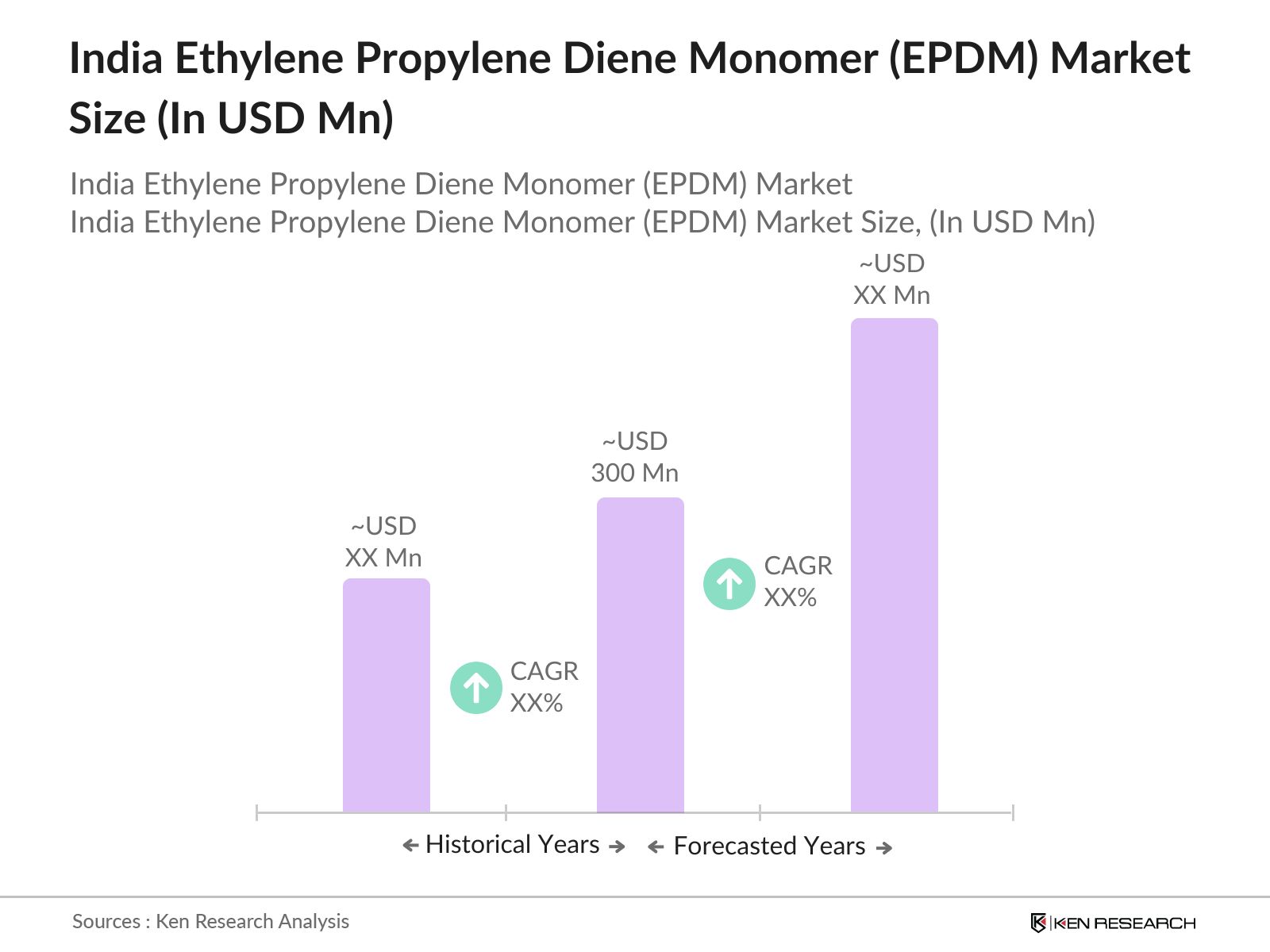
The India EPDM market is valued at USD 300 million, driven by its widespread use in automotive, construction, and electrical applications.
Challenges in the India EPDM market include fluctuating raw material prices, environmental regulations, and competition from alternative elastomers like silicone and natural rubber.
Major players in the India EPDM market include Reliance Industries Ltd, Indian Oil Corporation Ltd, Mitsui Chemicals, SABIC, and Dow Chemical Company.
Growth drivers include increasing demand for EPDM in automotive components, expansion of construction and infrastructure projects, and advancements in EPDM manufacturing technologies.

What makes us stand out is that our consultants follows Robust, Refine and Result (RRR) methodology. i.e. Robust for clear definitions, approaches and sanity checking, Refine for differentiating respondents facts and opinions and Result for presenting data with story

We have set a benchmark in the industry by offering our clients with syndicated and customized market research reports featuring coverage of entire market as well as meticulous research and analyst insights.

While we don't replace traditional research, we flip the method upside down. Our dual approach of Top Bottom & Bottom Top ensures quality deliverable by not just verifying company fundamentals but also looking at the sector and macroeconomic factors.

With one step in the future, our research team constantly tries to show you the bigger picture. We help with some of the tough questions you may encounter along the way: How is the industry positioned? Best marketing channel? KPI's of competitors? By aligning every element, we help maximize success.

Our report gives you instant access to the answers and sources that other companies might choose to hide. We elaborate each steps of research methodology we have used and showcase you the sample size to earn your trust.

If you need any support, we are here! We pride ourselves on universe strength, data quality, and quick, friendly, and professional service.