
India Feed Amino Acids Market Outlook to 2030
Region:Asia
Author(s):Naman Rohilla
Product Code:KROD5332
December 2024
97
About the Report
India Feed Amino Acids Market Overview
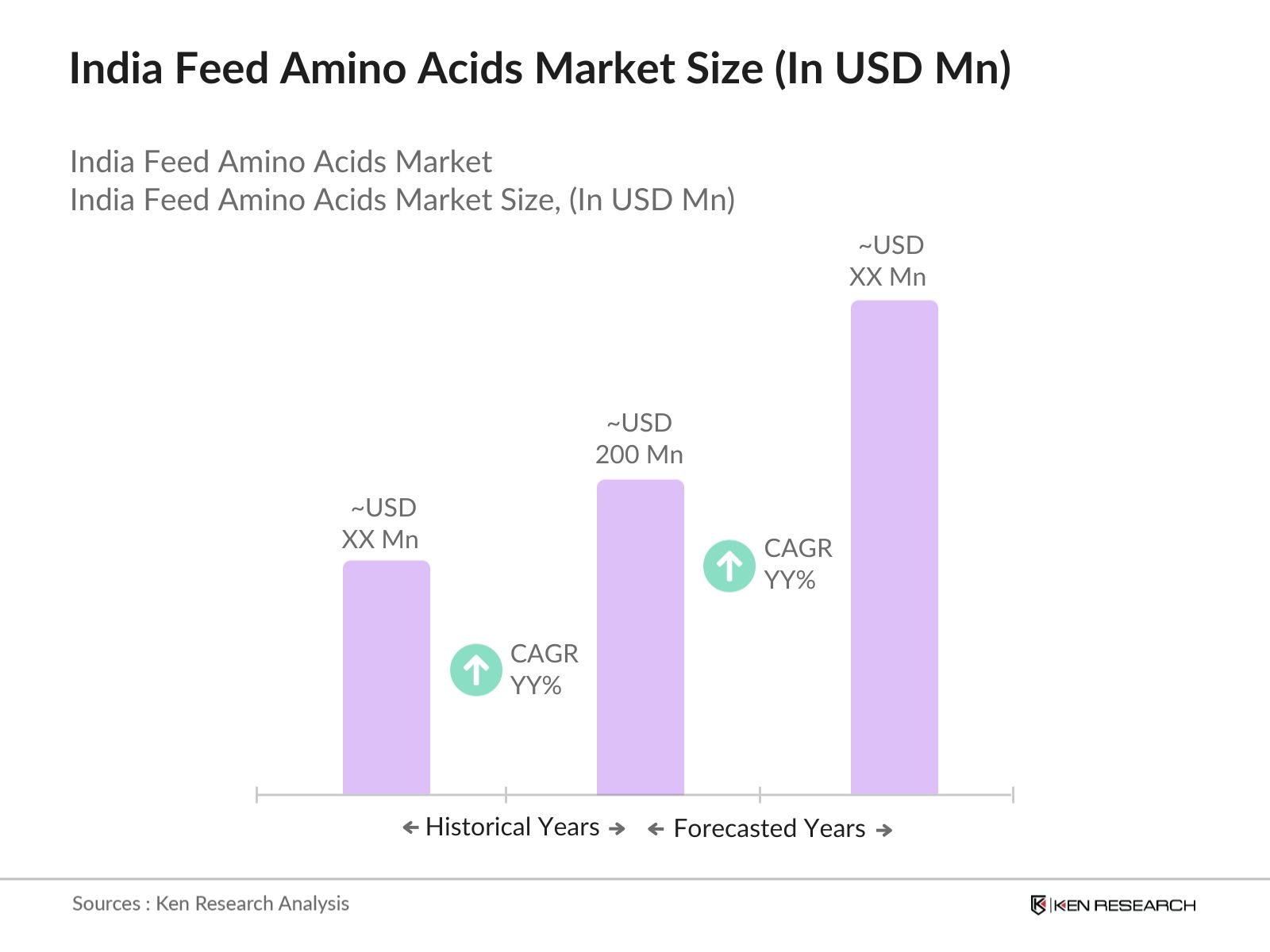
- The India Feed Amino Acids Market is currently valued at USD 200 million, driven by increasing demand for high-quality animal protein, particularly in poultry and dairy sectors. Feed amino acids are essential for livestock as they enhance nutrient absorption and overall feed efficiency, reducing costs and improving production output. Indias growing population and increased consumption of meat and dairy products continue to push the demand for amino acids in feed formulations. Key contributors to market growth include rising awareness about animal nutrition, government policies promoting sustainable livestock farming, and the expanding livestock population across the country.
- In the India Feed Amino Acids Market, dominant regions include Maharashtra, Tamil Nadu, and Andhra Pradesh, primarily because of their advanced livestock farming practices and the presence of major animal feed manufacturers. These regions have large-scale dairy and poultry industries, which demand consistent and high-quality feed supplements. The availability of raw materials for amino acid production, along with strong transportation networks and well-established livestock farming industries, further contribute to their market dominance.
- The Feed Safety and Standards Act of India mandates stringent guidelines for the quality and safety of animal feed, directly impacting the use of amino acids. This Act has increased compliance costs for feed manufacturers by 10-15%, but has also improved the overall quality and safety of feed products. It ensures that amino acids used in feed formulations meet specific safety standards, thereby supporting the growth of the market.
India Feed Amino Acids Market Segmentation
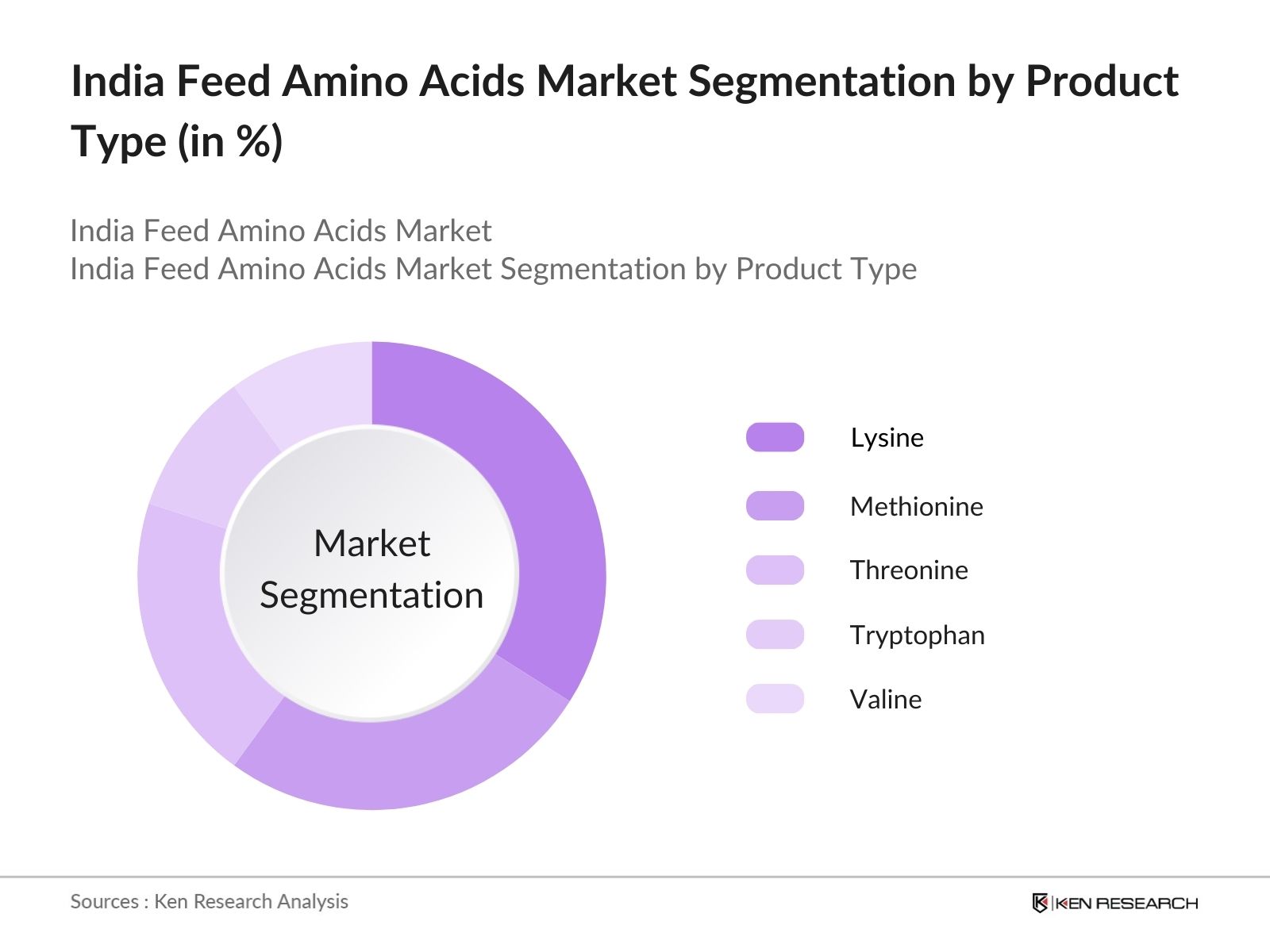
By Product Type: The India Feed Amino Acids market is segmented by product type into Lysine, Methionine, Threonine, Tryptophan, and Valine. Lysine holds a dominant share in the market, as it plays a critical role in protein synthesis and growth enhancement in animals. The demand for lysine in poultry and swine feed is particularly high, as it helps improve feed efficiency and reduces nitrogen excretion, making it a preferred amino acid for intensive livestock farming. Methionine is also gaining importance due to its role in promoting feather growth in poultry and enhancing milk yield in dairy cattle.
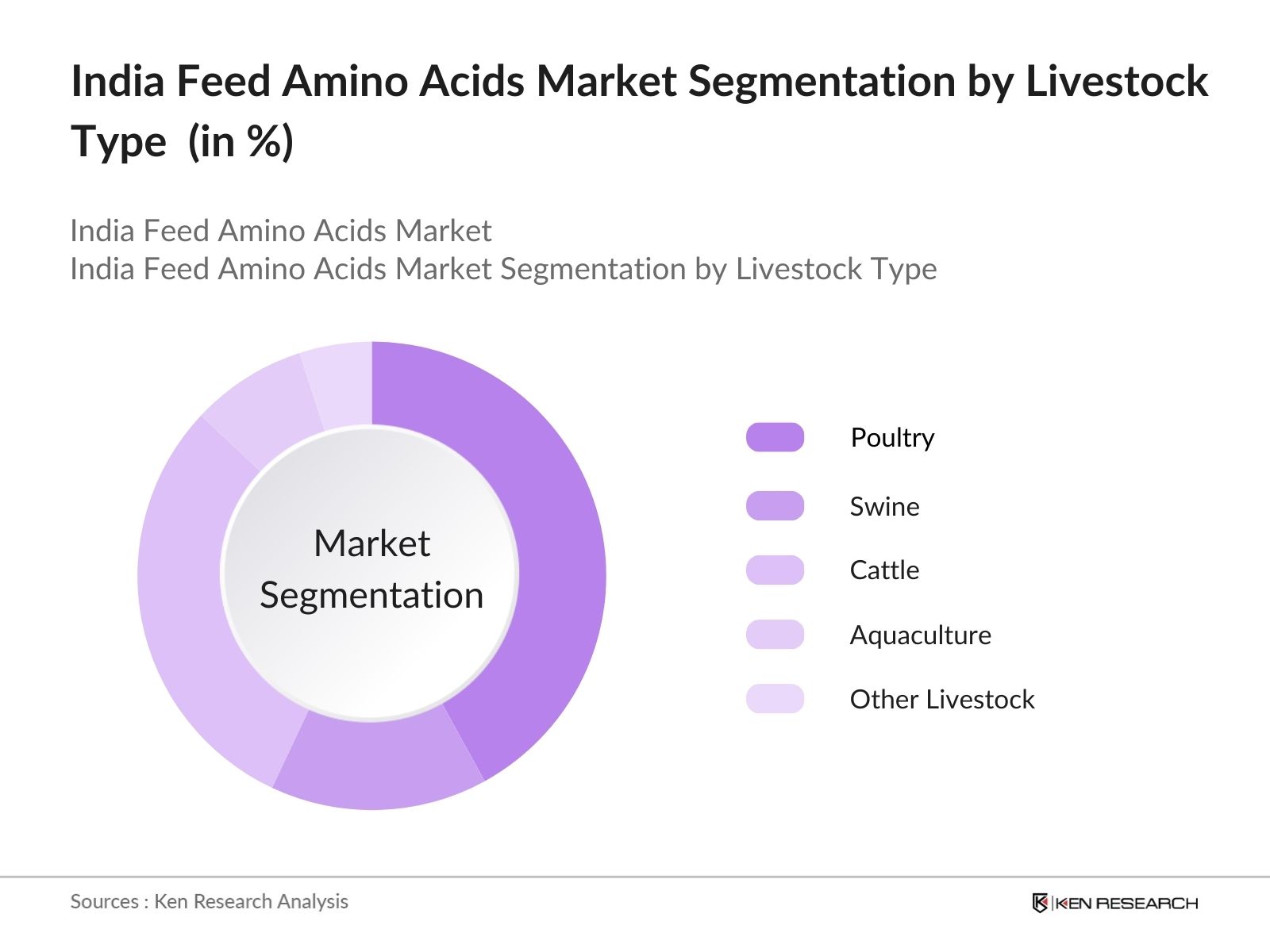
By Livestock Type: India Feed Amino Acids market is further segmented by livestock type into Poultry, Swine, Cattle, Aquaculture, and Other Livestock. Poultry remains the dominant segment due to the widespread consumption of chicken and eggs in India, which has led to large-scale poultry farming operations. Amino acids like lysine and methionine are vital for poultry growth and feed efficiency. The rise in poultry consumption, combined with the need for nutrient-rich feed, drives this segments dominance. The cattle segment also shows considerable growth, fueled by the increasing demand for dairy products.
India Feed Amino Acids Market Competitive Landscape
The India Feed Amino Acids Market is dominated by a few international manufacturers like Ajinomoto and Evonik Industries, alongside domestic giants such as Cargill and BASF SE. These companies have a strong presence in India, leveraging advanced production technologies and extensive distribution networks to maintain their competitive edge. This consolidation of market share in the hands of a few key players reflects the barriers to entry due to the capital-intensive nature of amino acid production and stringent quality control standards.
|
Company Name |
Established Year |
Headquarters |
Number of Employees |
Production Capacity (Tons) |
Revenue (USD Mn) |
R&D Investments (USD Mn) |
Patents |
Global Reach (Countries) |
Product Portfolio |
|
Ajinomoto Co. Inc. |
1909 |
Tokyo, Japan |
- |
- |
- |
- |
- |
- |
- |
|
Archer Daniels Midland Company |
1902 |
Illinois, USA |
- |
- |
- |
- |
- |
- |
- |
|
Evonik Industries AG |
2007 |
Essen, Germany |
- |
- |
- |
- |
- |
- |
- |
|
Cargill, Inc. |
1865 |
Minnesota, USA |
- |
- |
- |
- |
- |
- |
- |
|
BASF SE |
1865 |
Ludwigshafen, Germany |
- |
- |
- |
- |
- |
- |
- |
India Feed Amino Acids Market Analysis
India Feed Amino Acids Market Growth Drivers
- Increased Livestock Production: India has witnessed a notable increase in livestock production due to the rising demand for animal-derived products. According to the Department of Animal Husbandry and Dairying, India had over 535.78 million livestock in 2022, with poultry accounting for around 851.8 million birds. The demand for animal-based protein continues to rise, which directly impacts the feed amino acids market, as these amino acids are critical for livestock health and productivity. Livestock expansion, particularly in poultry and dairy farming, is set to drive the consumption of feed additives like amino acids.
- Rising Awareness of Animal Nutrition: There has been a shift in focus towards animal nutrition, particularly protein and amino acid intake, as a means to boost animal health and productivity. According to FAO reports, India's per capita consumption of animal-based products has grown by 3.2 kilograms annually over the past five years, highlighting the importance of optimized nutrition in livestock farming. This has led to increased demand for amino acids, specifically lysine and methionine, in animal feed to support optimal growth and production.
- Expanding Poultry and Dairy Industries: India is one of the worlds largest producers of poultry meat and dairy, with milk production exceeding 221 million tonnes in 2023, according to the National Dairy Development Board (NDDB). The growth of these sectors has fueled the demand for efficient feed ingredients, including amino acids, which are essential for the health and productivity of poultry and dairy livestock. The expansion of these industries has contributed to the growing demand for amino acids in animal feed formulations.
India Feed Amino Acids Market Challenges
- High Production Costs: The cost of producing amino acids has increased due to the volatility in raw material prices. The global supply chain disruptions in 2022, driven by geopolitical tensions and rising crude oil prices, have escalated the costs of key inputs such as corn and soy, which are essential in amino acid production. This has led to challenges for producers in maintaining profitability, as raw material costs can represent up to 60% of the total production expenses in amino acid manufacturing.
- Limited Availability of Key Raw Materials: India faces limitations in the availability of essential raw materials for amino acid production, such as corn and soybean. These are heavily relied upon for producing amino acids like lysine and methionine. According to the Indian Ministry of Commerce, corn production fell by 3.1 million tonnes in 2023 due to erratic weather patterns, impacting the supply chain for amino acid manufacturers. This scarcity presents a hurdle to the continuous growth of the feed amino acids market.
India Feed Amino Acids Market Future Outlook
Over the next five years, the India Feed Amino Acids Market is expected to witness substantial growth, driven by the expansion of the livestock industry, increasing investments in sustainable feed ingredients, and advancements in amino acid production technologies. The growing emphasis on optimizing livestock health and nutrition will continue to drive the demand for feed amino acids. Additionally, government initiatives promoting sustainable agriculture and livestock farming are expected to further boost market growth.
India Feed Amino Acids Market Opportunities
- Innovations in Amino Acid Production: Innovations in fermentation technology have enabled more efficient production of amino acids. This process offers a sustainable and cost-effective method of producing essential amino acids like lysine, methionine, and threonine. According to the Indian Council of Agricultural Research (ICAR), companies that adopt these methods can reduce production costs by up to 30%, making the products more affordable for feed manufacturers. This technological shift creates opportunities for the feed amino acids market.
- Expansion of Feed Industry in Emerging Regions: The rapid development of the feed industry in rural and Tier-II cities offers a key growth opportunity for the amino acids market in India. The Indian Ministry of Rural Development highlighted that agricultural mechanization and livestock farming have expanded by 15% in Tier-II cities in 2023, increasing the demand for feed additives. This growing market base creates a new avenue for the distribution and consumption of feed amino acids in less urbanized regions.
Scope of the Report
|
Product Type |
Lysine Methionine Threonine Tryptophan Valine |
|
Livestock Type |
Poultry Swine Cattle Aquaculture Other Livestock |
|
Form |
Dry Form Liquid Form |
|
Application |
Feed Additives Nutritional Supplements Functional Feed |
|
Region |
North India South India East India West India |
Products
Key Target Audience
Livestock Farmers
Feed Manufacturers
Amino Acid Producers
Banks and Financial Institutions
Government and Regulatory Bodies (Ministry of Agriculture, Food Safety and Standards Authority of India)
Animal Health and Nutrition Experts
Investor and Venture Capitalist Firms
Agribusiness Corporations
Raw Material Suppliers
Companies
Players Mentioned in the Report:
Ajinomoto Co. Inc.
Archer Daniels Midland Company
Evonik Industries AG
Cargill, Inc.
BASF SE
CJ CheilJedang Corporation
Novus International
Royal DSM
Kemin Industries, Inc.
Adisseo France SAS
Table of Contents
1. India Feed Amino Acids Market Overview
1.1. Definition and Scope
1.2. Market Taxonomy
1.3. Market Growth Rate
1.4. Market Segmentation Overview
2. India Feed Amino Acids Market Size (In USD Bn)
2.1. Historical Market Size
2.2. Year-On-Year Growth Analysis
2.3. Key Market Developments and Milestones
3. India Feed Amino Acids Market Analysis
3.1. Growth Drivers
3.1.1. Increased Livestock Production
3.1.2. Rising Awareness of Animal Nutrition
3.1.3. Expanding Poultry and Dairy Industries
3.1.4. Government Policies for Animal Health
3.2. Market Challenges
3.2.1. High Production Costs (Raw Material Volatility)
3.2.2. Limited Availability of Key Raw Materials
3.2.3. Environmental Regulations
3.3. Opportunities
3.3.1. Innovations in Amino Acid Production (Fermentation Process)
3.3.2. Expansion of Feed Industry in Emerging Regions (Rural and Tier-II Cities)
3.3.3. Technological Advancements in Animal Nutrition
3.4. Trends
3.4.1. Sustainable Amino Acid Production (Environmentally Friendly Methods)
3.4.2. Growing Use of Specialty Feed Ingredients
3.4.3. Increasing Focus on Precision Nutrition
3.5. Government Regulations
3.5.1. Feed Safety and Standards Act
3.5.2. Import-Export Regulations (Trade Policies)
3.5.3. Subsidies for Amino Acid Feed Production
3.6. SWOT Analysis
3.7. Stakeholder Ecosystem
3.8. Porters Five Forces Analysis
3.8.1. Bargaining Power of Suppliers
3.8.2. Bargaining Power of Buyers
3.8.3. Threat of New Entrants
3.8.4. Threat of Substitutes
3.8.5. Competitive Rivalry
3.9. Competitive Ecosystem
4. India Feed Amino Acids Market Segmentation
4.1. By Product Type (In Value %)
4.1.1. Lysine
4.1.2. Methionine
4.1.3. Threonine
4.1.4. Tryptophan
4.1.5. Valine
4.2. By Livestock Type (In Value %)
4.2.1. Poultry
4.2.2. Swine
4.2.3. Cattle
4.2.4. Aquaculture
4.2.5. Other Livestock
4.3. By Form (In Value %)
4.3.1. Dry Form
4.3.2. Liquid Form
4.4. By Application (In Value %)
4.4.1. Feed Additives
4.4.2. Nutritional Supplements
4.4.3. Functional Feed
4.5. By Region (In Value %)
4.5.1. North India
4.5.2. South India
4.5.3. East India
4.5.4. West India
5. India Feed Amino Acids Market Competitive Analysis
5.1. Detailed Profiles of Major Companies
5.1.1. Ajinomoto Co. Inc.
5.1.2. Archer Daniels Midland Company
5.1.3. Evonik Industries AG
5.1.4. BASF SE
5.1.5. Cargill, Inc.
5.1.6. Royal DSM
5.1.7. CJ CheilJedang Corporation
5.1.8. Novus International
5.1.9. Kemin Industries, Inc.
5.1.10. Meihua Holdings Group Co.
5.1.11. Adisseo France SAS
5.1.12. Daesang Corporation
5.1.13. Fufeng Group Company Limited
5.1.14. Global Bio-Chem Technology Group
5.1.15. Sumitomo Chemical Co., Ltd.
5.2. Cross Comparison Parameters (Number of Employees, Headquarters, Revenue, Production Capacity, R&D Focus, Product Portfolio, Patents, Geographic Reach)
5.3. Market Share Analysis
5.4. Strategic Initiatives (New Product Launches, Joint Ventures, Collaborations)
5.5. Mergers and Acquisitions
5.6. Investment Analysis (Venture Capital, Private Equity)
5.7. Government Incentives
5.8. Key Supply Chain Partnerships
6. India Feed Amino Acids Market Regulatory Framework
6.1. Regulatory Standards for Feed Amino Acids
6.2. Environmental Compliance (Regulations on Emissions)
6.3. Certification Processes (ISO, HACCP)
7. India Feed Amino Acids Future Market Size (In USD Bn)
7.1. Future Market Size Projections
7.2. Key Factors Driving Future Market Growth
8. India Feed Amino Acids Future Market Segmentation
8.1. By Product Type (In Value %)
8.2. By Livestock Type (In Value %)
8.3. By Form (In Value %)
8.4. By Application (In Value %)
8.5. By Region (In Value %)
9. India Feed Amino Acids Market Analysts Recommendations
9.1. TAM/SAM/SOM Analysis
9.2. Marketing Initiatives
9.3. White Space Opportunities
Disclaimer Contact UsResearch Methodology
Step 1: Identification of Key Variables
This phase involves mapping out the India Feed Amino Acids Market ecosystem, focusing on stakeholders such as feed manufacturers, livestock farmers, and amino acid producers. Extensive desk research is conducted to identify the key factors influencing the market, such as demand drivers, regulatory frameworks, and technological advancements.
Step 2: Market Analysis and Construction
This step includes the analysis of historical data and current market trends related to feed amino acids. We assess the production capacity, raw material availability, and market penetration across different regions in India, using secondary and proprietary databases.
Step 3: Hypothesis Validation and Expert Consultation
Market hypotheses are validated through expert consultations and interviews with professionals in the livestock feed industry. This process provides insights into market dynamics, pricing strategies, and consumer preferences, ensuring accuracy in our market projections.
Step 4: Research Synthesis and Final Output
In this final stage, data from multiple sources, including primary research and statistical databases, is synthesized to provide a comprehensive market analysis. This includes evaluating production trends, market shares, and competitive strategies to deliver a detailed, validated report on the India Feed Amino Acids Market.
Frequently Asked Questions
01. How big is the India Feed Amino Acids Market?
The India Feed Amino Acids market is valued at USD 200 million, driven by the growing livestock industry, particularly in poultry and dairy segments.
02. What are the challenges in the India Feed Amino Acids Market?
Challenges in the India Feed Amino Acids market include fluctuating raw material costs, regulatory hurdles related to animal feed safety, and environmental concerns related to amino acid production.
03. Who are the major players in the India Feed Amino Acids Market?
Key players in the India Feed Amino Acids market include Ajinomoto Co. Inc., Archer Daniels Midland Company, Evonik Industries AG, Cargill, Inc., and BASF SE. These companies dominate due to their large-scale production capacity and strong distribution networks.
04. What are the growth drivers of the India Feed Amino Acids Market?
The India Feed Amino Acids market is propelled by the increasing demand for high-quality animal protein, advancements in amino acid production technologies, and government policies promoting sustainable livestock farming.
Why Buy From Us?

What makes us stand out is that our consultants follows Robust, Refine and Result (RRR) methodology. i.e. Robust for clear definitions, approaches and sanity checking, Refine for differentiating respondents facts and opinions and Result for presenting data with story

We have set a benchmark in the industry by offering our clients with syndicated and customized market research reports featuring coverage of entire market as well as meticulous research and analyst insights.

While we don't replace traditional research, we flip the method upside down. Our dual approach of Top Bottom & Bottom Top ensures quality deliverable by not just verifying company fundamentals but also looking at the sector and macroeconomic factors.

With one step in the future, our research team constantly tries to show you the bigger picture. We help with some of the tough questions you may encounter along the way: How is the industry positioned? Best marketing channel? KPI's of competitors? By aligning every element, we help maximize success.

Our report gives you instant access to the answers and sources that other companies might choose to hide. We elaborate each steps of research methodology we have used and showcase you the sample size to earn your trust.

If you need any support, we are here! We pride ourselves on universe strength, data quality, and quick, friendly, and professional service.