India Food Pathogen Testing Market Outlook to 2030

Region:Asia

Author(s):Sanjeev

Product Code:KROD3437

Published On

November 2024

Total pages

99

About the Report

India Food Pathogen Testing Market Overview

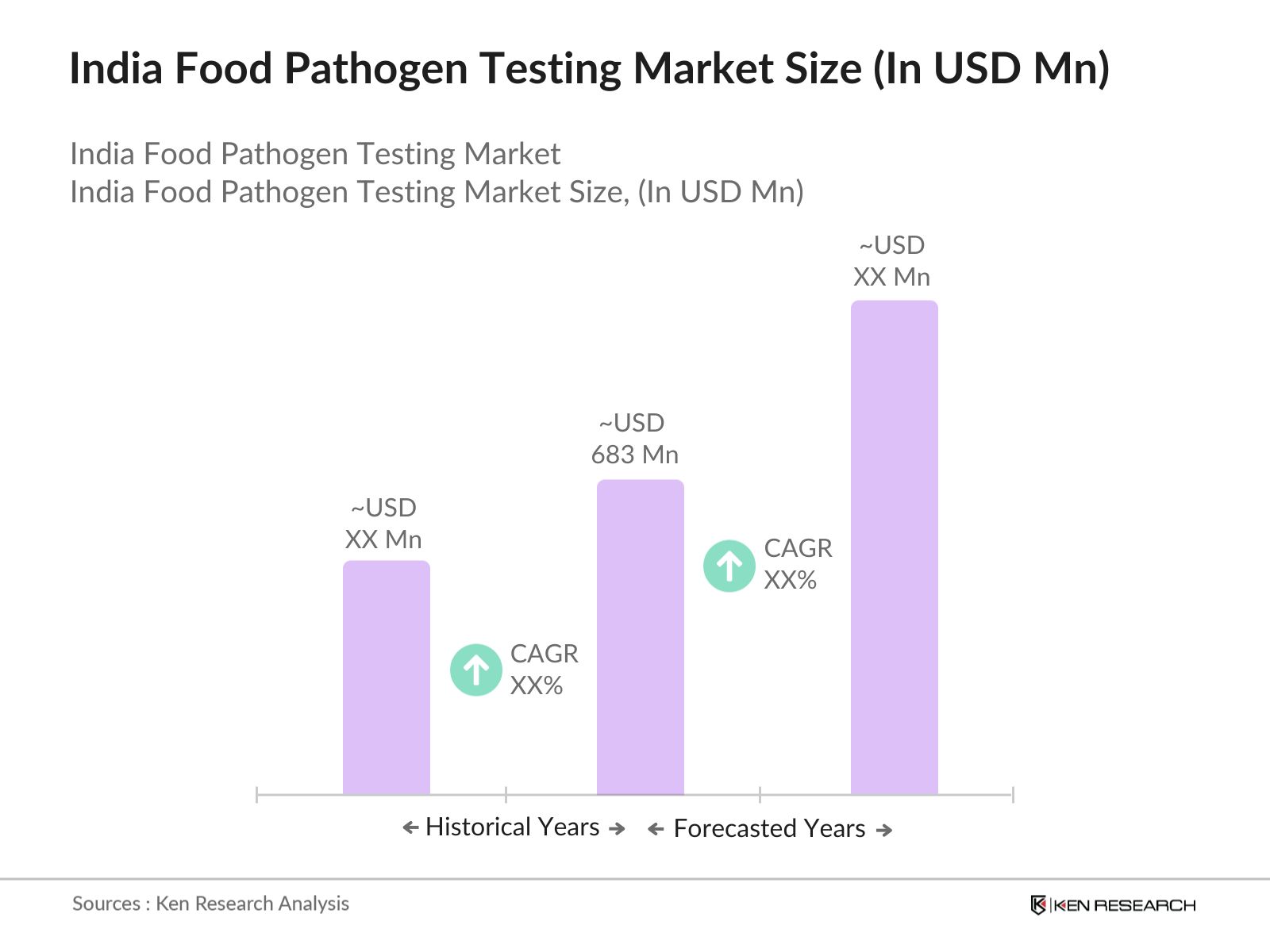
  • The India Food Pathogen Testing Market is valued at USD 683 million, driven by increasing concerns over foodborne illnesses and stringent government regulations regarding food safety standards. As the demand for processed foods grows, both domestically and internationally, food manufacturers are adopting advanced pathogen testing methods to ensure compliance and consumer safety. This has led to a surge in the usage of rapid diagnostic tools and sophisticated testing procedures across food manufacturing units in India.
  • The dominant regions within this market are Northern and Southern India, driven by the concentration of large food processing plants and a robust regulatory framework. Northern India is home to major food production hubs, benefiting from established infrastructure and supply chain logistics, while Southern India is driven by its expanding seafood and processed food industries, both of which have stringent export testing requirements to meet international food safety norms.
  • The FSSAI, India's premier food regulatory body, enforces comprehensive guidelines to ensure food safety, including mandatory pathogen testing for high-risk food categories. The FSSAIs guidelines were updated in 2022 to include stricter protocols for dairy, seafood, and ready-to-eat foods. Over 50,000 food samples were tested in 2022 under the FSSAIs surveillance programs, helping detect and prevent contamination across food categories.

market overviews

India Food Pathogen Testing Market Segmentation

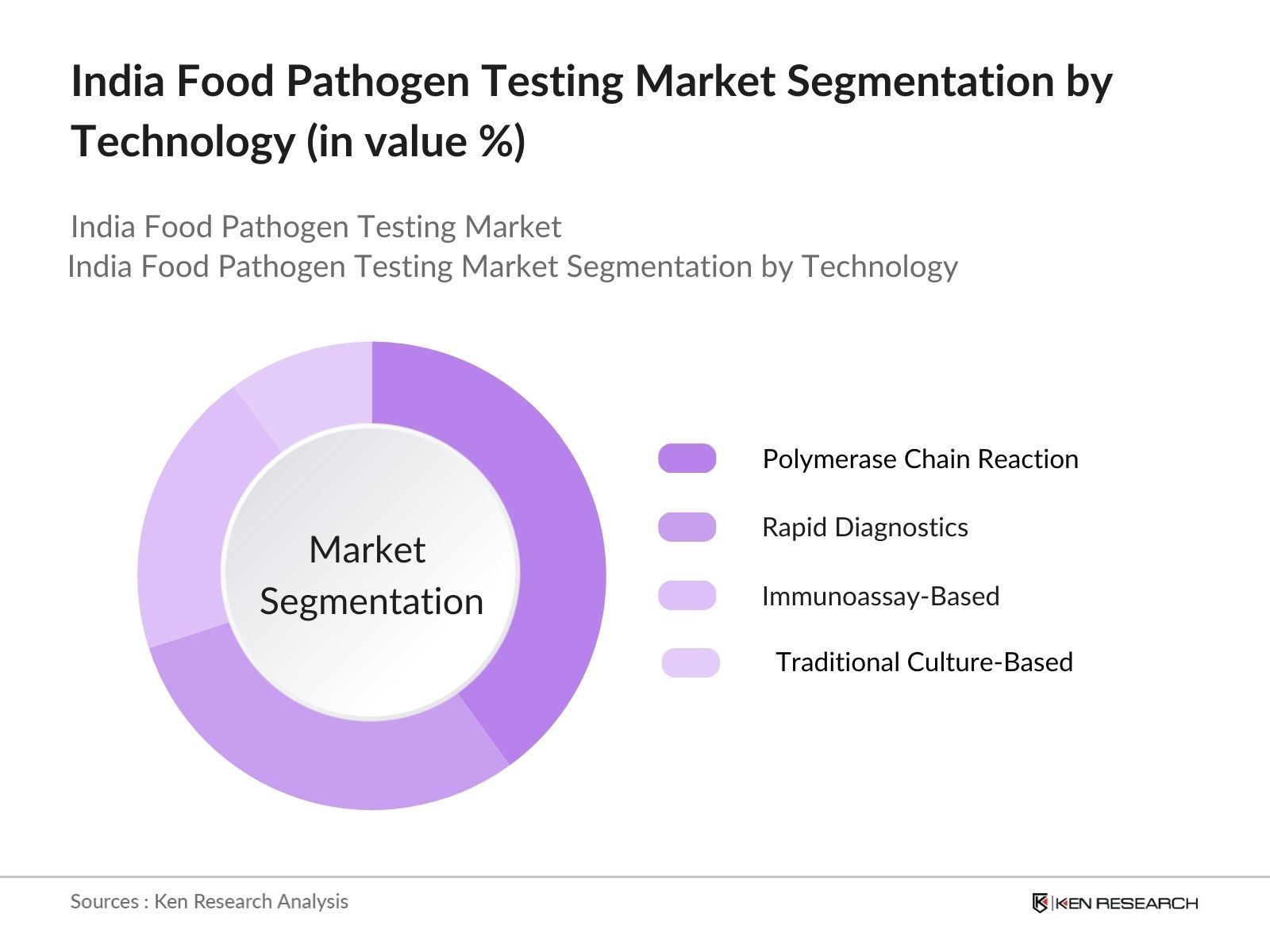
The India Food Pathogen Testing Market is segmented by pathogen type and by technology.
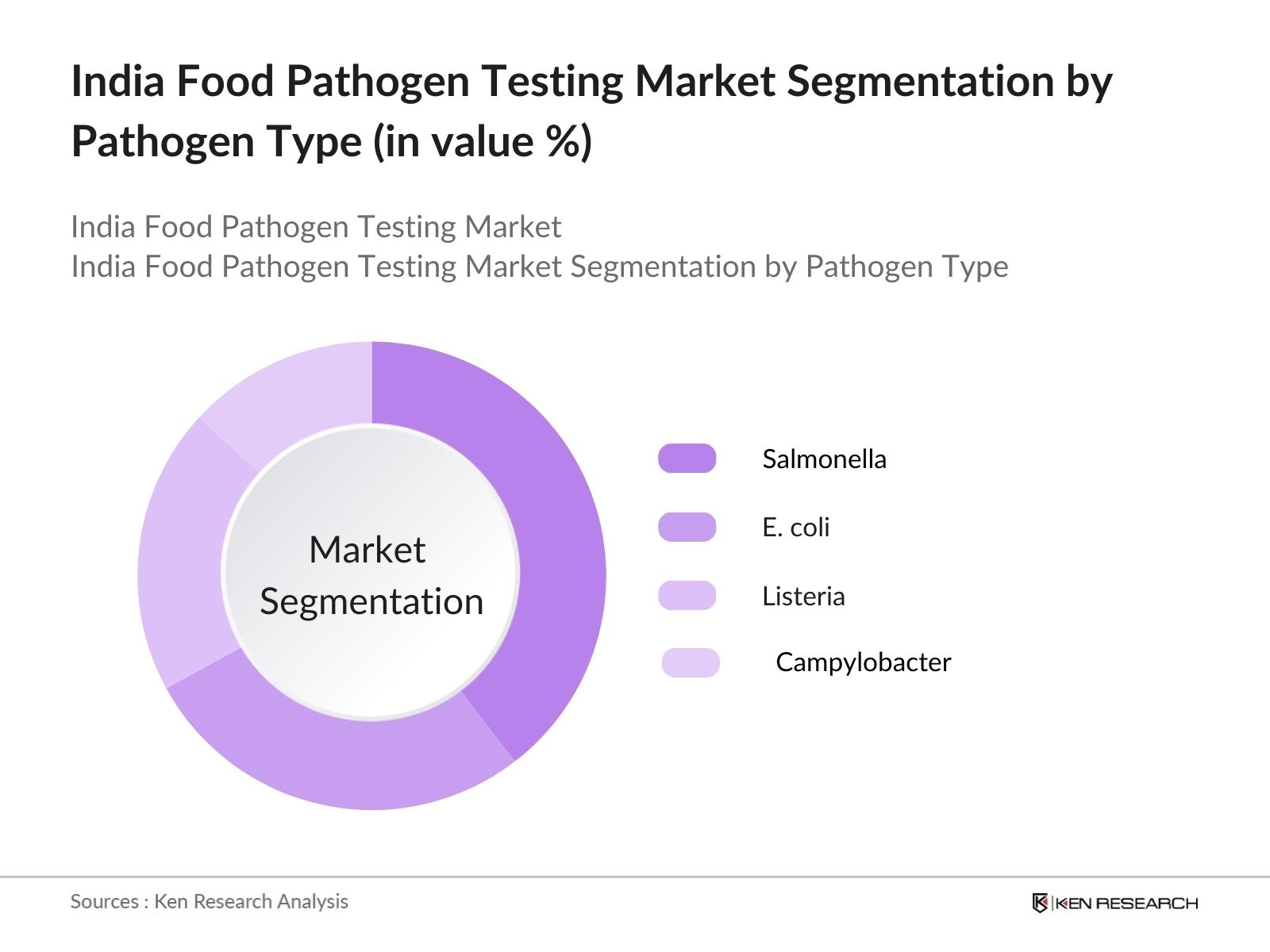
  • By Pathogen Type: The market is segmented by pathogen type into Salmonella, E. coli, Listeria, and Campylobacter. Salmonella holds the dominant market share due to its prevalence in contaminated poultry, meat, and egg products. The rise in consumption of these protein sources and the heightened awareness of food safety has necessitated increased testing for Salmonella across food manufacturing and retail industries. Additionally, government initiatives to curb foodborne illnesses have driven the demand for extensive Salmonella testing protocols.market overviews
  • By Technology: The market is also segmented by technology into Traditional Culture-Based Testing, Immunoassay-Based Testing, Polymerase Chain Reaction (PCR), and Rapid Diagnostics. Polymerase Chain Reaction (PCR) dominates the market due to its ability to detect pathogens with high accuracy and speed, significantly reducing the time required for testing compared to traditional methods. As food manufacturers prioritize rapid turnaround times for testing, PCR technology has seen widespread adoption, particularly in large-scale manufacturing units where delays in testing can affect distribution timelines.market overviews

India Food Pathogen Testing Market Competitive Landscape

The India Food Pathogen Testing Market is dominated by a combination of global giants and local players that cater to specific testing needs. Key players are continuously innovating and expanding their service portfolios to meet the growing demands of the market. The competitive landscape is characterized by a few major players with substantial market influence. Companies like Thermo Fisher Scientific and Bio-Rad Laboratories dominate through their technological innovation and extensive product portfolios. Local firms are also making significant strides in providing affordable testing solutions, making the market increasingly competitive.

Company

Established

Headquarters

Product Range

Revenue (2023)

No. of Employees

Thermo Fisher Scientific

1956

Waltham, USA


Bio-Rad Laboratories

1952

California, USA


Merck KGaA

1668

Darmstadt, Germany


3M Company

1902

Minnesota, USA


Neogen Corporation

1982

Lansing, USA


India Food Pathogen Testing Industry Analysis

Market Growth Drivers

  • Increasing Foodborne Illnesses and Consumer Awareness: The rise in foodborne illnesses is a key driver of the food pathogen testing market in India. According to the World Health Organization, foodborne diseases account for an estimated 100,000 deaths annually in Southeast Asia, which includes India. The increasing consumer awareness about the risks of foodborne pathogens is pressuring food manufacturers to implement stringent testing. With 1.3 billion people in India, the food safety risks are magnified, leading to the adoption of preventive testing measures by both consumers and regulatory bodies to avoid public health crises.
  • Adoption of Advanced Testing Technologies: The adoption of advanced technologies like PCR (Polymerase Chain Reaction) and immunoassays is enhancing the accuracy and speed of food pathogen testing in India. Over 500 food laboratories in India now use non-culture-based molecular testing to detect pathogens faster than traditional methods. Laboratories certified by the FSSAI have significantly reduced testing turnaround time from 72 hours to less than 24 hours. This shift towards technology-driven testing solutions addresses the increasing demand for quicker results, especially in sectors like processed foods and dairy.
  • Growth in Processed Food Industry: The rapid growth of the processed food industry is contributing to increased pathogen testing in India. According to the Ministry of Food Processing Industries (MOFPI), India's food processing sector saw a 12% increase in output in 2023, with over 400 million tons of processed food produced annually. The increase in processed food production heightens the risk of contamination during packaging and storage, leading to a surge in testing requirements across various sectors, including dairy, meat, and packaged foods.

Market Challenges

  • High Costs of Testing Procedures: One of the main challenges for the food pathogen testing market in India is the high cost of advanced testing methods. Molecular testing techniques, such as PCR, cost between INR 2,500 to INR 5,000 per sample, which is prohibitively expensive for many small-scale food producers. Furthermore, the limited number of accredited testing laboratories across the country increases logistical expenses, adding to the overall cost burden for manufacturers. This challenge restricts widespread adoption of frequent testing, especially among smaller businesses.
  • Limited Awareness Among Small-Scale Food Manufacturers: Indias food industry comprises a vast number of small-scale food manufacturers, many of whom have limited awareness about food pathogen testing protocols and their importance. According to the Ministry of Micro, Small, and Medium Enterprises (MSME), over 50 million small-scale enterprises contribute significantly to food production. However, many lack access to information or resources for proper testing, which poses challenges in ensuring compliance with food safety regulations, particularly in rural and semi-urban areas.

India Food Pathogen Testing Market Future Outlook

Over the next five years, the India Food Pathogen Testing Market is expected to experience robust growth, driven by continuous advancements in pathogen detection technologies and the growing complexity of food supply chains. The demand for accurate and rapid testing solutions will surge, especially in response to rising food safety standards across both domestic and international markets. In addition, the expansion of the processed food industry, coupled with government initiatives aimed at improving food safety compliance, is anticipated to propel market growth further.

Market Opportunities

  • Rising Demand for Rapid Testing Methods: The increasing need for rapid food pathogen testing methods is creating opportunities for innovation in the market. Food manufacturers are increasingly adopting rapid test kits that provide results within hours, as opposed to days. In 2023, over 50 new rapid testing methods were approved by the FSSAI, enabling manufacturers to streamline production processes without compromising on safety. These rapid tests are particularly beneficial for high-volume sectors like dairy and meat processing, where time-sensitive testing can prevent foodborne outbreaks.
  • Growth in Export-Oriented Food Manufacturing: Indias food exports reached $56 billion in 2022, driven by demand for dairy, seafood, and spices. With major export markets such as the United States and the European Union implementing stringent food safety regulations, Indian manufacturers are investing in advanced pathogen testing to meet international standards. This growing emphasis on exports creates opportunities for pathogen testing labs to expand their services, particularly in export-heavy regions like Gujarat and Maharashtra, where food export industries are booming.

Scope of the Report

By Pathogen Type

Salmonella

E. coli

Listeria

Campylobacter

By Technology

Traditional Culture-Based

Immunoassay-Based

PCR

Rapid Diagnostics

By Food Type

Meat and Poultry

Dairy

Processed Foods

Cereals and Grains

Fruits and Vegetables

By End-Use Industry

Food Manufacturers

Government Regulatory Bodies

Independent Laboratories

By Region

North

East

West

South

Products

Key Target Audience

  • Food Manufacturing Companies

  • Government and Regulatory Bodies (Food Safety and Standards Authority of India)

  • Pathogen Testing Technology Providers

  • Independent Food Testing Laboratories

  • Retail and Consumer Goods Companies

  • Hospitality and Food Service Providers

  • Investors and Venture Capitalist Firms

  • Food Export and Import Agencies

Companies

Players Mention in the Report:

  • Thermo Fisher Scientific

  • Bio-Rad Laboratories

  • 3M Company

  • Neogen Corporation

  • Merck KGaA

  • Agilent Technologies

  • Eurofins Scientific

  • PerkinElmer Inc.

  • Romer Labs

  • Biomerieux SA

  • Hygiena LLC

  • ALS Limited

  • Bureau Veritas

  • FOSS A/S

  • AsureQuality

Table of Contents

1. India Food Pathogen Testing Market Overview

1.1. Definition and Scope
1.2. Market Taxonomy
1.3. Market Growth Rate
1.4. Market Segmentation Overview

2. India Food Pathogen Testing Market Size (In USD Mn)

2.1. Historical Market Size
2.2. Year-on-Year Growth Analysis
2.3. Key Market Developments and Milestones

3. India Food Pathogen Testing Market Analysis

3.1. Growth Drivers
3.1.1. Increasing Foodborne Illnesses and Consumer Awareness
3.1.2. Stringent Food Safety Regulations
3.1.3. Adoption of Advanced Testing Technologies
3.1.4. Growth in Processed Food Industry
3.2. Market Challenges
3.2.1. High Costs of Testing Procedures
3.2.2. Limited Awareness Among Small-Scale Food Manufacturers
3.2.3. Variations in Regional Food Regulations
3.3. Opportunities
3.3.1. Rising Demand for Rapid Testing Methods
3.3.2. Growth in Export-Oriented Food Manufacturing
3.3.3. Expansion of Pathogen Testing in Non-Meat Products
3.4. Trends
3.4.1. Shift Towards Non-Culture Based Testing
3.4.2. Increasing Automation in Laboratories
3.4.3. Adoption of Blockchain for Traceability
3.5. Government Regulation
3.5.1. Food Safety and Standards Authority of India (FSSAI) Guidelines
3.5.2. Import/Export Food Testing Norms
3.5.3. Industry-Specific Pathogen Limits
3.6. SWOT Analysis
3.7. Stakeholder Ecosystem
3.8. Porters Five Forces Analysis
3.9. Competition Ecosystem

4. India Food Pathogen Testing Market Segmentation

4.1. By Pathogen Type (In Value %)
4.1.1. Salmonella
4.1.2. E. coli
4.1.3. Listeria
4.1.4. Campylobacter
4.1.5. Others
4.2. By Technology (In Value %)
4.2.1. Traditional Culture-Based Testing
4.2.2. Immunoassay-Based Testing
4.2.3. Polymerase Chain Reaction (PCR)
4.2.4. Rapid Diagnostics
4.3. By Food Type (In Value %)
4.3.1. Meat and Poultry
4.3.2. Dairy Products
4.3.3. Processed Foods
4.3.4. Cereals and Grains
4.3.5. Fruits and Vegetables
4.4. By End-Use Industry (In Value %)
4.4.1. Food Manufacturing Companies
4.4.2. Government Food Regulatory Bodies
4.4.3. Independent Laboratories
4.5. By Region (In Value %)
4.5.1. North
4.5.2. South
4.5.3. West
4.5.4. East

5. India Food Pathogen Testing Market Competitive Analysis

5.1. Detailed Profiles of Major Competitors
5.1.1. Thermo Fisher Scientific
5.1.2. Bio-Rad Laboratories
5.1.3. 3M Company
5.1.4. Neogen Corporation
5.1.5. Agilent Technologies
5.1.6. Merck KGaA
5.1.7. Eurofins Scientific
5.1.8. PerkinElmer Inc.
5.1.9. Romer Labs
5.1.10. Biomerieux SA
5.1.11. Hygiena LLC
5.1.12. ALS Limited
5.1.13. Bureau Veritas
5.1.14. FOSS A/S
5.1.15. AsureQuality
5.2. Cross Comparison Parameters (Revenue, Technology Portfolio, Market Presence, Testing Capacity, Product Innovation, Key Patents, Certifications, Geographical Coverage)
5.3. Market Share Analysis
5.4. Strategic Initiatives
5.5. Mergers and Acquisitions
5.6. Investment Analysis
5.7. Venture Capital Funding
5.8. Government Grants
5.9. Private Equity Investments

6. India Food Pathogen Testing Market Regulatory Framework

6.1. Compliance to Food Safety Standards
6.2. Certification and Accreditation Requirements
6.3. Industry-Wide Quality Standards

7. India Food Pathogen Testing Market Future Size (In USD Mn)

7.1. Future Market Size Projections
7.2. Key Factors Driving Future Market Growth

8. India Food Pathogen Testing Market Future Segmentation

8.1. By Pathogen Type (In Value %)
8.2. By Technology (In Value %)
8.3. By Food Type (In Value %)
8.4. By End-Use Industry (In Value %)
8.5. By Region (In Value %)

9. India Food Pathogen Testing Market Analysts' Recommendations

9.1. TAM/SAM/SOM Analysis
9.2. Product Development Roadmap
9.3. Marketing Initiatives
9.4. White Space Opportunity Analysis

DisclaimerContact Us

Research Methodology

Step 1: Identification of Key Variables

This phase involves mapping the entire ecosystem of the India Food Pathogen Testing Market. Desk research is conducted using a combination of secondary sources, proprietary databases, and industry-level information to identify critical market variables influencing food safety, technological trends, and regulatory developments.

Step 2: Market Analysis and Construction

We compile and analyze historical data on food safety incidences, pathogen testing methods, and advancements in testing technologies. The market penetration and the revenue generation from pathogen testing services are evaluated, with a focus on emerging trends such as rapid diagnostics and PCR.

Step 3: Hypothesis Validation and Expert Consultation

Hypotheses regarding the future growth of the pathogen testing market are validated through interviews with key stakeholders in the industry, including food safety experts, government officials, and representatives from leading testing companies.

Step 4: Research Synthesis and Final Output

The final stage synthesizes data from both primary and secondary sources to create a comprehensive market analysis. The information is verified through bottom-up approaches, ensuring the accuracy of revenue estimates and future market projections.

Frequently Asked Questions

01. How big is the India Food Pathogen Testing Market?

The India Food Pathogen Testing Market is valued at USD 683 million, driven by increased regulatory scrutiny and the rising demand for safe, pathogen-free food products.

02. What are the challenges in the India Food Pathogen Testing Market?

Challenges in India Food Pathogen Testing Market include the high cost of testing, lack of awareness among small-scale food manufacturers, and regional discrepancies in food safety regulations, which complicate the standardization of testing protocols.

03. Who are the major players in the India Food Pathogen Testing Market?

Key players in India Food Pathogen Testing Market include Thermo Fisher Scientific, Bio-Rad Laboratories, 3M Company, Neogen Corporation, and Merck KGaA, known for their cutting-edge technologies and strong market presence.

04. What are the growth drivers of the India Food Pathogen Testing Market?

The growth drivers in India Food Pathogen Testing Market include rising consumer awareness of foodborne illnesses, increasing government regulations around food safety, and advancements in rapid pathogen detection technologies.

05. Which region dominates the India Food Pathogen Testing Market?

North India dominates the India Food Pathogen Testing Market due to the high concentration of food production hubs and established infrastructure, while Southern India is driven by its booming processed food and seafood export industries.

Why Buy From Us?

RRR
Refine Robust Result (RRR) Framework

What makes us stand out is that our consultants follows Robust, Refine and Result (RRR) methodology. i.e. Robust for clear definitions, approaches and sanity checking, Refine for differentiating respondents facts and opinions and Result for presenting data with story

Our Reach Is Unmatched

We have set a benchmark in the industry by offering our clients with syndicated and customized market research reports featuring coverage of entire market as well as meticulous research and analyst insights.

Research
Shifting the Research Paradigm

While we don't replace traditional research, we flip the method upside down. Our dual approach of Top Bottom & Bottom Top ensures quality deliverable by not just verifying company fundamentals but also looking at the sector and macroeconomic factors.

Insite
More Insights-Better Decisions

With one step in the future, our research team constantly tries to show you the bigger picture. We help with some of the tough questions you may encounter along the way: How is the industry positioned? Best marketing channel? KPI's of competitors? By aligning every element, we help maximize success.

Trust
Transparency and Trust

Our report gives you instant access to the answers and sources that other companies might choose to hide. We elaborate each steps of research methodology we have used and showcase you the sample size to earn your trust.

support
Round the Clock Support

If you need any support, we are here! We pride ourselves on universe strength, data quality, and quick, friendly, and professional service.

Why Client Choose Us?

400000+ Reports in repository
150+ Consulting project a year
100+ Analysts
8000+ Client Queries in 2022