Ken Research Logo

India Food Processing Equipment Market Outlook to 2030

Region:Asia

Author(s):Shubham Kashyap

Product Code:KROD4953

Published On

December 2024

Total pages

80

About the Report

India Food Processing Equipment Market Overview

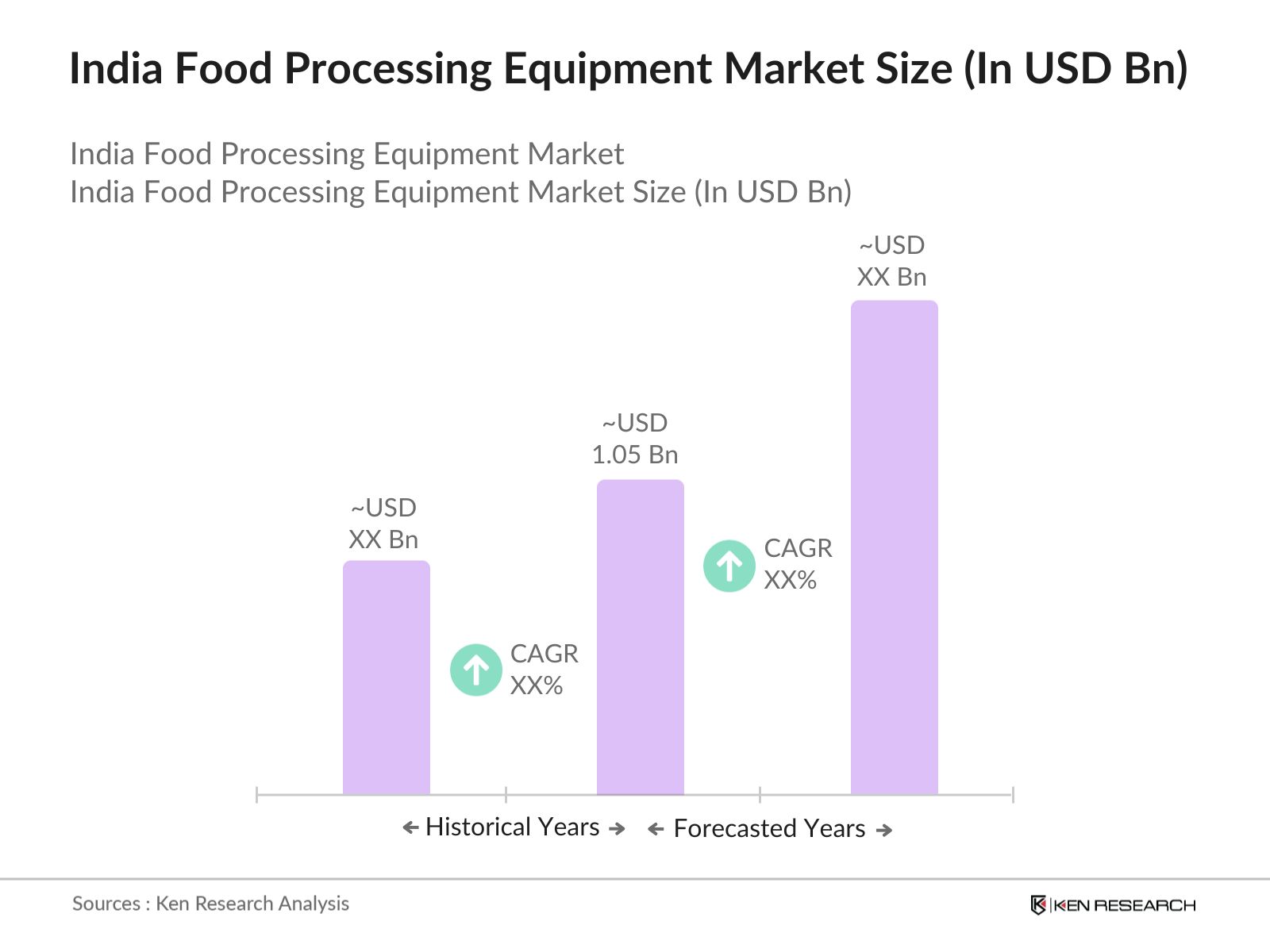
  • The India food processing equipment market is valued at USD 1.05 billion, driven primarily by the expanding demand for packaged and processed foods, technological advancements in processing equipment, and government initiatives aimed at boosting the food processing sector. As urbanization and disposable incomes increase, consumers are shifting towards convenient, ready-to-eat food options, propelling growth in the industry. This momentum is supported by policies like the Pradhan Mantri Kisan SAMPADA Yojana, designed to enhance food supply chain efficiency and support equipment demand across the country.

India Food Processing Equipment Market Size

  • Major demand centers for food processing equipment in India include New Delhi, Mumbai, and Bengaluru. These regions dominate due to well-established infrastructure, significant investments in food processing hubs, and a high concentration of food manufacturing companies. Additionally, proximity to ports and key transportation networks provides logistical advantages, further strengthening these regions roles as prominent hubs in the market.
  • India permits 100% FDI in food processing under the automatic route, encouraging foreign investment in the sector. This policy has resulted in a USD 870 million increase in FDI in the past year, according to the Ministry of Commerce, strengthening the domestic food processing equipment industry by attracting global technologies and expertise.

India Food Processing Equipment Market Segmentation

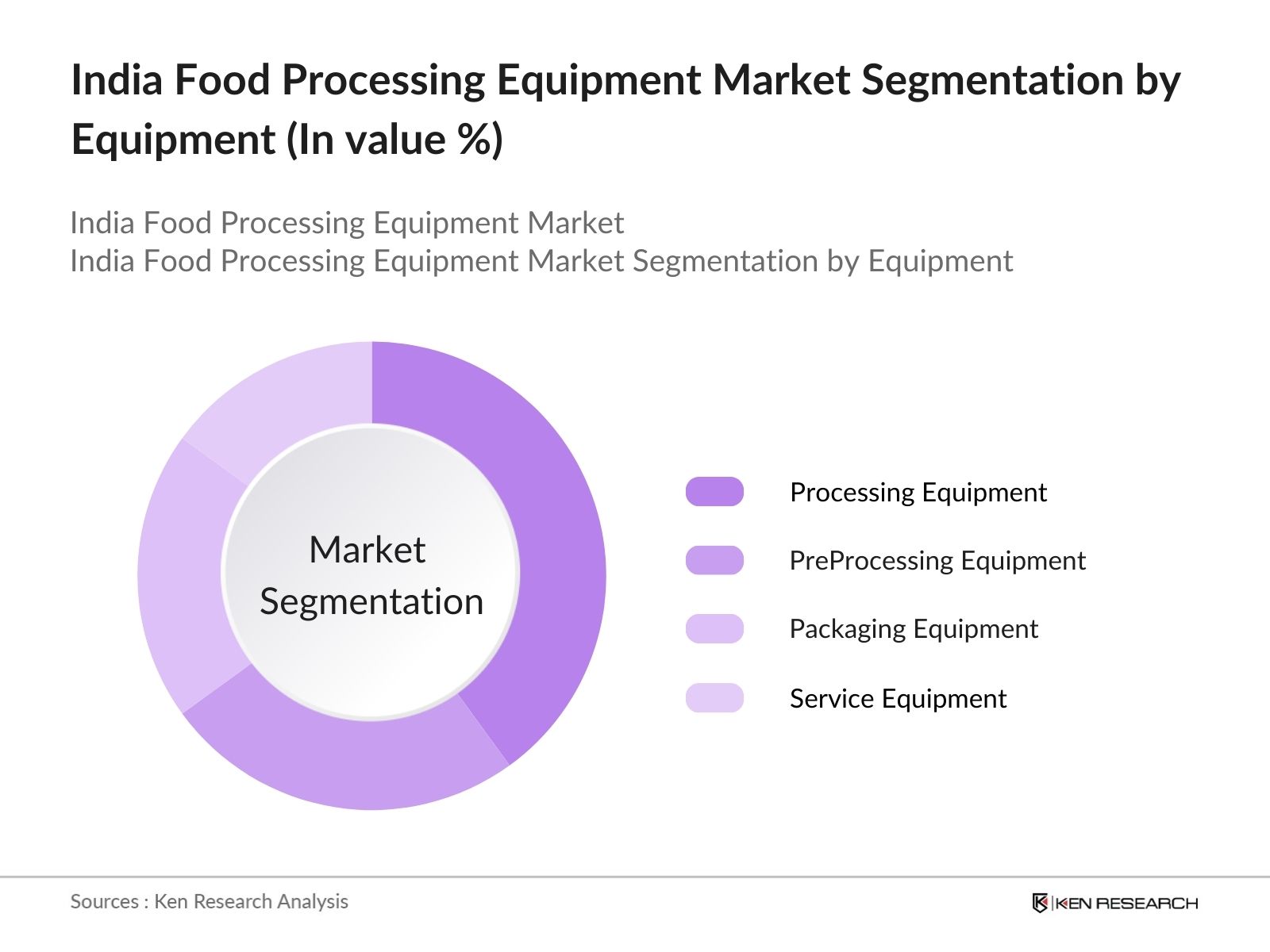
  • By Equipment Type: The market is segmented by equipment type into processing equipment, preprocessing equipment, packaging equipment, and service equipment. Recently, processing equipment holds a dominant market share under this segmentation. This trend can be attributed to the extensive usage of processing equipment in various food preparation stages, including grinding, mixing, cooking, and cutting. With increased demand for efficiency, quality control, and largescale production, the food processing industry relies heavily on these machines. Additionally, advanced processing equipment helps maintain safety and hygiene standards, making them indispensable in largescale food processing facilities.

India Food Processing Equipment Market Segmentation By Equipment Type

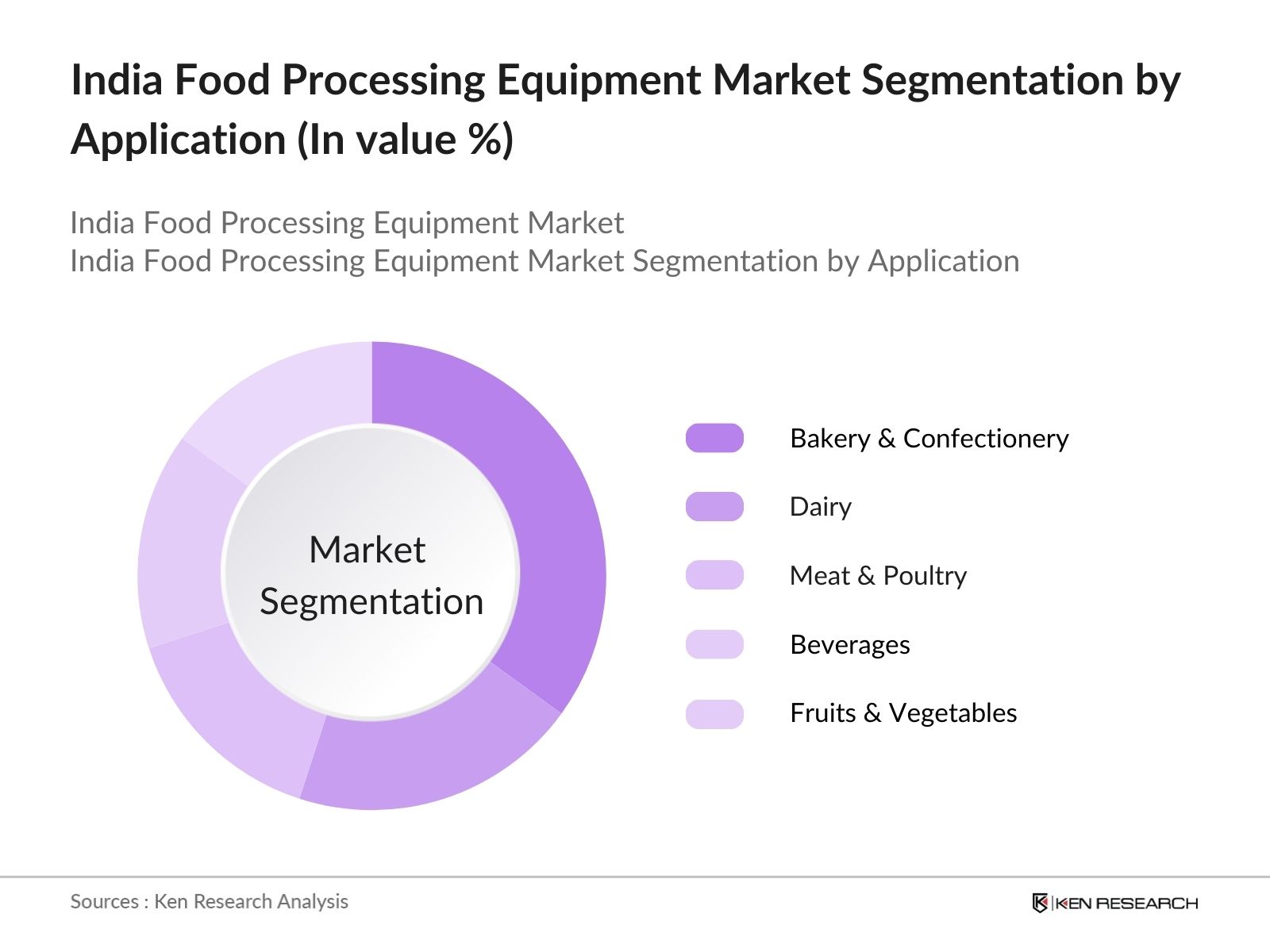
  • By Application: The market is further segmented by application into bakery & confectionery, dairy, meat & poultry, beverages, and fruits & vegetables. Bakery & confectionery applications currently dominate, primarily driven by consumer demand for diverse and convenient baked goods. Equipment such as ovens, mixers, and dough sheeters are in high demand to meet the requirements of both largescale bakeries and smaller establishments. Increased demand for processed bakery items in both urban and rural areas further boosts this segment. Moreover, this categorys growth is fueled by changing consumer preferences and lifestyle patterns, which favor readytoeat and packaged bakery products.

India Food Processing Equipment Market Segmentation By Application

India Food Processing Equipment Market Competitive Landscape

The India food processing equipment market is led by major players who provide diverse product offerings across the food processing sector. These players leverage advanced technologies, strategic investments, and extensive distribution networks to maintain their market positions.

The competitive landscape highlights key players like Alfa Laval, Tetra Pak, and GEA Group, who dominate due to their innovative product ranges, strong market presence, and partnerships with leading Indian food brands.
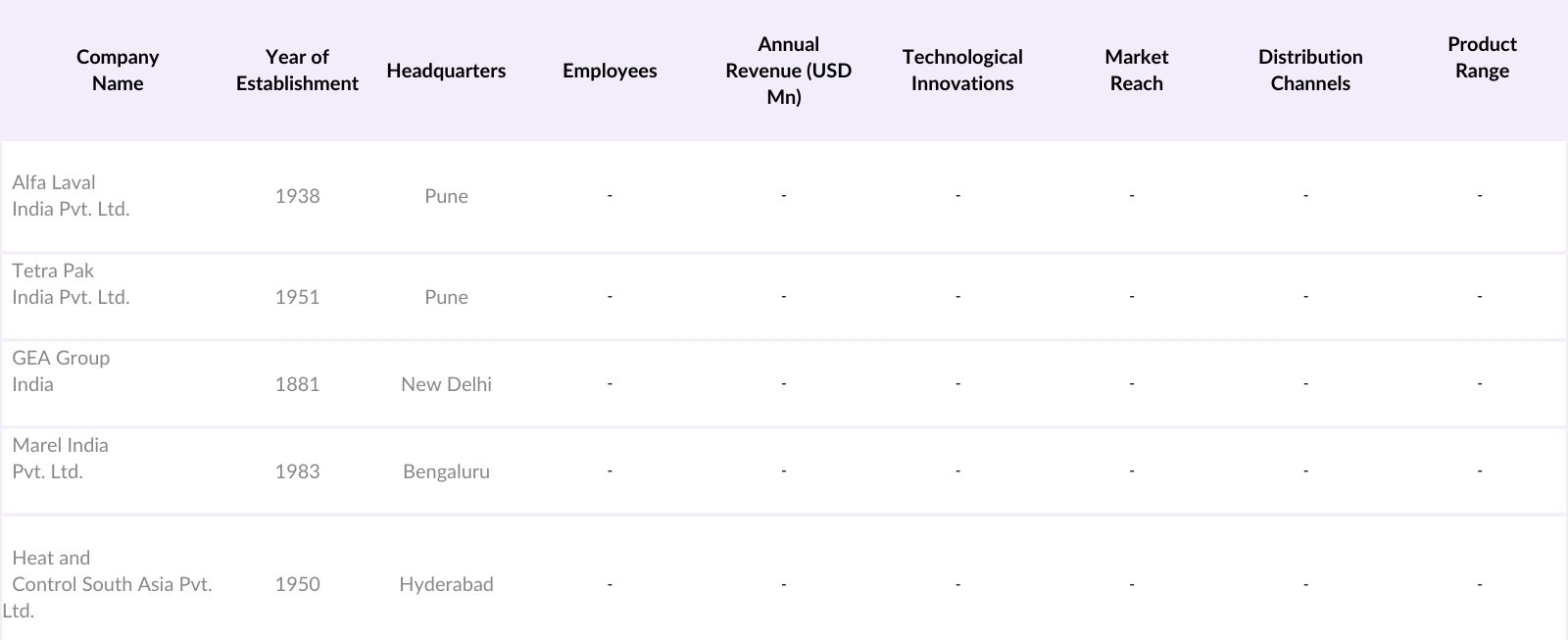
India Food Processing Equipment Market Competitive Landscape

India Food Processing Equipment Market Analysis

Growth Drivers

  • Rapid Urbanization: India's urban population continues to rise, reaching 519 million individuals in 2023, according to the World Bank. This shift to urban areas has led to an increased demand for processed foods, driving the food processing equipment industry forward. With 33% of the population now living in urban areas, the need for efficient food processing equipment is critical to meet this demand in densely populated cities. Urbanization also fuels the growth of modern retail stores, which rely heavily on processed food products, further boosting equipment requirements. Additionally, urban areas contribute over 60% of the total food retail sales in India, highlighting the critical role of equipment in ensuring suppl
  • Rising Disposable Income: Indias disposable income has seen a significant rise, reaching USD 2,500 per capita in the fiscal year of 2023-2024, influenced by sustained GDP growth, which the IMF projects at 6.1% for the year. This increase in disposable income has spurred higher spending on ready-to-eat and processed foods, propelling demand for food processing equipment that enables faster and more efficient production. This increased consumption directly aligns with the growth in equipment deployment for food processing plants nationwide. Notably, urban households spend more on food-related expenses compared to rural households, underscoring the heightened role of advanced equipment in this growth.
  • Changing Consumer Preferences: With a shifting demographic profile, India is witnessing a notable demand for convenience and packaged foods. Recent reports from the Ministry of Consumer Affairs highlight that a major portion of Indian households now prefer processed foods over traditional options due to time constraints and lifestyle changes. This demand for processed products necessitates advanced food processing equipment to ensure quality, safety, and efficiency. The processed food segment accounts for over 30% of total food consumption in India, emphasizing the need for technologically advanced production capabilities.

Challenges

  • High Initial Investment Costs: The average cost of setting up a small to medium-sized food processing unit in India represents a significant financial burden, often deterring new entrants from adopting advanced equipment, particularly for small enterprises. This barrier is more pronounced in semi-urban areas, where access to financing for high-capital equipment remains limited. The lack of affordable financing solutions further exacerbates this challenge for emerging businesses.
  • Technological Obsolescence: Many food processing units in India continue to operate with outdated equipment, risking inefficiencies and reduced quality in production compared to global standards. This challenge drives the need for constant technological upgrades, which entail substantial costs and resource allocation. Adopting modern technology is critical for staying competitive in both domestic and export markets.

India Food Processing Equipment Market Future Outlook

The India Food Processing Equipment Market is expected to experience steady growth, driven by continuous investment in food processing infrastructure, advancements in automation, and increasing consumer demand for packaged foods. Government support for the food processing sector, coupled with innovations in processing and packaging technologies, positions this market for sustained expansion. Equipment manufacturers are likely to benefit from a rising focus on energy efficient, high-capacity machinery, which will help meet future demands while ensuring compliance with stringent safety and quality standards.

Future Market Opportunities

  • Technological Advancements: The adoption of automation technologies, including robotics, has increased efficiency notably in food processing plants, as per the Ministry of Commerce. These advancements improve productivity, quality, and safety, making modern equipment more desirable. With the Indian food industry projected to grow substantially, investment in automation remains a valuable opportunity for both local and international equipment suppliers.
  • Expansion into Rural Markets: Rural India comprises around 60% of the countrys population, representing a vast market for processed foods. As per government statistics, the Ministry of Rural Development has observed a substantial increase in rural consumer spending on processed foods. With targeted government schemes improving rural infrastructure, theres a burgeoning demand for small-scale food processing equipment tailored to these regions unique requirements.

Scope of the Report

By Equipment Type

Processing Equipment
PreProcessing Equipment
Packaging Equipment
Service Equipment

By Application

Bakery & Confectionery
Dairy
Meat & Poultry
Beverages
Fruits & Vegetables

By Mode of Operation

Automatic
SemiAutomatic
Manual

By End Product Form

Solid
SemiSolid
Liquid

By Region

North
South
East
West

Products

Key Target Audience

  • Food Processing Companies

  • Investors and Venture Capitalist Firms

  • Banks and Financial Institutions

  • Government and Regulatory Bodies (Ministry of Food Processing Industries, FSSAI)

  • Packaging Solution Providers

  • Technology Providers for Automation

  • Food Safety and Quality Control Agencies

  • Distributors and Suppliers in the Food Sector

Companies

Players Mentioned in the Report

  • Alfa Laval India Pvt. Ltd.

  • Tetra Pak India Pvt. Ltd.

  • GEA Group India

  • Bhler India Pvt. Ltd.

  • SPX Flow Technology India Pvt. Ltd.

  • Krones India Pvt. Ltd.

  • Marel India Pvt. Ltd.

  • Heat and Control South Asia Pvt. Ltd.

  • JBT Corporation India

  • Middleby Celfrost Innovations Pvt. Ltd.

  • John Bean Technologies India Pvt. Ltd.

  • Multivac Laraon India Pvt. Ltd.

  • Nichrome India Ltd.

  • Bosch Packaging Technology India Pvt. Ltd.

  • Ishida India Pvt. Ltd.

Table of Contents

01 India Food Processing Equipment Market Overview

Definition and Scope

Market Taxonomy

Market Growth Rate

Market Segmentation Overview

02 India Food Processing Equipment Market Size (In INR Billion)

Historical Market Size

YearOnYear Growth Analysis

Key Market Developments and Milestones

03 India Food Processing Equipment Market Analysis

Growth Drivers

Rapid Urbanization

Rising Disposable Income

Changing Consumer Preferences

Government Initiatives

Market Challenges

High Initial Investment Costs

Technological Obsolescence

Regulatory Compliance

Opportunities

Technological Advancements

Expansion into Rural Markets

Export Potential

Trends

Automation and Industry 4.0 Adoption

Integration of IoT in Equipment

Emphasis on Energy Efficiency

Government Regulations

FDI Policies in Food Processing

Food Safety and Standards Authority of India (FSSAI) Guidelines

Subsidies and Incentives for Equipment Upgradation

SWOT Analysis

Stakeholder Ecosystem

Porters Five Forces Analysis

Competitive Landscape

04 India Food Processing Equipment Market Segmentation

By Equipment Type (In Value %)

Processing Equipment

PreProcessing Equipment

Packaging Equipment

Service Equipment

By Mode of Operation (In Value %)

Automatic

SemiAutomatic

Manual

By Form of End Product (In Value %)

Solid

SemiSolid

Liquid

By Application (In Value %)

Bakery & Confectionery Products

Meat & Poultry Products

Fish & Seafood

Dairy Products

Alcoholic Beverages

NonAlcoholic Beverages

Others

By Region (In Value %)

North India

South India

East India

West India

05 India Food Processing Equipment Market Competitive Analysis

Detailed Profiles of Major Companies

Alfa Laval India Pvt. Ltd.

Tetra Pak India Pvt. Ltd.

GEA Group India

Bhler India Pvt. Ltd.

SPX Flow Technology India Pvt. Ltd.

Krones India Pvt. Ltd.

Marel India Pvt. Ltd.

Heat and Control South Asia Pvt. Ltd.

JBT Corporation India

Middleby Celfrost Innovations Pvt. Ltd.

John Bean Technologies India Pvt. Ltd.

Multivac Laraon India Pvt. Ltd.

Nichrome India Ltd.

Bosch Packaging Technology India Pvt. Ltd.

Ishida India Pvt. Ltd.

Cross Comparison Parameters (Number of Employees, Headquarters, Inception Year, Revenue, Product Portfolio, Market Share, Regional Presence, Technological Innovations)

Market Share Analysis

Strategic Initiatives

Mergers and Acquisitions

Investment Analysis

Venture Capital Funding

Government Grants

Private Equity Investments

06 India Food Processing Equipment Market Regulatory Framework

Environmental Standards

Compliance Requirements

Certification Processes

07 India Food Processing Equipment Future Market Size (In INR Billion)

Future Market Size Projections

Key Factors Driving Future Market Growth

08 India Food Processing Equipment Future Market Segmentation

By Equipment Type (In Value %)

By Mode of Operation (In Value %)

By Form of End Product (In Value %)

By Application (In Value %)

By Region (In Value %)

09 India Food Processing Equipment Analysts Recommendations

Total Addressable Market (TAM), Serviceable Available Market (SAM), Serviceable Obtainable Market (SOM) Analysis

Customer Cohort Analysis

Marketing Initiatives

White Space Opportunity Analysis

Disclaimer Contact Us

Research Methodology

Step 1: Identification of Key Variables


The initial phase involves constructing a comprehensive ecosystem map of the Indian Food Processing Equipment Market, gathering insights from secondary research sources, and identifying critical variables such as consumer preferences, regulatory impacts, and technological advancements.

Step 2: Market Analysis and Construction


This phase focuses on collecting and analyzing historical data on equipment usage, production efficiency, and revenue generation. Data is evaluated across different product types to understand the growth trajectories of individual segments.

Step 3: Hypothesis Validation and Expert Consultation


Market hypotheses are formulated based on preliminary findings and validated through interviews with industry experts. Insights are collected from leading equipment manufacturers, distributors, and endusers, offering realtime operational perspectives.

Step 4: Research Synthesis and Final Output


The final phase involves synthesizing primary and secondary research findings, ensuring a robust dataset to support market conclusions. This step includes validation from leading stakeholders, finalizing a comprehensive, datadriven report on the India Food Processing Equipment Market.

Frequently Asked Questions

01. How big is the India Food Processing Equipment Market?

The India Food Processing Equipment Market is valued at USD 1.05 billion, driven by rising demand for processed foods and infrastructure development initiatives.

02. What challenges does the India Food Processing Equipment Market face?

Challenges in the India Food Processing Equipment Market include high initial costs for machinery, regulatory compliance hurdles, and the need for skilled operators to manage advanced equipment.

03. Who are the major players in the India Food Processing Equipment Market?

Key players in the India Food Processing Equipment Market include Alfa Laval India Pvt. Ltd., Tetra Pak India Pvt. Ltd., GEA Group India, Marel India Pvt. Ltd., and Heat and Control South Asia Pvt. Ltd., which dominate due to their advanced technology offerings and extensive product portfolios.

04. What factors are driving growth in the India Food Processing Equipment Market?

The India Food Processing Equipment Market is driven by increasing demand for packaged foods, government support for food processing infrastructure, and innovations in food processing technology.

Why Buy From Us?

RRR
Refine Robust Result (RRR) Framework

What makes us stand out is that our consultants follows Robust, Refine and Result (RRR) methodology. i.e. Robust for clear definitions, approaches and sanity checking, Refine for differentiating respondents facts and opinions and Result for presenting data with story

Our Reach Is Unmatched

We have set a benchmark in the industry by offering our clients with syndicated and customized market research reports featuring coverage of entire market as well as meticulous research and analyst insights.

Research
Shifting the Research Paradigm

While we don't replace traditional research, we flip the method upside down. Our dual approach of Top Bottom & Bottom Top ensures quality deliverable by not just verifying company fundamentals but also looking at the sector and macroeconomic factors.

Insite
More Insights-Better Decisions

With one step in the future, our research team constantly tries to show you the bigger picture. We help with some of the tough questions you may encounter along the way: How is the industry positioned? Best marketing channel? KPI's of competitors? By aligning every element, we help maximize success.

Trust
Transparency and Trust

Our report gives you instant access to the answers and sources that other companies might choose to hide. We elaborate each steps of research methodology we have used and showcase you the sample size to earn your trust.

support
Round the Clock Support

If you need any support, we are here! We pride ourselves on universe strength, data quality, and quick, friendly, and professional service.

Why Client Choose Us?

400000+ Reports in repository
150+ Consulting project a year
100+ Analysts
8000+ Client Queries in 2022