
India Geographic Information System Market Outlook to 2030
Region:Asia
Author(s):Paribhasha Tiwari
Product Code:KROD10763
December 2024
89
About the Report
India Geographic Information System Market Overview
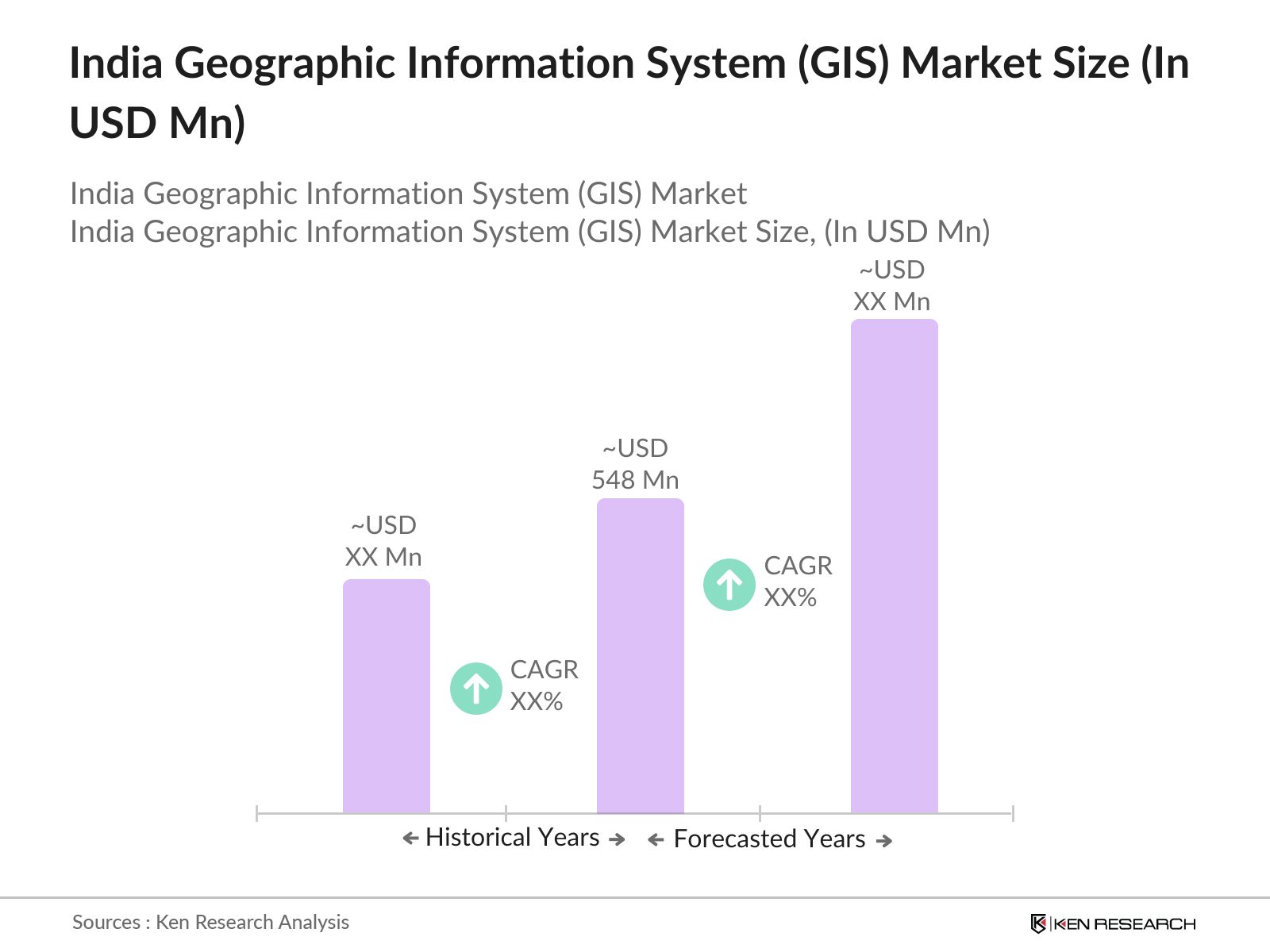
- The India Geographic Information System (GIS) market, valued at USD 548 million, is driven by substantial investments in digital infrastructure and urban planning initiatives. Rising demand from sectors such as agriculture, transportation, and utilities, coupled with government-backed projects like Smart Cities, is bolstering GIS adoption. Technological advancements, including artificial intelligence and machine learning integration within GIS, further enhance the market's growth, offering refined spatial data analysis that fuels decision-making across industries.
- The primary regions leading the India GIS market include Maharashtra, Karnataka, and Delhi NCR, primarily due to their high population density, economic activities, and advanced digital infrastructures. Maharashtra, for example, benefits from Mumbais urban complexity, creating a significant demand for geospatial data, while Karnataka's robust tech ecosystem in Bangalore contributes to GIS technology development. Delhi NCRs focus on infrastructure modernization also propels it as a dominant market region.
- Data localization policies in India mandate that all geospatial data be stored locally to enhance data security and sovereignty. Enforced by the Ministry of Electronics and Information Technology, this regulation supports secure geospatial data management within India. By 2024, an estimated 90% of GIS firms complied with localization policies, ensuring data protection in government-backed GIS projects.
India Geographic Information System Market Segmentation
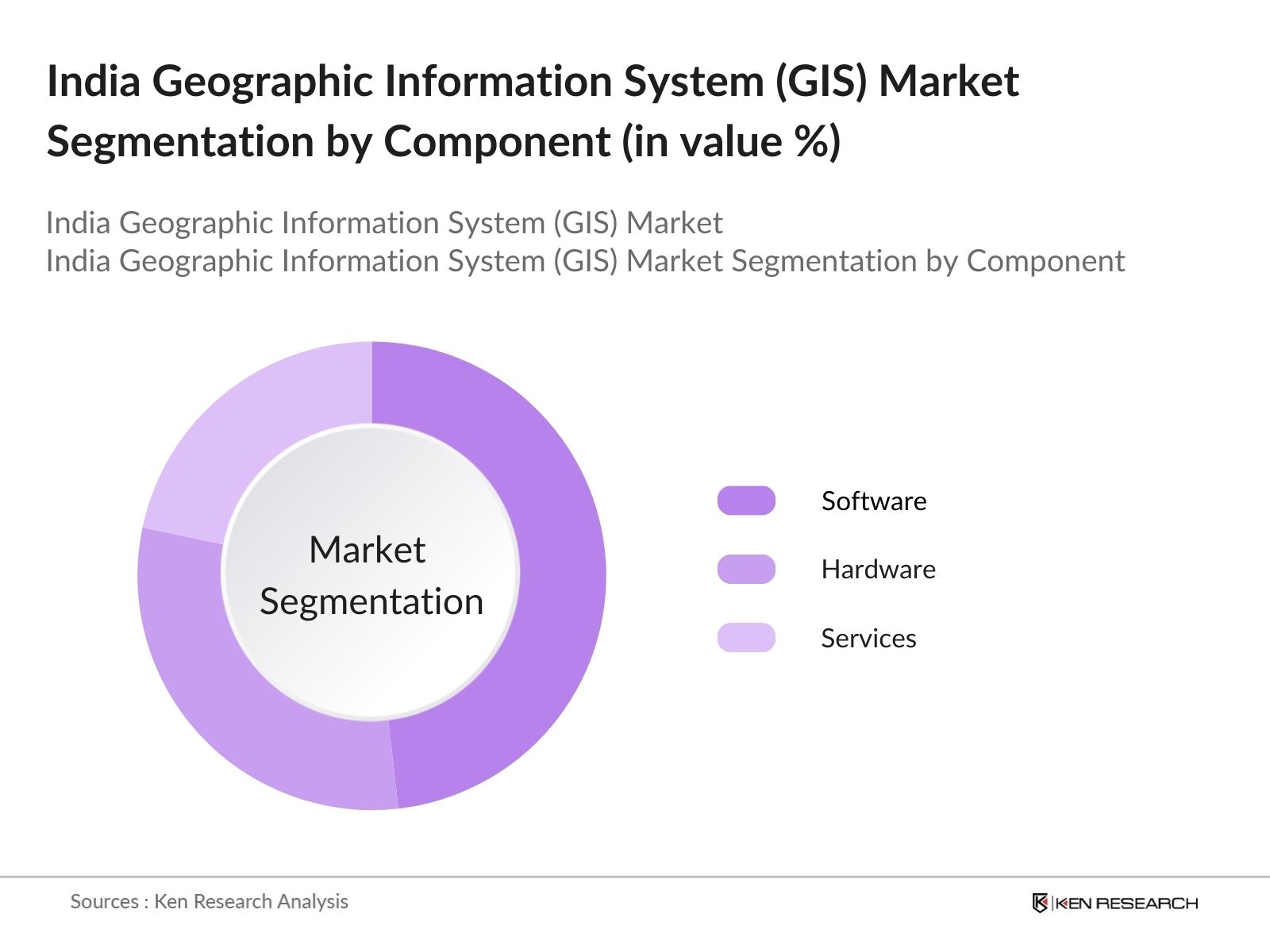
By Component: The India GIS market is segmented by component into software, hardware, and services. Software holds a dominant share due to the increasing integration of GIS applications across industries, offering enhanced functionalities for spatial data management and analysis. Leading GIS software providers have expanded their offerings, driving adoption in areas like transportation and urban planning where real-time data analysis is critical for effective operations.
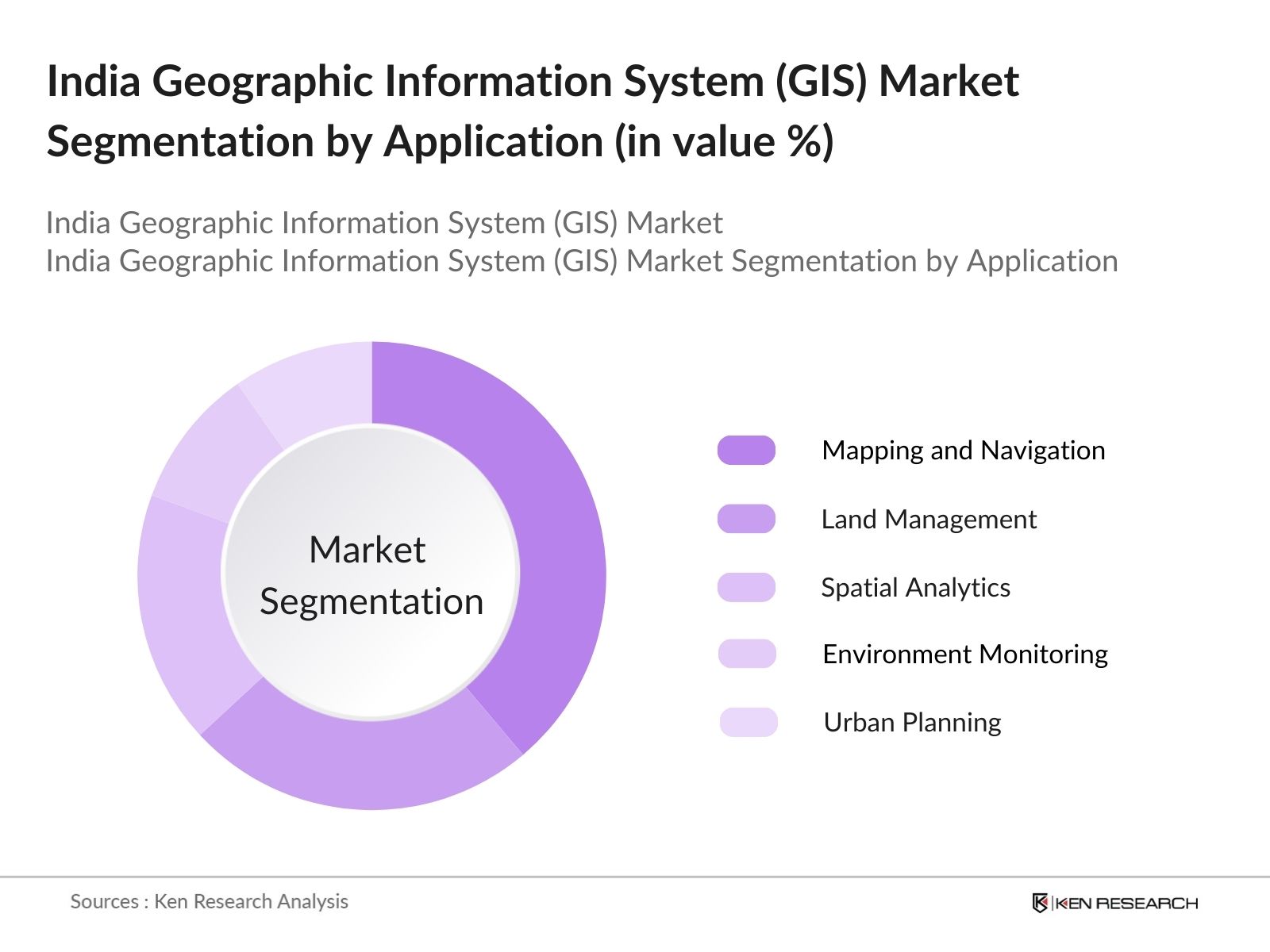
By Application: The GIS market in India is segmented by application into mapping and navigation, land management, spatial analytics, environment monitoring, and urban planning. Mapping and navigation lead this segment, with widespread usage in transportation, logistics, and navigation services. Increasing demand for location-based services has reinforced this segment's market share as industries seek efficient routing and asset tracking solutions.
India Geographic Information System Market Competitive Landscape
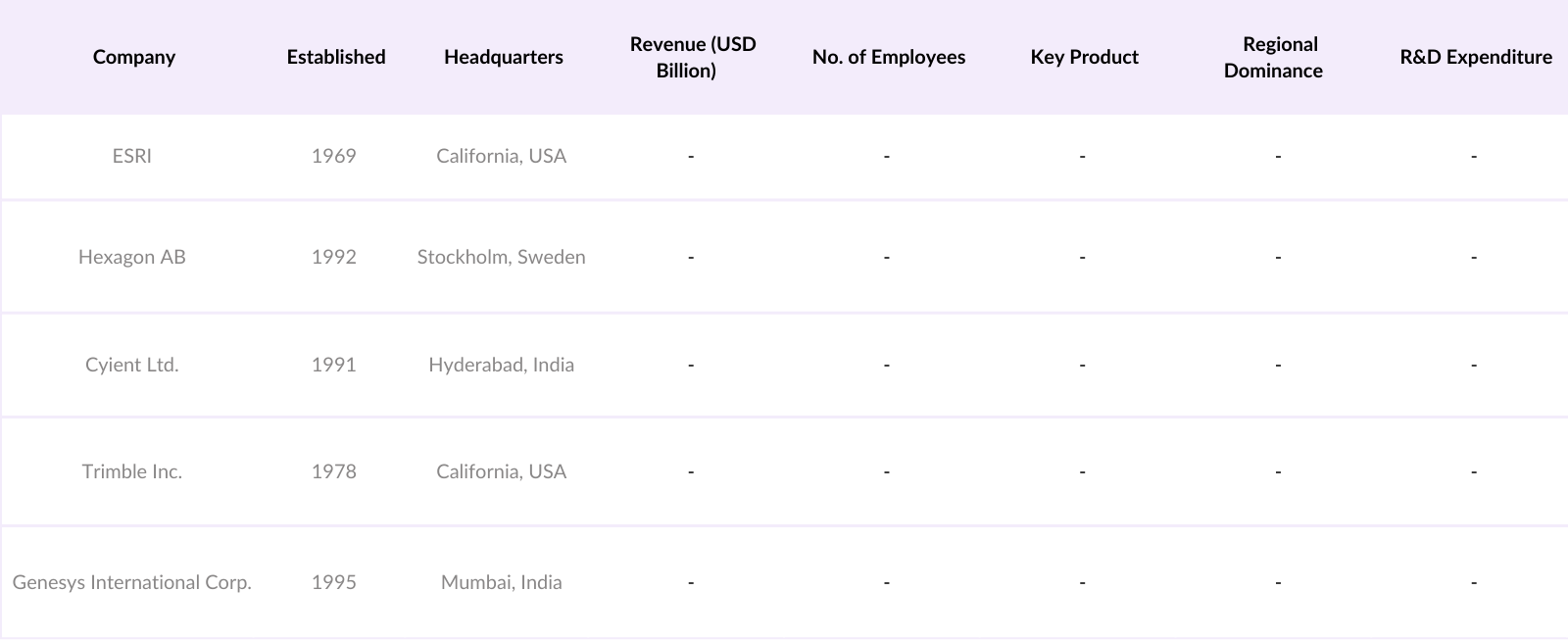
The India GIS market is dominated by a few key players, including global giants and local companies with significant influence across various applications. Leading players have built a stronghold by offering innovative solutions tailored to India's diverse industry needs.
India Geographic Information System (GIS) Market Analysis
Growth Drivers
- Increased Government Investments in Digital Infrastructure: India's government has prioritized digital infrastructure with substantial investments to strengthen GIS integration across sectors. In 2023, the Indian Ministry of Electronics and Information Technology allocated INR 9,000 crores to bolster digital services and improve geospatial data access across states. This investment has expanded GIS adoption in areas like transport and urban planning, aligning with the Digital India initiative, which aims to digitally empower various sectors. World Bank statistics show Indias digital infrastructure growth rate has increased by 12% annually since 2022, supporting enhanced GIS deployment in real-time mapping and data analytics.
- Urbanization and Smart City Initiatives: Indias rapid urbanization has accelerated GIS implementation, especially in smart city projects. By 2024, Indias urban population reached approximately 480 million, as noted by the Ministry of Housing and Urban Affairs. GIS applications are essential for infrastructure planning in Smart Cities Mission, covering 100 cities, with INR 2,05,018 crore earmarked for projects such as intelligent traffic management and waste management systems. This funding directly supports real-time geospatial solutions for urban challenges, making GIS vital to smart city frameworks.
- Integration of GIS with Artificial Intelligence and Machine Learning: The integration of GIS with AI and ML technologies has expanded data processing capabilities, leading to more efficient geospatial data analysis. The Indian government allocated INR 3,700 crore in the National Geospatial Programme in 2023 to foster AI-driven geospatial technologies. This investment facilitates AI-powered mapping and predictive analytics in sectors like agriculture, water resources, and urban planning. The integration of AI with GIS enables higher data accuracy and real-time applications, thus enhancing decision-making capabilities for state and local governments.
Market Challenges
- High Implementation Costs: Implementing GIS technology remains costly, with state governments reporting average initial investments of INR 1,500 crore per major urban project. High costs associated with software, infrastructure, and data integration, particularly for small cities and rural areas, restrict widespread GIS adoption. The Ministry of Finance has acknowledged this in its 2024 Economic Survey, identifying cost barriers as a critical challenge in digital infrastructure, including GIS.
- Ministry of Finance Source.
- Data Privacy and Security Concerns: Data security has posed significant challenges, especially with the increasing integration of GIS in government projects. In 2024, the Ministry of Electronics and Information Technology reported a 35% rise in cyber threats targeting geospatial data, reflecting rising security concerns. Policies on data localization and privacy, particularly after the implementation of the Personal Data Protection Act, have introduced stringent measures to protect sensitive GIS data, yet compliance costs remain high for organizations.
India Geographic Information System Market Future Outlook
The India GIS market is expected to experience sustained growth, supported by continuous advancements in digital technologies, rising demand for geospatial data across public and private sectors, and increased investments in smart infrastructure projects. As GIS applications expand into more sectors, they will offer improved spatial intelligence, optimizing planning and operations for government agencies and businesses alike. The integration of AI and big data analytics will play a crucial role in expanding the capabilities of GIS, potentially enhancing decision-making across various domains.
Market Opportunities
- Expansion into Rural and Agricultural Applications: GIS technology has vast potential in Indias agriculture sector, where it aids in precision farming, water resource management, and crop yield analysis. The Ministry of Agriculture allocated INR 2,000 crore in 2023 to integrate GIS solutions in agriculture, reaching an estimated 120 million rural farmers. GIS enables efficient land use and resource management, boosting productivity while reducing environmental impact. This technology offers significant potential in enhancing Indias agricultural sustainability.
- Development of Cloud-Based GIS Solutions: Cloud-based GIS adoption is increasing, offering scalable and cost-effective solutions for organizations. According to the National Informatics Centre, cloud-based GIS use grew by 22% in 2023, as organizations sought solutions that reduce infrastructure expenses. The Indian government invested INR 1,200 crore in the Cloud India initiative to foster cloud adoption across sectors, supporting growth opportunities for GIS providers.
Scope of the Report
|
By Component |
Software Hardware Services |
|
By End-User |
Government and Defense Transportation and Logistics Natural Resources Utilities Agriculture |
|
By Technology |
Remote Sensing LiDAR Aerial Photography 3D Modeling Data Visualization |
|
By Application |
Mapping and Navigation Land Management Spatial Analytics Environment Monitoring Urban Planning |
|
By Region |
North South East West |
Products
Key Target Audience
GIS Technology Providers
Public Sector Utilities and Urban Planning Departments
Agriculture and Natural Resources Companies
Transportation and Logistics Companies
Environmental Monitoring and Conservation Agencies
Investment and Venture Capitalist Firms
Real Estate Development Companies
Government and Regulatory Bodies (Ministry of Electronics and Information Technology, Department of Science and Technology)
Companies
Players Mentioned in the report:
ESRI
Hexagon AB
Cyient Ltd.
Trimble Inc.
Genesys International Corporation
Bentley Systems
Autodesk Inc.
SuperMap Software Co. Ltd.
Fugro N.V.
MappointAsia
Table of Contents
1. India Geographic Information System (GIS) Market Overview
1.1 Definition and Scope
1.2 Market Taxonomy
1.3 Key Metrics (Geospatial Data, Technology Integration, Public and Private Sector Application)
1.4 Market Segmentation Overview
2. India Geographic Information System (GIS) Market Size (In USD Billion)
2.1 Historical Market Size
2.2 Year-On-Year Growth Analysis
2.3 Key Market Developments and Milestones
3. India Geographic Information System (GIS) Market Analysis
3.1 Growth Drivers
3.1.1 Increased Government Investments in Digital Infrastructure
3.1.2 Urbanization and Smart City Initiatives
3.1.3 Integration of GIS with Artificial Intelligence and Machine Learning
3.1.4 Rising Demand for Real-Time Geospatial Data
3.2 Market Challenges
3.2.1 High Implementation Costs
3.2.2 Data Privacy and Security Concerns
3.2.3 Limited Skilled Workforce
3.2.4 Complexity in Data Integration Across Platforms
3.3 Opportunities
3.3.1 Expansion into Rural and Agricultural Applications
3.3.2 Development of Cloud-Based GIS Solutions
3.3.3 Increased Use of GIS in Disaster Management and Environmental Monitoring
3.4 Trends
3.4.1 Adoption of GIS for Logistics and Supply Chain Optimization
3.4.2 Growth of Location-Based Services
3.4.3 Integration with IoT and 5G Networks
3.5 Government Regulation
3.5.1 National Geospatial Policy
3.5.2 Data Localization Requirements
3.5.3 Government GIS Infrastructure Investments
3.6 SWOT Analysis
3.7 Stake Ecosystem (Stakeholders Analysis: Government Bodies, Private Firms, Technology Providers)
3.8 Porters Five Forces
3.9 Competition Ecosystem
4. India Geographic Information System (GIS) Market Segmentation
4.1 By Component (In Value %)
4.1.1 Software
4.1.2 Hardware
4.1.3 Services
4.2 By End-User Industry (In Value %)
4.2.1 Government and Defense
4.2.2 Transportation and Logistics
4.2.3 Natural Resources
4.2.4 Utilities
4.2.5 Agriculture
4.3 By Technology (In Value %)
4.3.1 Remote Sensing
4.3.2 LiDAR
4.3.3 Aerial Photography
4.3.4 3D Modeling
4.3.5 Data Visualization
4.4 By Application (In Value %)
4.4.1 Mapping and Navigation
4.4.2 Land Management
4.4.3 Spatial Analytics
4.4.4 Environment Monitoring
4.4.5 Urban Planning
4.5 By Region (In Value %)
4.5.1 North India
4.5.2 South India
4.5.3 East India
4.5.4 West India
5. India Geographic Information System (GIS) Market Competitive Analysis
5.1 Detailed Profiles of Major Companies
5.1.1 ESRI
5.1.2 Hexagon AB
5.1.3 Trimble Inc.
5.1.4 Autodesk, Inc.
5.1.5 Bentley Systems
5.1.6 GEOVIS
5.1.7 SuperMap Software Co., Ltd.
5.1.8 RMSI Pvt. Ltd.
5.1.9 Cyient Ltd.
5.1.10 Spatial Networks, Inc.
5.1.11 MappointAsia
5.1.12 Genesys International Corporation
5.1.13 Fugro N.V.
5.1.14 Rolta India Ltd.
5.1.15 TIBCO Software Inc.
5.2 Cross Comparison Parameters (Revenue, Employee Count, Headquarters, Geographic Reach, Key Clients, Partnerships, Technological Capabilities, R&D Spending)
5.3 Market Share Analysis
5.4 Strategic Initiatives
5.5 Mergers And Acquisitions
5.6 Investment Analysis
5.7 Venture Capital Funding
5.8 Government Grants
5.9 Private Equity Investments
6. India Geographic Information System (GIS) Market Regulatory Framework
6.1 Data Privacy Laws
6.2 Compliance Requirements for GIS Data
6.3 Certification and Standards (ISO, National Standards)
7. India Geographic Information System (GIS) Future Market Size (In USD Billion)
7.1 Future Market Size Projections
7.2 Key Factors Driving Future Market Growth
8. India Geographic Information System (GIS) Future Market Segmentation
8.1 By Component (In Value %)
8.2 By End-User Industry (In Value %)
8.3 By Technology (In Value %)
8.4 By Application (In Value %)
8.5 By Region (In Value %)
9. India Geographic Information System (GIS) Market Analysts Recommendations
9.1 Total Addressable Market (TAM)/Serviceable Available Market (SAM)/Serviceable Obtainable Market (SOM) Analysis
9.2 Customer Cohort Analysis
9.3 Marketing Initiatives
9.4 White Space Opportunity Analysis
Disclaimer Contact UsResearch Methodology
Step 1: Identification of Key Variables
This step involves mapping out the ecosystem for Indias GIS market, focusing on all significant stakeholders and industry influencers. Key data sources include government databases and proprietary market research platforms to capture the variables influencing market trends.
Step 2: Market Analysis and Construction
Historical data for Indias GIS market is gathered and analyzed, examining market penetration rates across primary sectors like agriculture and transportation. Industry performance indicators, including revenue and adoption rates, are evaluated to form a precise market structure.
Step 3: Hypothesis Validation and Expert Consultation
Data validation is conducted through interviews with industry experts from both public and private sectors. This approach ensures the accuracy of collected data, incorporating insights from industry practitioners on operational dynamics.
Step 4: Research Synthesis and Final Output
In this stage, data is synthesized into a detailed report, with inputs from key market stakeholders. The final report is validated through cross-referencing with multiple data sources, ensuring a comprehensive and credible analysis of Indias GIS market.
Frequently Asked Questions
01. How big is the India Geographic Information System (GIS) Market?
The India GIS market was valued at USD 548 million, driven by strong government support for digital transformation, coupled with increased adoption across key industries such as agriculture, transportation, and utilities.
02. What are the challenges in the India GIS Market?
Challenges in the India GIS market include high initial costs of GIS infrastructure, data privacy concerns, and limited availability of skilled professionals. These factors can hinder the widespread adoption of GIS technologies across smaller enterprises and rural sectors.
03. Who are the major players in the India GIS Market?
Key players in the India GIS market include ESRI, Hexagon AB, Cyient Ltd., Trimble Inc., and Genesys International Corporation. These companies maintain dominance through a mix of technological innovation, robust industry networks, and established client relationships.
04. What are the growth drivers of the India GIS Market?
Growth drivers of the India GIS market include government initiatives like the Smart Cities Mission, demand for accurate spatial data, and advancements in AI and machine learning, which enhance the analytical capabilities of GIS solutions.
Why Buy From Us?

What makes us stand out is that our consultants follows Robust, Refine and Result (RRR) methodology. i.e. Robust for clear definitions, approaches and sanity checking, Refine for differentiating respondents facts and opinions and Result for presenting data with story

We have set a benchmark in the industry by offering our clients with syndicated and customized market research reports featuring coverage of entire market as well as meticulous research and analyst insights.

While we don't replace traditional research, we flip the method upside down. Our dual approach of Top Bottom & Bottom Top ensures quality deliverable by not just verifying company fundamentals but also looking at the sector and macroeconomic factors.

With one step in the future, our research team constantly tries to show you the bigger picture. We help with some of the tough questions you may encounter along the way: How is the industry positioned? Best marketing channel? KPI's of competitors? By aligning every element, we help maximize success.

Our report gives you instant access to the answers and sources that other companies might choose to hide. We elaborate each steps of research methodology we have used and showcase you the sample size to earn your trust.

If you need any support, we are here! We pride ourselves on universe strength, data quality, and quick, friendly, and professional service.