
India Gesture Recognition Market Outlook to 2030
Region:India
Author(s):Shubham Kashyap
Product Code:KROD3392
Region:India
Author(s):Shubham Kashyap
Product Code:KROD3392
October 2024
97
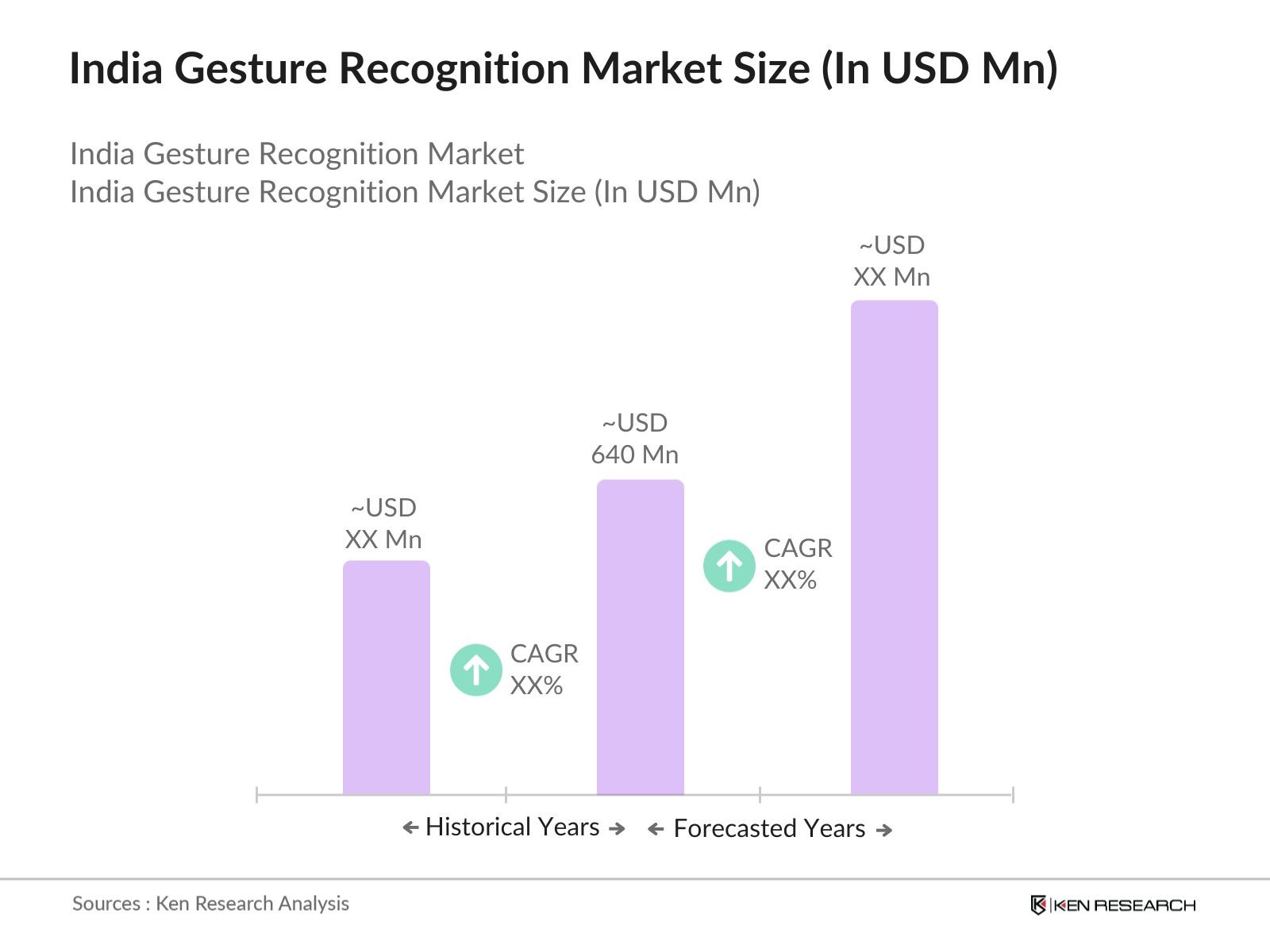
The India Gesture Recognition market is valued at USD 640 million, reflecting the growing adoption of touchless technologies across sectors such as automotive, healthcare, consumer electronics, and gaming. The gesture recognition market in India has been witnessing rapid growth, primarily driven by the increasing demand for contactless interaction, advancements in sensor technology, and the rising adoption of smart devices. The market is also gaining momentum with the integration of gesture recognition systems in augmented reality (AR) and virtual reality (VR) applications, particularly in gaming and entertainment.
Major hubs for gesture recognition technology development in India include Bengaluru, Hyderabad, and Pune, where there is a robust ecosystem of tech startups and research institutions. These cities have seen significant investments from both global tech companies and domestic enterprises to enhance their gesture recognition capabilities, focusing on innovation in artificial intelligence (AI) and machine learning (ML) algorithms.
The government's push for digitalization and smart city initiatives has further accelerated the growth of gesture recognition technology. Moreover, the COVID-19 pandemic has heightened the demand for touchless technology solutions, as industries increasingly shift towards contactless interfaces to reduce the risk of virus transmission in public spaces.
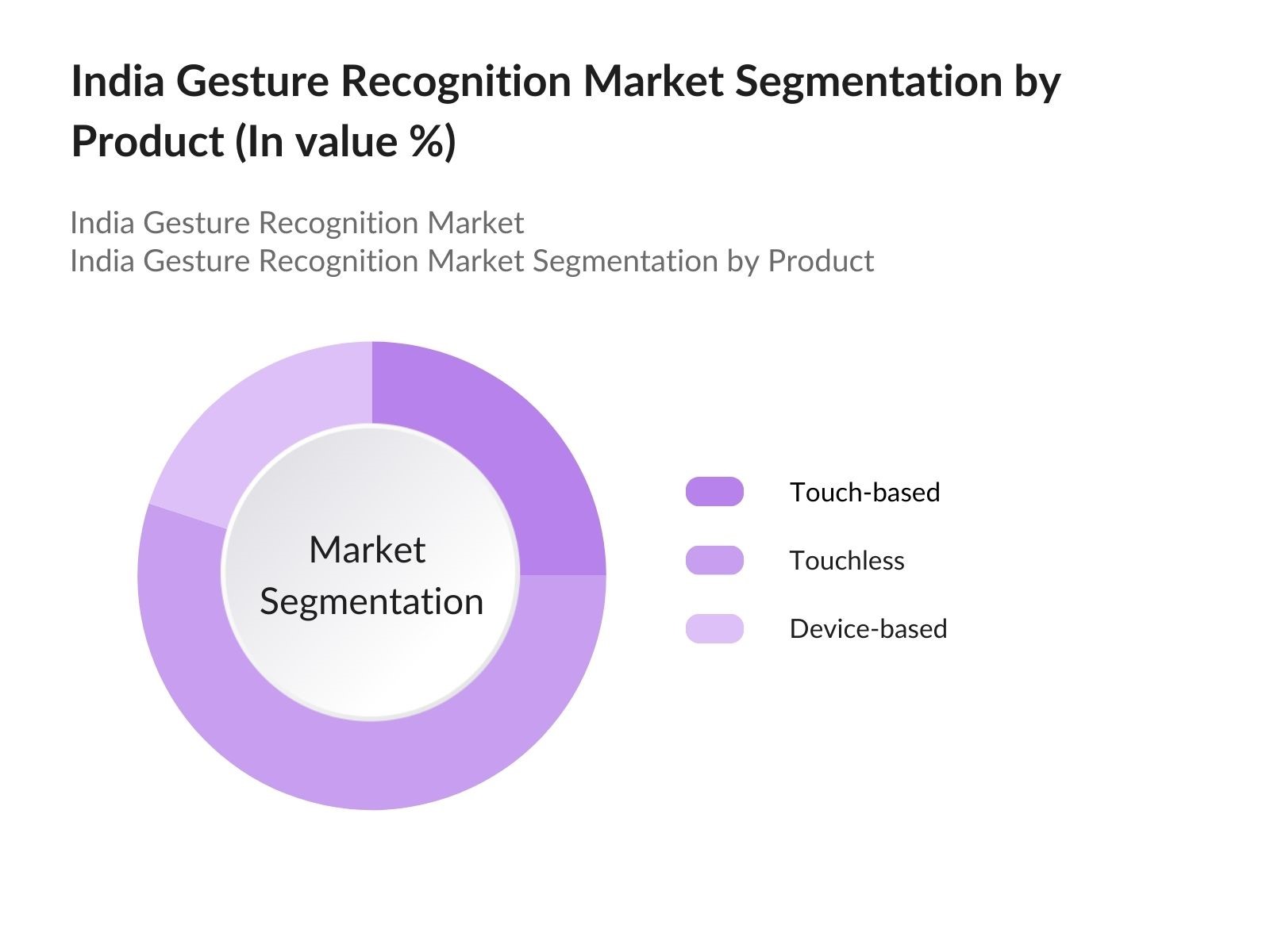
By Product Type: The market is segmented by product type into touch-based, touchless, and device-based gesture recognition systems. Touchless systems hold a dominant market share due to their increasing applications in automotive and consumer electronics. These systems, leveraging technologies like infrared sensors and 3D cameras, have found widespread use in smartphones, laptops, and smart home devices. Touch-based systems, though less prevalent, remain relevant in gaming and medical sectors, where precision and real-time feedback are crucial.
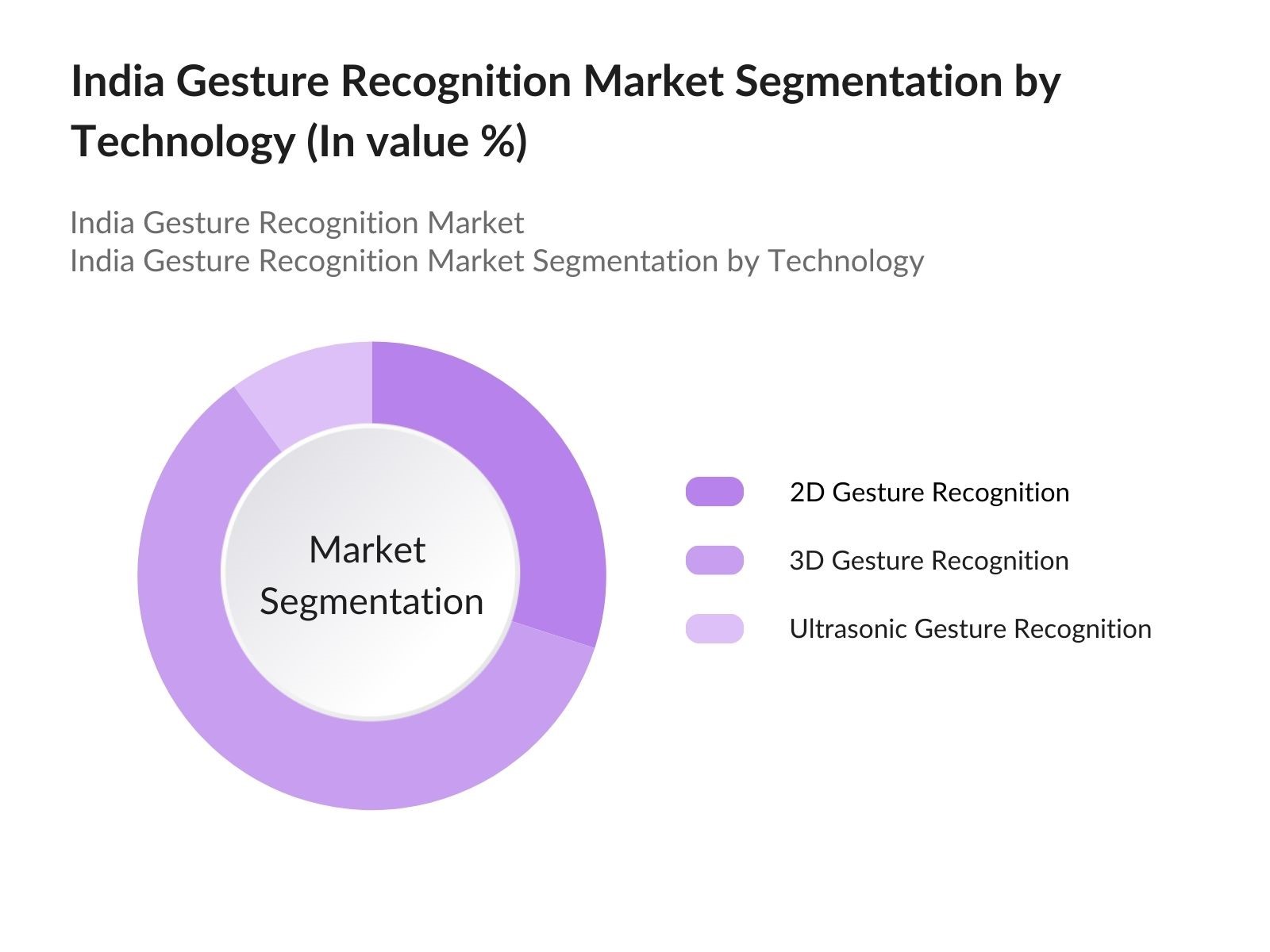
By Technology: The market is segmented by technology into 2D, 3D, and ultrasonic gesture recognition technologies. 3D gesture recognition technology, with its application in automotive, gaming, and consumer electronics, holds the largest share, driven by its enhanced accuracy and immersive user experience. Ultrasonic technology is gaining traction in healthcare, where touchless control is essential for maintaining hygiene standards during surgical procedures and patient care.
The India Gesture Recognition market is highly competitive, with a mix of domestic and international players driving innovation and adoption. Key companies such as Intel, Cognitec Systems, GestureTek, Microsoft, and Leap Motion dominate the market, leveraging strategic partnerships, advancements in AI, and the expansion of R&D capabilities to maintain their competitive edge.
|
Company Name |
Establishment Year |
Headquarters |
Revenue (2023) |
Employees |
Key Products |
R&D Investment |
Key Clients |
Partnerships |
|
Intel |
1968 |
USA |
||||||
|
Cognitec Systems |
2002 |
Germany |
||||||
|
GestureTek |
1986 |
Canada |
||||||
|
Microsoft |
1975 |
USA |
||||||
|
Leap Motion |
2010 |
USA |
Increasing Demand for Touchless Technology: The adoption of touchless technologies is witnessing significant growth, particularly in India's automotive and consumer electronics sectors. The Indian automotive industry produced over 27 million vehicles in 2023, with several manufacturers incorporating gesture recognition to enhance in-car systems, promoting safer and more convenient operations. In consumer electronics, smartphones, tablets, and other smart devices are rapidly integrating gesture-based controls to offer intuitive user experiences. India's electronics market witnessed remarkable growth in 2022, with gesture recognition being a pivotal technology driving growth in these industries.
Rise in Smart Devices (Smartphones, Wearables): India's smart devices market is rapidly expanding, fueled by the country's increasing adoption of smartphones and wearables. Over 931 million smartphone users were recorded in 2023, with wearables such as smartwatches becoming increasingly popular, expected to reach 83 million units by 2024. Gesture recognition technology, particularly in wearables, enhances user interaction, offering contactless control, fitness tracking, and health monitoring. This surge in smart devices, alongside India's youthful, tech-savvy population, is contributing significantly to the demand for gesture recognition technologies.
Expanding Applications in Healthcare and Automotive: Gesture recognition technology is increasingly being adopted in India’s healthcare sector, enabling contactless controls in surgery rooms, patient monitoring, and telemedicine. The Indian healthcare market grew exceptionally in 2023 as a result hospitals are gradually integrating such technology to ensure sterile environments and seamless interactions. In the automotive industry, India's shift towards electric vehicles (EVs) and connected cars is spurring the adoption of gesture control for enhanced driver safety and entertainment systems.
High Costs of Advanced Gesture Recognition Systems: Implementing 3D and AI-based gesture recognition systems remains expensive, particularly in price-sensitive markets like India. The cost of integrating these technologies into consumer electronics and automobiles is a deterrent for manufacturers targeting mass-market segments. The high capital required for these advanced systems is slowing the adoption rate in sectors like consumer electronics and healthcare, as companies face challenges in balancing innovation with affordability.
Limited Awareness and Adoption in Small and Medium Enterprises (SMEs): SMEs play a vital role in India's economic landscape. However, awareness about the potential benefits of gesture recognition technology remains low among SMEs. Many small and medium enterprises lack the technical knowledge and resources to adopt these technologies. This has led to slow uptake of gesture recognition systems, particularly in sectors such as manufacturing, retail, and education, where this technology could streamline operations and enhance customer experiences.
The India Gesture Recognition market is expected to experience substantial growth through 2028, driven by the increasing demand for touchless technologies across automotive, healthcare, and consumer electronics sectors. Innovations in AI and sensor technologies will further enhance the capabilities of gesture recognition systems, broadening their application in emerging industries such as smart homes and industrial automation.
|
By Product Type |
Touch-based Touchless Device-based |
|
By Technology |
2D Gesture Recognition 3D Gesture Recognition Ultrasonic Gesture Recognition |
|
By End-User |
Automotive Healthcare Consumer Electronics Gaming Others |
|
By Component |
Sensors Cameras Software |
|
By Application |
Gaming Automotive Healthcare Smart Home Others |
1.1. Definition and Scope
1.2. Market Taxonomy
1.3. Market Growth Rate (CAGR, Industry Metrics)
1.4. Market Segmentation Overview
1.5. Key Market Developments and Milestones
2.1. Historical Market Size
2.2. Year-On-Year Growth Analysis (Volume, Value, Percentage)
2.3. Key Market Trends (Technological Advancements, Adoption Rates)
3.1. Growth Drivers
3.1.1. Increasing Demand for Touchless Technology (Adoption in Automotive, Consumer Electronics)
3.1.2. Rise in Smart Devices (Smartphones, Wearables)
3.1.3. Technological Advancements (AI, Machine Learning Integration)
3.1.4. Expanding Applications in Healthcare and Automotive (Contactless Control, Remote Operations)
3.2. Market Challenges
3.2.1. High Costs of Advanced Systems (3D, AI-based Gesture Recognition)
3.2.2. Limited Awareness Among SMEs (Barriers in Adoption)
3.2.3. Technological Barriers (Low-accuracy Systems, AI Limitations)
3.3. Opportunities
3.3.1. Growth in AR/VR Applications (Gaming, Education, Healthcare)
3.3.2. Expansion in Emerging Markets (Rural Areas, Smart Cities)
3.3.3. Increasing Integration with AI-based Systems (Automation and Machine Learning)
3.4. Trends
3.4.1. Gesture Recognition in Wearable Devices
3.4.2. Integration with Augmented Reality (AR) and Virtual Reality (VR)
3.4.3. Adoption in Smart Home Solutions (Home Automation, Contactless Interaction)
3.5. Government Regulations
3.5.1. Digital India Initiative (Impact on Gesture Recognition Adoption)
3.5.2. Policies on Contactless Technology Integration
3.5.3. Focus on Manufacturing and Local Production of Technological Solutions
3.6. SWOT Analysis
3.7. Stakeholder Ecosystem
3.8. Porter’s Five Forces
3.9. Competition Ecosystem
4.1. By Product Type (In Value %) 4.1.1. Touch-based
4.1.2. Touchless
4.1.3. Device-based
4.2. By Technology (In Value %)
4.2.1. 2D Gesture Recognition
4.2.2. 3D Gesture Recognition
4.2.3. Ultrasonic Gesture Recognition
4.3. By End-User (In Value %)
4.3.1. Automotive
4.3.2. Healthcare
4.3.3. Consumer Electronics
4.3.4. Gaming
4.3.5. Others
4.4. By Component (In Value %)
4.4.1. Sensors
4.4.2. Cameras
4.4.3. Software
4.5. By Application (In Value %)
4.5.1. Gaming
4.5.2. Automotive
4.5.3. Healthcare
4.5.4. Smart Home
4.5.5. Others
5.1. Detailed Profiles of Major Companies
5.1.1. Intel
5.1.2. Cognitec Systems
5.1.3. GestureTek
5.1.4. Microsoft
5.1.5. Leap Motion
5.1.6. SoftKinetic
5.1.7. XYZ Interactive
5.1.8. Eyesight Technologies
5.1.9. Microchip Technology
5.1.10. Apple Inc.
5.1.11. Qualcomm
5.1.12. Infineon Technologies
5.1.13. Sony Corporation
5.1.14. Google LLC
5.1.15. OmniVision Technologies
5.2. Cross Comparison Parameters (No. of Employees, Headquarters, Inception Year, Revenue, R&D Expenditure, Key Technologies, Product Range, Key Clients)
5.3. Market Share Analysis
5.4. Strategic Initiatives
5.5. Mergers and Acquisitions
5.6. Investment Analysis
5.7. Venture Capital Funding
5.8. Government Grants
5.9. Private Equity Investments
6.1. Standards for Gesture Recognition Systems (Safety, Accuracy, Latency)
6.2. Certification Processes for Technology Adoption
6.3. Compliance with National Technology Guidelines
7.1. Future Market Size Projections
7.2. Key Factors Driving Future Market Growth
8.1. By Product Type (In Value %)
8.2. By Technology (In Value %)
8.3. By End-User (In Value %)
8.4. By Component (In Value %)
8.5. By Application (In Value %)
9.1. TAM/SAM/SOM Analysis
9.2. Customer Cohort Analysis
9.3. Marketing Initiatives
9.4. White Space Opportunity Analysis
The initial phase involves creating an ecosystem map covering all key stakeholders in the India Gesture Recognition Market. This step uses extensive desk research, accessing both proprietary databases and secondary research sources to gather comprehensive data about the market dynamics.
During this phase, we collect and analyze historical data on the India Gesture Recognition Market. This includes examining the penetration of gesture-based technologies across various sectors and their impact on revenue generation. We assess market performance metrics to ensure data accuracy and reliability.
We develop market hypotheses based on the gathered data and validate them through telephonic interviews with key industry experts. These discussions offer critical operational insights, helping to refine and verify our market estimates.
This final stage involves direct engagement with gesture recognition technology developers and manufacturers. Detailed insights on product performance, sales data, and consumer preferences are gathered to ensure the comprehensive validation of market estimates and projections.
The India Gesture Recognition market is valued at USD 640 million, driven by the growing adoption of touchless technology across sectors such as automotive, healthcare, and consumer electronics.
Key challenges in the India Gesture Recognition market include the high cost of advanced gesture recognition systems, limited awareness of the technology’s benefits among smaller enterprises, and technological barriers in achieving real-time accuracy.
Major players in the India Gesture Recognition market include Intel, Microsoft, Leap Motion, Cognitec Systems, and SoftKinetic, all of which have established strong positions through innovation and strategic partnerships.
The India Gesture Recognition market is driven by increasing demand for touchless solutions in automotive and healthcare, advancements in AI and sensor technology, and the integration of gesture recognition in smart home devices.

What makes us stand out is that our consultants follows Robust, Refine and Result (RRR) methodology. i.e. Robust for clear definitions, approaches and sanity checking, Refine for differentiating respondents facts and opinions and Result for presenting data with story

We have set a benchmark in the industry by offering our clients with syndicated and customized market research reports featuring coverage of entire market as well as meticulous research and analyst insights.

While we don't replace traditional research, we flip the method upside down. Our dual approach of Top Bottom & Bottom Top ensures quality deliverable by not just verifying company fundamentals but also looking at the sector and macroeconomic factors.

With one step in the future, our research team constantly tries to show you the bigger picture. We help with some of the tough questions you may encounter along the way: How is the industry positioned? Best marketing channel? KPI's of competitors? By aligning every element, we help maximize success.

Our report gives you instant access to the answers and sources that other companies might choose to hide. We elaborate each steps of research methodology we have used and showcase you the sample size to earn your trust.

If you need any support, we are here! We pride ourselves on universe strength, data quality, and quick, friendly, and professional service.