
India Hospital Beds Market Outlook to 2029
Region:India
Author(s):Shashank, Harshit
Product Code:KR1496
Region:India
Author(s):Shashank, Harshit
Product Code:KR1496
April 2025
80-100
By Functionality: The India hospital beds market is segmented by functionality into ward care beds, ICU beds, pediatric beds, bariatric beds, and maternity beds. Ward care beds currently hold the highest market share due to their indispensable role in general healthcare wards, especially in public and low-cost hospitals. These beds are affordable, easy to maintain, and suitable for a wide variety of inpatient settings, making them the default choice across urban and rural health centers.
By Bed Type: The India hospital beds market is segmented by bed type into manual beds, semi-electric beds, and fully electric beds. Manual beds have the highest market share, largely due to their affordability and suitability for rural and tier-2 healthcare centers. Their low maintenance cost and operational simplicity continue to make them the first choice for government tenders and budget-conscious facilities.
The India hospital beds market is moderately consolidated, with top players like Midmark, Paramount Bed, Arjo, Godrej Interio, and Carevel leading in product innovation and price range diversity. The presence of both international and domestic manufacturers has created a healthy balance between premium and budget offerings, tailored to public procurement and private hospital expansion.
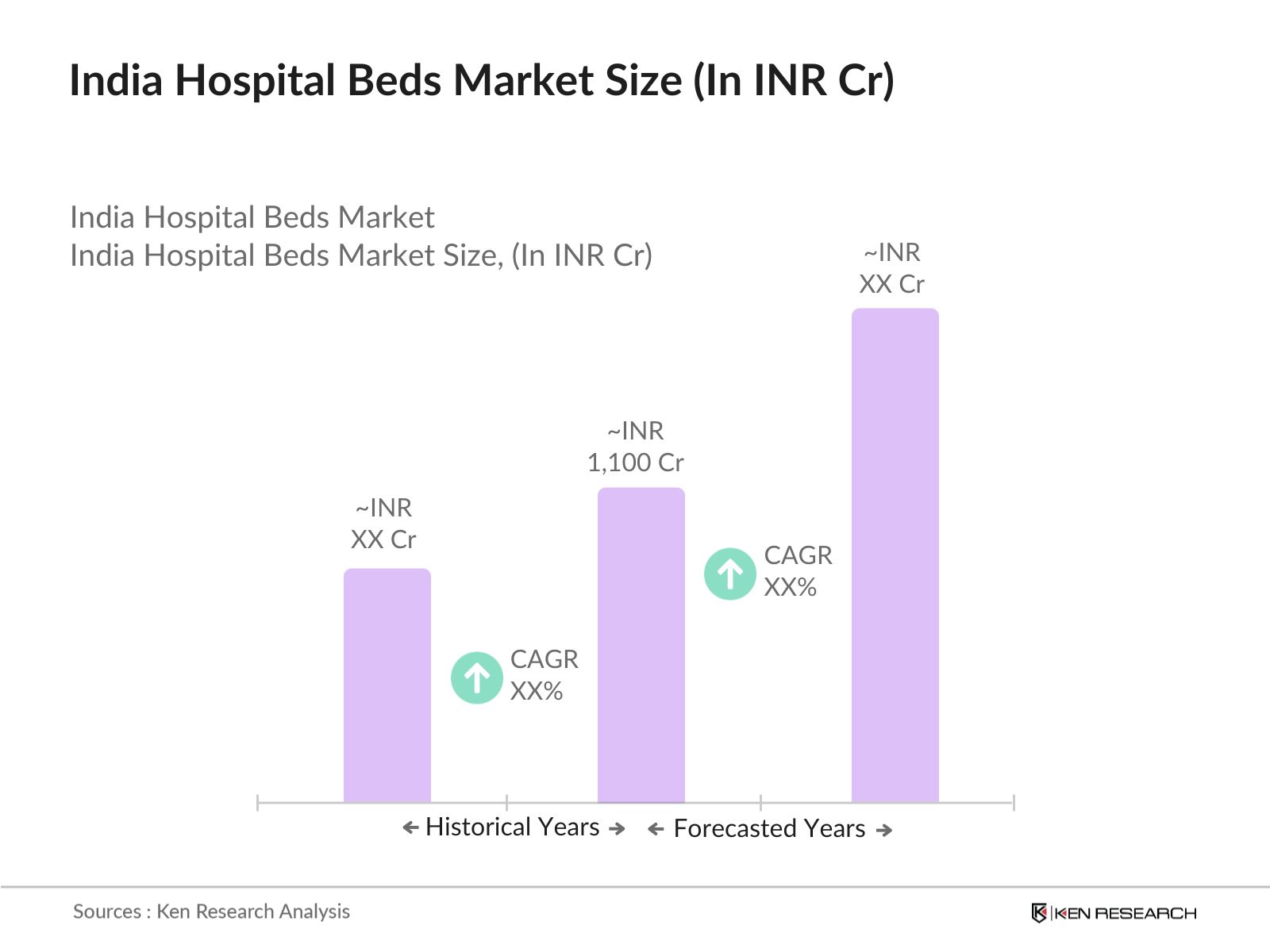
Over the next five years, the India hospital beds market is expected to witness sustained growth driven by public hospital infrastructure expansion, growth in the ICU and maternity bed segments, and increased adoption of semi-electric and smart beds. Financial allocations under national health schemes and evolving standards for patient comfort and monitoring will further push demand, particularly in tier-2 and tier-3 cities.
|
Bed Type |
Manual Beds |
|
Functionality |
Ward Care Beds |
|
End User |
Government Hospitals |
|
Price Range |
Budget Beds |
|
Region |
North |
1.1. Definition and Scope
1.2. Market Taxonomy
1.3. Market Growth Rate
1.4. Market Segmentation Overview
2.1. Historical Market Size
2.2. Year-On-Year Growth Analysis
2.3. Key Market Developments and Milestones
3.1. Growth Drivers
3.1.1. Government Infrastructure Expansion
3.1.2. Increase in Institutional Deliveries
3.1.3. Rise in Medical Tourism
3.2. Restraints
3.2.1. Import Dependency on Smart Components
3.2.2. Rural Supply Chain Limitations
3.3. Opportunities
3.3.1. AI-Integrated Smart Beds
3.3.2. Budget Boost for Tier-2 Facilities
3.4. Trends
3.4.1. Smart Nurse Station Compatibility
3.4.2. Motorized Bed Automation for ICU & Ward Use
3.4.3. Shift Toward Home Healthcare Bed Rentals
3.5. Government Regulation
3.5.1. CDSCO Classification (Class A Medical Device)
3.5.2. BIS Certification Compliance for Public Procurement
3.5.3. NABH Bed Standards for Patient Safety
3.5.4. Procurement Rules under PM-ABHIM & GeM Portal
3.6. SWOT Analysis
3.7. Stake Ecosystem
3.8. Porter’s Five Forces
3.9. Competition Ecosystem
4.1. By Bed Type (In Volume and Value%)
4.1.1. Manual Beds
4.1.2. Semi-Electric Beds
4.1.3. Fully Electric Beds
4.2. By Functionality (In Volume and Value%)
4.2.1. Ward Care Beds
4.2.2. ICU Beds
4.2.3. Pediatric Beds
4.2.4. Bariatric Beds
4.2.5. Maternity Beds
4.3. By End User (In Volume and Value %)
4.3.1. Government Hospitals
4.3.2. Private Hospitals
4.3.3. Specialty Clinics
4.3.4. Home Healthcare Providers
4.3.5. Ambulatory Care Centers
4.4. By Price Range (In Volume and Value%)
4.4.1. Budget Beds
4.4.2. Mid-Tier Beds
4.4.3. Premium Beds
4.5. By Region (In Volume and Value %)
4.5.1. North India
4.5.2. South India
4.5.3. West India
4.5.4. East India
4.5.5. Central India
5.1. Detailed Profiles of Major Companies
5.1.1. Midmark
5.1.2. Paramount Bed
5.1.3. Arjo
5.1.4. Godrej Interio
5.1.5. Carevel
5.1.6. United Surgical
5.1.7. Meditek Engineers
5.1.8. PMT Healthcare
5.1.9. GPC Medical
5.1.10. Steelcraft
5.1.11. DiaMedical
5.1.12. Stryker
5.1.13. Vissco
5.1.14. Baxter (Hillrom)
5.1.15. Interio
5.2. Cross Comparison Parameters (Bed Type Specialization, AI Integration, In-House Manufacturing, Tender Win Rate, Regional Reach, Private/Public Mix, Smart Bed Capability)
5.3. Market Share Analysis
5.4. Strategic Initiatives
5.5. Mergers And Acquisitions
5.6. Investor Analysis
5.7. Venture Capital Funding
5.8. Government Grants
5.9. Private Equity Investments
6.1. CDSCO Licensing Pathway
6.2. BIS Mandatory Certification Updates
6.3. NABH Guidelines for Equipment Safety
6.4. GeM Registration and Procurement Eligibility
6.5. PM-ABHIM Allocation and Compliance Norms
7.1. Future Market Size Projections
7.2. Key Factors Driving Future Market Growth
8.1. By Bed Type (In Volume and Value %)
8.2. By Functionality (In Volume and Value% )
8.3. By End User (In Volume and Value %)
8.4. By Price Range (In Volume and Value% )
8.5. By Region (In Volume and Value %)
9.1. TAM/SAM/SOM Analysis
9.2. Customer Cohort Analysis
9.3. Marketing Initiatives
9.4. White Space Opportunity Analysis
The initial phase involves constructing an ecosystem map encompassing all major stakeholders within the India Hospital Beds Market. This step is underpinned by extensive desk research, utilizing a combination of secondary and proprietary databases to gather comprehensive industry-level information. The primary objective is to identify and define the critical variables that influence market dynamics.
In this phase, we compiled and analyzed historical data pertaining to the India Hospital Beds Market. This includes assessing market penetration, hospital infrastructure expansion, and government health spending. An evaluation of smart bed adoption and ICU capacity gaps was also conducted to ensure the reliability of revenue and unit estimates.
Market hypotheses were validated through direct interviews and consultations with procurement heads of hospitals, government officials, and device manufacturers. These sessions provided granular insights into product usage trends, pricing preferences, and challenges in bed installation and service logistics.
The final phase involved integrating supplier-side data with buyer-side perspectives. Multiple manufacturer interactions and on-ground pricing analysis helped confirm retail vs. tender pricing gaps, technology usage, and demand by bed functionality. This ensured a well-rounded, verified market overview.
The India Hospital Beds Market is valued at INR 1,166.9 crore. This valuation is based on a historical analysis of demand across government and private healthcare institutions, with a consistent CAGR driven by ICU expansion, home care needs, and procurement reforms.
India Hospital Beds Market Key drivers include increased ICU bed demand, expansion of public healthcare infrastructure under national health missions, and rising smart bed installations in private hospitals. Medical tourism and higher public expenditure on health are further contributing factors.
In India Hospital Beds Market Manual beds dominate the market by bed type due to affordability, suitability for rural and budget healthcare facilities, and long-standing government procurement patterns under tender-based systems.
Metro cities like Delhi, Mumbai, and Bengaluru lead the India Hospital Beds Market due to better infrastructure, availability of specialty care, and higher adoption of advanced and smart hospital beds.
Government initiatives in India Hospital Beds Market such as PM-Ayushman Bharat Health Infrastructure Mission and increased health budgets significantly influence procurement and expansion, especially in underserved regions.

What makes us stand out is that our consultants follows Robust, Refine and Result (RRR) methodology. i.e. Robust for clear definitions, approaches and sanity checking, Refine for differentiating respondents facts and opinions and Result for presenting data with story

We have set a benchmark in the industry by offering our clients with syndicated and customized market research reports featuring coverage of entire market as well as meticulous research and analyst insights.

While we don't replace traditional research, we flip the method upside down. Our dual approach of Top Bottom & Bottom Top ensures quality deliverable by not just verifying company fundamentals but also looking at the sector and macroeconomic factors.

With one step in the future, our research team constantly tries to show you the bigger picture. We help with some of the tough questions you may encounter along the way: How is the industry positioned? Best marketing channel? KPI's of competitors? By aligning every element, we help maximize success.

Our report gives you instant access to the answers and sources that other companies might choose to hide. We elaborate each steps of research methodology we have used and showcase you the sample size to earn your trust.

If you need any support, we are here! We pride ourselves on universe strength, data quality, and quick, friendly, and professional service.