Ken Research Logo

India Housing Finance Market Outlook to 2030

Region:Asia

Author(s):Naman Rohilla

Product Code:KROD6928

Published On

December 2024

Total pages

81

About the Report

India Housing Finance Market Overview

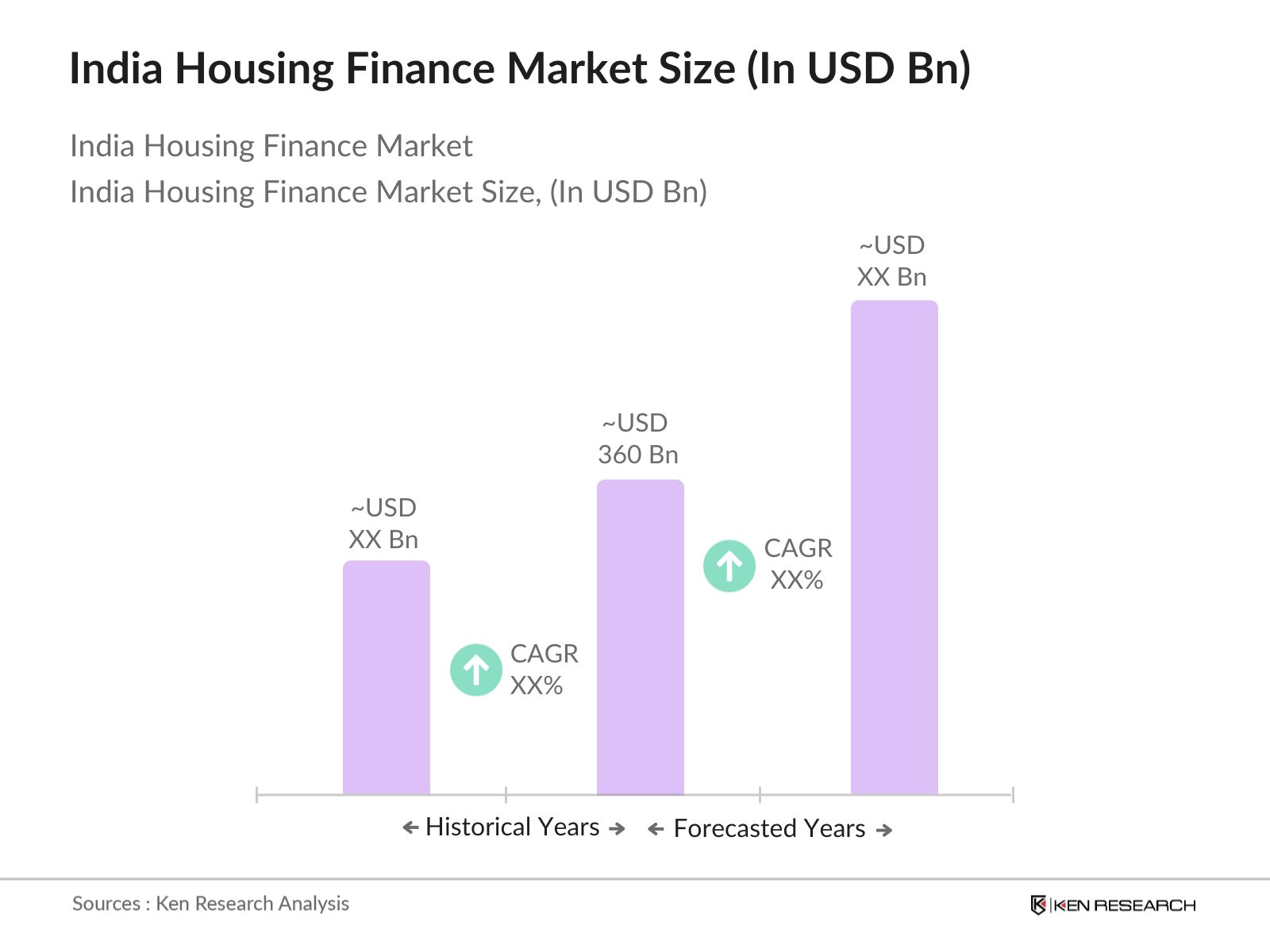
  • The India Housing Finance market is valued at USD 360 billion, based on a five-year historical analysis. This market is primarily driven by increasing urbanization, a growing middle-class population, and favourable government schemes such as the Pradhan Mantri Awas Yojana (PMAY), which promotes affordable housing for all. The demand for home loans has surged due to these initiatives, along with favourable interest rates, allowing first-time homebuyers easier access to credit, thus propelling market growth.
  • The housing finance market is predominantly driven by major metropolitan cities such as Mumbai, Delhi, Bengaluru, and Pune. These cities dominate due to high demand for residential properties, greater economic activity, and robust infrastructure development. Additionally, these regions are home to a larger proportion of the affluent and middle-class population, who are the primary consumers of housing finance products. The rapid expansion of urban infrastructure in these regions further fuels the demand for housing finance.
  • The Affordable Housing Fund (AHF), launched in 2018, continues to play a vital role in supporting housing finance for low-income households. As of 2024, the AHF has disbursed over INR 20,000 crore to HFCs focused on affordable housing projects. This funding helps reduce the interest rates on loans for economically weaker sections, making homeownership more accessible. The government's commitment to funding affordable housing through the AHF remains a key driver in the housing finance sector.

market overviews

India Housing Finance Market Segmentation

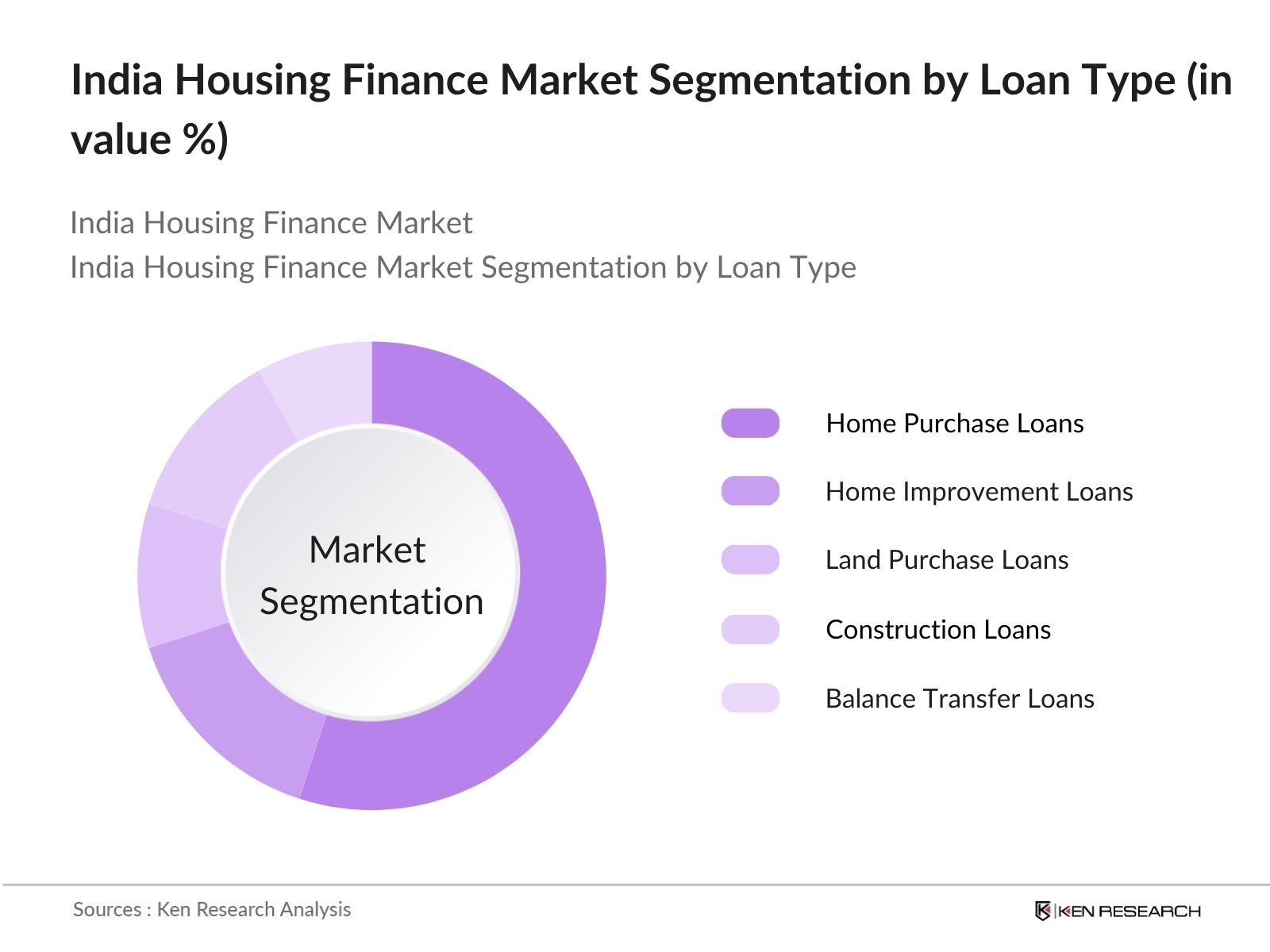
  • By Loan Type: The market is segmented by loan type into home purchase loans, home improvement loans, land purchase loans, construction loans, and balance transfer loans. Recently, home purchase loans have dominated the market due to the rising affordability of housing, especially in the affordable segment. The governments subsidy programs for first-time buyers and the ease of obtaining loans at lower interest rates have made this segment the most preferred option for the majority of consumers. Additionally, an increase in urban migration and the desire for home ownership has further cemented the dominance of home purchase loans in the market.

market overviews

  • By Provider Type: The India Housing Finance market is also segmented by provider type into public sector banks, private sector banks, housing finance companies (HFCs), non-banking financial companies (NBFCs), and FinTech lenders. Housing Finance Companies (HFCs) hold the largest share due to their specialized focus on providing housing loans. Their deep understanding of the housing sector and customer needs allows them to cater to a broader range of customers, particularly in the affordable housing segment. HFCs also offer tailored loan products and flexible repayment options, contributing to their dominance in this market.

market overviews

India Housing Finance Market Competitive Landscape

The India Housing Finance market is dominated by several major players, including both public sector banks and private financial institutions. Companies like HDFC and LIC Housing Finance have a stronghold due to their vast networks and tailored products, while newer FinTech players are introducing innovation into the space, offering digital-first mortgage solutions.

Company Name

Establishment Year

Headquarters

Loan Portfolio (INR Cr)

Digital Lending Initiatives

NPA (%)

Market Share (%)

No. of Branches

ESG Initiatives

Housing Development Finance Corp.

1977

Mumbai

-

-

-

-

-

-

State Bank of India

1955

Mumbai

-

-

-

-

-

-

LIC Housing Finance Ltd.

1989

Mumbai

-

-

-

-

-

-

ICICI Bank

1994

Mumbai

-

-

-

-

-

-

Indiabulls Housing Finance Ltd.

2000

New Delhi

-

-

-

-

-

-

India Housing Finance Market Analysis

India Housing Finance Market Growth Drivers

  • Urbanization and Housing Demand: Indias urban population has surged, with over 35% of the population residing in urban areas in 2024, according to the United Nations World Urbanization Prospects. This influx has driven the demand for housing in urban centers. States like Maharashtra, Karnataka, and Tamil Nadu have witnessed high housing demand due to increased migration and job opportunities in these regions. The demand for housing loans has increased proportionally, especially in metro cities, with over 10 million housing units required annually to meet urban demand.
  • Interest Rate Dynamics: Indias interest rate regime has been favourable for borrowers due to the reduction in repo rates. As of 2024, the Reserve Bank of India (RBI) holds the repo rate at 6.25%, encouraging affordable housing finance by lowering borrowing costs. As the average home loan rate hovers between 8.4% and 9.6% in 2024, borrowers are increasingly incentivized to take housing loans, driving growth in the housing finance sector. Lower interest rates are particularly attractive for first-time homebuyers, further expanding loan demand.
  • Rising Middle-Class Population: Indias middle-class population, estimated at around 400 million people in 2024, is one of the primary contributors to the growing housing demand. This demographic increasingly seeks homeownership as disposable incomes rise. With per capita income standing at INR 170,000 (USD 2,070) in 2024, more middle-class families are eligible for housing finance. The housing finance market benefits from this expanding base of eligible borrowers, as the middle class remains a dominant driver of residential housing demand.

India Housing Finance Market Challenges

  • Regulatory Constraints: Housing finance companies (HFCs) in India face stringent regulatory constraints. For instance, the Reserve Bank of India's regulations mandate that HFCs maintain a minimum capital adequacy ratio (CAR) of 15%, limiting their ability to offer riskier loans. In 2024, the RBI also revised its guidelines on Loan-to-Value (LTV) ratios for HFCs, reducing the maximum permissible LTV to 80%, which further impacts the loan amounts borrowers can avail of. These regulations ensure financial stability but restrict lending capacity, posing a challenge to housing finance growth.
  • Non-Performing Assets (NPA) in Housing Finance: The housing finance sector in India is grappling with a rising number of non-performing assets (NPAs). In 2023, NPAs in the housing finance segment were reported at 4.3%, up from 3.8% in 2022. High NPAs, particularly in the affordable housing segment, are attributed to borrower defaults amid economic challenges, especially in Tier-II and Tier-III cities. The increasing NPAs weigh on the financial health of HFCs, leading to a tightening of credit norms and negatively affecting loan disbursements.

India Housing Finance Market Future Outlook

Over the next five years, the India Housing Finance market is expected to witness robust growth driven by continued government initiatives promoting affordable housing, coupled with increasing urbanization and a growing middle-class population. The rise of FinTech lenders providing digital mortgage solutions and the development of green housing finance products will also contribute to the expansion of the market. Additionally, lower interest rates and innovative loan products are expected to further fuel demand for home loans in both metropolitan and tier-2 cities.

India Housing Finance Market Opportunities

  • Digitalization of Housing Finance: The digital transformation of Indias housing finance sector is creating new opportunities for lenders. As of 2024, 92% of housing finance applications are processed online, a leap from just 60% in 2020. Leading housing finance companies are adopting digital tools for credit assessment, loan disbursement, and customer service, making the process faster and more efficient. The integration of AI-driven credit scoring systems, especially for assessing first-time borrowers, further boosts financial inclusion and enables housing finance companies to expand their customer base.
  • Growth in Affordable Housing Segment: The demand for affordable housing is a growth driver for Indias housing finance market. According to the Ministry of Housing and Urban Affairs, over 20 million housing units are required for the economically weaker section (EWS) and lower-income group (LIG). In 2024, the government continues to push affordable housing through schemes such as the Affordable Housing Fund (AHF). Housing finance companies that cater to this segment are experiencing substantial growth, as demand far exceeds supply in urban and peri-urban areas

Scope of the Report

Loan Type

Home Purchase Loans

Home Improvement Loans

Land Purchase Loans

Construction Loans

Balance Transfer Loans

End-User

Individuals

Developers

Institutions

Interest Rate Type

Fixed Rate

Floating Rate

Hybrid Rate

Provider Type

Public Sector Banks

Private Sector Banks

Housing Finance Companies (HFCs)

Non-Banking Financial Companies (NBFCs)

FinTech Lenders

Region

Northern India

Southern India

Eastern India

Western India

Products

Key Target Audience

  • Housing Finance Companies (HFCs)

  • Public Sector Banks

  • Private Sector Banks

  • Non-Banking Financial Companies (NBFCs)

  • Banks and Financial Institutions

  • FinTech Lenders

  • Government and Regulatory Bodies (e.g., National Housing Bank, Ministry of Housing and Urban Affairs)

  • Real Estate Developers

  • Investors and Venture Capital Firms

Companies

Players Mentioned in the Report

  • Housing Development Finance Corporation (HDFC)

  • State Bank of India (SBI)

  • LIC Housing Finance Ltd.

  • Indiabulls Housing Finance Ltd.

  • ICICI Bank

  • Axis Bank

  • Bank of Baroda

  • Bajaj Finserv

  • Tata Capital Housing Finance

  • PNB Housing Finance Ltd.

Table of Contents

1. India Housing Finance Market Overview

1.1 Definition and Scope

1.2 Market Taxonomy

1.3 Market Growth Rate

1.4 Market Segmentation Overview

2. India Housing Finance Market Size (In INR Trillion)

2.1 Historical Market Size

2.2 Year-On-Year Growth Analysis

2.3 Key Market Developments and Milestones

3. India Housing Finance Market Analysis

3.1 Growth Drivers

3.1.1 Urbanization and Housing Demand

3.1.2 Government Schemes (e.g., PMAY, Housing for All)

3.1.3 Interest Rate Dynamics

3.1.4 Rising Middle-Class Population

3.2 Market Challenges

3.2.1 Regulatory Constraints

3.2.2 Non-Performing Assets (NPA) in Housing Finance

3.2.3 Access to Affordable Credit

3.3 Opportunities

3.3.1 Digitalization of Housing Finance

3.3.2 Growth in Affordable Housing Segment

3.3.3 Entry of FinTech in Mortgage Solutions

3.4 Trends

3.4.1 Increasing Adoption of AI for Credit Scoring

3.4.2 Rise of Green Housing Loans

3.4.3 Integration of Blockchain in Loan Processing

3.5 Government Regulations

3.5.1 RBI Guidelines for Housing Finance

3.5.2 Affordable Housing Fund (AHF) Policies

3.5.3 Regulatory Framework on Loan-to-Value (LTV) Ratios

3.6 SWOT Analysis

3.7 Stake Ecosystem

3.8 Porters Five Forces Analysis

3.9 Competition Ecosystem

4. India Housing Finance Market Segmentation

4.1 By Loan Type (In Value %)

4.1.1 Home Purchase Loans

4.1.2 Home Improvement Loans

4.1.3 Land Purchase Loans

4.1.4 Construction Loans

4.1.5 Balance Transfer Loans

4.2 By End-User (In Value %)

4.2.1 Individuals

4.2.2 Developers

4.2.3 Institutions

4.3 By Interest Rate Type (In Value %)

4.3.1 Fixed Rate

4.3.2 Floating Rate

4.3.3 Hybrid Rate

4.4 By Provider Type (In Value %)

4.4.1 Public Sector Banks

4.4.2 Private Sector Banks

4.4.3 Housing Finance Companies (HFCs)

4.4.4 Non-Banking Financial Companies (NBFCs)

4.4.5 FinTech Lenders

4.5 By Region (In Value %)

4.5.1 Northern India

4.5.2 Southern India

4.5.3 Eastern India

4.5.4 Western India

5. India Housing Finance Market Competitive Analysis

5.1 Detailed Profiles of Major Companies

5.1.1 Housing Development Finance Corporation (HDFC)

5.1.2 State Bank of India (SBI)

5.1.3 ICICI Bank

5.1.4 LIC Housing Finance Ltd.

5.1.5 Indiabulls Housing Finance Ltd.

5.1.6 PNB Housing Finance Ltd.

5.1.7 Axis Bank

5.1.8 Bajaj Finserv

5.1.9 Bank of Baroda

5.1.10 Canara Bank

5.1.11 DHFL

5.1.12 Tata Capital Housing Finance

5.1.13 Kotak Mahindra Bank

5.1.14 Reliance Home Finance

5.1.15 Piramal Capital & Housing Finance Ltd.

5.2 Cross Comparison Parameters (No. of Employees, Headquarters, Inception Year, Loan Portfolio, Market Share, NPA %, Digital Lending Initiatives, ESG Compliance)

5.3 Market Share Analysis

5.4 Strategic Initiatives

5.5 Mergers and Acquisitions

5.6 Investment Analysis

5.7 Venture Capital Funding

5.8 Government Grants

5.9 Private Equity Investments

6. India Housing Finance Market Regulatory Framework

6.1 Housing Finance Guidelines by NHB

6.2 Compliance Requirements for Housing Finance Companies

6.3 Certification Processes for Affordable Housing Loans

7. India Housing Finance Future Market Size (In INR Trillion)

7.1 Future Market Size Projections

7.2 Key Factors Driving Future Market Growth

8. India Housing Finance Future Market Segmentation

8.1 By Loan Type (In Value %)

8.2 By End-User (In Value %)

8.3 By Interest Rate Type (In Value %)

8.4 By Provider Type (In Value %)

8.5 By Region (In Value %)

9. India Housing Finance Market Analyst's Recommendations

9.1 TAM/SAM/SOM Analysis

9.2 Customer Cohort Analysis

9.3 Marketing Initiatives

9.4 White Space Opportunity Analysis

Disclaimer Contact Us

Research Methodology

Step 1: Identification of Key Variables

This initial phase involved identifying key variables such as loan portfolios, market penetration, and government schemes, which influence the dynamics of the India Housing Finance Market. Extensive desk research using secondary databases was conducted to gather relevant data.

Step 2: Market Analysis and Construction

We compiled and analyzed historical data on housing loan disbursements, interest rate trends, and policy impacts. The aim was to understand market dynamics and gauge future projections.

Step 3: Hypothesis Validation and Expert Consultation

Experts from housing finance companies, real estate developers, and policymakers were consulted through interviews. Their insights provided critical validation of the trends identified during the desk research.

Step 4: Research Synthesis and Final Output

This step involved synthesizing findings into a comprehensive report. Data from both primary and secondary sources were combined to ensure a holistic and accurate portrayal of the market.

Frequently Asked Questions

01. How big is the India Housing Finance Market?

The India Housing Finance Market is valued at USD 360 billion, driven by government schemes promoting affordable housing and increasing urban migration.

02. What are the challenges in the India Housing Finance Market?

Challenges in the India Housing Finance Market include regulatory constraints, non-performing assets (NPA) issues, and the limited availability of affordable credit options for low-income consumers.

03. Who are the major players in the India Housing Finance Market?

Key players in the India Housing Finance Market include Housing Development Finance Corporation (HDFC), State Bank of India, LIC Housing Finance Ltd., Indiabulls Housing Finance Ltd., and ICICI Bank.

04. What are the growth drivers of the India Housing Finance Market?

Growth drivers of the India Housing Finance Market include urbanization, the increasing middle-class population, government schemes such as PMAY, and the rise of digital mortgage solutions.

Why Buy From Us?

RRR
Refine Robust Result (RRR) Framework

What makes us stand out is that our consultants follows Robust, Refine and Result (RRR) methodology. i.e. Robust for clear definitions, approaches and sanity checking, Refine for differentiating respondents facts and opinions and Result for presenting data with story

Our Reach Is Unmatched

We have set a benchmark in the industry by offering our clients with syndicated and customized market research reports featuring coverage of entire market as well as meticulous research and analyst insights.

Research
Shifting the Research Paradigm

While we don't replace traditional research, we flip the method upside down. Our dual approach of Top Bottom & Bottom Top ensures quality deliverable by not just verifying company fundamentals but also looking at the sector and macroeconomic factors.

Insite
More Insights-Better Decisions

With one step in the future, our research team constantly tries to show you the bigger picture. We help with some of the tough questions you may encounter along the way: How is the industry positioned? Best marketing channel? KPI's of competitors? By aligning every element, we help maximize success.

Trust
Transparency and Trust

Our report gives you instant access to the answers and sources that other companies might choose to hide. We elaborate each steps of research methodology we have used and showcase you the sample size to earn your trust.

support
Round the Clock Support

If you need any support, we are here! We pride ourselves on universe strength, data quality, and quick, friendly, and professional service.

Why Client Choose Us?

400000+ Reports in repository
150+ Consulting project a year
100+ Analysts
8000+ Client Queries in 2022