
India Industrial Automation Market Outlook to 2030
Region:India
Author(s):Paribhasha Tiwari
Product Code:KROD4477
Region:India
Author(s):Paribhasha Tiwari
Product Code:KROD4477
December 2024
90
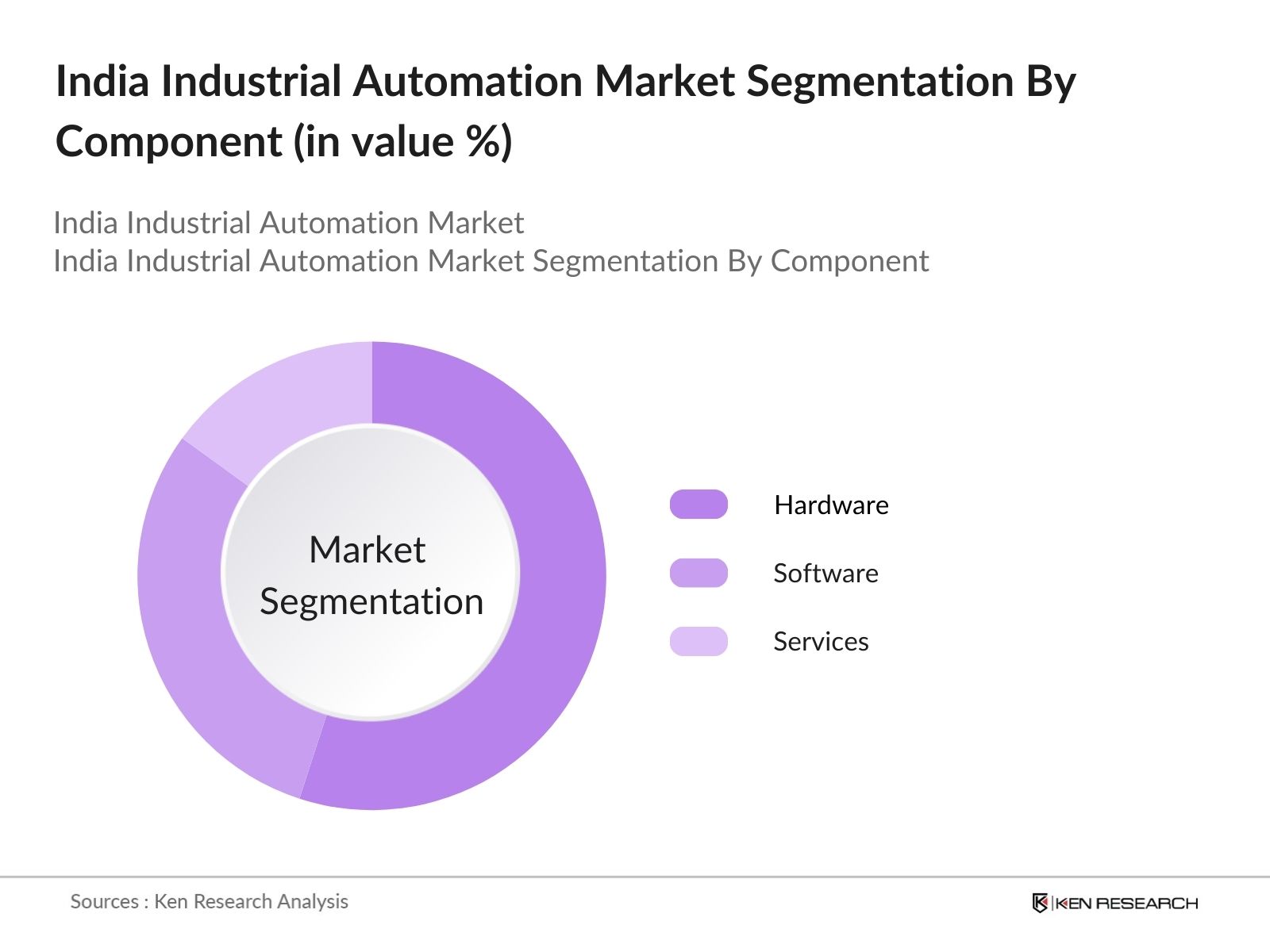
By Component: Indias industrial automation market is segmented by component into hardware, software, and services. Hardware components, including sensors, actuators, and robots, hold a dominant market share. This is largely due to the critical role they play in enabling automation across manufacturing floors, from production lines to packaging processes. The growing adoption of smart sensors and industrial robots for precision control and monitoring also contributes to the dominance of this segment.
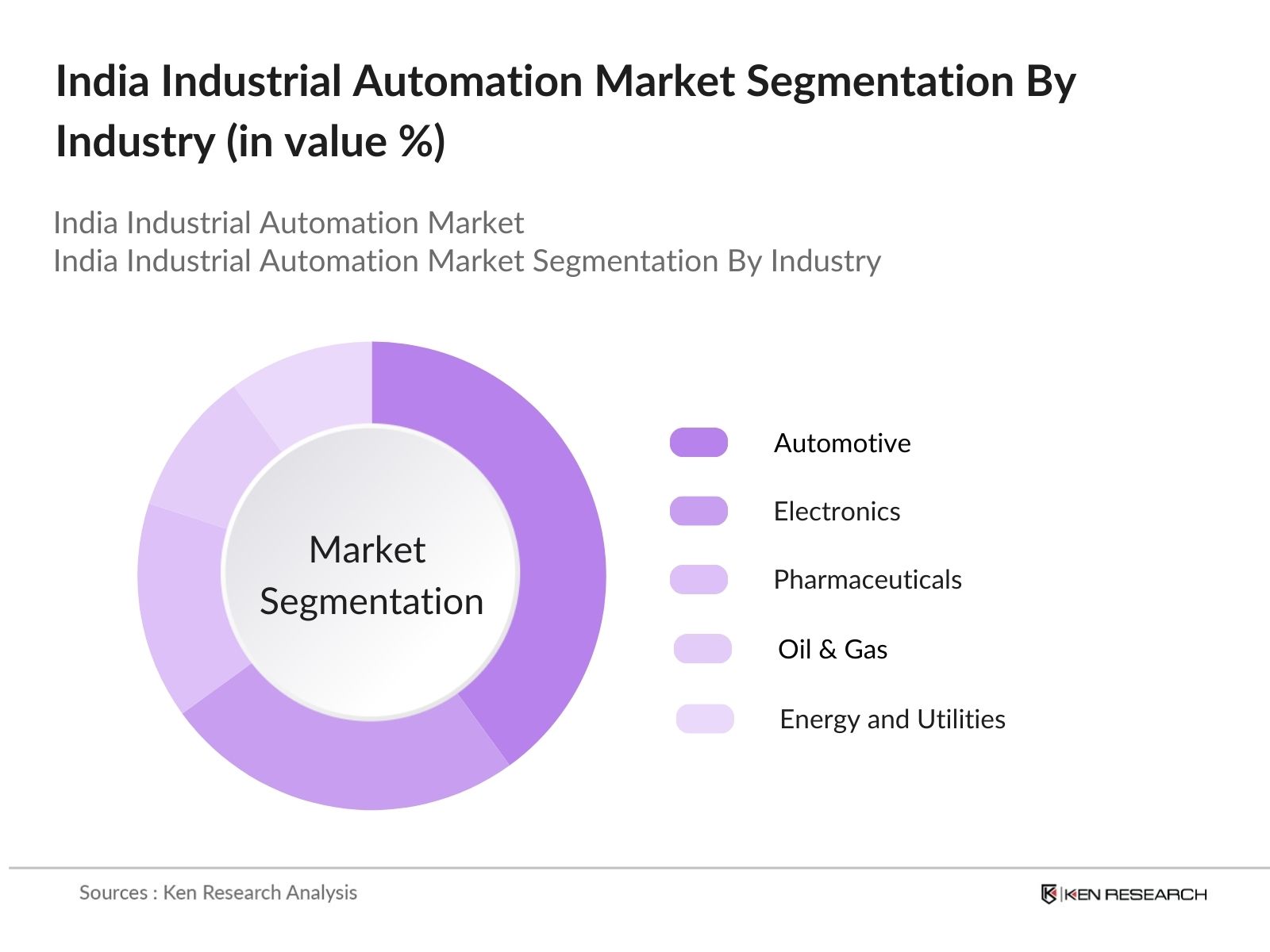
By Industry: Indias industrial automation market is segmented by industry into automotive, electronics, pharmaceuticals, oil & gas, and energy and utilities. The automotive sector has a dominant market share due to its early adoption of automation technologies such as robotics, PLCs (programmable logic controllers), and IIoT (Industrial Internet of Things). Automation in this sector has been critical for improving productivity, reducing production errors, and ensuring consistent quality in mass production environments.
The Indian industrial automation market is dominated by a few key players, each contributing to the consolidation of market influence. Companies such as Siemens, ABB India Ltd., and Rockwell Automation are recognized for their advanced technologies and robust portfolios of automation solutions. Local firms, along with global giants, continue to shape the competitive landscape, where technological advancements and innovation serve as critical differentiators.
|
Company |
Establishment Year |
Headquarters |
Revenue (USD Bn) |
Product Portfolio |
Market Presence |
R&D Investment |
Automation Solutions |
Client Base |
|
Siemens AG |
1847 |
Munich, Germany |
- | - | - | - | - | - |
|
ABB India Ltd. |
1883 |
Zurich, Switzerland |
- | - | - | - | - | - |
|
Honeywell Automation India Ltd. |
1906 |
Charlotte, USA |
- | - | - | - | - | - |
|
Rockwell Automation |
1903 |
Milwaukee, USA |
- | - | - | - | - | - |
|
Larsen & Toubro Ltd. |
1938 |
Mumbai, India |
- | - | - | - | - | - |
Over the next five years, Indias industrial automation market is expected to witness significant growth driven by rapid industrialization, increased investments in smart factories, and the integration of advanced technologies such as AI, IIoT, and robotics. Government initiatives aimed at boosting domestic manufacturing, especially in the automotive and electronics sectors, are likely to further fuel automation adoption. Companies are expected to invest heavily in upgrading their manufacturing processes to meet global standards of production, efficiency, and sustainability. Automation will play a critical role in achieving these objectives.
|
By Component |
Hardware Software Services |
|
By Industry |
Automotive Electronics Pharmaceuticals Oil & Gas Energy and Utilities |
|
By Technology |
AI/ML Robotics IIoT Cloud Edge Computing |
|
By Solution Type |
SCADA DCS PLC HMI MES |
|
By Region |
North West South East |
1.1. Definition and Scope
1.2. Market Taxonomy
1.3. Key Market Growth Metrics (e.g., Industry Output Growth, Automation Penetration Rate, Technological Advancements)
1.4. Market Segmentation Overview
2.1. Historical Market Size
2.2. Year-On-Year Growth Analysis (Key Milestones, Market Developments)
2.3. Current Industrial Automation Metrics (Manufacturing Output Contribution, Automation Investment as % of GDP)
2.4. Key Economic Drivers (Inflation Rates, Industrial Production Indices)
3.1. Growth Drivers
3.1.1. Increasing Demand for Operational Efficiency
3.1.2. Government Initiatives (e.g., Make in India, Production-Linked Incentive Schemes)
3.1.3. Adoption of Advanced Technologies (Robotics, AI, IIoT)
3.1.4. Rising Investments in Smart Factories
3.2. Market Challenges
3.2.1. High Initial Investment Costs
3.2.2. Limited Skilled Workforce for Advanced Automation Technologies
3.2.3. Cybersecurity Risks in Industrial Networks
3.2.4. Interoperability Issues Across Legacy Systems
3.3. Opportunities
3.3.1. Expansion of Automation in SMEs
3.3.2. Export Potential of Automation Systems
3.3.3. Integration of AI and ML in Industrial Processes
3.3.4. Emergence of Industry 4.0 Solutions
3.4. Trends
3.4.1. Adoption of Digital Twins and Simulation Technologies
3.4.2. Increasing Focus on Predictive Maintenance Solutions
3.4.3. Surge in Demand for Edge Computing and Cloud Automation
3.4.4. Evolution of Collaborative Robots (Cobots)
3.5. Government Regulation
3.5.1. Industrial Standards for Automation and Robotics
3.5.2. Environmental Regulations and Automation in Green Manufacturing
3.5.3. Regulatory Compliance for Industrial Safety Systems
3.5.4. Tax Incentives and Subsidies for Automation Adoption
3.6. Stakeholder Ecosystem
3.6.1. Key Suppliers and Manufacturers
3.6.2. Automation Solution Providers
3.6.3. End-Users: Manufacturing, Automotive, Energy, Pharmaceuticals
3.6.4. R&D Institutions and Academia
3.7. Porters Five Forces Analysis
3.8. SWOT Analysis
3.9. Competition Ecosystem
4.1. By Component (In Value %)
4.1.1. Hardware (Sensors, Actuators, Robots)
4.1.2. Software (SCADA, DCS, MES, PLC)
4.1.3. Services (System Integration, Consulting, Maintenance)
4.2. By Industry (In Value %)
4.2.1. Automotive
4.2.2. Electronics and Electrical
4.2.3. Pharmaceuticals
4.2.4. Oil & Gas
4.2.5. Energy and Utilities
4.3. By Technology (In Value %)
4.3.1. AI and Machine Learning
4.3.2. Robotics and Automation
4.3.3. Industrial Internet of Things (IIoT)
4.3.4. Cloud Computing
4.3.5. Edge Computing
4.4. By Solution Type (In Value %)
4.4.1. SCADA (Supervisory Control and Data Acquisition)
4.4.2. Distributed Control Systems (DCS)
4.4.3. Programmable Logic Controllers (PLC)
4.4.4. Human-Machine Interface (HMI)
4.4.5. Manufacturing Execution Systems (MES)
4.5. By Region (In Value %)
4.5.1. North India
4.5.2. West India
4.5.3. South India
4.5.4. East India
5.1. Detailed Profiles of Major Companies
5.1.1. Siemens AG
5.1.2. ABB India Ltd.
5.1.3. Honeywell Automation India Ltd.
5.1.4. Rockwell Automation
5.1.5. Larsen & Toubro
5.1.6. Schneider Electric India
5.1.7. Mitsubishi Electric
5.1.8. General Electric
5.1.9. Emerson Electric Co.
5.1.10. Bosch Rexroth India
5.1.11. Bharat Heavy Electricals Limited (BHEL)
5.1.12. Yokogawa Electric Corporation
5.1.13. Fanuc India Pvt. Ltd.
5.1.14. Honeywell Process Solutions
5.1.15. Toshiba India Pvt. Ltd.
5.2. Cross Comparison Parameters (Revenue, Market Share, Product Portfolio, R&D Investment, Technological Integration, Industry Collaboration, Employee Strength, Global Reach)
5.3. Strategic Initiatives
5.4. Market Share Analysis
5.5. Mergers and Acquisitions
5.6. Investment Analysis
5.7. Venture Capital Funding and Private Equity
5.8. Government Grants and Subsidies
6.1. Industry Standards (IEC 61508, ISO 13849, etc.)
6.2. Safety and Compliance (Occupational Safety Standards)
6.3. Environmental Regulations (Energy Efficiency, Sustainability Measures)
6.4. Industry-Specific Compliance (Pharmaceuticals, Automotive Regulations)
7.1. Automation Maturity Model Evaluation
7.2. Product Innovation Strategies
7.3. Expansion into Emerging Sectors
7.4. Automation ROI Analysis
7.5. Recommendations for SMEs
Disclaimer Contact UsThe initial phase involves constructing an ecosystem map encompassing all major stakeholders within the India Industrial Automation Market. This step is underpinned by extensive desk research, utilizing a combination of secondary and proprietary databases to gather comprehensive industry-level information. The primary objective is to identify and define the critical variables that influence market dynamics.
In this phase, we will compile and analyze historical data pertaining to the India Industrial Automation Market. This includes assessing market penetration, the ratio of manufacturers to service providers, and the resultant revenue generation. Furthermore, an evaluation of manufacturing output statistics will be conducted to ensure the reliability and accuracy of the revenue estimates.
Market hypotheses will be developed and subsequently validated through computer-assisted telephone interviews (CATIs) with industry experts representing a diverse array of companies. These consultations will provide valuable operational and financial insights directly from industry practitioners, which will be instrumental in refining and corroborating the market data.
The final phase involves direct engagement with multiple industrial automation solution providers to acquire detailed insights into product segments, sales performance, consumer preferences, and other pertinent factors. This interaction will serve to verify and complement the statistics derived from the bottom-up approach, thereby ensuring a comprehensive, accurate, and validated analysis of the India Industrial Automation market.
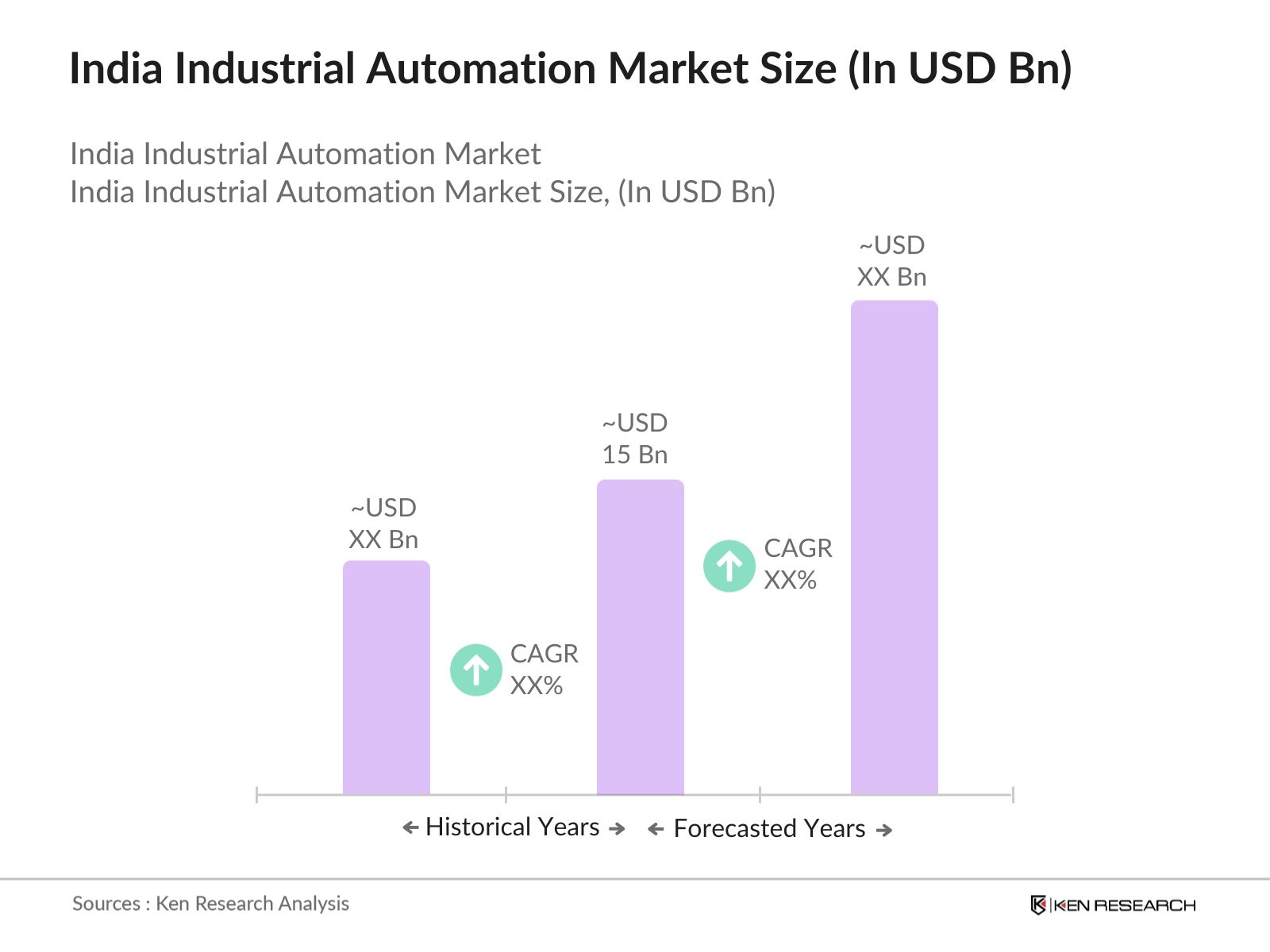
India industrial automation market is valued at USD 15 billion, driven by the rapid adoption of automation technologies in the manufacturing, automotive, and electronics sectors.
Challenges in the India industrial automation market include high initial investment costs, a shortage of skilled workforce, and the complex integration of legacy systems with modern automation technologies.
Major players in the India industrial automation market include Siemens AG, ABB India Ltd., Honeywell Automation India Ltd., Rockwell Automation, and Larsen & Toubro Ltd. These companies have extensive portfolios of automation solutions and a strong market presence.
The India industrial automation market is driven by increasing demand for operational efficiency, government initiatives to boost manufacturing, and the integration of advanced technologies like AI, IIoT, and robotics in industrial processes.

What makes us stand out is that our consultants follows Robust, Refine and Result (RRR) methodology. i.e. Robust for clear definitions, approaches and sanity checking, Refine for differentiating respondents facts and opinions and Result for presenting data with story

We have set a benchmark in the industry by offering our clients with syndicated and customized market research reports featuring coverage of entire market as well as meticulous research and analyst insights.

While we don't replace traditional research, we flip the method upside down. Our dual approach of Top Bottom & Bottom Top ensures quality deliverable by not just verifying company fundamentals but also looking at the sector and macroeconomic factors.

With one step in the future, our research team constantly tries to show you the bigger picture. We help with some of the tough questions you may encounter along the way: How is the industry positioned? Best marketing channel? KPI's of competitors? By aligning every element, we help maximize success.

Our report gives you instant access to the answers and sources that other companies might choose to hide. We elaborate each steps of research methodology we have used and showcase you the sample size to earn your trust.

If you need any support, we are here! We pride ourselves on universe strength, data quality, and quick, friendly, and professional service.