
India IVD Market Outlook to 2030
Region:Asia
Author(s):Shubham Kashyap
Product Code:KROD3223
November 2024
85
About the Report
India IVD Market Overview
- The Indian In Vitro Diagnostics (IVD) market has reached a size of USD 1.70 billion, underpinned by the growing burden of chronic diseases, rising healthcare expenditure, and the expanding reach of diagnostic services across urban and rural areas. The market has seen growth during the historical period, driven by the increasing demand for diagnostic services and advancements in medical technology. Key drivers of the market include the rising incidence of conditions such as diabetes, cardiovascular diseases, and cancer, which necessitate accurate and timely diagnostic tools.
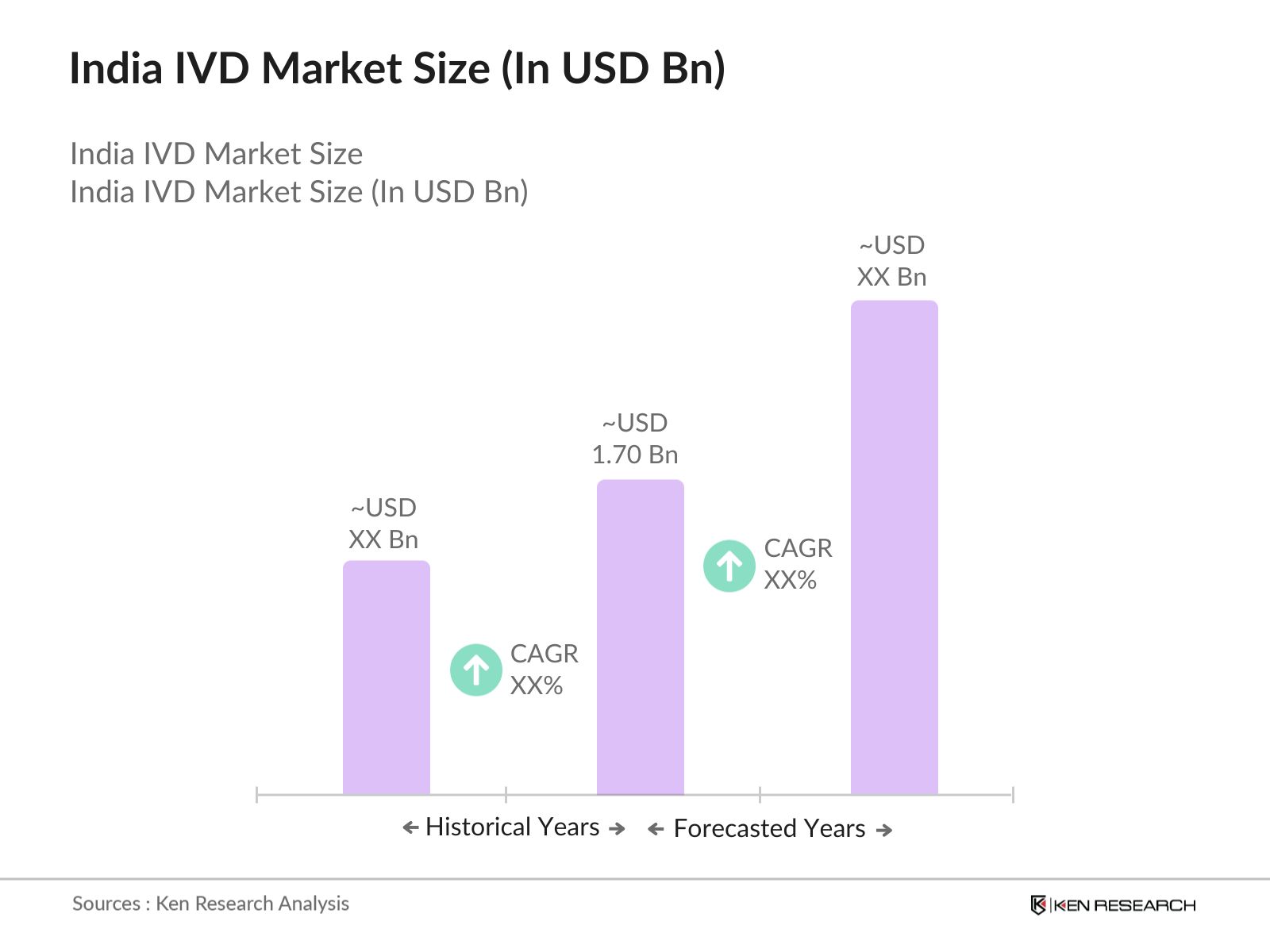
- Major metropolitan cities like Delhi, Mumbai, and Bangalore account for a share of the market due to the concentration of diagnostic centers and hospitals, while the governments push to improve healthcare access in rural regions is opening new opportunities in tier 2 and tier 3 cities. However, challenges such as regulatory constraints and the lack of skilled professionals continue to pose barriers to the seamless adoption of IVD technologies across the country.
- The Indian governments initiatives to improve healthcare infrastructure and expand diagnostic capabilities, especially under programs such as Ayushman Bharat, have also contributed to the markets growth. Additionally, the increasing adoption of point-of-care (POC) diagnostics and the integration of digital technologies into diagnostic systems are further propelling the market forward.
India IVD Market Segmentation
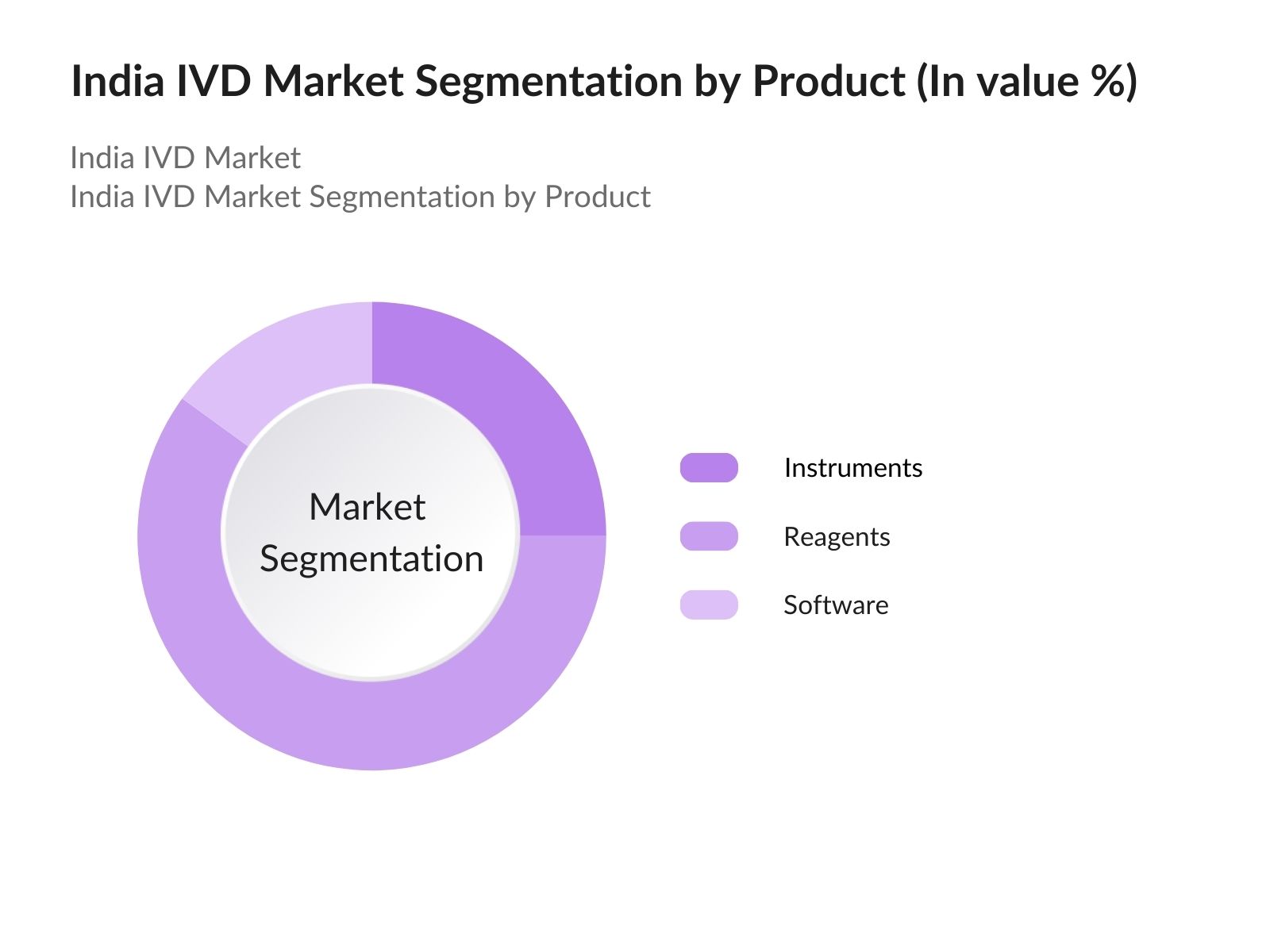
- By Product Type: The market is segmented into instruments, reagents, and software. Reagents dominate the market, accounting for the largest share due to their frequent use in various diagnostic tests. Instruments are also gaining traction, especially with the increasing demand for automation and high-throughput systems in diagnostic laboratories. Software solutions, which are critical for data management and diagnostic accuracy, are growing steadily as laboratories integrate digital solutions.
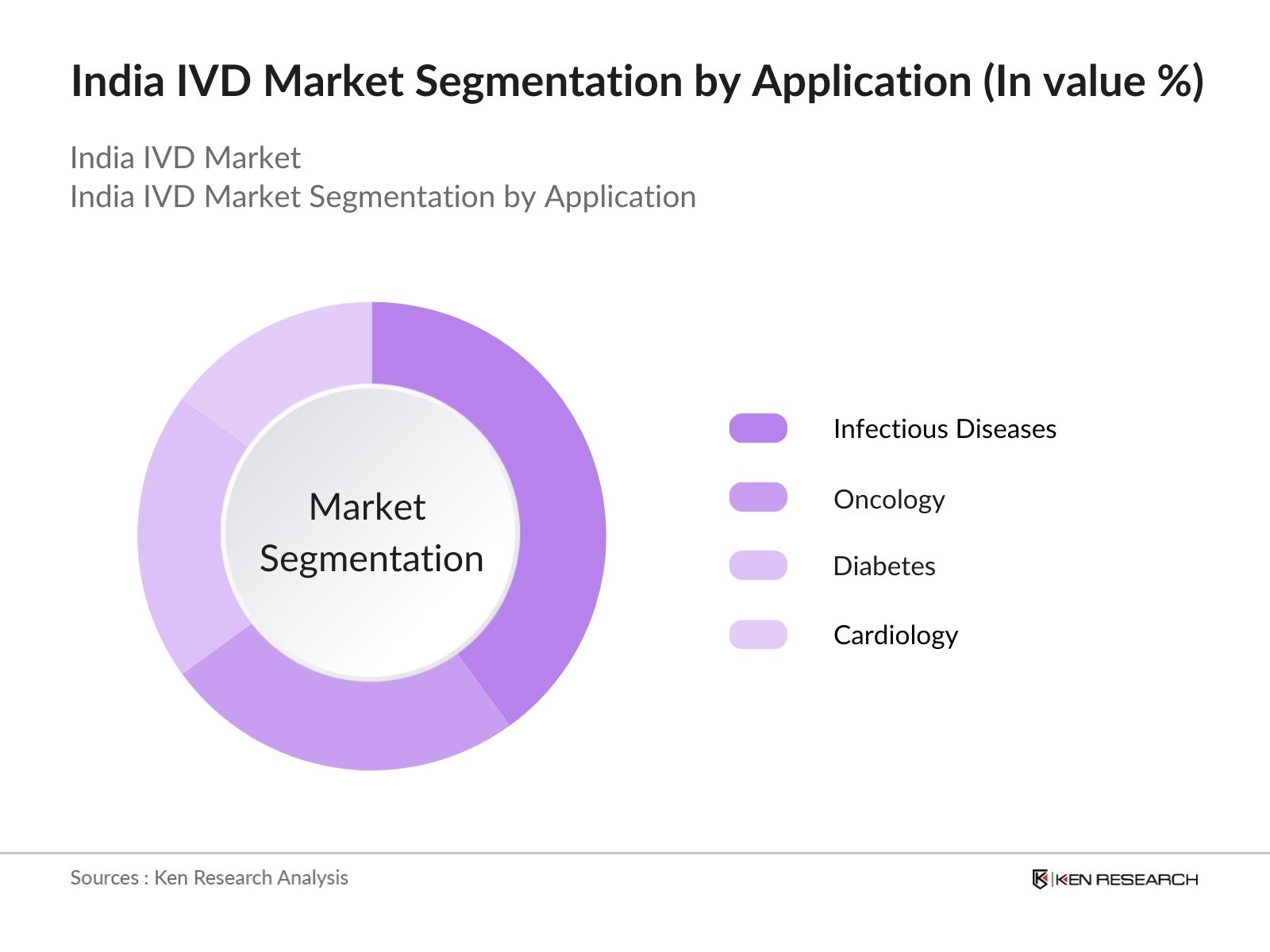
- By Application: The market is further segmented by application into infectious diseases, oncology, diabetes, and cardiology. Infectious diseases lead in this category due to the high prevalence of viral and bacterial infections in India, which require timely diagnostic testing. The need for early diagnosis and proper management of diseases like tuberculosis, hepatitis, and HIV/AIDS has ensured that this sub-segment remains a priority within IVD testing.
India IVD Market Competitive Landscape
The India IVD Market is competitive, with both domestic and international players vying for market share. Major companies include Dr. Lal PathLabs, SRL Diagnostics, and Thyrocare from the domestic market, while global players like Siemens Healthineers, Abbott, and Roche Diagnostics have also established a strong presence, particularly in high-end diagnostic segments.
Companies are increasingly focusing on research and development to introduce innovative diagnostics, including molecular diagnostics and immunoassays, which are gaining popularity due to their precision and efficiency. Strategic initiatives such as partnerships with hospitals and diagnostic chains, along with the expansion of distribution networks, are helping companies penetrate deeper into the Indian market.
|
Company Name |
Establishment Year |
Headquarters |
Revenue (2023) |
Key Products |
R&D Investment |
No. of Employees |
Distribution Channels |
Strategic Initiatives |
|
Dr. Lal PathLabs |
1949 |
Delhi |
||||||
|
SRL Diagnostics |
1995 |
Gurugram |
||||||
|
Thyrocare |
1996 |
Mumbai |
||||||
|
Siemens Healthineers |
1896 |
Germany |
||||||
|
Abbott |
1888 |
USA |
India IVD Market Analysis
Growth Drivers
- Rising Burden of Chronic Diseases: India has witnessed a sharp rise in chronic diseases such as diabetes, cardiovascular diseases, and cancer. According to the World Health Organization (WHO), India is home to over 77 million diabetics, and this number is expected to grow, increasing the demand for diagnostic services. The increasing burden of these diseases has led to a higher requirement for regular diagnostic testing, boosting the IVD market.
- Increasing Adoption of Point-of-Care Diagnostics (POC): The demand for Point-of-Care (POC) diagnostics has surged in India, especially following the COVID-19 pandemic. In 2024, the market for POC diagnostics is seeing adoption in rural and urban healthcare settings, supported by over 140,000 Health and Wellness Centers established under the Ayushman Bharat program. This expansion enhances diagnostic accessibility and affordability, leading to increased use of POC IVD products.
- Technological Advancements: India's diagnostic sector is experiencing rapid technological advancements, with AI and automation being integrated into laboratories and diagnostics. In 2024, AI-driven diagnostics will revolutionize disease detection, with applications in imaging, pathology, and genetic testing. Automation has reduced manual errors and improved diagnostic accuracy, facilitating the faster adoption of advanced IVD instruments in major hospitals and diagnostic labs. The increased efficiency and accuracy provided by these technologies are further driving the growth of the IVD market in India.
Market Challenges
- Regulatory Hurdles and Compliance: India's regulatory landscape for IVD products remains complex, with compliance requirements varying between domestic and international standards. The Central Drugs Standard Control Organization (CDSCO) regulates IVD products, and manufacturers must navigate complex approval processes. For example, local manufacturing and distribution of IVD devices must comply with both ISO 13485 and CDSCO guidelines, posing challenges for smaller companies
- Shortage of Skilled Professionals: India faces a critical shortage of skilled healthcare professionals, including laboratory technicians and diagnostic experts. In 2023, the country had a healthcare workforce deficit of around 600,000 professionals, particularly in rural areas where diagnostic services are expanding under government initiatives. This shortage hinders the full utilization of advanced diagnostic technologies, including IVD, limiting the reach and efficiency of diagnostic services across the country.
India IVD Market Future Outlook
The India IVD Market is poised for robust growth in the forecasted period, driven by the increasing prevalence of chronic diseases, rising healthcare expenditure, and the growing demand for diagnostic services. The market is expected to benefit from government initiatives aimed at improving healthcare infrastructure and expanding access to diagnostic services in rural and remote areas.
Future Market Opportunities
- Rise of Molecular Diagnostics (PCR, NGS): Molecular diagnostics, particularly Polymerase Chain Reaction (PCR) and Next-Generation Sequencing (NGS), have seen a surge in demand across India. By 2024, the country has over 1,200 PCR labs, fueled by growing demand for accurate disease detection, including for infectious diseases and cancer. Molecular diagnostics offer precise detection and have become essential for personalized medicine, providing opportunities for IVD companies to expand their molecular product lines.
- Expansion in Tier 2 and Tier 3 Cities: The diagnostic market in India is witnessing rapid expansion in Tier 2 and Tier 3 cities, driven by government initiatives such as the Ayushman Bharat program. In 2023, diagnostic penetration in these regions improved , with over 12,000 new diagnostic centers established in smaller cities. This expansion provides an untapped market for IVD manufacturers, as these regions demand more affordable and accessible diagnostic solutions.
Scope of the Report
|
By Product |
Instruments Reagents Software |
|
By Technology |
Molecular Diagnostics (PCR, NGS) Immunoassays Clinical Chemistry Hematology |
|
By Application |
Infectious Diseases Oncology Diabetes Cardiology |
|
By End User |
Hospitals Diagnostic Laboratories Home Care Settings |
|
By Region |
North South East West |
Products
Key Target Audience
Diagnostic Laboratories
Hospitals and Healthcare Providers
Medical Device Manufacturers
Investors and Venture Capitalist Firms
Government and Regulatory Bodies (Indian Council of Medical Research, Ministry of Health and Family Welfare)
Health Insurance Providers
Point-of-Care Testing Service Providers
Private Healthcare Chains
Banks and Financial Institutions
Companies
Major Players Mentioned in the Report
Dr. Lal PathLabs
SRL Diagnostics
Thyrocare
Siemens Healthineers
Roche Diagnostics
Abbott Diagnostics
BioMrieux
Danaher Corporation
Thermo Fisher Scientific
PerkinElmer
Becton Dickinson
Randox Laboratories
Horiba
Sysmex
Agappe Diagnostics
Table of Contents
01 India IVD Market Overview
1.1 Definition and Scope
1.2 Market Taxonomy
1.3 Market Growth Rate
1.4 Market Segmentation Overview
02 India IVD Market Size (In USD Bn)
2.1 Historical Market Size
2.2 Year-On-Year Growth Analysis
2.3 Key Market Developments and Milestones
03 India IVD Market Analysis
3.1 Growth Drivers (Prevalence of Chronic Diseases, Diagnostic Advancements)
3.1.1 Rise in Chronic Diseases (Diabetes, Cardiovascular Diseases, Cancer)
3.1.2 Expansion of Healthcare Infrastructure (Ayushman Bharat, National Health Mission)
3.1.3 Increasing Adoption of Point-of-Care Diagnostics (POC)
3.1.4 Technological Advancements (AI Integration, Automation in Diagnostics)
3.2 Market Challenges (Regulatory Complexities, Skilled Workforce Shortage)
3.2.1 Regulatory Barriers and Compliance (Complex Approvals, Local vs. Global Standards)
3.2.2 Shortage of Skilled Healthcare Professionals (Technicians, Lab Experts)
3.2.3 High Cost of Advanced Diagnostic Instruments (Impact on Diagnostic Labs)
3.2.4 Uneven Distribution of Diagnostic Services (Urban-Rural Gap)
3.3 Opportunities (Growing Demand for Molecular Diagnostics, Home-Based Testing)
3.3.1 Rise of Molecular Diagnostics (PCR, NGS)
3.3.2 Home-Based Diagnostics (Post-Pandemic Shift, Chronic Disease Management)
3.3.3 Expansion in Tier 2 and Tier 3 Cities (Increased Diagnostic Penetration)
3.3.4 Private-Public Partnerships (Boost in Healthcare Access)
3.4 Trends (Digital Transformation, Personalized Medicine)
3.4.1 Digital Integration in Diagnostic Labs (Cloud-Based Solutions, Telemedicine)
3.4.2 Growing Focus on Personalized Medicine (Precision Diagnostics, Genetic Testing)
3.4.3 Shift Towards Preventive Healthcare (Proactive Diagnostics, Wellness Monitoring)
3.4.4 Development of Multi-Use Diagnostic Platforms (Flexible Testing Solutions)
3.5 Government Regulations (Diagnostic Guidelines, Public Health Initiatives)
3.5.1 National Diagnostics Policy (Regulation on IVD Products)
3.5.2 Health Ministry Initiatives (Ayushman Bharat, National Health Stack)
3.5.3 Regulatory Authority Approvals (CDSCO, NABL)
3.5.4 Incentives for Local Manufacturing (Make in India, PLI Scheme)
3.6 SWOT Analysis
3.7 Stake Ecosystem
3.8 Porters Five Forces
3.9 Competition Ecosystem
04 India IVD Market Segmentation
4.1 By Product Type (In Value %)
4.1.1 Instruments
4.1.2 Reagents
4.1.3 Software
4.2 By Technology (In Value %)
4.2.1 Molecular Diagnostics (PCR, NGS)
4.2.2 Immunoassays
4.2.3 Clinical Chemistry
4.2.4 Hematology
4.3 By Application (In Value %)
4.3.1 Infectious Diseases
4.3.2 Oncology
4.3.3 Diabetes
4.3.4 Cardiology
4.4 By End User (In Value %)
4.4.1 Hospitals
4.4.2 Diagnostic Laboratories
4.4.3 Home Care Settings
4.5 By Region (In Value %)
4.5.1 North
4.5.2 South
4.5.3 West
4.5.4 East
05 India IVD Market Competitive Analysis
5.1 Detailed Profiles of Major Companies
5.1.1 Dr. Lal PathLabs
5.1.2 SRL Diagnostics
5.1.3 Thyrocare
5.1.4 Siemens Healthineers
5.1.5 Roche Diagnostics
5.1.6 Abbott Diagnostics
5.1.7 BioMrieux
5.1.8 Danaher Corporation
5.1.9 Thermo Fisher Scientific
5.1.10 PerkinElmer
5.1.11 Becton Dickinson
5.1.12 Randox Laboratories
5.1.13 Horiba
5.1.14 Sysmex
5.1.15 Agappe Diagnostics
5.2 Cross Comparison Parameters (No. of Employees, Headquarters, R&D Investment, Strategic Initiatives, Revenue, Market Share, Product Range, Innovation Index)
5.3 Market Share Analysis
5.4 Strategic Initiatives
5.5 Mergers and Acquisitions
5.6 Investment Analysis
5.7 Venture Capital Funding
5.8 Government Grants
5.9 Private Equity Investments
06 India IVD Market Regulatory Framework
6.1 Licensing and Compliance Requirements
6.2 Certification Processes (NABL, ISO Standards)
6.3 Quality Assurance Measures (Quality Control Protocols, External Audits)
6.4 Import-Export Regulations (CDSCO Guidelines)
07 India IVD Market Future Market Size (In USD Bn)
7.1 Future Market Size Projections
7.2 Key Factors Driving Future Market Growth
08 India IVD Market Future Market Segmentation
8.1 By Product Type (In Value %)
8.2 By Technology (In Value %)
8.3 By Application (In Value %)
8.4 By End User (In Value %)
8.5 By Region (In Value %)
09 India IVD Market Analysts Recommendations
9.1 TAM/SAM/SOM Analysis
9.2 Customer Cohort Analysis
9.3 Marketing Initiatives
9.4 White Space Opportunity Analysis
Research Methodology
Step 1: Identification of Key Variables
The first step involves mapping out all major stakeholders within the India IVD Market. This includes diagnostic labs, hospitals, medical device manufacturers, and healthcare institutions. A thorough desk review of secondary resources, including government reports and healthcare databases, was conducted to gather essential market data.
Step 2: Market Analysis and Construction
In this phase, historical market data for the India IVD market was gathered and analyzed. This data includes diagnostic services growth, healthcare infrastructure development, and technological adoption. The analysis also considered how market players have adapted to evolving customer needs.
Step 3: Hypothesis Validation and Expert Consultation
Key market hypotheses were developed and validated through direct engagement with industry experts. Interviews were conducted with leaders from diagnostic chains, healthcare providers, and medical device companies to validate market projections and insights.
Step 4: Research Synthesis and Final Output
The final stage involves synthesizing the collected data, validated through expert feedback. The research culminated in creating a detailed market report highlighting the current market conditions, key drivers, challenges, and future opportunities in the India IVD market.
Frequently Asked Questions
01. How big is the India IVD Market?
The India IVD market is valued at USD 1.70 billion, driven by the rising burden of chronic diseases, increasing healthcare expenditure, and advancements in diagnostic technologies. The market has shown growth over the past five years.
02. What are the challenges in the India IVD Market?
Challenges in the India IVD market include regulatory barriers, high costs of advanced diagnostic instruments, and a shortage of skilled professionals. These factors hinder the rapid adoption of new diagnostic technologies, especially in rural regions.
03. Who are the major players in the India IVD Market?
Key players in the India IVD market include Dr. Lal PathLabs, SRL Diagnostics, Thyrocare, Siemens Healthineers, and Abbott Diagnostics. These companies dominate the market due to their extensive networks, advanced product portfolios, and strong R&D capabilities.
04. What are the growth drivers of the India IVD Market?
The primary growth drivers of the India IVD market are the increasing prevalence of chronic diseases, government initiatives to improve healthcare access, and advancements in molecular diagnostics and point-of-care testing. The adoption of digital technologies in diagnostics is also a key growth factor.
Why Buy From Us?

What makes us stand out is that our consultants follows Robust, Refine and Result (RRR) methodology. i.e. Robust for clear definitions, approaches and sanity checking, Refine for differentiating respondents facts and opinions and Result for presenting data with story

We have set a benchmark in the industry by offering our clients with syndicated and customized market research reports featuring coverage of entire market as well as meticulous research and analyst insights.

While we don't replace traditional research, we flip the method upside down. Our dual approach of Top Bottom & Bottom Top ensures quality deliverable by not just verifying company fundamentals but also looking at the sector and macroeconomic factors.

With one step in the future, our research team constantly tries to show you the bigger picture. We help with some of the tough questions you may encounter along the way: How is the industry positioned? Best marketing channel? KPI's of competitors? By aligning every element, we help maximize success.

Our report gives you instant access to the answers and sources that other companies might choose to hide. We elaborate each steps of research methodology we have used and showcase you the sample size to earn your trust.

If you need any support, we are here! We pride ourselves on universe strength, data quality, and quick, friendly, and professional service.