
India Lighting Market Outlook to 2030
Region:Asia
Author(s):Shreya
Product Code:KROD9478
Region:Asia
Author(s):Shreya
Product Code:KROD9478
November 2024
97
The India lighting market is dominated by several key players who focus on a range of products from basic lighting solutions to smart lighting systems. These companies have gained significant market shares due to their extensive distribution networks, continuous innovation in energy-efficient products, and ability to meet the increasing demand for smart and sustainable lighting solutions. The India lighting market is a highly competitive space with key players like Philips Lighting (Signify), Havells, and Syska competing through product innovation and market expansion.
|
Company |
Year Established |
Headquarters |
Revenue (INR Mn) |
Product Portfolio |
R&D Expenditure (%) |
Market Reach |
No. of Employees |
Technological Edge |
Sustainability Initiatives |
|
Philips Lighting (Signify) |
1891 |
Eindhoven, Netherlands |
|||||||
|
Havells India Ltd. |
1958 |
Noida, India |
|||||||
|
Syska LED Lights |
1989 |
Pune, India |
|||||||
|
Crompton Greaves Consumer Electricals |
1878 |
Mumbai, India |
|||||||
|
Bajaj Electricals |
1938 |
Mumbai, India |
Growth Drivers
Market Challenges
Over the coming years, the India lighting market is expected to experience significant growth, driven by government initiatives promoting energy conservation, the rise of smart cities, and the increasing adoption of LED lighting in both urban and rural areas. The market is also witnessing a growing demand for smart and connected lighting solutions, especially in metropolitan regions. Additionally, the expansion of solar-powered lighting in rural areas is anticipated to create further growth opportunities in the market.
Future Market Opportunities
|
Segments |
Sub-Segments |
|
By Product Type |
LED Lighting CFL Incandescent HID |
|
By Application |
Residential Commercial Industrial Public Infrastructure |
|
By Technology |
Smart Lighting Solar Lighting Energy-Efficient Lighting Systems |
|
By Distribution Channel |
Retail Online Sales Wholesale |
|
By Region |
North South West East |
1.1. Definition and Scope
1.2. Market Taxonomy
1.3. Lighting Industry Ecosystem (Energy demand, product lifecycle, value chain)
1.4. Market Segmentation Overview
2.1. Historical Market Size (In INR Mn)
2.2. Year-On-Year Growth Analysis (Demand and supply-side drivers)
2.3. Key Market Developments and Milestones
3.1. Growth Drivers
3.1.1. Energy Efficiency Mandates
3.1.2. Urbanization and Real Estate Boom
3.1.3. Smart City Initiatives
3.1.4. Government Policies for Renewable Energy (Energy conservation act, UJALA scheme)
3.2. Market Challenges
3.2.1. High Upfront Costs of LED Lighting
3.2.2. Low Penetration in Rural Markets
3.2.3. Supply Chain Disruptions
3.2.4. Low Consumer Awareness
3.3. Opportunities
3.3.1. Rural Electrification Programs (Saubhagya scheme)
3.3.2. Growing Popularity of Solar Lighting
3.3.3. Technological Innovations in Lighting Controls
3.4. Trends
3.4.1. Adoption of IoT-based Smart Lighting
3.4.2. Integration with Building Automation Systems
3.4.3. Growth of Human-Centric Lighting
3.4.4. Expansion of Energy Service Companies (ESCOs)
3.5. Government Regulation
3.5.1. National Energy Conservation Building Code
3.5.2. Smart Metering Initiatives
3.5.3. Public-Private Partnerships for Smart Cities
3.5.4. Incentives for Domestic Lighting Manufacturers
3.6. SWOT Analysis
3.6.1. Strengths
3.6.2. Weaknesses
3.6.3. Opportunities
3.6.4. Threats
3.7. Stakeholder Ecosystem
3.8. Porters Five Forces Analysis
3.9. Competition Ecosystem (OEMs, Distributors, Installers)
4.1. By Product Type (In Value %)
4.1.1. LED Lighting
4.1.2. CFL (Compact Fluorescent Lamps)
4.1.3. Incandescent Lighting
4.1.4. HID (High-Intensity Discharge) Lamps
4.2. By Application (In Value %)
4.2.1. Residential
4.2.2. Commercial
4.2.3. Industrial
4.2.4. Public Infrastructure (Street lighting, railways, airports)
4.3. By Technology (In Value %)
4.3.1. Smart Lighting
4.3.2. Solar Lighting
4.3.3. Energy-Efficient Lighting Systems
4.4. By Distribution Channel (In Value %)
4.4.1. Retail
4.4.2. Online Sales
4.4.3. Wholesale
4.5. By Region (In Value %)
4.5.1. North
4.5.2. South
4.5.3. West
4.5.4. East
5.1. Detailed Profiles of Major Companies
5.1.1. Philips Lighting (Signify)
5.1.2. Havells India Ltd.
5.1.3. Syska LED Lights
5.1.4. Bajaj Electricals
5.1.5. Crompton Greaves Consumer Electricals
5.1.6. Surya Roshni Ltd.
5.1.7. Orient Electric
5.1.8. Wipro Lighting
5.1.9. Osram India
5.1.10. Panasonic Life Solutions India
5.1.11. Eveready Industries India Ltd.
5.1.12. Legrand India
5.1.13. Anchor Electricals
5.1.14. GE Lighting
5.1.15. K-Lite Industries
5.2. Cross Comparison Parameters (Headquarters, Revenue, Market Share, Product Portfolio, Technological Edge, Distribution Network, R&D Investments, Sustainability Initiatives)
5.3. Market Share Analysis
5.4. Strategic Initiatives
5.5. Mergers and Acquisitions
5.6. Investment Analysis
5.7. Private Equity Investments
5.8. Government Support for Lighting Sector
6.1. BIS Certification Standards (Mandatory standards for lighting products)
6.2. Energy Efficiency Labeling Requirements (BEE ratings)
6.3. Industry Compliance Regulations (Safety and environmental compliance)
6.4. Incentives for Domestic Manufacturing
7.1. Projected Market Growth
7.2. Key Factors Driving Future Growth
8.1. By Product Type (In Value %)
8.2. By Application (In Value %)
8.3. By Technology (In Value %)
8.4. By Distribution Channel (In Value %)
8.5. By Region (In Value %)
9.1. TAM/SAM/SOM Analysis
9.2. Customer Cohort Analysis
9.3. Strategic Partnerships
9.4. White Space Opportunity Analysis
This step involves an extensive study of the India lighting market through secondary research using government reports, industry whitepapers, and proprietary databases to identify key variables influencing market growth.
Historical data and market trends are analyzed to understand market dynamics, including lighting technology adoption and public infrastructure developments. This step also involves revenue data collection from key market players and energy consumption analysis.
The data collected is validated by conducting interviews with industry experts, lighting manufacturers, and key stakeholders to ensure the accuracy of the market forecasts and demand analysis.
The final step includes compiling the data, verifying through expert inputs, and producing a comprehensive market report, ensuring a robust and well-rounded analysis of the India lighting market.
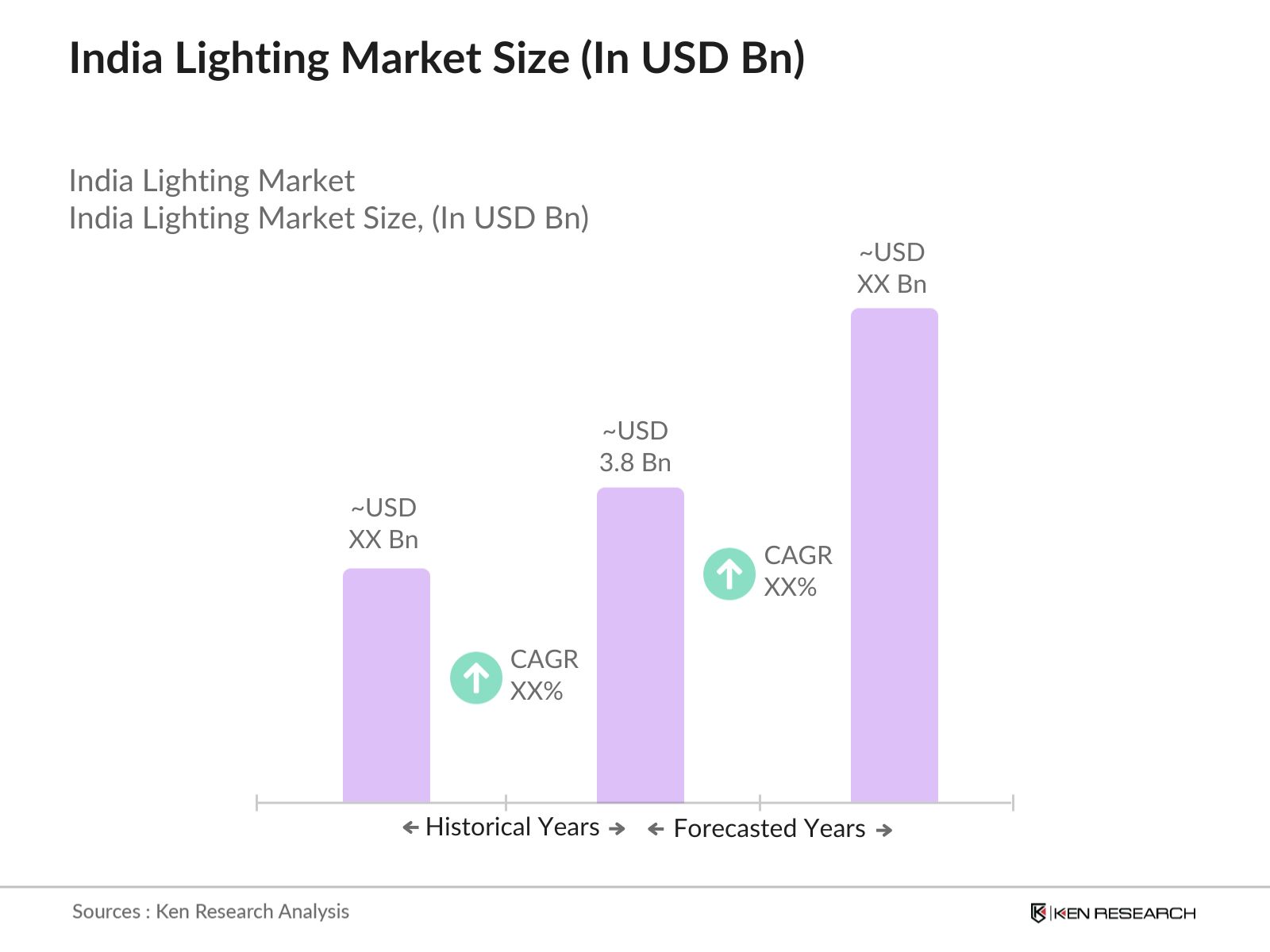
The India lighting market is valued at USD 3.8 billion, driven by increased urbanization, government energy efficiency initiatives, and growing consumer demand for sustainable lighting solutions.
Challenges in the India lighting market include high upfront costs for LED installations, low penetration in rural areas, and a lack of consumer awareness regarding energy-efficient products.
Key players in the India lighting market include Philips Lighting (Signify), Havells India, Syska LED Lights, Bajaj Electricals, and Crompton Greaves Consumer Electricals. These companies lead due to their expansive distribution networks and innovative product offerings.
The India lighting market is driven by government initiatives promoting energy conservation, rapid urbanization, the development of smart cities, and increasing adoption of LED lighting systems.
Cities like Mumbai, Delhi, and Bangalore dominate the India lighting market due to their large-scale infrastructure projects, smart city initiatives, and higher consumer awareness regarding energy-efficient lighting solutions.

What makes us stand out is that our consultants follows Robust, Refine and Result (RRR) methodology. i.e. Robust for clear definitions, approaches and sanity checking, Refine for differentiating respondents facts and opinions and Result for presenting data with story

We have set a benchmark in the industry by offering our clients with syndicated and customized market research reports featuring coverage of entire market as well as meticulous research and analyst insights.

While we don't replace traditional research, we flip the method upside down. Our dual approach of Top Bottom & Bottom Top ensures quality deliverable by not just verifying company fundamentals but also looking at the sector and macroeconomic factors.

With one step in the future, our research team constantly tries to show you the bigger picture. We help with some of the tough questions you may encounter along the way: How is the industry positioned? Best marketing channel? KPI's of competitors? By aligning every element, we help maximize success.

Our report gives you instant access to the answers and sources that other companies might choose to hide. We elaborate each steps of research methodology we have used and showcase you the sample size to earn your trust.

If you need any support, we are here! We pride ourselves on universe strength, data quality, and quick, friendly, and professional service.