Join Meeting Now

Your data is secure and never shared.

India
August 2026

India Machine Tool Market Size, Share & Forecast, By Product Type, End-Use Industry & Technology, 2026–2032

2032

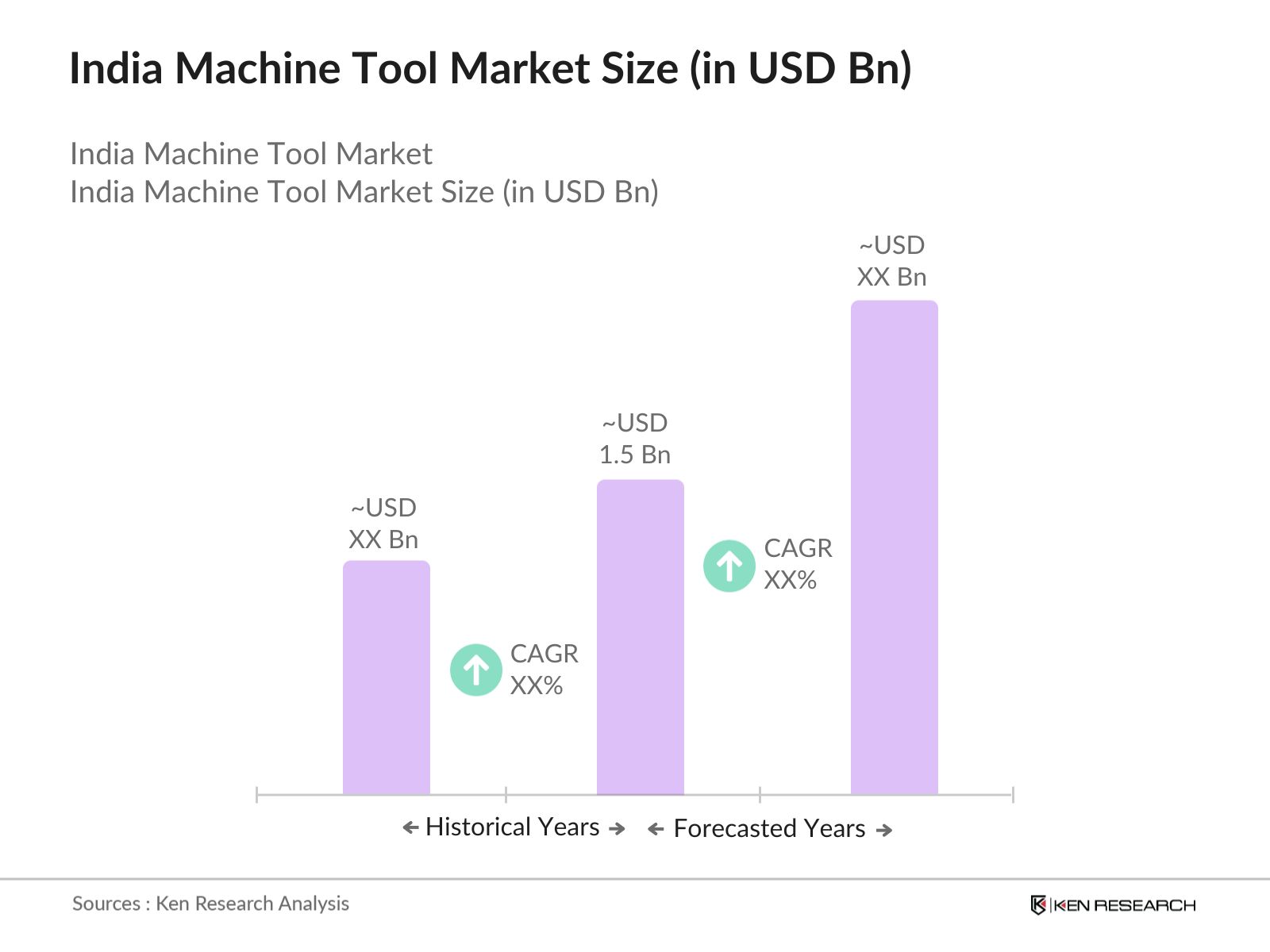
The India Machine Tool Market worth USD 3.7 billion in 2025 is growing at a CAGR of 11.00% to reach USD 6.9 billion by 2031. Ace Designers Limited, Jyoti CNC Automation Limited, Bharat Fritz Werner Limited, LMW Limited and Macpower CNC Machines Limited are the major companies operating in this market.

Report Details

Base Year

2025

Pages

84

Region

India

Author

Ken Research

Product Code
KR-RPT-V02-01893

CHAPTER 1 - MARKET SUMMARY

Market Overview

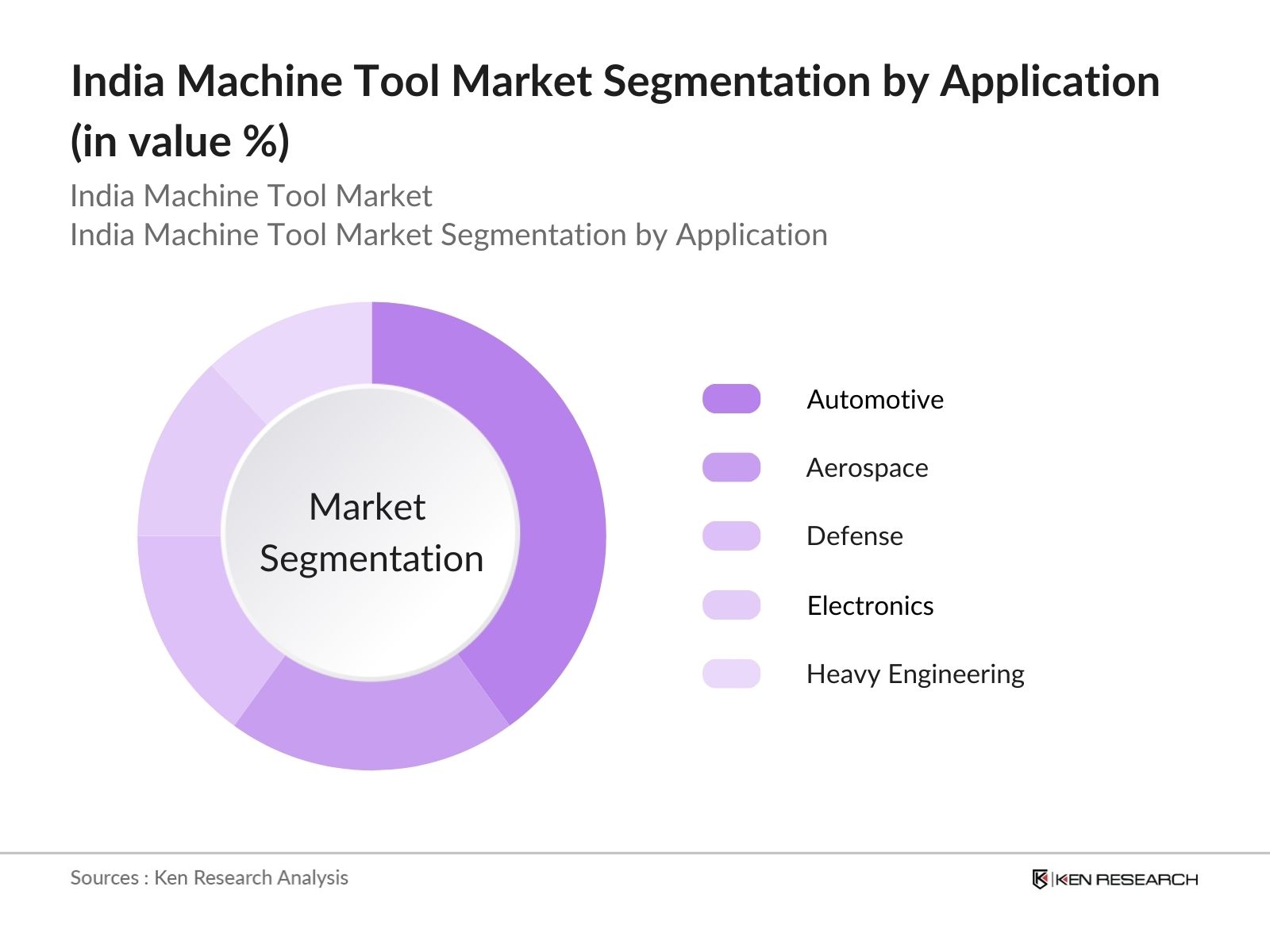
The India Machine Tool Market operates as an equipment-investment market serving component manufacturers, OEM plants, tool rooms and precision-engineering suppliers. Automotive and auto components represented approximately 50% of machine-tool demand in FY2024-25, making vehicle platforms, powertrain localization and component-capacity cycles central to order intake. This concentration is gradually diversifying toward defence, aerospace, railways, electronics and other precision-manufacturing applications.

South India is the principal production and technology cluster, led by Bengaluru, Tumakuru and Coimbatore. Karnataka, particularly Bengaluru and its surrounding industrial belt, accounts for more than 50% of Indian machine-tool production. This concentration combines OEM manufacturing, precision-component suppliers, technical talent and major industry infrastructure, lowering ecosystem coordination costs for manufacturers and making southern India strategically important for capacity additions and technology partnerships.

Market Value

USD 3,700 million

2025

Dominant Region

South India

2025

Dominant Segment

Multi-Axis CNC

fastest growing, 2025-2032

Total Number of Players

500

Future Outlook

The India Machine Tool Market is projected to move from USD 3,700 million in 2025 to approximately USD 7,682 million by 2032, implying an 11.00% forecast CAGR. This trajectory follows a 10.76% historical CAGR over 2020-2025, despite the severe 2020-21 industrial disruption. The underlying demand mix should become less dependent on conventional automotive machining as defence, aerospace, electronics, rail mobility and renewable-energy manufacturing require higher precision, multi-axis processing and integrated automation. IMTMA-linked industry projections indicate Indian machine-tool consumption could approach ?59,444 crore by 2031 under continued manufacturing investment.

Growth quality should increasingly depend on localization rather than demand expansion alone. Domestic production reached ?14,566 crore in FY2024-25 and increased to approximately ?16,478 crore in FY2025-26, while imports still represented around 60-65% of consumption. Manufacturers able to close technology gaps in five-axis machining, high-speed machining, turn-mill systems, precision grinding, automation and connected CNC architectures can capture a larger share of the industry's incremental profit pool. Capital-goods technology programmes, rising defence localization and automotive advanced-technology investment provide a supportive investment backdrop through 2032.

11.00%

Forecast CAGR

$7,682 Mn

2030 Projection

Base Year

2025

Historical Period

2020-2025

Forecast Period

2025-2032

Historical CAGR

10.76%

CHAPTER 2 - SCOPE OF REPORT

Scope of the Market

Click to Explore Interactive Mind Map

CHAPTER 3 - Key Stakeholders

Key Target Audience

Key stakeholders who can leverage from this market analysis for investment, strategy, and operational planning.

Investors

CAGR, localization upside, capex intensity, margins, technology risk

Corporates

equipment sourcing, automation ROI, capacity, accuracy, lifecycle cost

Government

import substitution, standards, skilling, localization, export competitiveness

Operators

utilization, cycle time, uptime, automation, service responsiveness

Financial institutions

equipment finance, order books, cash flows, collateral, demand

What You'll Gain

  • Market sizing and trajectory
  • Import localization opportunity
  • Technology adoption priorities
  • Segment demand structure
  • Competitive landscape shortlist
  • Investment risk priorities

80+

Pages of insights

CHAPTER 4 - Market Size & Growth

Market Size, Growth Forecast and Trends

This section evaluates the historical market size, analyzes year-over-year growth dynamics, and presents forecast projections supported by market performance indicators and demand-side drivers.

Historical & Projected Market Size ($ Million)

Year-over-Year Growth Rate (%)

Market Value vs Volume Growth (%)

Historical Market Performance (2020-2025)

The historical cycle includes a sharp FY2020-21 trough followed by an unusually strong industrial-equipment recovery. Consumption fell to roughly ?12,036 crore in FY2020-21 before reaching ?15,791 crore in FY2021-22 and ?24,536 crore in FY2022-23. FY2022-23 represented the main inflection point, with consumption expanding approximately 55% and production around 32%. By FY2024-25, production had reached ?14,566 crore. The recovery therefore reflected both replacement investment and new manufacturing capacity rather than price effects alone.

Forecast Market Outlook (2025-2032)

The forecast assumes an 11.00% value CAGR through 2032, with physical machine-equivalent volume expanding more slowly as the mix shifts toward multi-axis CNC, automation, higher spindle performance, digital monitoring and turnkey cells. FY2025-26 already provides a supportive operating signal: domestic production turnover reached approximately ?16,478 crore, up about 13%, while order bookings reached roughly ?16,176 crore, up around 20%. The forecast therefore embeds continued capacity investment alongside an improving technology mix and rising average value per machine-equivalent unit.

CHAPTER 5 - Market Data

Market Breakdown

The India Machine Tool Market is transitioning from a predominantly conventional and automotive-led equipment base toward a more diversified precision-manufacturing ecosystem. For CEOs and investors, import penetration, domestic production momentum and localization are the three operating KPIs most closely linked to profit-pool migration.

Market Breakdown

Historical Data (2020-2024) • Base Data (2025) • Forecast Data (2026-2032)

Year
Market Size (USD Mn)
YoY Growth (%)
Import Penetration (%)
Domestic Production Index (2025=100)
Domestic Supply Share (%)
Period
2020$2,220 Mn+-65.6%42.2
$#%
Forecast
2021$1,622 Mn+-26.9%49.6%45.3
$#%
Forecast
2022$2,120 Mn+30.7%46.8%63.9
$#%
Forecast
2023$3,053 Mn+44.0%55.7%84.6
$#%
Forecast
2024$3,293 Mn+7.9%56.3%93.2
$#%
Forecast
2025$3,700 Mn+12.4%58.8%100.0
$#%
Forecast
2026$4,107 Mn+11.0%58.0%113.1
$#%
Forecast
2027$4,559 Mn+11.0%57.0%126.0
$#%
Forecast
2028$5,060 Mn+11.0%56.0%140.0
$#%
Forecast
2029$5,617 Mn+11.0%55.0%154.0
$#%
Forecast
2030$6,235 Mn+11.0%54.0%169.0
$#%
Forecast
2031$6,921 Mn+11.0%53.0%184.0
$#%
Forecast
2032$7,682 Mn+11.0%52.0%200.0
$#%
Forecast

Import Penetration

58.8%, FY2024-25, India. Import dependence concentrates the largest localization opportunity in technologically advanced CNC categories. FY2025-26 imports subsequently crossed ?20,000 crore and represented roughly 60-65% of consumption.

Domestic Production Index

113.1, FY2025-26, India. Domestic machine-tool output is scaling faster as OEMs add capacity and broaden product architecture. Production turnover increased about 13% to approximately ?16,478 crore in FY2025-26, the industry's highest level.

Domestic Supply Share

41.2%, FY2024-25, India. Domestic suppliers captured less than half of apparent consumption after accounting for exports. This leaves material whitespace for localized high-specification turning, multi-axis machining, grinding and automated cells as customer qualification improves.

CHAPTER 6 - Segmentation

Market Segmentation Framework

Comprehensive analysis across key dimensions providing insights into market structure, customer demand, technology adoption and distribution patterns.

No of Segments

7

Dominant Segment

Product Type

Fastest Growing Segment

Technology

Product Type

Turning Machines
$%
Machining Centres
$%
Grinding & Finishing Machines
$%
Metal Forming Machines
$%
EDM & Non-Traditional Machines
$%

End-Use Industry

Automotive & Auto Components
$%
General Engineering
$%
Defence & Aerospace
$%
Railways & Heavy Transport
$%
Electrical & Electronics
$%

Application

High-Volume Component Machining
$%
Precision Die & Mold Manufacturing
$%
Large-Part & Heavy Machining
$%
Sheet Metal Forming
$%
Precision Grinding & Finishing
$%

Customer Type

OEM Manufacturing Plants
$%
Component Suppliers
$%
Tool Rooms & Job Shops
$%
Defence & Public-Sector Manufacturing
$%
Contract Manufacturers
$%

Sales Channel

Direct OEM Sales
$%
Authorized Dealer Sales
$%
Turnkey System Integrators
$%
Government & PSU Tenders
$%
Export Distributor Networks
$%

Technology

Conventional Machine Tools
$%
2-Axis & 3-Axis CNC
$%
Multi-Axis CNC
$%
Automated CNC Cells
$%
Connected Smart Machine Tools
$%

Geography

South India
$%
West India
$%
North India
$%
East & Central India
$%

Key Segmentation Takeaways

Comprehensive analysis across all extracted segmentation dimensions providing insights into market structure, customer preferences, technology requirements and distribution patterns.

Product Type

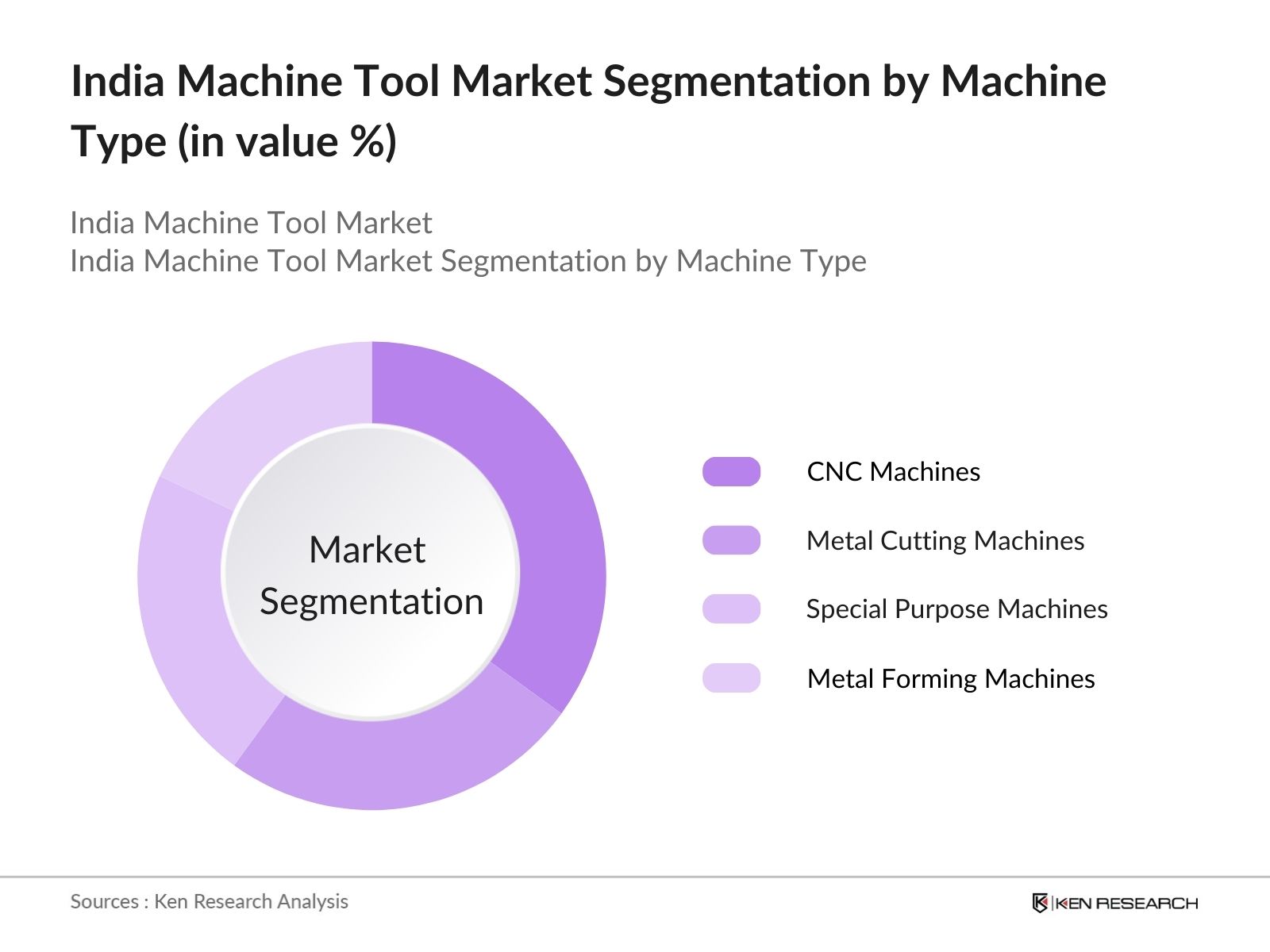
Product architecture remains the clearest revenue-allocation lens because machine specifications, selling prices, service intensity and buyer qualification differ materially across turning, machining-centre, grinding, forming and EDM categories. Machining centres are strategically important because horizontal, vertical and five-axis variants serve automotive, aerospace, defence and precision-engineering applications with substantially different productivity and automation requirements.

Technology

Technology is the fastest-changing segmentation dimension as buyers shift capital expenditure toward multi-axis CNC, automated cells and connected machines that reduce setup time, labour dependency and process variability. Five-axis machining and turn-mill architectures are especially relevant for aerospace, defence, tooling and complex automotive components, while sensor-enabled monitoring expands aftermarket software and lifecycle-service economics for equipment manufacturers.

CHAPTER 7 - Regional Analysis

Regional Analysis

India is among Asia's largest machine-tool demand markets and was ranked fourth globally in machine-tool consumption for calendar 2024 by the World Machine Tool Survey cited by IMTMA. Within a selected Asian peer set, India ranks behind China but ahead of Japan, South Korea and Taiwan on the demand measure used in this report, while offering a materially faster medium-term growth profile.

Focus Country Ranking

2nd among selected Asian peers

Focus Country Market Size

USD 3.7 Bn (2025)

India CAGR (2025-2032)

11.0%

Regional Analysis (Current Year)

Regional Analysis Comparison

MetricIndiaChinaJapanSouth KoreaTaiwan
Market SizeUSD 3.7 BnUSD 25.6 BnUSD 3.5 BnUSD 3.0 BnUSD 1.8 Bn
CAGR (%)11.0%3.5%2.5%3.2%3.0%
Manufacturing Value Added (% of GDP)~17%~25%~21%~27%~32%
Machine Tool Production / Supply Proxy (USD Bn)1.7~26.0~6.0~3.5~2.4

Market Position

India ranks second in the selected Asian comparison, supported by USD 3.7 billion of 2025 apparent consumption and a global consumption rank of fourth in 2024. Domestic demand depth distinguishes India from several export-oriented Asian producers.

Growth Advantage

India's modeled 11.0% CAGR materially exceeds the 2.5-3.5% scenario range for mature East Asian peers, reflecting faster manufacturing-capacity formation, localization and expansion of precision-intensive end industries.

Competitive Strengths

India combines a large domestic demand base, more than 50% production concentration around Karnataka's machine-tool ecosystem and ?1,207 crore of capital-goods technology support, strengthening conditions for local technology development and scale.

CHAPTER 8 - INDUSTRY ANALYSIS

Growth Drivers, Challenges & Opportunities

Comprehensive analysis of key factors shaping the India Machine Tool Market, including growth catalysts, operational challenges, and emerging opportunities across production, distribution, and customer segments.

Growth Drivers

Automotive and Advanced Mobility Capital Expenditure

  • PLI-Auto participants had deployed ?35,657 crore of cumulative investment (September 2025, India), supporting new machining, tooling and production-line requirements across advanced vehicle and component platforms.
  • The PLI-Auto programme carries a ?25,938 crore budgetary outlay (scheme period, India), improving the business case for domestic advanced automotive technology manufacturing and associated capital equipment.
  • PLI-Auto requires minimum 50% domestic value addition (2025, India) for incentivised products, increasing localization pressure on machining-intensive component supply chains and supporting domestic equipment qualification.

Defence, Aerospace and Precision Manufacturing Expansion

  • Defence manufacturing increased 15.6% year-on-year (FY2025-26, India), supporting requirements for multi-axis machining, precision turning, milling and process qualification among defence suppliers.
  • Private-sector defence participation reached 24% of production (FY2025-26, India), broadening the addressable buyer universe beyond public-sector manufacturing plants and creating opportunities for commercially supplied CNC equipment.
  • Electronics production expanded to an estimated ?13.11 lakh crore (FY2025-26, India), creating additional precision-tooling, mold, enclosure and component-machining requirements outside traditional automotive applications.

Capital-Goods Technology and Localization Support

  • The programme had sanctioned 29 projects with ?891.37 crore project cost (March 2026, India), building technical infrastructure relevant to machine tools and advanced manufacturing.
  • Government budgetary support across sanctioned Phase II projects reached ?714.64 crore (March 2026, India), lowering industry-level development barriers for testing, engineering and technology demonstration.
  • Phase I and II initiatives had generated 70 filed IPRs (FY2025-26, India), indicating movement from imported technology dependence toward locally developed industrial solutions and proprietary know-how.

Market Challenges

Persistent Import Dependence in High-Value Equipment

  • Machine-tool imports reached ?18,686 crore (FY2024-25, India), exceeding domestic production and indicating strong customer reliance on overseas technology for advanced categories.
  • FY2025-26 imports crossed ?20,000 crore (FY2025-26, India), indicating that market growth alone does not automatically translate into a larger domestic OEM revenue pool.
  • Imports represented roughly 60-65% of consumption (FY2025-26, India), making localization success dependent on accuracy, reliability, cycle-time performance and after-sales capability rather than price substitution alone.

CNC Skills and Application-Engineering Constraints

  • Machine-tool production expanded approximately 13% in FY2025-26 (India), increasing the requirement for CNC programming, commissioning, maintenance and application-engineering talent alongside equipment output.
  • Order booking increased around 20% in FY2025-26 (India), which can tighten service and application resources when supplier workforce growth does not match equipment-delivery growth.
  • The capital-goods scheme includes qualification-pack and advanced-skilling components within a ?1,207 crore Phase II programme (2026, India), highlighting skills as an institutional competitiveness priority rather than solely a company-level issue.

Changing Machinery Certification and Compliance Framework

  • The rescission was formally notified through S.O. 239(E), 16 January 2026 (India), changing the immediate compliance assumptions used by domestic and foreign machinery suppliers.
  • BIS continues to operate Scheme-X and other compulsory certification mechanisms in 2026 (India), requiring equipment suppliers to maintain active standards surveillance when planning product launches and imports.
  • The transition follows an FY2024-25 period in which the 2024 order was a major industry-policy issue, creating a two-year regulatory reset between 2024 and 2026 (India) that raises planning costs for certification-intensive product portfolios.

Market Opportunities

Import Substitution in Advanced CNC Categories

  • Domestic manufacturers can target the ?20,000+ crore import pool (FY2025-26, India) through five-axis machining, premium turning, high-speed machining and high-precision grinding platforms.
  • Manufacturers, technology licensors and component suppliers benefit where localized machines close reliability gaps against imports while capturing more than half of current consumption value (FY2025-26, India).
  • Localization requires stronger domestic engineering, testing and qualification capability, supported by 29 sanctioned capital-goods projects (March 2026, India) across centres of excellence, testing and technology acceleration.

Multi-Axis, Automated and Connected Machine Platforms

  • Equipment suppliers can raise revenue per installation by combining CNC machines with automation, application engineering and monitoring as production turnover grows from ?14,566 crore to ?16,478 crore between FY2024-25 and FY2025-26 (India).
  • Defence manufacturers produced ?1.78 lakh crore of output in FY2025-26 (India), benefiting machine-tool vendors capable of supplying complex-geometry, high-precision and qualification-intensive production systems.
  • Technology adoption must move from standalone CNC equipment toward integrated cells and digital production systems as electronics output reaches ?13.11 lakh crore in FY2025-26 (India).

Export Scaling and International Market Development

  • Export-oriented OEMs can monetize domestic scale by moving beyond a 12% production-export share baseline (industry target period, India) into markets requiring cost-competitive CNC and engineered solutions.
  • Increasing the share toward 20% by 2028 (India) would improve plant utilization, diversify currency exposure and reduce dependence on domestic capital-investment cycles for qualified manufacturers.
  • Export growth requires internationally competitive accuracy, certification, service coverage and distributor capability as domestic production moves above ?16,478 crore in FY2025-26 (India).

CHAPTER 9 - Competitive Landscape

Competitive Landscape Overview

The India Machine Tool Market combines large domestic CNC manufacturers, public-sector heritage suppliers and global technology companies, while a fragmented regional tail competes in standard machines, specialized applications and aftermarket engineering.

Market Share Distribution

Ace Designers Limited
Jyoti CNC Automation Limited
Bharat Fritz Werner Limited
LMW Limited, Machine Tool Division

Top 5 Players

1
Ace Designers Limited
!$*
2
Jyoti CNC Automation Limited
^&
3
Bharat Fritz Werner Limited
#@
4
LMW Limited, Machine Tool Division
$
5
Macpower CNC Machines Limited
&@$
Combined Share$%

Market Dynamics

Local Players70%
Regional/Int'l30%

8 new entrants in the past 5 years, indicating strong market attractiveness and growth potential.

Company Profiles (Top 10 Players)
Company Name
Market Share
Headquarters
Founding Year
Core Market Focus
Ace Designers Limited
-Bengaluru, India-CNC turning centres, machining centres and factory automation
Jyoti CNC Automation Limited
-Rajkot, India-CNC turning, machining centres, multi-axis systems and automation
Bharat Fritz Werner Limited
-Bengaluru, India1961Vertical and horizontal machining, turning, five-axis and engineered systems
LMW Limited, Machine Tool Division
-Coimbatore, India1988CNC lathes, machining centres, turn-mill and vertical turning systems
Macpower CNC Machines Limited
-Rajkot, India2003CNC turning centres, VMCs, HMCs and vertical turning systems
Lokesh Machines Limited
-Hyderabad, India-Special-purpose machines, CNC machines and automotive machining solutions
HMT Machine Tools Limited
-Bengaluru, India-General-purpose and specialized machine tools and industrial projects
DMG MORI India Pvt. Ltd.
-Bengaluru, India-Premium turning, milling, multi-axis machining and digital manufacturing
Makino India Pvt. Ltd.
-Bengaluru, India1996High-speed machining centres, five-axis systems, EDM and turnkey engineering
Yamazaki Mazak India Pvt. Ltd.
-India-Multi-tasking, turning, machining centres, automation and CNC solutions

Cross Comparison Parameters

The report provides detailed cross-comparison of key players across 10 performance parameters to identify competitive strengths and weaknesses.

Analysis Covered

Market Share Analysis:

Benchmarks competitive scale across domestic and international machine-tool suppliers nationwide

Cross Comparison Matrix:

Compares production capability, order momentum, revenue growth and profitability metrics

SWOT Analysis:

Assesses technology depth, manufacturing scale, channels, localization and execution risks

Pricing Strategy Analysis:

Evaluates specification premiums, lifecycle economics, localization and service-value differentiation strategies

Company Profiles:

Reviews product portfolios, manufacturing footprint, positioning and strategic expansion priorities

CHAPTER 10 - REPORT TOC

Table of Contents

84Pages
34Chapters
10Companies Profiled
7Segmentation Types
Phase 1

Market Assessment Phase

11

Supply-side and competitive intelligence covering market sizing, segmentation, competitive dynamics, regulatory landscape, and future forecasts.

Phase 2

Go-To-Market Strategy Phase

15 chapters

Entry strategy evaluation, execution roadmap, partner recommendations, and profitability outlook.

Phase 3

Survey Phase

8 chapters

Demand-side primary research conducted through structured interviews and online surveys with end users across priority metros and Tier 2/3 cities to capture consumption behavior, unmet needs, and purchase drivers.

Complete Report Coverage

201+ detailed sections covering every aspect of the market

143

Assessment Sections

58

Strategy Sections

CHAPTER 11 - Our Approach

Research Methodology

Desk Research

  • Tracked machine-tool production and consumption trends
  • Reviewed CNC import and export flows
  • Mapped end-industry manufacturing investment cycles
  • Benchmarked machine technology and pricing

Primary Research

  • Interviewed machine-tool plant operations directors
  • Consulted CNC application engineering heads
  • Engaged manufacturing procurement decision makers
  • Interviewed dealer and service heads

Validation and Triangulation

  • Validated findings across 290 respondents
  • Reconciled domestic output with trade
  • Cross-checked OEM and buyer estimates
  • Tested price-volume consistency across categories

CHAPTER 12 - FAQ

FAQs

Still have questions?

Our research team is here to help you find the right solution

Contact Research Team

CHAPTER 13 - Related Research

Explore Related Reports

Expand your market intelligence with complementary research across regions and adjacent markets.

Regional/Country Reports

Related market analysis across key regions

Adjacent Reports

Related markets and complementary research

  • Malaysia Machine Tool Services Market
  • Vietnam Advanced Automation Technology Market
  • UAE 5-Axis CNC Machining Market
  • Kuwait Precision Component Manufacturing Market
  • Singapore Defense Industry Equipment Market

500+

Market Research Reports

50+

Countries Covered

15+

Industry Verticals

Want the full report and an analyst walkthrough?

Unlock the complete dataset, segmentation cuts, and competitive analysis—plus a discovery call that maps insights to your go-to-market priorities.

;