















India Microgrid Market Outlook to 2030
Region:Asia
Author(s):Naman Rohilla
Product Code:KROD2779
November 2024
88
About the Report
India Microgrid Market Overview
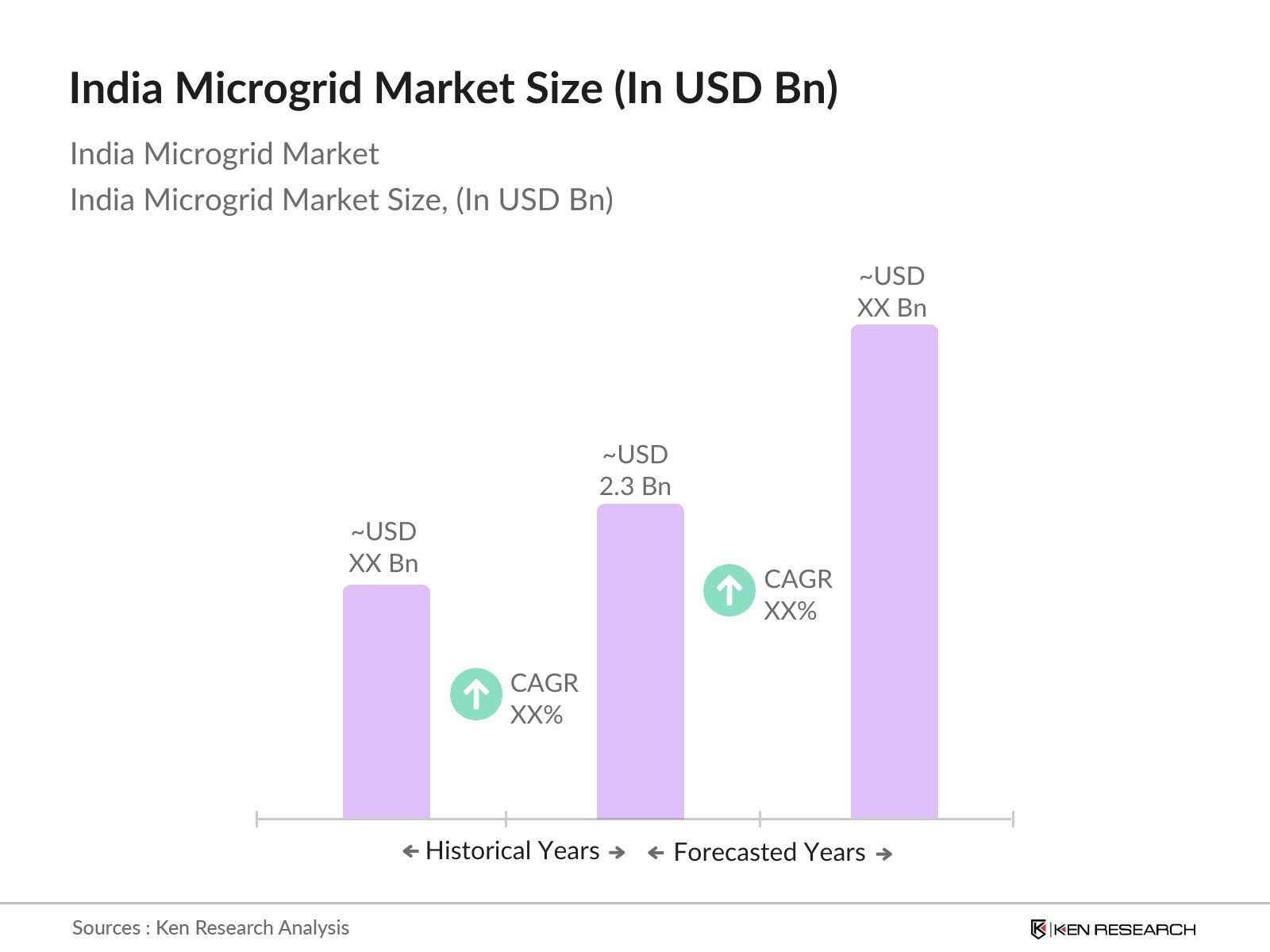
- The India Microgrid Market is valued at USD 2.3 billion, driven by the rising need for energy security, government initiatives promoting renewable energy, and advancements in battery storage technologies. Key drivers include the adoption of microgrids in rural electrification, and industrial sectors, and increasing demand for reliable, decentralized energy solutions.
- Key players in the India Microgrid Market include Schneider Electric, ABB, Siemens, General Electric, and Tata Power. These companies have been at the forefront of developing microgrid solutions that integrate renewable energy sources, offering stability and sustainability to the grid.
- Tata Power has partnered with the Rockefeller Foundation to establish microgrid projects across Indias rural regions. Tata Power and the Rockefeller Foundation aim to establish 10,000 renewable microgrids by 2026, providing clean energy to 5 million households and impacting 25 million lives. This initiative will reduce carbon emissions by 1 million tons annually and support 100,000 rural enterprises.
- The Northern region, particularly states like Uttar Pradesh and Bihar, dominated the market in 2023 due to high rural electrification needs and government investments in microgrid projects. The region is expected to witness rapid growth driven by ongoing projects and government funding.
India Microgrid Market Segmentation
The India Microgrid Market is segmented by component type, end-use industry, and region.
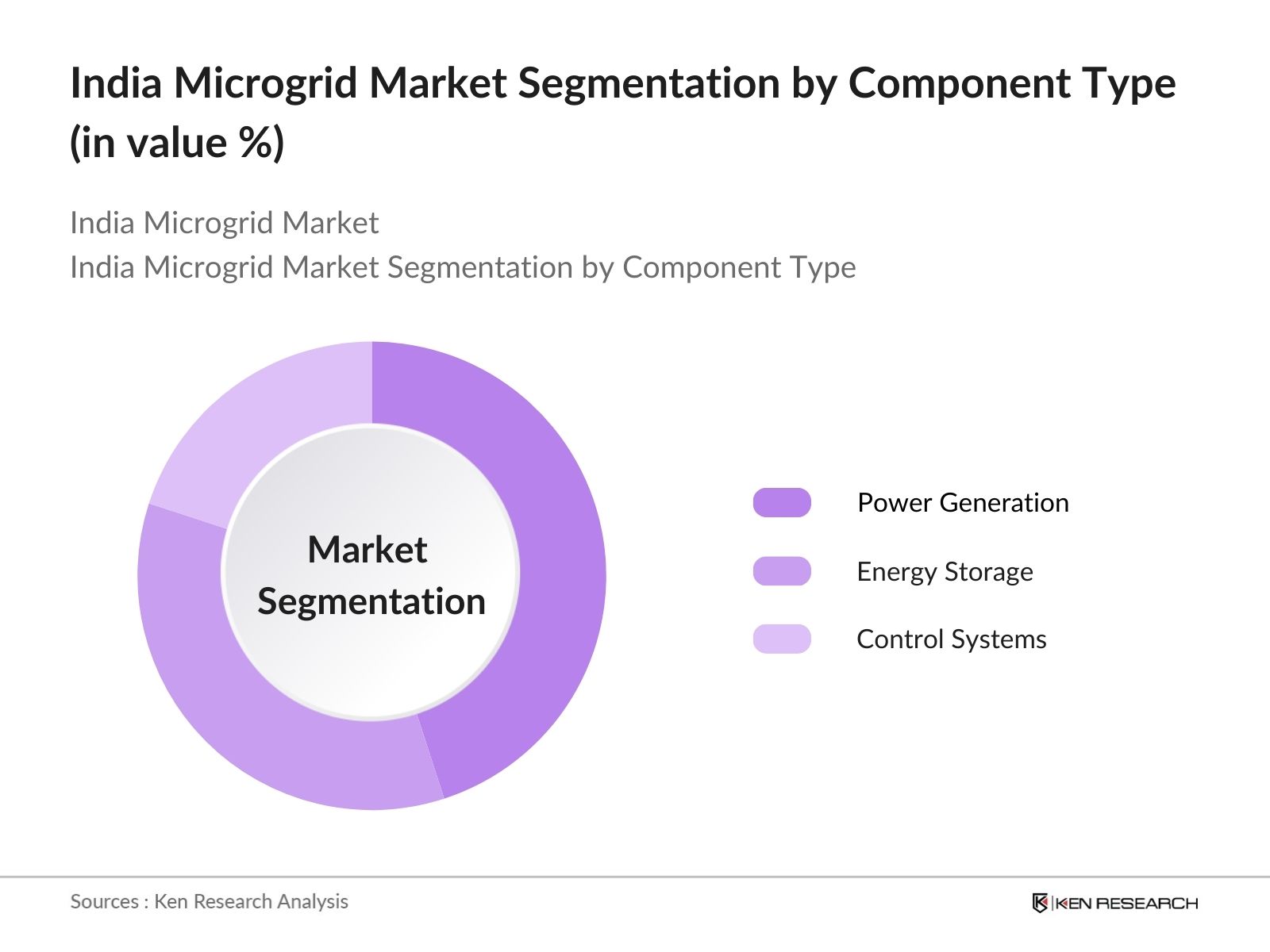
- By Component Type: The market is segmented into power generation (solar, wind, and diesel), energy storage (batteries, flywheels), and control systems. Energy storage held the largest market share in 2023, driven by advancements in battery technology and the need for reliable power solutions.
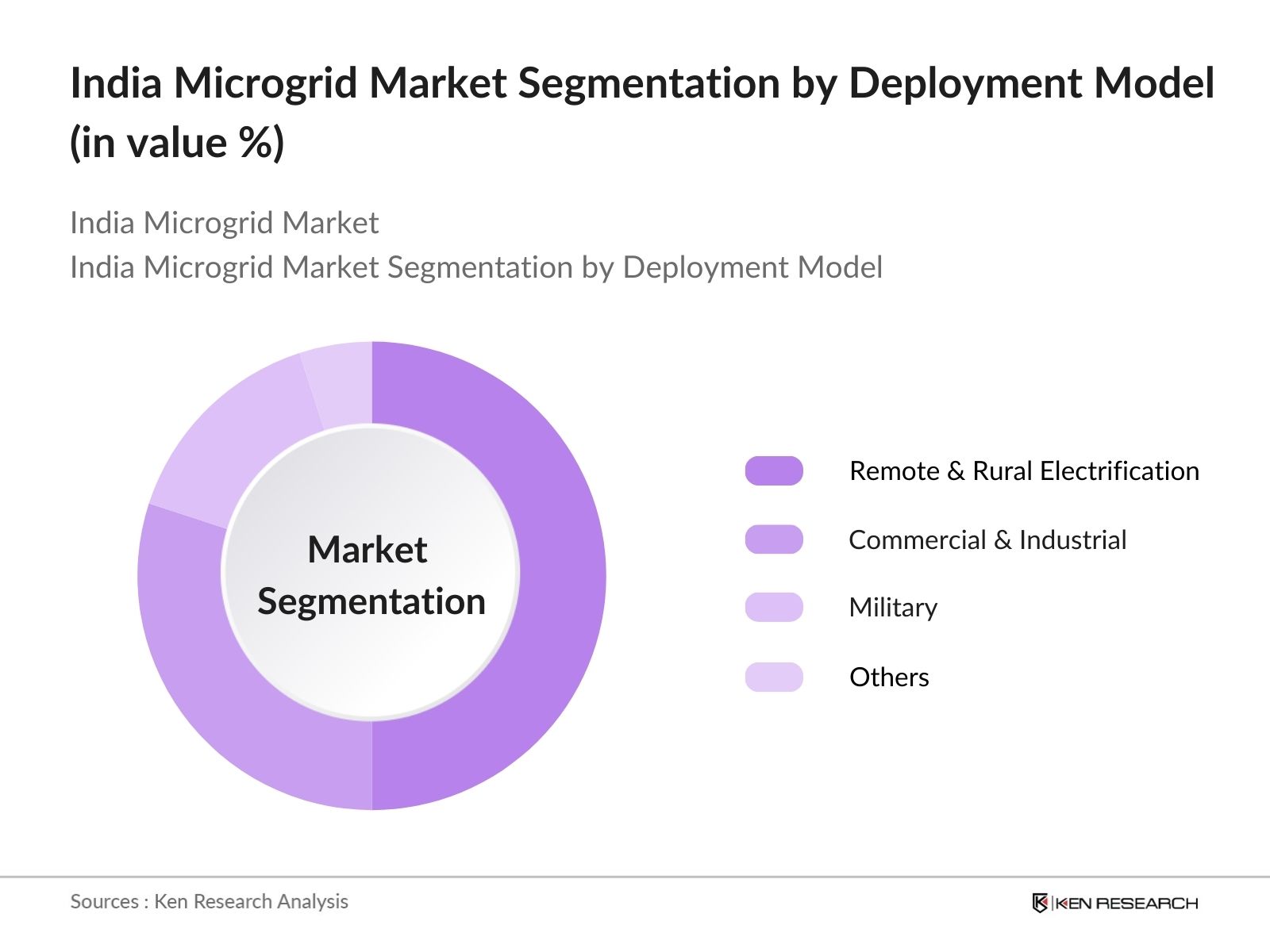
- By End-Use Industry: The market is segmented into commercial & industrial, remote & rural electrification, military, and others. Remote & rural electrification dominated the market in 2023 due to ongoing government initiatives to improve energy access in underserved areas.
- By Region: The market is segmented into North, South, East, and West. The Northern region led in 2023, with substantial investments in microgrid projects aimed at rural electrification and industrial energy needs.
India Microgrid Market Competitive Landscape
|
Company |
Establishment Year |
Headquarters |
|
Schneider Electric |
1836 |
Rueil-Malmaison, France |
|
ABB |
1883 |
Zurich, Switzerland |
|
Siemens |
1847 |
Munich, Germany |
|
General Electric |
1892 |
Boston, USA |
|
Tata Power |
1919 |
Mumbai, India |
- Schneider Electric: Schneider Electric has launched an all-in-one Battery Energy Storage System (BESS) designed for microgrids, enhancing energy management and efficiency. This system integrates seamlessly with EcoStruxure software, enabling flexible configurations and supporting renewable energy use, while Graybar serves as its inaugural distribution partner.
- ABB: Rolls-Royce and ABB announced a global cooperation to develop and deliver microgrids, combining Rolls-Royce's MTU brand microgrid control systems with ABB's microgrid solutions to provide reliable, sustainable and cost-effective power for remote areas and islands.
India Microgrid Market Analysis
India Microgrid Market Growth Drivers:
- Energy Security: Over 50% of rural households in India experience power outages, with some regions reporting an average outage duration of 90 minutes daily. This unreliability drives the demand for decentralized microgrid systems, which can provide consistent electricity and enhance energy security for these communities.
- Renewable Integration: Microgrids integrating renewable energy sources like solar and wind are gaining traction, with solar capacity reaching over 62 GW in India by March 2023. This shift not only reduces carbon emissions but also decreases reliance on fossil fuels, aligning with India's sustainability goals.
- Electrification of Remote Areas: Despite achieving 100% electrification, many rural areas still face unreliable power supply. Studies indicate that rural households endure up to 11 hours of outages daily. Microgrids offer a reliable alternative, improving living standards and enabling economic activities in these remote communities.
India Microgrid Market Challenges:
- High Initial Investment: The installation of microgrid systems can exceed 1 crore per project, making it a substantial financial burden for small-scale industries. With many rural enterprises operating on tight budgets, this high initial investment limits their ability to adopt these advanced technologies effectively.
- Regulatory Issues: India has over 250 million people without reliable access to electricity, highlighting the need for a robust regulatory framework for microgrids. Currently, the absence of uniform regulations across states creates uncertainty for private investors, hindering the widespread adoption and expansion of microgrid solutions.
India Microgrid Market Government Initiatives:
- National Smart Grid Mission (NSGM): Launched in 2015, the NSGM aims to develop smart grids and microgrids across India. The program has allocated 27 crores for microgrid development as part of its broader objectives, which include enhancing rural electrification and integrating renewable energy sources into the grid.
- Rural Electrification Initiatives: Various state governments are collaborating with private companies to establish microgrid systems in off-grid rural areas. Initiatives like the Deendayal Upadhyaya Gram Jyoti Yojana (DDUGJY) aim to electrify un-electrified villages, with over 18,000 villages electrified by 2018, providing uninterrupted power supply to remote communities.
India Microgrid Market Future Market Outlook
The India Microgrid Market is expected to grow substantially over the next five years, driven by increased investments in renewable energy, rising demand for decentralized power systems, and supportive government policies. The adoption of hybrid microgrids combining solar, wind, and battery storage will enhance energy efficiency and sustainability.
India Microgrid Market Future Market Trends:
- Hybrid Microgrids: In the next five years, the integration of renewable energy sources, particularly solar and wind, with advanced battery storage systems will drive the adoption of hybrid microgrids in India. This shift will enhance energy resilience and sustainability, enabling localized energy generation and consumption.
- Smart Microgrids: Over the next five years, the rise of digital technologies will lead to the integration of microgrids with AI and IoT solutions, enabling real-time energy management. This advancement will optimize power distribution across industrial and residential applications, improving efficiency and reliability in energy systems.
Scope of the Report
|
By Component Type |
Power Generation (Solar, Wind, Diesel) Energy Storage (Batteries, Flywheels) Control Systems |
|
By End-Use Industry |
Commercial & Industrial Remote & Rural Electrification Military Others |
|
By Region |
North South East West |
Products
Key Target Audience Organizations and Entities Who Can Benefit by Subscribing This Report:
Government and Regulatory Bodies
Banks and Financial Institutes
Investors and Venture Capitalists
Renewable Energy Companies
Microgrid Technology Companies
Infrastructure Developing Companies
Commercial & Industrial Enterprises
Rural Electrification Companies
Time Period Captured in the Report
Historical Period: 2018-2023
Base Year: 2023
Forecast Period: 2023-2028
Table of Contents
1. India Microgrid Market Overview
1.1 Definition and Scope of the India Microgrid Market
1.2 Market Taxonomy (Component Type, End-Use Industry, Region)
1.3 Market Growth Rate and Trends
1.4 Market Drivers (Energy Security, Renewable Energy Integration, Advancements in Battery Storage)
1.5 Market Restraints (High Initial Investment, Regulatory Challenges)
2. India Microgrid Market Size (in USD Billion)
2.1 Historical Market Size Analysis (2018-2023)
2.2 Year-on-Year Growth Analysis
2.3 Forecast Market Size and Growth Projections (2023-2028)
2.4 Key Market Developments and Milestones
3. India Microgrid Market Analysis
3.1 Growth Drivers
3.1.1 Energy Security and Rural Electrification
3.1.2 Renewable Energy Integration
3.1.3 Electrification of Remote Areas
3.2 Market Challenges
3.2.1 High Initial Investment Costs
3.2.2 Regulatory Issues
3.3 Opportunities
3.3.1 Hybrid Microgrids and Battery Storage Solutions
3.3.2 Integration of Renewable Energy Sources in Microgrids
3.4 Market Trends
3.4.1 Growing Use of Solar and Wind Energy in Microgrids
3.4.2 Increased Demand for Decentralized Power Systems in Remote Areas
4. India Microgrid Market Segmentation
4.1 By Component Type (in Value %)
4.1.1 Power Generation (Solar, Wind, Diesel)
4.1.2 Energy Storage (Batteries, Flywheels)
4.1.3 Control Systems
4.2 By End-Use Industry (in Value %)
4.2.1 Remote & Rural Electrification
4.2.2 Commercial & Industrial
4.2.3 Military
4.2.4 Others
4.3 By Region (in Value %)
4.3.1 North
4.3.2 South
4.3.3 East
4.3.4 West
5. India Microgrid Market Competitive Landscape
5.1 Competitive Market Share Analysis
5.2 Company Profiles
5.2.1 Schneider Electric (Established 1836, Headquarters: Rueil-Malmaison, France)
5.2.2 ABB (Established 1883, Headquarters: Zurich, Switzerland)
5.2.3 Siemens (Established 1847, Headquarters: Munich, Germany)
5.2.4 General Electric (Established 1892, Headquarters: Boston, USA)
5.2.5 Tata Power (Established 1919, Headquarters: Mumbai, India)
5.2.6 Hitachi Energy
5.2.7 Rolls-Royce Power Systems
5.2.8 Microgrid Labs
5.2.9 Sunverge Energy
5.2.10 PowerSecure
5.2.11 Eaton Corporation
5.2.12 Bloom Energy
5.2.13 ENGIE Group
5.2.14 Advanced Microgrid Solutions
6. India Microgrid Market Government Regulations and Initiatives
6.1 National Smart Grid Mission (NSGM)
6.2 Rural Electrification Initiatives (Deendayal Upadhyaya Gram Jyoti Yojana, etc.)
6.3 Government Support for Renewable Energy Integration
6.4 State-Specific Regulations and Collaborations for Microgrid Implementation
7. India Microgrid Market Future Market Size and Segmentation
7.1 Market Segmentation by Component Type (2023-2028)
7.2 Market Segmentation by End-Use Industry (2023-2028)
7.3 Market Segmentation by Region (2023-2028)
7.4 Future Market Trends (Hybrid Microgrids, Smart Microgrids, AI & IoT Integration)
8. India Microgrid Market Technological Advancements
8.1 Advancements in Battery Energy Storage Systems (BESS)
8.2 Innovations in Power Generation (Solar, Wind, and Diesel)
8.3 Integration of AI and IoT in Microgrids for Real-Time Energy Management
8.4 Smart Microgrid Technologies and Real-Time Energy Optimization
9. India Microgrid Market Investment and Funding Landscape
9.1 Government Funding and Incentives for Microgrid Projects
9.2 Key Investments in Microgrid Infrastructure and Renewable Energy Projects
9.3 Private Equity and Venture Capital Funding in the Microgrid Industry
9.4 Collaborations and Strategic Partnerships for Microgrid Expansion
10. India Microgrid Market SWOT Analysis
10.1 Strengths (Decentralized Energy Solutions, Renewable Energy Integration)
10.2 Weaknesses (High Initial Costs, Regulatory Gaps)
10.3 Opportunities (Hybrid Microgrids, AI and IoT Integration)
10.4 Threats (Regulatory Challenges, High Infrastructure Costs)
11. Analysts Recommendations
11.1 Strategic Market Entry and Expansion Opportunities
11.2 Collaborations with Government and Private Enterprises for Rural Electrification Projects
11.3 Innovation in Renewable Energy and Storage Solutions for Microgrids
11.4 Market Positioning Strategies for Key Players
Disclaimer Contact UsResearch Methodology
Step: 1 Identifying Key Variables
Ecosystem creation for all the major entities and referring to multiple secondary and proprietary databases to perform desk research around the market to collate market-level information.
Step: 2 Market Building
Collating statistics on the India Microgrid Market over the years and analyzing the penetration of products as well as the ratio of suppliers to compute the revenue generated for the market. We will also review product quality statistics to ensure accuracy behind the data points shared.
Step: 3 Validating and Finalizing
Building market hypotheses and conducting CATIs with market experts from different companies to validate statistics and seek operational and financial information from company representatives.
Step: 4 Research Output
Our research team approaches multiple manufacturers of microgrid service providers, energy consultants, and industry leaders to understand product segments, sales trends, consumer preferences, and other parameters. This approach supports us in validating the statistics derived from the bottom-up approach of these multiple microgrid service providers, energy consultants, and industry leaders.
Frequently Asked Questions
01. How big is the India Microgrid Market?
The India Microgrid Market was valued at USD 2.3 billion, driven by increasing demand for decentralised power systems, government initiatives, and renewable energy integration. The market is poised for substantial growth by 2028.
02. Who are the major players in the India Microgrid Market?
Major players in the India Microgrid Market include Schneider Electric, ABB, Siemens, General Electric, and Tata Power. These companies lead through advanced microgrid technologies, integrating renewable energy sources and offering customised solutions for various applications.
03. What are the growth drivers of the India Microgrid Market?
Key growth drivers for the India Microgrid Market include government initiatives for rural electrification, increasing renewable energy adoption, demand for reliable power supply, and advancements in battery storage technologies enabling efficient energy management.
04. What are the India Microgrid Market challenges?
Challenges in the India Microgrid Market include high initial setup costs, regulatory barriers, lack of standardised policies, and complex integration of various energy sources, making it difficult for smaller companies to implement microgrid systems effectively.
Why Buy From Us?

What makes us stand out is that our consultants follows Robust, Refine and Result (RRR) methodology. i.e. Robust for clear definitions, approaches and sanity checking, Refine for differentiating respondents facts and opinions and Result for presenting data with story

We have set a benchmark in the industry by offering our clients with syndicated and customized market research reports featuring coverage of entire market as well as meticulous research and analyst insights.

While we don't replace traditional research, we flip the method upside down. Our dual approach of Top Bottom & Bottom Top ensures quality deliverable by not just verifying company fundamentals but also looking at the sector and macroeconomic factors.

With one step in the future, our research team constantly tries to show you the bigger picture. We help with some of the tough questions you may encounter along the way: How is the industry positioned? Best marketing channel? KPI's of competitors? By aligning every element, we help maximize success.

Our report gives you instant access to the answers and sources that other companies might choose to hide. We elaborate each steps of research methodology we have used and showcase you the sample size to earn your trust.

If you need any support, we are here! We pride ourselves on universe strength, data quality, and quick, friendly, and professional service.