CHAPTER 1 - MARKET SUMMARY
Market Overview
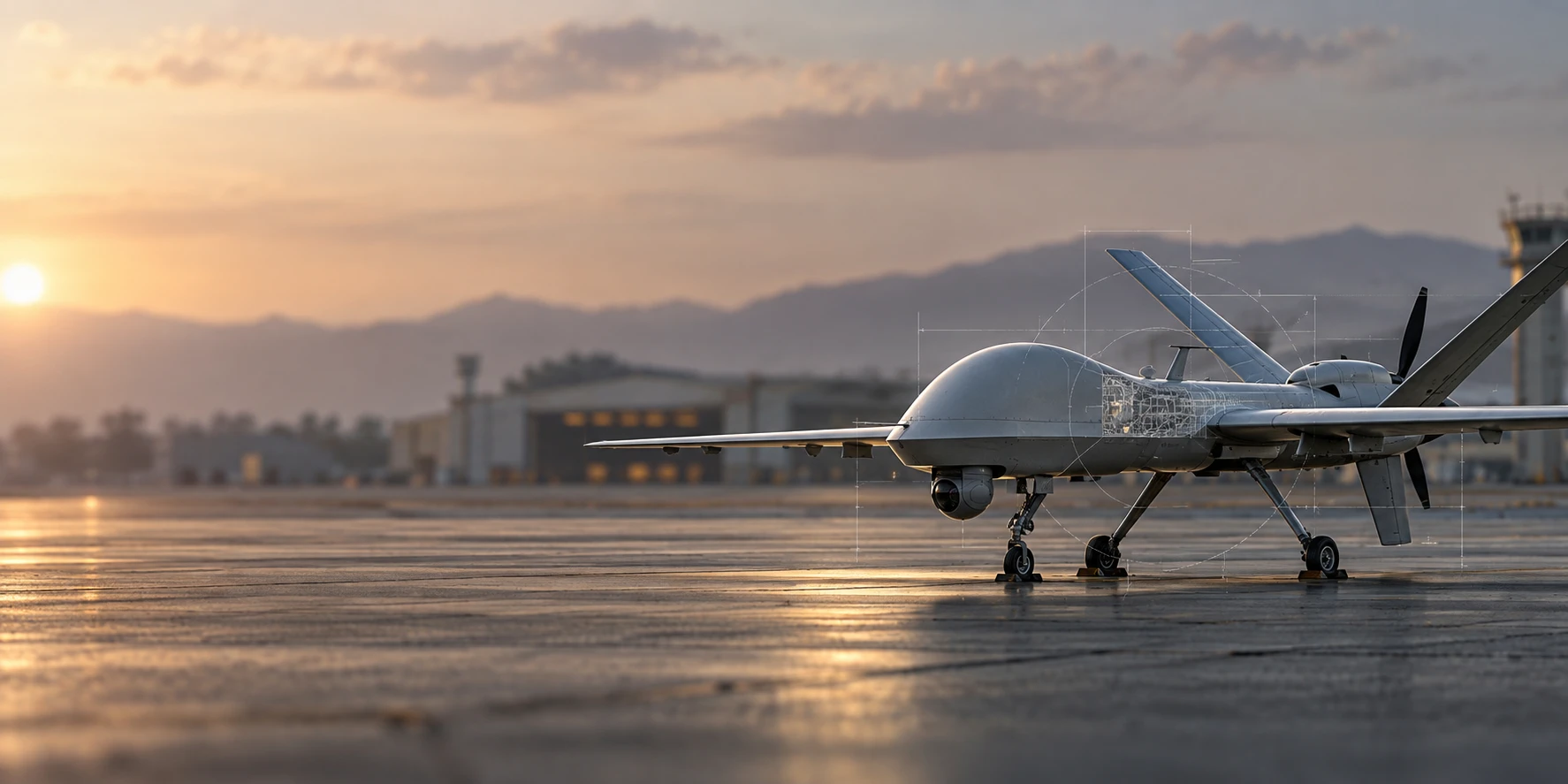
The India Military Drone Market operates through centralised armed-forces procurement, emergency purchases, indigenous development contracts and limited government-to-government imports. Demand is concentrated in intelligence, surveillance, reconnaissance, precision strike and tactical resupply missions. Industry participants indicated potential requirements approaching 10,000 military drones during 2026, demonstrating a shift from limited fleet acquisition toward scalable, attritable inventories.
Hyderabad, Bengaluru, Mumbai and the National Capital Region form the principal manufacturing and engineering clusters. Hyderabad hosts India's first private facility producing strategic and long-endurance UAVs, while Bengaluru concentrates autonomy, avionics and swarm-development capabilities. The Drone Federation of India represents more than 550 companies, creating a diversified supplier base for airframes, propulsion, payloads, software and maintenance.
Market Value
USD 1,947 million
2025
Dominant Region
Southern India Defence-Aerospace Cluster
Dominant Segment
Fixed-Wing Military Drones
largest revenue segment, 2025
Total Number of Players
100+
Future Outlook
The India Military Drone Market is projected to expand from USD 1,947 Mn in 2025 to USD 3,998 Mn by 2031. Historical growth of 19.90% during 2020-2025 reflected accelerated tactical UAV procurement, border-surveillance requirements, loitering-munition induction and replacement of imported systems. Forecast growth moderates to 11.80% during 2026-2031 as procurement shifts from emergency purchases to structured fleet programmes. The August 2025 approval for tri-service MALE remotely piloted aircraft and the prospective domestic tactical-drone order exceeding USD 2 billion provide visibility for airframe, payload, autonomy-software and sustainment suppliers.
Future value creation will increasingly migrate toward autonomous mission software, electronic-warfare-resistant navigation, secure datalinks, advanced payloads and lifecycle support. Hybrid VTOL and fully autonomous systems are expected to outgrow traditional remotely piloted platforms because they combine runway independence with longer range and reduced operator workload. Indigenous value share is forecast to rise from approximately 64% in 2025 to 85% by 2031, although imported sensors, processors and battery materials will remain constraints. Companies possessing proprietary flight-control software, military certification capability and scalable manufacturing will capture disproportionate contract value and export opportunities.
11.80%
Forecast CAGR
USD 3,998 Mn
2030 Projection
Base Year
2025
Historical Period
2020-2025
Forecast Period
2026-2031
Historical CAGR
19.90%
CHAPTER 2 - SCOPE OF REPORT
Scope of the Market
CHAPTER 3 - Key Stakeholders
Key Target Audience
Key stakeholders who can leverage from this market analysis for investment, strategy, and operational planning.
Investors
CAGR, order visibility, margins, localisation, technology risk
Corporates
tender pipeline, partnerships, capacity, payload integration, exports
Government
indigenisation, readiness, procurement, security, supply resilience
Operators
endurance, availability, survivability, payload performance, maintenance
Financial institutions
working capital, contract risk, capex, revenue visibility
CHAPTER 4 - Market Size & Growth
Market Size, Growth Forecast and Trends
This section evaluates the historical market size, analyzes year-over-year growth dynamics, and presents forecast projections supported by market performance indicators and demand-side drivers.
Historical & Projected Market Size ($ Million)
Year-over-Year Growth Rate (%)
Market Value vs Volume Growth (%)
Historical Market Performance (2020-2025)
The historical period recorded a 19.90% CAGR, with the sharpest annual increase of 27.5% occurring in 2025. Annual platform-equivalent deliveries rose from approximately 2,350 systems in 2020 to 4,650 systems in 2025. The inflection began in 2022 as tactical surveillance, swarm-drone and loitering-munition programmes moved from trials toward procurement. Combat and loitering applications increased from approximately 12% of delivered value in 2020 to 29% in 2025, widening the addressable market beyond traditional ISR platforms.
Forecast Market Outlook (2026-2031)
The forecast period is expected to deliver an 11.80% CAGR, increasing annual market value to USD 3,998 Mn by 2031. Annual deliveries are projected to reach approximately 8,250 platform equivalents, while average value per delivered system rises as secure datalinks, multisensor payloads, autonomy software and electronic-warfare protection become standard. Indigenous value share is expected to reach 85%, supported by Buy Indian IDDM, iDEX and domestic-production requirements. Hybrid VTOL, swarm-controlled systems and armed MALE platforms will generate the strongest incremental revenue pools.
CHAPTER 5 - Market Data
Market Breakdown
The India Military Drone Market is transitioning from fragmented platform purchases toward layered unmanned capability portfolios. For CEOs and investors, value growth will depend on the ability to combine scalable production with certified payloads, sovereign software, electronic-warfare resilience and dependable lifecycle support.
Year | Market Size (USD Mn) | YoY Growth (%) | Annual Deliveries (Systems) | Indigenous Value Share (%) | Combat and Loitering Share (%) | Period |
|---|---|---|---|---|---|---|
| 2020 | $785 Mn | +- | 2,350 | 38% | Forecast | |
| 2021 | $895 Mn | +14.0% | 2,590 | 42% | Forecast | |
| 2022 | $1,048 Mn | +17.1% | 2,950 | 47% | Forecast | |
| 2023 | $1,262 Mn | +20.4% | 3,380 | 52% | Forecast | |
| 2024 | $1,527 Mn | +21.0% | 3,900 | 58% | Forecast | |
| 2025 | $1,947 Mn | +27.5% | 4,650 | 64% | Forecast | |
| 2026 | $2,289 Mn | +17.6% | 5,200 | 69% | Forecast | |
| 2027 | $2,559 Mn | +11.8% | 5,770 | 73% | Forecast | |
| 2028 | $2,861 Mn | +11.8% | 6,360 | 77% | Forecast | |
| 2029 | $3,199 Mn | +11.8% | 6,970 | 80% | Forecast | |
| 2030 | $3,576 Mn | +11.8% | 7,600 | 83% | Forecast | |
| 2031 | $3,998 Mn | +11.8% | 8,250 | 85% | Forecast |
Annual Deliveries
4,650 systems, 2025, India. Higher volumes favour modular airframes and common control architectures. Industry sources expect India's military requirement to include as many as 10,000 drones as tactical inventories expand.
Indigenous Value Share
64%, 2025, India. Local-content gains improve domestic revenue retention but require sensor, battery, semiconductor and propulsion localisation. Government policy reserved approximately 70% of defence order value for domestic industry.
Combat and Loitering Share
29%, 2025, India. Revenue is shifting toward expendable strike systems, warhead integration and target-recognition software. Official operational reporting confirmed effective use of indigenous long-range drones and loitering munitions during Operation SINDOOR.
CHAPTER 6 - Segmentation
Market Segmentation Framework
Comprehensive analysis across key dimensions providing insights into market structure, procurement priorities, mission requirements and competitive positioning.
No of Segments
7
Dominant Segment
Platform Type
Fastest Growing Segment
Operating Mode
Platform Type
Application
End-Use Force
Operating Mode
Range Class
Payload Type
Procurement Route
Key Segmentation Takeaways
Comprehensive analysis across all extracted segmentation dimensions provides insights into platform economics, buyer priorities, operating requirements and contract-allocation mechanisms.
Platform Type
Fixed-wing UAVs remain the largest value pool because MALE and strategic ISR systems carry higher unit values, sophisticated payloads and long-term maintenance requirements. Rotary-wing and hybrid VTOL platforms lead tactical deployment volumes because they operate without runways. Loitering munitions are expanding rapidly as artillery, infantry and special-forces units seek low-cost precision engagement and scalable battlefield inventories.
Operating Mode
Fully autonomous and swarm-controlled systems represent the fastest-growing capability layer as armed forces seek reduced operator workload, resilience to communications disruption and coordinated mass effects. The strongest growth is expected in autonomous target recognition, collaborative navigation and manned-unmanned teaming. Suppliers with sovereign algorithms, secure edge computing and electronically contested navigation will command higher margins and stronger export potential.
CHAPTER 7 - Regional Analysis
Regional Analysis
India ranked second among the selected Asia-Pacific military-drone markets in 2025, behind China but ahead of Japan, South Korea and Australia. India's position reflects its large defence budget, extended land and maritime borders and rapidly expanding indigenous UAV ecosystem.
Regional Ranking
2nd
India Market Size (2025)
USD 1,947 Mn
India CAGR (2026-2031)
11.8%
Regional Ranking
2nd
India Market Size (2025)
USD 1,947 Mn
India CAGR (2026-2031)
11.8%
Regional Analysis (Current Year)
Market Position
India ranked second among the five peers with USD 1,947 Mn in 2025, supported by sustained border surveillance and tri-service modernisation requirements.
Growth Advantage
India's 11.8% CAGR exceeds China's 9.7%, Australia's 10.8% and the 11.4% forecasts for Japan and South Korea, positioning India as the peer group's growth leader.
Competitive Strengths
India combines USD 86.1 Bn of annual military expenditure, 100-plus defence-drone participants and a policy reserving approximately 70% of order value for domestic suppliers.
CHAPTER 8 - INDUSTRY ANALYSIS
Growth Drivers, Challenges & Opportunities
Comprehensive analysis of key factors shaping the India Military Drone Market, including growth catalysts, operational challenges and emerging opportunities across platform manufacturing, procurement and battlefield deployment.
Growth Drivers
Acceleration of Tactical and Attritable Drone Procurement
- Proposed purchases are expected to cover thousands of reconnaissance, strike and logistics systems, shifting manufacturers from project-based production toward repeatable assembly and fleet-replenishment economics. More than 100 defence-focused drone firms (2026, India) could compete for platform, subsystem and maintenance contracts.
- Emergency procurement shortens acquisition cycles for operationally urgent systems, allowing successful field-tested products to generate revenue before lengthy conventional tenders conclude. Indian Army emergency contracts worth INR 1,981.90 crore (2025, India) covered capabilities including situational awareness and lethality.
- Higher attrition and replacement requirements create recurring demand for airframes, batteries, propellers, payload repairs and software upgrades. Industry estimates suggest requirements of as many as 10,000 drones (2026, India), favouring modular products with standardised components and rapid field servicing.
Expansion of Long-Endurance and Armed UAV Programmes
- MALE platforms require complex airframes, satellite communications, radar, electro-optical payloads, weapons integration and ground-control infrastructure. The planned acquisition of 87 armed MALE systems (2025, India) could establish two scalable domestic production lines and substantial lifecycle-support revenue.
- India's acquisition of 31 MQ-9B aircraft (2024, India) establishes operational benchmarks for long-endurance surveillance, maritime awareness and precision engagement, increasing demand for complementary indigenous payloads, datalinks, training systems and mission-planning infrastructure.
- Domestic MALE development supports export ambitions by creating certified production, test and maintenance facilities. The government's wider defence-production objective targets USD 30 billion of annual revenue by 2030, encouraging investment in higher-value unmanned aircraft rather than only small tactical platforms.
Policy Support for Indigenous Defence Innovation
- The iDEX scheme received an outlay of INR 498.78 crore for 2021-22 to 2025-26, while ADITI received INR 750 crore, reducing early-stage development risk for autonomy, propulsion, sensors, counter-jamming and swarming technologies.
- Domestic procurement preference directs a substantial portion of expenditure toward Indian primes and startups. Approximately 70% of defence order value (FY2025-26, India) was reserved for domestic industry, improving revenue visibility for local suppliers with qualifying indigenous content.
- Positive Indigenisation Lists include naval shipborne UAVs and tactical drone categories, creating defined import-substitution deadlines. More than 3,738 defence items (2023, India) had been included across early positive lists, enabling component suppliers to plan localisation investments against policy-backed demand.
Market Challenges
Dependence on Imported Mission-Critical Components
- China-linked supply chains remain important for magnets and battery materials, creating procurement risk during geopolitical escalation. Replacement suppliers frequently involve higher qualification costs and longer lead times, reducing gross margins for fixed-price defence contracts. More than 550 ecosystem firms (2026, India) face varying localisation capability.
- High-end electro-optical payloads, satellite communications and specialised engines account for a disproportionate share of strategic UAV value. The continued purchase of 31 imported MQ-9B platforms (2024, India) indicates capability gaps that domestic manufacturers must close through technology partnerships and sustained R&D.
- Local alternatives require environmental, electromagnetic and weapons-integration qualification before fielding. These processes increase non-recurring engineering expenditure and working-capital needs, particularly for startups competing against established primes. The defence R&D allocation was INR 26,816.82 crore (FY2025-26, India).
Electronic Warfare and Communications Vulnerability
- Low-cost drones frequently depend on commercial navigation and radio components that are easier to disrupt than military-grade systems. Buyers therefore require multi-band datalinks, inertial navigation and terrain-referenced autonomy, raising platform cost and extending development cycles. The TPCR identifies requirements for drone-based electronic-warfare capabilities through a 20-year horizon.
- Secure beyond-line-of-sight operation requires satellite bandwidth, encryption, resilient waveforms and network integration. Strategic programmes may therefore remain concentrated among companies able to fund costly verification and cybersecurity processes, narrowing the supplier pool despite more than 100 defence-drone participants (2026, India).
- Adversaries increasingly deploy integrated detection, jamming and kinetic interception systems. Manufacturers must continuously update signatures, frequency management and autonomous recovery logic, converting software maintenance into a recurring requirement. BEL systems can detect micro-drones at approximately 4 kilometres (2025, India), illustrating improving counter-UAS capability.
Fragmented Trials, Certification and Procurement Cycles
- Army, Air Force, Navy and paramilitary users apply different endurance, altitude, payload and communications requirements. Limited standardisation forces suppliers to maintain multiple configurations, weakening scale economies even when aggregate demand exceeds thousands of systems annually (2026, India).
- Small firms face cash-flow pressure because prototype development and field trials precede firm orders. Although iDEX signed 551 design and development contracts by March 2026, only solutions completing user trials and commercial negotiations generate large-scale procurement revenue.
- High-value MALE, HALE and swarm systems above specified financial thresholds require central procurement approval, limiting local-command purchasing flexibility. The 2026 delegation framework states that drones costing above INR 5 crore per system require central procurement.
Market Opportunities
Domestic Tactical Drone Manufacturing at Scale
- Repeat orders, fleet replenishment, batteries, payload swaps and annual maintenance can shift manufacturer economics from irregular projects toward recurring revenue. Potential delivery timelines of 18-24 months (2026, India) favour companies with established production capacity.
- Integrated UAV OEMs, composite manufacturers, electronics suppliers and field-service providers can participate across platform tiers. More than 600 drone-related firms and 100 defence-focused companies (2026, India) provide a broad partnership and acquisition pipeline.
- Common technical standards, approved vendor components and shared trial protocols are required to reduce configuration proliferation. Procurement authorities must translate operational requirements into multi-year frameworks rather than isolated emergency orders exceeding USD 2 billion (2026, India).
Autonomous Swarms and Manned-Unmanned Teaming
- Swarm mission software, edge-computing modules and secure networking can produce higher-margin intellectual-property revenue than airframe manufacturing. NewSpace Research is developing indigenous collaborative systems for reconnaissance, force protection and strike coordination.
- AI developers, semiconductor designers, datalink suppliers and defence primes can jointly address multi-platform programmes. iDEX engagement with 676 innovators (March 2026, India) creates a pipeline of acquisition and teaming opportunities for larger contractors.
- Armed forces need doctrine, communications architecture and rules for human oversight of autonomous systems. Investment must also prioritise GNSS-denied navigation and distributed control so swarms remain operational after command-link disruption. The roadmap includes requirements for stealth RPAs and UCAVs through TPCR 2025.
Localisation of Sensors, Propulsion and Secure Electronics
- Qualified electro-optical payloads, autopilots, motors, batteries and encrypted datalinks can serve multiple OEMs, generating platform-agnostic revenue and aftermarket sales. India's defence-production policy targets annual sector revenue of USD 30 billion by 2030.
- Electronics manufacturers, precision-machining firms, semiconductor startups and strategic investors can enter through joint ventures or technology licensing. The FY2026-27 policy environment opens approximately 25% of defence R&D funding to industry, startups and academia.
- Buyers must aggregate demand across programmes and provide predictable qualification pathways. Without common interfaces and volume commitments, suppliers cannot justify specialised production for military-grade components currently sourced through foreign supply chains. 31 imported MQ-9B platforms (2024, India) illustrate the remaining technology gap.
CHAPTER 9 - Competitive Landscape
Competitive Landscape Overview
Competition combines large defence primes, listed specialist manufacturers and venture-funded UAV companies. Entry barriers centre on military trials, secure technology, indigenous intellectual property, production scalability and access to service-specific procurement channels.
Market Share Distribution
Top 5 Players
Market Dynamics
8 new entrants in the past 5 years, indicating strong market attractiveness and growth potential.
Company Name | Market Share | Headquarters | Founding Year | Core Market Focus |
|---|---|---|---|---|
Adani Defence & Aerospace | - | Ahmedabad, India | - | MALE UAVs, tactical UAVs, loitering munitions and integrated unmanned systems |
Tata Advanced Systems | - | Hyderabad, India | 2007 | Fixed-wing UAVs, VTOL systems, loitering systems and payload integration |
ideaForge Technology | - | Mumbai, India | 2007 | Tactical surveillance UAVs, high-altitude systems and mission software |
NewSpace Research & Technologies | - | Bengaluru, India | 2018 | Autonomous swarms, collaborative combat systems and long-endurance UAVs |
Solar Industries India | - | Nagpur, India | 1995 | Loitering munitions, armed VTOL systems and precision defence payloads |
Raphe mPhibr | - | Noida, India | 2017 | Military-grade tactical UAVs, swarm platforms and indigenous subsystems |
Hindustan Aeronautics Limited | - | Bengaluru, India | 1940 | High-end UCAVs, loyal-wingman systems and strategic unmanned aircraft |
Asteria Aerospace | - | Bengaluru, India | 2011 | Surveillance UAVs, command software and government security applications |
Paras Defence & Space Technologies | - | Navi Mumbai, India | 2009 | Drone subsystems, defence optics, electronics and UAV integration |
Garuda Aerospace | - | Chennai, India | 2015 | Tactical UAVs, swarm platforms, logistics drones and defence manufacturing |
Cross Comparison Parameters
The report provides detailed cross-comparison of key players across 10 performance parameters to identify competitive strengths and weaknesses.
Mission-Ready Fleet Availability
Indigenous Content Ratio
Sector Revenue Growth
EBITDA Margin
Analysis Covered
Market Share Analysis:
Compares contract value, deliveries and installed military fleet presence.
Cross Comparison Matrix:
Benchmarks technology, production, financial strength and mission readiness.
SWOT Analysis:
Evaluates proprietary capabilities, dependencies, opportunities and procurement exposure.
Pricing Strategy Analysis:
Reviews platform pricing, payload premiums and lifecycle contract economics.
Company Profiles:
Assesses ownership, capabilities, products, partnerships and strategic priorities.
CHAPTER 10 - REPORT TOC
Table of Contents
Market Assessment Phase
Supply-side and competitive intelligence covering market sizing, segmentation, competitive dynamics, regulatory landscape, and future forecasts.
Go-To-Market Strategy Phase
15 chapters
Entry strategy evaluation, execution roadmap, partner recommendations, and profitability outlook.
Survey Phase
8 chapters
Demand-side primary research conducted through structured interviews and online surveys with end users across priority metros and Tier 2/3 cities to capture consumption behavior, unmet needs, and purchase drivers.
Complete Report Coverage
201+ detailed sections covering every aspect of the market
143
Assessment Sections
58
Strategy Sections
CHAPTER 11 - Our Approach
Research Methodology
Desk Research
- Reviewed defence procurement and budget documents
- Mapped military UAV contracts and tenders
- Analysed OEM filings and capabilities
- Assessed indigenous component supply networks
Primary Research
- Interviewed military UAV programme directors
- Consulted defence procurement specialists
- Engaged payload integration engineering leaders
- Interviewed drone manufacturing executives
Validation and Triangulation
- 320 interviews across defence drone ecosystem
- Reconciled contract and delivery volumes
- Validated platform pricing and payloads
- Benchmarked comparable military UAV programmes
CHAPTER 12 - FAQ
FAQs
Still have questions?
Our research team is here to help you find the right solution
CHAPTER 13 - Related Research
Explore Related Reports
Expand your market intelligence with complementary research across regions and adjacent markets.
Regional/Country ReportsRelated market analysis across key regions
Related market analysis across key regions
- APAC Military Drone Market Outlook to 2030: Size, Share, Growth and Trends
- Indonesia Military Drone Market
- Vietnam Military Drone Market
- Thailand Military Drone Market
- Malaysia Military Drone Market
Adjacent ReportsRelated markets and complementary research
Related markets and complementary research
- Bahrain Electro-Optical Sensors Market
- South Africa Semiconductor Manufacturing Market
- Qatar High-Density Battery Technology Market
- Vietnam Aerospace Component Manufacturing Market
- Brazil Propulsion System Design Market
500+
Market Research Reports
50+
Countries Covered
15+
Industry Verticals