India POS Terminals Market Outlook to 2030

Region:Asia

Author(s):Naman Rohilla

Product Code:KROD6410

Published On

December 2024

Total pages

88

About the Report

India POS Terminals Market Overview

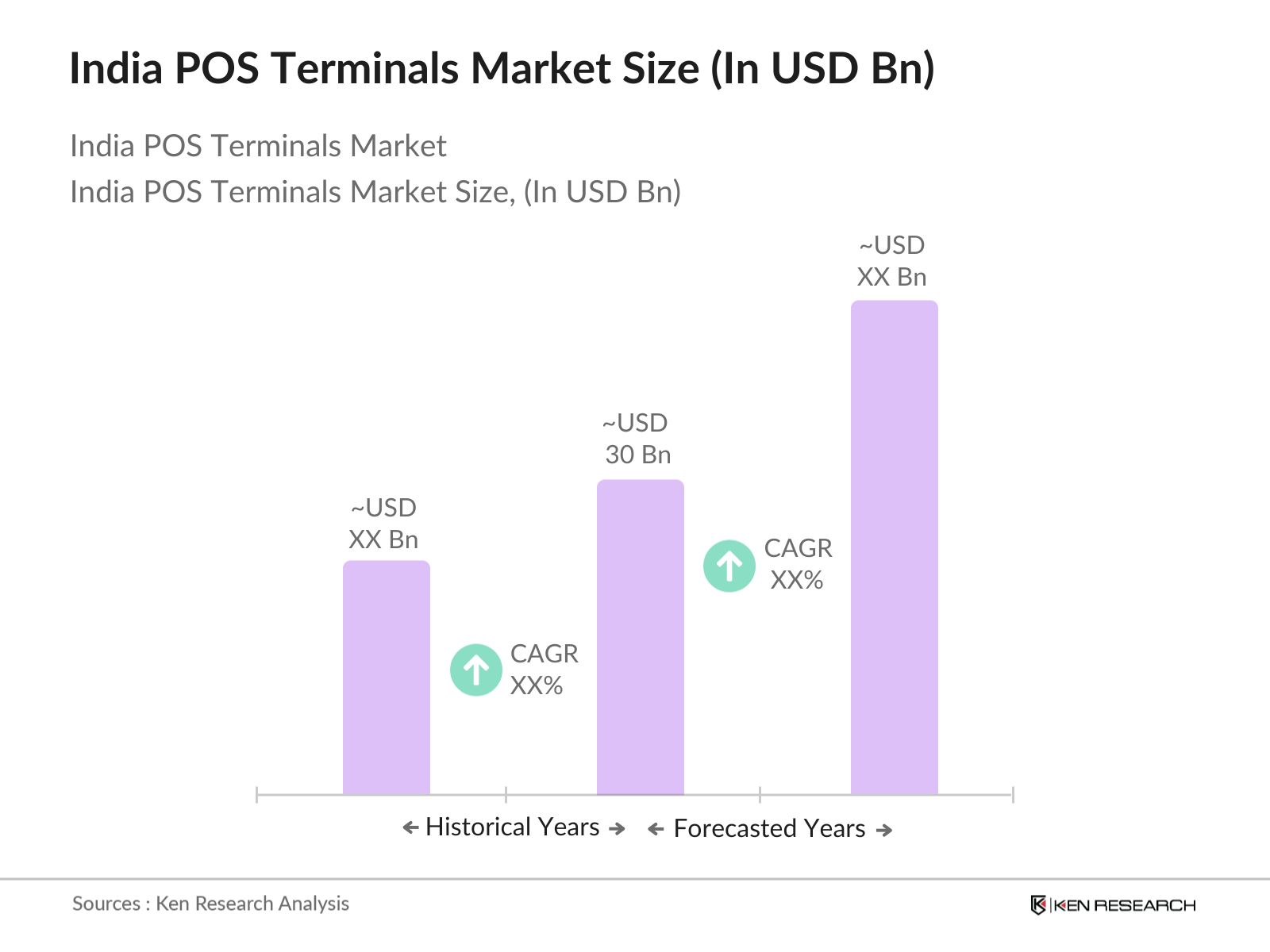
  • The India POS Terminals market is valued at USD 30 billion, based on a five-year historical analysis. The market is driven by factors such as the government's push towards a cashless economy, the rise of digital payment solutions, and the rapid expansion of e-commerce in India. The adoption of POS technology has accelerated, particularly in retail and hospitality, as businesses focus on streamlining transactions and improving customer experiences. Key players in the industry are also offering more advanced POS solutions, such as mobile POS and cloud-based systems, to meet diverse business needs.
  • Major cities like Mumbai, Delhi, and Bengaluru dominate the POS terminals market in India. These cities have a high concentration of organized retail outlets and service providers, along with strong digital infrastructure. The rapid adoption of digital payment systems in these cities is largely due to their economic importance, high population density, and the presence of large enterprises and SMEs that invest in technology to remain competitive in a digital-first environment.
  • The Digital India Initiative, launched by the Government of India, has played a crucial role in promoting the use of digital payments and POS terminals. As of 2023, the initiative facilitated over 13 billion digital transactions, as reported by the Ministry of Electronics and IT. The initiative focuses on transforming India into a digitally empowered society, and its emphasis on promoting financial inclusion has led to the widespread adoption of POS systems across various sectors.

market overviews

India POS Terminals Market Segmentation

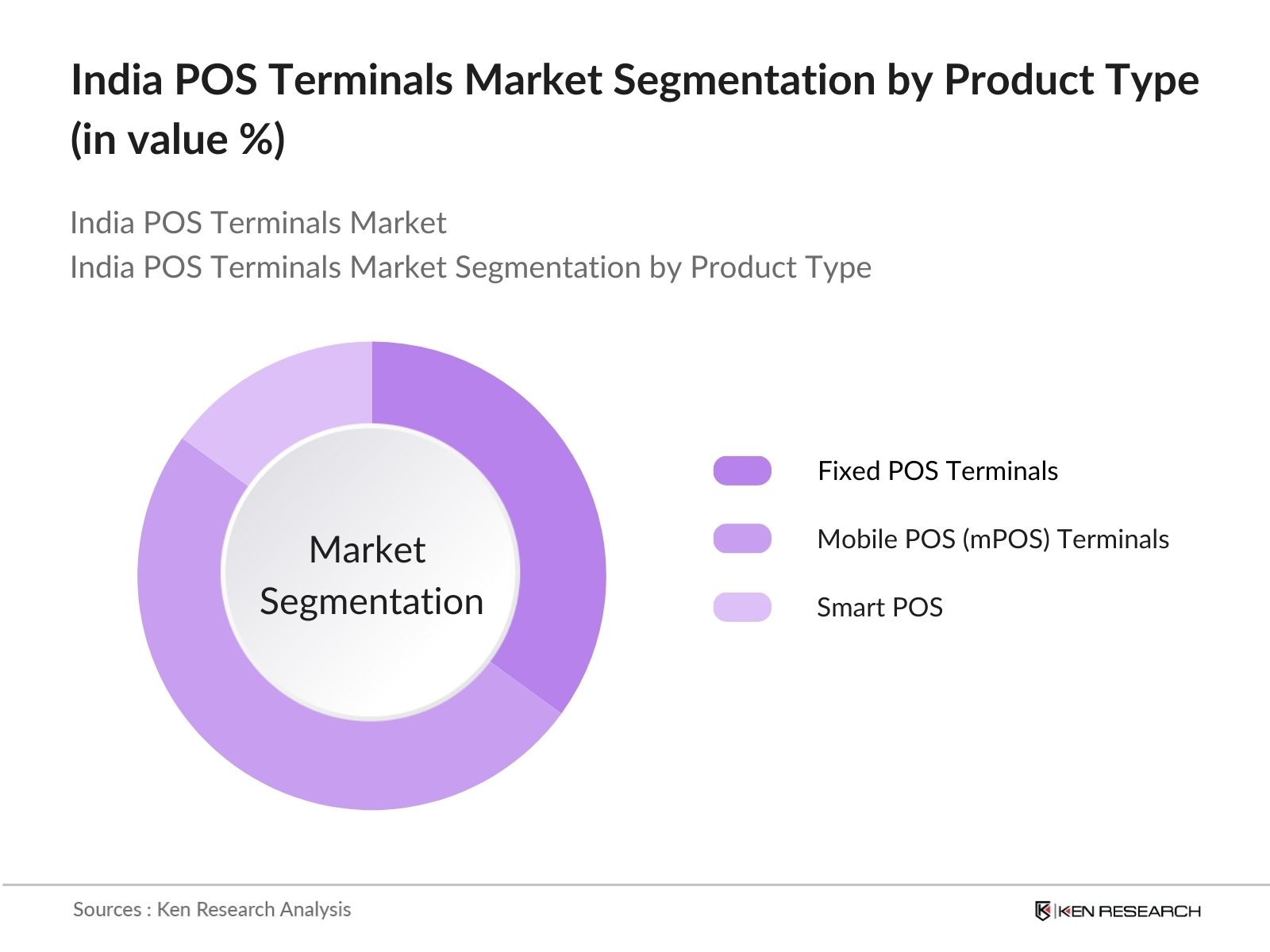
  • By Product Type: The market is segmented by product type into fixed POS terminals, mobile POS (mPOS) terminals, and smart POS. Mobile POS (mPOS) terminals dominate the market due to their flexibility, low cost, and ease of use. They are increasingly popular among small and medium-sized enterprises, especially in sectors like retail, food delivery, and transportation, where mobility is key to service efficiency.

market overviews

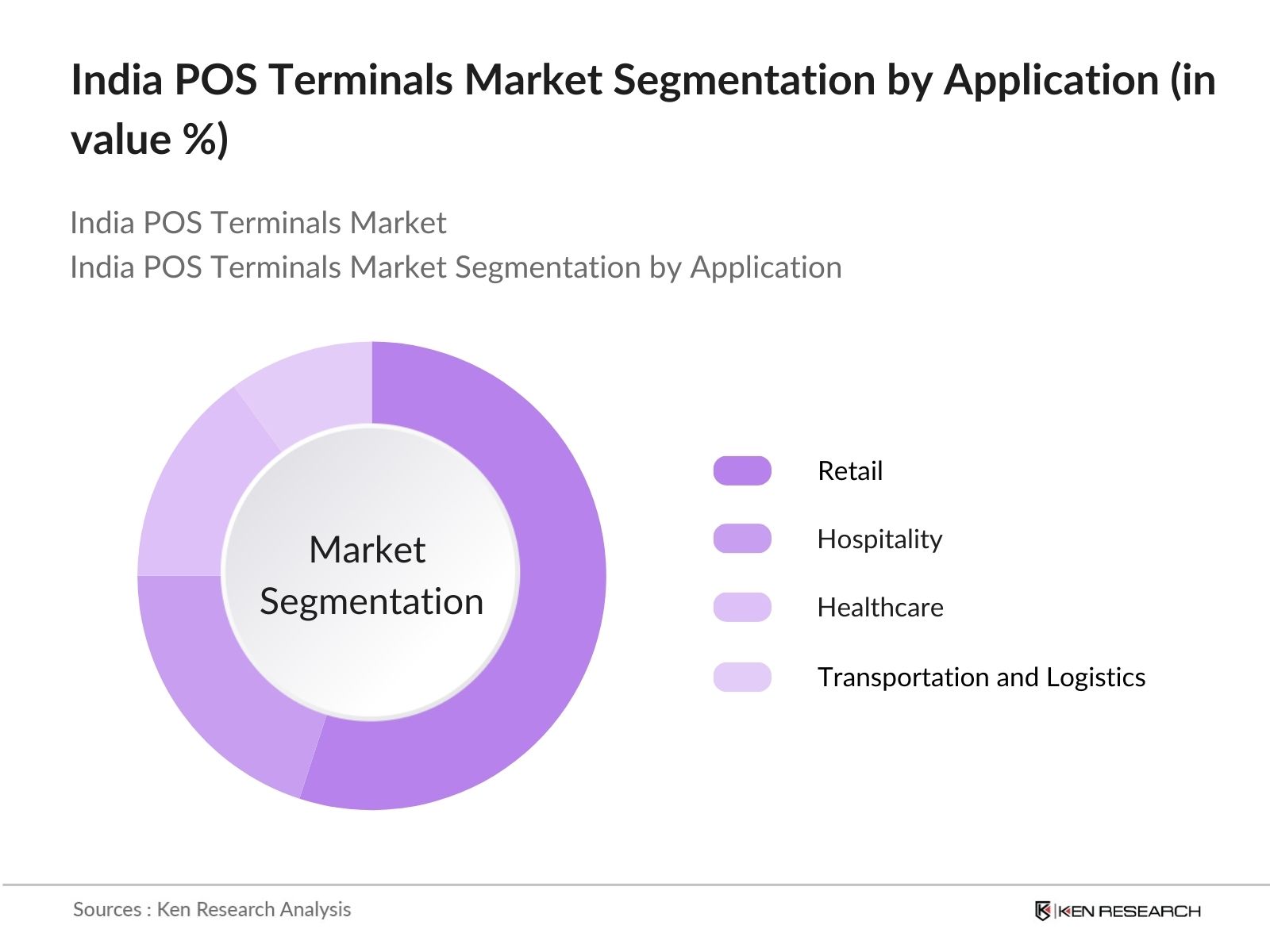
  • By Application: The market is further segmented by application into retail, hospitality, healthcare, and transportation and logistics. The retail sector holds a dominant market share as large retail chains and independent stores are heavily investing in POS systems to improve transaction speed and customer satisfaction. The growing e-commerce sector is also contributing to the widespread adoption of POS terminals in retail, as businesses seek to enhance their online-to-offline integration for seamless payment processing.

market overviews

India POS Terminals Market Competitive Landscape

The India POS Terminals market is dominated by a mix of global and domestic players, with major international companies leading the market due to their extensive product portfolios, technological advancements, and established market presence. The market is highly competitive, with companies investing heavily in research and development to offer innovative solutions, such as mobile payments, biometric authentication, and cloud-based POS systems.

Company Name

Establishment Year

Headquarters

Patents

R&D Spending

Employee Count

Partnerships

Revenue

Product Portfolio

Ingenico

1980

France

-

-

-

-

-

-

Verifone Systems

1981

USA

-

-

-

-

-

-

PAX Technology

2000

China

-

-

-

-

-

-

Mswipe Technologies

2011

India

-

-

-

-

-

-

NCR Corporation

1884

USA

-

-

-

-

-

-

India POS Terminals Market Analysis

India POS Terminals Market Growth Drivers

  • Cashless Economy Initiatives: The Government of India has been pushing for a cashless economy, primarily through initiatives like Digital India. According to the Reserve Bank of India (RBI), the value of digital transactions in India reached INR 3,732 trillion by the end of 2023. This shift is supported by the increasing penetration of smartphones, with India having over 700 million smartphone users as of 2024. The government's promotion of digital payments and the launch of Unified Payments Interface (UPI) have fueled the adoption of POS terminals in the country, especially in tier 2 and tier 3 cities.
  • Rising Digital Payments: Digital payments have surged in India due to widespread smartphone usage and increased internet penetration. As of 2024, UPI alone processed over 75 billion transactions, making India one of the largest digital payment ecosystems globally. The World Bank has noted that India's financial inclusion efforts have resulted in over 80% of adults having a bank account. This increase in financial inclusion directly correlates with the rising need for POS terminals, as businesses aim to accommodate the growing demand for digital payment options.
  • E-Commerce Expansion: The Indian e-commerce sector is projected to reach $200 billion by 2025, driven by rising internet penetration and a growing middle class. As of 2023, there were over 150 million online shoppers in India, according to the Ministry of Commerce. This e-commerce boom has fueled the need for POS terminals, particularly mobile POS (mPOS) systems, to handle online and offline transactions seamlessly. With the government's focus on digital India and the retail sector's growth, the demand for advanced POS systems has seen traction.

India POS Terminals Market Challenges

  • High Installation and Maintenance Costs: The installation and maintenance costs of POS terminals remain a challenge, especially for small and medium-sized enterprises (SMEs) in India. According to the Ministry of Electronics and Information Technology, the average cost of a POS terminal in India can range from INR 15,000 to INR 50,000, with additional expenses for software updates and connectivity. This cost barrier prevents smaller businesses, particularly in rural areas, from adopting POS systems, thereby hindering overall market penetration.
  • Connectivity Issues in Rural Areas: While urban India enjoys seamless internet connectivity, rural areas still struggle with inconsistent network infrastructure. The Telecom Regulatory Authority of India (TRAI) reported in 2023 that only 48% of rural areas have access to stable 4G networks. This lack of reliable connectivity affects the adoption of POS terminals in rural markets, as constant internet access is required for real-time transaction processing. The challenge of poor network coverage remains a significant hurdle for the widespread adoption of POS systems in non-urban regions.

India POS Terminals Market Future Outlook

Over the next five years, the India POS Terminals market is expected to witness growth driven by continuous technological advancements, government support for financial inclusion, and the rising adoption of digital payment solutions. With the growing demand for mobile POS systems and contactless payments, businesses are expected to increase their investments in modern POS infrastructure. The introduction of artificial intelligence and machine learning to enhance payment security and fraud detection is also anticipated to play a key role in driving future growth.

India POS Terminals Market Opportunities

  • Increasing Usage of Mobile POS (mPOS): The adoption of mobile POS systems has seen significant growth, particularly among small businesses and street vendors. As of 2023, over 3 million mPOS units were deployed across India, according to data from the Ministry of Electronics and IT. The convenience and affordability of mPOS devices have made them a popular choice for businesses looking to accept digital payments without the need for traditional, bulky POS systems. The rising number of smartphone users and UPI transactions have further fueled this trend.
  • Adoption of NFC and Contactless Payments: Contactless payments have gained momentum in India, driven by the increasing use of Near Field Communication (NFC) technology. In 2024, the RBI reported that over 50 million contactless payment cards were issued in the country, contributing to a surge in contactless transactions. POS terminals equipped with NFC technology are becoming essential for retailers to meet the growing demand for quick, secure, and hygienic payment solutions. This trend is expected to further drive the adoption of advanced POS terminals across retail sectors.

Scope of the Report

Product Type

Fixed POS Terminals

Mobile POS (mPOS) Terminals

Smart POS

Component

Hardware

Software

Services

Application

Retail

Hospitality

Healthcare

Transportation and Logistics

Deployment Mode

Cloud-based POS

On-premise POS

End-User

Small and Medium Enterprises (SMEs)

Large Enterprises

Products


Key Target Audience

  • POS Hardware Manufacturers

  • POS Software Developers

  • Banks and Financial Institutions

  • Telecom Providers

  • Retail Chains (Reliance Retail, Big Bazaar, etc.)

  • Small and Medium Enterprises (SMEs)

  • Investor and Venture Capitalist Firms

  • Government and Regulatory Bodies (Reserve Bank of India, National Payments Corporation of India)

Companies


Players Mentioned in the Report

  • Ingenico

  • Verifone Systems

  • PAX Technology

  • NCR Corporation

  • Mswipe Technologies

  • Centerm Information Co.

  • Clover Network (Fiserv)

  • Toshiba Tec Corporation

  • Honeywell International

  • Diebold Nixdorf

Table of Contents

1. India POS Terminals Market Overview

1.1. Definition and Scope
1.2. Market Taxonomy
1.3. Market Growth Rate
1.4. Market Segmentation Overview

2. India POS Terminals Market Size (In INR Billion)

2.1. Historical Market Size
2.2. Year-On-Year Growth Analysis
2.3. Key Market Developments and Milestones

3. India POS Terminals Market Analysis

3.1. Growth Drivers
3.1.1. Cashless Economy Initiatives
3.1.2. Rising Digital Payments
3.1.3. E-Commerce Expansion
3.1.4. Government Regulations for Financial Inclusion
3.2. Market Challenges
3.2.1. High Installation and Maintenance Costs
3.2.2. Connectivity Issues in Rural Areas
3.2.3. Cybersecurity Concerns
3.3. Opportunities
3.3.1. Increasing Usage of Mobile POS (mPOS)
3.3.2. Adoption of NFC and Contactless Payments
3.3.3. Emerging Technologies: Cloud-Based POS
3.4. Trends
3.4.1. Integration with Digital Wallets
3.4.2. Increased Demand for Biometric Authentication
3.4.3. Omnichannel Payment Solutions
3.5. Government Regulation
3.5.1. Digital India Initiative
3.5.2. GST and Taxation Policies
3.5.3. RBI Guidelines on Digital Payments
3.6. SWOT Analysis
3.7. Stakeholder Ecosystem (Hardware Providers, Software Developers, Payment Gateway Providers)
3.8. Porters Five Forces
3.9. Competition Ecosystem

4. India POS Terminals Market Segmentation

4.1. By Product Type (In Value %)
4.1.1. Fixed POS Terminals
4.1.2. Mobile POS (mPOS) Terminals
4.1.3. Smart POS
4.2. By Component (In Value %)
4.2.1. Hardware
4.2.2. Software
4.2.3. Services
4.3. By Application (In Value %)
4.3.1. Retail
4.3.2. Hospitality
4.3.3. Healthcare
4.3.4. Transportation and Logistics
4.4. By Deployment Mode (In Value %)
4.4.1. Cloud-based POS
4.4.2. On-premise POS
4.5. By End-User (In Value %)
4.5.1. Small and Medium Enterprises (SMEs)
4.5.2. Large Enterprises

5. India POS Terminals Market Competitive Analysis

5.1. Detailed Profiles of Major Companies
5.1.1. Ingenico
5.1.2. Verifone Systems
5.1.3. PAX Technology
5.1.4. Newland Payment Technology
5.1.5. Clover Network (Fiserv)
5.1.6. Toshiba Tec Corporation
5.1.7. NCR Corporation
5.1.8. Honeywell International
5.1.9. Diebold Nixdorf
5.1.10. SZZT Electronics Co.
5.1.11. Castles Technology
5.1.12. BBPOS
5.1.13. Centerm Information Co.
5.1.14. Fujitsu
5.1.15. Mswipe Technologies
5.2. Cross Comparison Parameters (Revenue, No. of Employees, R&D Expenditure, Market Share, Product Portfolio, Strategic Partnerships, Global vs. Local Presence, Sustainability Initiatives)
5.3. Market Share Analysis
5.4. Strategic Initiatives
5.5. Mergers and Acquisitions
5.6. Investment Analysis
5.7. Venture Capital Funding
5.8. Government Grants and Incentives
5.9. Private Equity Investments

6. India POS Terminals Market Regulatory Framework

6.1. RBI Guidelines
6.2. NPCI Compliance Requirements
6.3. Payment Security Standards (PCI DSS)
6.4. Data Protection and Privacy Regulations
6.5. Certification Processes

7. India POS Terminals Future Market Size (In INR Billion)

7.1. Future Market Size Projections
7.2. Key Factors Driving Future Market Growth

8. India POS Terminals Future Market Segmentation

8.1. By Product Type (In Value %)
8.2. By Component (In Value %)
8.3. By Application (In Value %)
8.4. By Deployment Mode (In Value %)
8.5. By End-User (In Value %)

9. India POS Terminals Market Analysts' Recommendations

9.1. TAM/SAM/SOM Analysis
9.2. Customer Cohort Analysis
9.3. Marketing Initiatives
9.4. White Space Opportunity Analysis

Disclaimer Contact Us

Research Methodology

Step 1: Identification of Key Variables

The research process begins by identifying key stakeholders, including hardware and software providers, financial institutions, and retailers, to understand their impact on the India POS Terminals market. Secondary research is conducted using proprietary databases and industry reports to map the market ecosystem and identify trends.

Step 2: Market Analysis and Construction

In this phase, historical data is analyzed to understand market trends, technology adoption, and end-user demand. The analysis covers market penetration, transaction volumes, and revenue generation by different POS segments to build accurate forecasts for the market.

Step 3: Hypothesis Validation and Expert Consultation

Market hypotheses are validated through consultations with industry experts, including executives from leading POS providers and retailers. These discussions provide insights into market drivers and challenges, complementing the data gathered from secondary sources.

Step 4: Research Synthesis and Final Output

The final stage involves synthesizing data from primary and secondary research into actionable insights. This approach ensures that the analysis is comprehensive, accurate, and validated by industry experts, offering a reliable view of the India POS Terminals market.

Frequently Asked Questions

01. How big is India POS Terminals Market?

The India POS terminals market is valued at USD 30 billion, driven by increasing digital payment adoption, government initiatives for financial inclusion, and growing demand for contactless payment solutions.

02. What are the challenges in ?

Challenges in the India POS terminals market include high installation and maintenance costs, especially for small businesses, cybersecurity threats, and limited access to reliable internet connectivity in rural areas.

03. Who are the major players in India POS Terminals Market?

Key players in the India POS terminals market include Ingenico, Verifone Systems, PAX Technology, Mswipe Technologies, and NCR Corporation, which dominate due to their extensive product portfolios and technological innovations.

04. What are the growth drivers of India POS Terminals Market?

The India POS terminals market is driven by the government's cashless economy initiative, rising digital payments, the growth of e-commerce, and technological advancements in contactless payments and mobile POS systems.

Why Buy From Us?

RRR
Refine Robust Result (RRR) Framework

What makes us stand out is that our consultants follows Robust, Refine and Result (RRR) methodology. i.e. Robust for clear definitions, approaches and sanity checking, Refine for differentiating respondents facts and opinions and Result for presenting data with story

Our Reach Is Unmatched

We have set a benchmark in the industry by offering our clients with syndicated and customized market research reports featuring coverage of entire market as well as meticulous research and analyst insights.

Research
Shifting the Research Paradigm

While we don't replace traditional research, we flip the method upside down. Our dual approach of Top Bottom & Bottom Top ensures quality deliverable by not just verifying company fundamentals but also looking at the sector and macroeconomic factors.

Insite
More Insights-Better Decisions

With one step in the future, our research team constantly tries to show you the bigger picture. We help with some of the tough questions you may encounter along the way: How is the industry positioned? Best marketing channel? KPI's of competitors? By aligning every element, we help maximize success.

Trust
Transparency and Trust

Our report gives you instant access to the answers and sources that other companies might choose to hide. We elaborate each steps of research methodology we have used and showcase you the sample size to earn your trust.

support
Round the Clock Support

If you need any support, we are here! We pride ourselves on universe strength, data quality, and quick, friendly, and professional service.

Why Client Choose Us?

400000+ Reports in repository
150+ Consulting project a year
100+ Analysts
8000+ Client Queries in 2022