
India Railway Market Outlook to 2030
Region:Asia
Author(s):Shreya Garg
Product Code:KROD9318
December 2024
83
About the Report
India Railway Market Overview
- The India Railway market is valued at USD 30.7 Billion, driven by a combination of strong governmental initiatives and an ever-increasing demand for both freight and passenger transportation. The governments focus on improving rail infrastructure through electrification, safety upgrades, and the modernization of tracks is playing a significant role in expanding the market. Indias reliance on rail for bulk freight transport, such as coal, steel, and agricultural produce, continues to fuel market demand, further supported by initiatives like the PM GatiShakti plan.

- The Indian Railway market is dominated by cities such as Delhi, Mumbai, and Kolkata, primarily because these cities serve as major hubs for both passenger and freight transport. Additionally, these metropolitan areas are well connected through vast railway networks that link with industrial zones and ports, enhancing their dominance. The concentration of population and industries in these areas necessitates extensive rail infrastructure, supporting their leading positions in the market.
- The National Rail Plan (NRP) outlines Indias rail infrastructure expansion goals for the next decade. In 2024, the government aims to double rail track capacity on high-density routes and complete the Dedicated Freight Corridors (DFCs), enhancing freight transportation efficiency. The plan also aims to increase rail freight traffic to 45% of total traffic by 2030. These efforts align with the governments target to reduce logistics costs, which currently stand at around 13-14% of GDP.
India Railway Market Segmentation
By Product Type: The market is segmented by product type into Rolling Stock, Railway Infrastructure, and Railway Services. Rolling stock, which includes locomotives, coaches, and wagons, holds a dominant share due to India's massive investments in modernizing its aging fleet. The governments push towards electrification and procurement of high-speed trains further contributes to the growth of this segment. Meanwhile, railway infrastructure, including tracks, bridges, and signaling systems, continues to expand, driven by significant capital expenditure on projects like dedicated freight corridors. 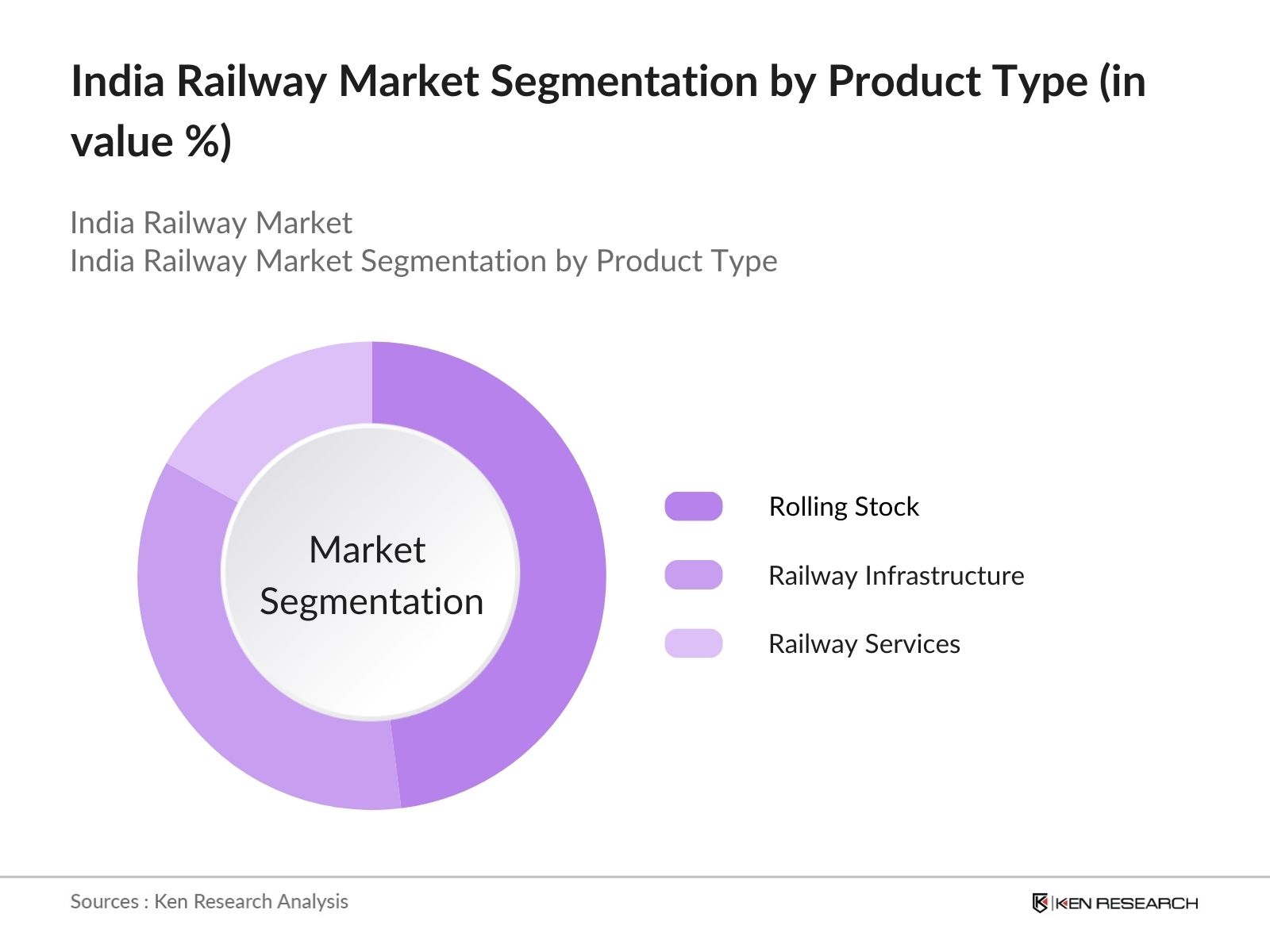
By Application: The market is segmented by application into Passenger Transport, Freight Transport, and Logistics Services. Freight transport dominates the segment due to India's reliance on the railway system for transporting bulk commodities like coal, iron ore, and cement across vast distances. The efficiency and cost-effectiveness of rail compared to road transport have further reinforced the dominance of this segment, particularly for heavy industries. On the passenger side, metropolitan and intercity trains continue to serve millions daily, but the volume of freight transported significantly outweighs passenger operations in revenue contribution. 
India Railway Market Competitive Landscape
The Indian Railway market is dominated by several key players, both local and international, which play significant roles in the sector's development. The market is consolidated with a few major competitors leading in rolling stock manufacturing, infrastructure development, and service provision. Indian Railways, along with companies like Larsen & Toubro and BHEL, hold a majority of contracts in areas such as infrastructure upgrades and locomotive production, while global companies such as Alstom and Siemens are actively involved in technology supply and high-speed rail projects.
|
Company |
Establishment Year |
Headquarters |
Rolling Stock |
Infrastructure Projects |
Electrification |
R&D Expenditure |
Fleet Size |
Freight Volume |
Technology Integration |
|
Indian Railways |
1853 |
New Delhi, India |
|||||||
|
Larsen & Toubro |
1938 |
Mumbai, India |
|||||||
|
BHEL |
1964 |
New Delhi, India |
|||||||
|
Alstom India |
1999 |
Bangalore, India |
|||||||
|
Siemens India |
1922 |
Mumbai, India |
India Railway Industry Analysis
Growth Drivers
- Government Infrastructure Initiatives: The Indian government's flagship infrastructure projects, like the PM GatiShakti plan and the National Rail Plan (NRP), aim to bolster railway infrastructure significantly. The NRP targets increasing freight capacity to 2,400 million tonnes by 2030 and boosting rail traffic from 36% to 45% by 2030. As of 2023, approximately 1,100 km of new freight corridors have been completed, easing transportation bottlenecks in major industrial regions. Additionally, the Dedicated Freight Corridors (DFCs) have already helped reduce logistical costs by 5-6%. These initiatives directly improve freight and passenger services, supporting the growing demands of Indias economy.
- Urbanization and Population Growth: Indias rapid urbanization, with more than 460 million people residing in urban areas in 2024, has driven the expansion of metro and commuter rail networks. As of 2023, metro rail services operate in 15 cities with a network of 850 km, and projects in over 20 cities are in various phases of construction. The Mumbai Suburban Rail, which serves over 7.5 million passengers daily, continues to expand. Population growth and urban migration have increased the reliance on public transport systems, making the metro and suburban rail expansions critical to easing congestion and reducing urban pollution.
- Rising Demand for Freight Transportation: Indias demand for freight services continues to surge, particularly in coal, cement, and steel transportation. Indian Railways moved over 1,500 million tonnes of freight in FY 2022-23, with coal accounting for more than 40% of the total volume. The rising demand for power generation and steel production to meet infrastructure development has made the transport of these materials crucial. With coal production reaching 892 million tonnes in 2023 and India's focus on steel manufacturing (targeting 300 million tonnes of production by 2030), freight railways play a pivotal role in sustaining industrial growth. Source: Ministry of Coal,
Market Challenges
- Funding and Investment Gaps: Despite ambitious railway projects, India faces challenges in securing adequate funding. Indian Railways' capital expenditure stood at 2.4 lakh crore in FY 2023-24, with significant contributions from government budgets and public borrowing. However, Foreign Direct Investment (FDI) inflows in railways have been limited due to stringent regulatory frameworks. The lack of substantial private and foreign investments has delayed certain infrastructure projects. The funding gap is also evident in the underdevelopment of key sectors like urban metro systems, where 50,000 crore more is required to complete ongoing projects.
- Aging Infrastructure: Indias railway infrastructure, much of which is decades old, presents significant challenges. Over 40% of the tracks have surpassed their recommended lifespan of 30 years, leading to frequent wear and maintenance costs. In 2023, 2,000 km of tracks were in urgent need of replacement, affecting operational efficiency. Additionally, outdated signaling systems contribute to delays, particularly on high-density routes. Modernizing these systems will require significant investments, which is challenging given budget constraints.
India Railway Market Future Outlook
Over the next five years, the Indian Railway market is expected to show significant growth driven by the government's continued investment in infrastructure, the shift towards 100% electrification, and the modernization of rail services. Key focus areas include the introduction of high-speed trains, expansion of dedicated freight corridors, and digitalization initiatives aimed at improving safety and operational efficiency. The rising demand for sustainable transport solutions and Indias increasing reliance on rail for bulk freight movement will also act as growth catalysts in the market.
Future Market Opportunities
- Public-Private Partnerships: Indias rail sector offers lucrative opportunities for Public-Private Partnerships (PPP). With the government easing FDI norms for railway infrastructure, several private players have entered the freight and passenger services segments. By 2024, private operators were running over 150 freight trains, improving operational efficiencies. The Indian government has also introduced PPP models for metro expansions, with a total of 35,000 crore expected to be invested in the next five years. This collaborative approach is seen as a vital step toward modernizing railways while easing the financial burden on public resources.
- Digital Transformation: The Indian rail sector is rapidly adopting digital technologies for operational efficiency and safety. AI-based predictive maintenance is being implemented to reduce breakdowns and service delays. Indian Railways plans to implement AI solutions across its network, potentially saving over 10,000 crore annually in maintenance costs. Furthermore, the deployment of AI-driven safety systems has already begun, with pilot projects underway for collision avoidance and automatic train control. In 2024, around 2,000 km of rail routes are expected to benefit from predictive maintenance systems, reducing operational delays and enhancing safety.
Scope of the Report
|
Product Type |
Rolling Stock Railway Infrastructure Railway Services |
|
Application |
Passenger Transport Freight Transport Logistics Services |
|
Technology |
Conventional Rail High-Speed Rail Electric Traction Systems |
|
Rail Gauge |
Broad Gauge Standard Gauge Narrow Gauge |
|
Region |
North South East West |
Products
Key Target Audience
Rolling Stock Manufacturers
Freight Operators
Railway Infrastructure Contractors
Logistics Service Providers
Private Train Operators
Government and Regulatory Bodies (Ministry of Railways, Indian Railways, Railway Board)
Investor and Venture Capitalist Firms
Rail Technology Providers
Companies
Major Players
Indian Railways
Larsen & Toubro
BHEL
Siemens India
Alstom India
Bombardier Transportation
Texmaco Rail & Engineering
Titagarh Wagons
Rail Vikas Nigam Ltd (RVNL)
GE Transportation
Hyundai Rotem
CAF India
Tata Projects
IRCON International
Jindal Steel & Power
Table of Contents
1. India Railway Market Overview
1.1. Definition and Scope
1.2. Market Taxonomy
1.3. Market Growth Rate (CAGR, Revenue in INR Crores, Growth %) 1.4. Market Segmentation Overview
2. India Railway Market Size (In INR Crores)
2.1. Historical Market Size (Growth Trends, Infrastructure Spending, CAPEX)
2.2. Year-On-Year Growth Analysis (Passenger and Freight Volumes, Fleet Size, Track Length)
2.3. Key Market Developments and Milestones (New Stations, Electrification, PPP Projects)
3. India Railway Market Analysis
3.1. Growth Drivers
3.1.1. Government Infrastructure Initiatives (PM GatiShakti, National Rail Plan)
3.1.2. Urbanization and Population Growth (Commuter Rail, Metro Expansions)
3.1.3. Rising Demand for Freight Transportation (Coal, Cement, Steel)
3.1.4. Technological Advancements (High-Speed Rail, Electrification, GPS-based Safety Systems)
3.2. Market Challenges
3.2.1. Funding and Investment Gaps (Public Funding, FDI Restrictions)
3.2.2. Aging Infrastructure (Track Wear, Outdated Signaling Systems)
3.2.3. Regulatory Barriers (Land Acquisition, Environmental Clearances)
3.3. Opportunities
3.3.1. Public-Private Partnerships (PPP Models, Foreign Investments)
3.3.2. Digital Transformation (AI in Rail Safety, Predictive Maintenance)
3.3.3. Expansion in Rural Connectivity (Last-mile Solutions, Connectivity to Underdeveloped Areas)
3.4. Trends
3.4.1. Electrification of Railways (Target for 100% Electrification)
3.4.2. Shift Towards Renewable Energy (Solar, Wind Installations Along Rail Tracks)
3.4.3. Introduction of High-Speed Rail (Bullet Train Projects, Semi-high-speed Corridors)
3.5. Government Regulations
3.5.1. National Rail Plan (Infrastructure Expansion, Freight Corridors)
3.5.2. Safety and Compliance Regulations (KAVACH, TPWS Systems)
3.5.3. Public-Private Partnerships in Rail Projects (Investment Policies, FDI Norms)
3.5.4. Railway Privatization Initiatives (Private Train Operations, Leasing of Rail Assets)
3.6. SWOT Analysis
3.7. Stakeholder Ecosystem (Railway Operators, Logistics Providers, Government Bodies)
3.8. Porters Five Forces Analysis (Buyer Power, Supplier Power, Threat of Substitutes, New Entrants, Industry Rivalry)
3.9. Competition Ecosystem (Overview of Major Companies and Market Segments)
4. India Railway Market Segmentation
4.1. By Product Type (In Value %)
4.1.1. Rolling Stock (Locomotives, Wagons, Coaches)
4.1.2. Railway Infrastructure (Tracks, Signaling, Bridges)
4.1.3. Railway Services (Passenger, Freight, Maintenance)
4.2. By Application (In Value %)
4.2.1. Passenger Transport (Commuter, Intercity, High-speed)
4.2.2. Freight Transport (Coal, Iron Ore, Petroleum Products)
4.2.3. Logistics Services (Container, Parcel, Express Freight)
4.3. By Technology (In Value %)
4.3.1. Conventional Rail
4.3.2. High-Speed Rail (Bullet Trains)
4.3.3. Electric Traction Systems
4.4. By Rail Gauge (In Value %)
4.4.1. Broad Gauge
4.4.2. Standard Gauge
4.4.3. Narrow Gauge
4.5. By Region (In Value %)
4.5.1. North
4.5.2. South
4.5.3. East
4.5.4. West
5. India Railway Market Competitive Analysis
5.1. Detailed Profiles of Major Competitors
5.1.1. Indian Railways
5.1.2. BHEL
5.1.3. Larsen & Toubro
5.1.4. Siemens India
5.1.5. Alstom India
5.1.6. Bombardier Transportation
5.1.7. Texmaco Rail & Engineering
5.1.8. Titagarh Wagons
5.1.9. Rail Vikas Nigam Ltd (RVNL)
5.1.10. GE Transportation
5.1.11. Hyundai Rotem
5.1.12. CAF India
5.1.13. Tata Projects
5.1.14. IRCON International
5.1.15. Jindal Steel & Power
5.2. Cross Comparison Parameters (Revenue, No. of Employees, Headquarters, Service Offerings, Fleet Size, Investments, R&D Expenditure, Strategic Projects)
5.3. Market Share Analysis
5.4. Strategic Initiatives (Expansion Plans, Technology Upgradation)
5.5. Mergers And Acquisitions
5.6. Investment Analysis
5.7. Government Grants and Public Funding
5.8. Private Equity Investments
6. India Railway Market Regulatory Framework
6.1. Railway Safety Standards
6.2. Environmental Standards (Green Rail Initiatives, Emission Reduction Targets)
6.3. Certification Processes (ISOs for Safety and Quality Control)
7. India Railway Future Market Size (In INR Crores)
7.1. Future Market Size Projections (Infrastructure Investments, Freight Market Expansion)
7.2. Key Factors Driving Future Market Growth (High-Speed Rail Network, Government Policies)
8. India Railway Future Market Segmentation
8.1. By Product Type (In Value %)
8.2. By Application (In Value %)
8.3. By Technology (In Value %)
8.4. By Rail Gauge (In Value %)
8.5. By Region (In Value %)
9. India Railway Market Analysts Recommendations
9.1. TAM/SAM/SOM Analysis
9.2. Investment Opportunities
9.3. White Space Opportunity Analysis
9.4. Customer Demographics and Preferences
Disclaimer Contact UsResearch Methodology
Step 1: Identification of Key Variables
The initial phase involves mapping out key stakeholders across the Indian Railway Market, ranging from manufacturers to service providers. This stage leverages both secondary sources and proprietary databases to understand market dynamics and identify critical variables such as freight volume, passenger trends, and infrastructure investments.
Step 2: Market Analysis and Construction
This phase focuses on gathering and analyzing historical market data, including infrastructure investments, CAPEX on electrification, and market penetration in passenger and freight services. The aim is to build a comprehensive dataset to support reliable and accurate market estimates.
Step 3: Hypothesis Validation and Expert Consultation
Hypotheses are tested via interviews with industry experts, including railway operators and infrastructure providers. These consultations provide key insights into real-world operational challenges and opportunities, thereby validating the data gathered from secondary sources.
Step 4: Research Synthesis and Final Output
In this stage, interactions with manufacturers and service providers enable further validation of market trends. The data collected is then synthesized into a final, actionable report, covering all aspects of the Indian Railway market.
Frequently Asked Questions
01 How big is the India Railway Market?
The India Railway market is valued at USD 30.7 Billion, driven by significant infrastructure investments and growing demand for both freight and passenger transport services.
02 What are the challenges in the India Railway Market?
Challenges in the India Railway market include funding gaps, outdated infrastructure, and regulatory barriers such as land acquisition issues. Additionally, the need for safety upgrades and technological modernization presents operational hurdles.
03 Who are the major players in the India Railway Market?
Key players in the India Railway market include Indian Railways, Larsen & Toubro, BHEL, Siemens India, and Alstom India. These companies dominate through a mix of government contracts, infrastructure projects, and advanced technology integration.
04 What are the growth drivers of the India Railway Market?
The India Railway market is propelled by governmental infrastructure initiatives, increasing freight demand, and modernization efforts such as the introduction of high-speed rail and electrification.
05 What are the opportunities in the India Railway Market?
Opportunities in the India Railway market include public-private partnerships, expansion into rural connectivity, and the growing adoption of green energy solutions along railway networks.
Why Buy From Us?

What makes us stand out is that our consultants follows Robust, Refine and Result (RRR) methodology. i.e. Robust for clear definitions, approaches and sanity checking, Refine for differentiating respondents facts and opinions and Result for presenting data with story

We have set a benchmark in the industry by offering our clients with syndicated and customized market research reports featuring coverage of entire market as well as meticulous research and analyst insights.

While we don't replace traditional research, we flip the method upside down. Our dual approach of Top Bottom & Bottom Top ensures quality deliverable by not just verifying company fundamentals but also looking at the sector and macroeconomic factors.

With one step in the future, our research team constantly tries to show you the bigger picture. We help with some of the tough questions you may encounter along the way: How is the industry positioned? Best marketing channel? KPI's of competitors? By aligning every element, we help maximize success.

Our report gives you instant access to the answers and sources that other companies might choose to hide. We elaborate each steps of research methodology we have used and showcase you the sample size to earn your trust.

If you need any support, we are here! We pride ourselves on universe strength, data quality, and quick, friendly, and professional service.