
India Rechargeable Battery Market Outlook to 2030
Region:Asia
Author(s):Sanjeev
Product Code:KROD8371
October 2024
81
About the Report
India Rechargeable Battery Market Overview
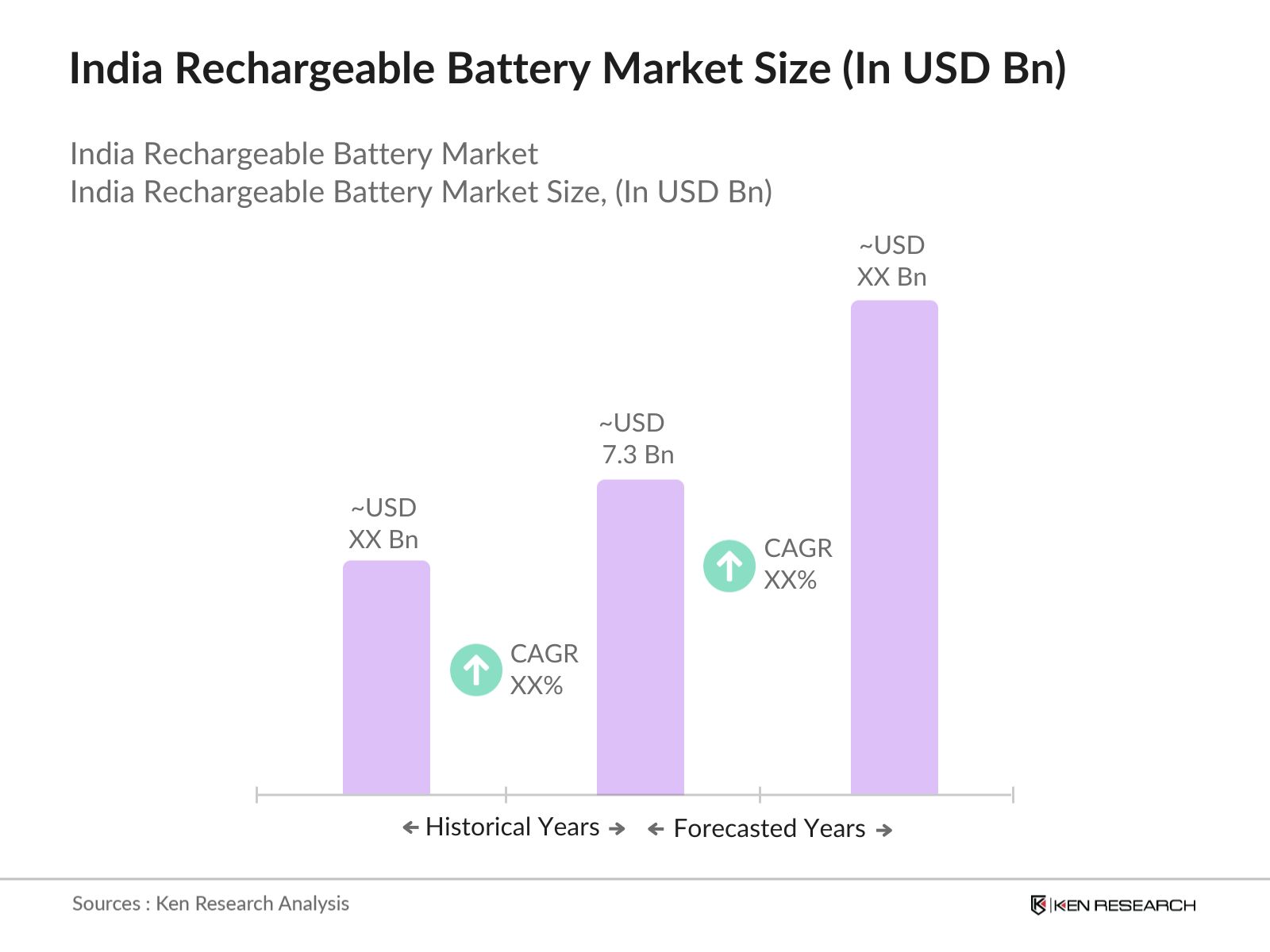
- The India rechargeable battery market is valued at USD 7.3 billion, based on a five-year historical analysis. This market has been driven by the growing demand for electric vehicles (EVs), increased use of portable electronics, and the expansion of renewable energy projects that require energy storage solutions. The Indian government's push for renewable energy adoption, alongside its ambitious plans for electric mobility, has further fueled the market's growth. Battery manufacturing incentives and policy-driven initiatives for clean energy storage systems have helped solidify the industry's importance.
- The market dominance is primarily concentrated in urban centers such as Delhi, Mumbai, and Bengaluru, where the demand for electric vehicles and consumer electronics is significantly higher. These cities lead in the adoption of new technologies due to their higher disposable income, urbanization, and availability of charging infrastructure. Furthermore, government policies such as subsidies on electric vehicles and renewable energy projects are more easily implemented and accessed in these urban hubs, reinforcing their dominance.
- The Indian governments PLI scheme for advanced chemistry cell (ACC) batteries is a major regulatory initiative, with USD 2.5 billion allocated for domestic battery production. This policy is designed to reduce reliance on imports and create over 50 GWh of battery manufacturing capacity by 2025. The PLI scheme supports local battery manufacturers, reducing costs and encouraging further investments in the sector.
India Rechargeable Battery Market Segmentation
The India rechargeable battery market is segmented by battery type and by application.
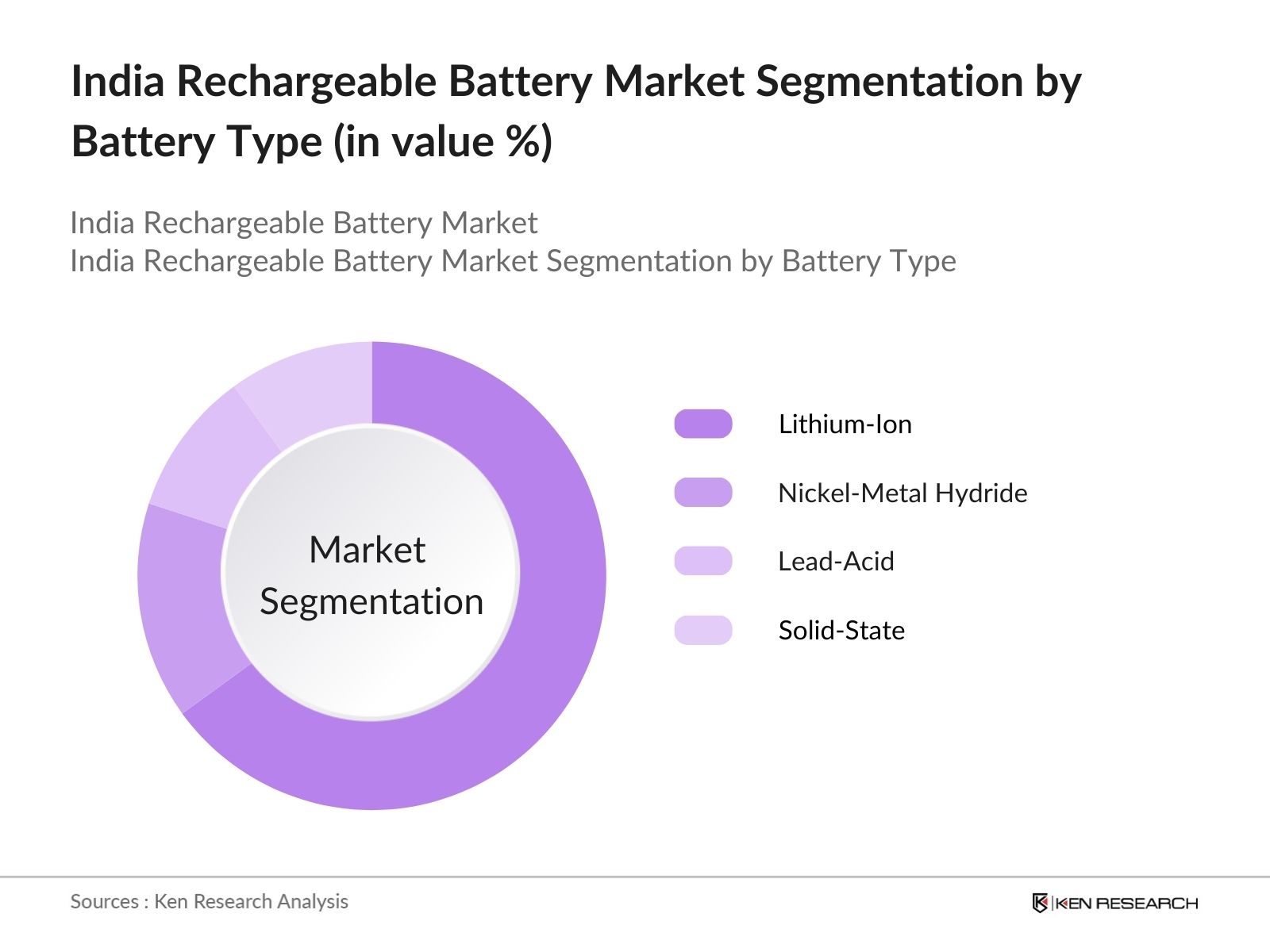
- By Battery Type: The market is segmented by battery type into lithium-ion (Li-ion), nickel-metal hydride (NiMH), lead-acid, and solid-state batteries. Lithium-ion batteries dominate the market because of their extensive use in electric vehicles and consumer electronics. These batteries are favored for their high energy density, longer lifespan, and ability to be recharged multiple times, making them ideal for high-drain applications like EVs and smartphones. As the demand for electric mobility rises, lithium-ion batteries are positioned to maintain their lead in the rechargeable battery segment.
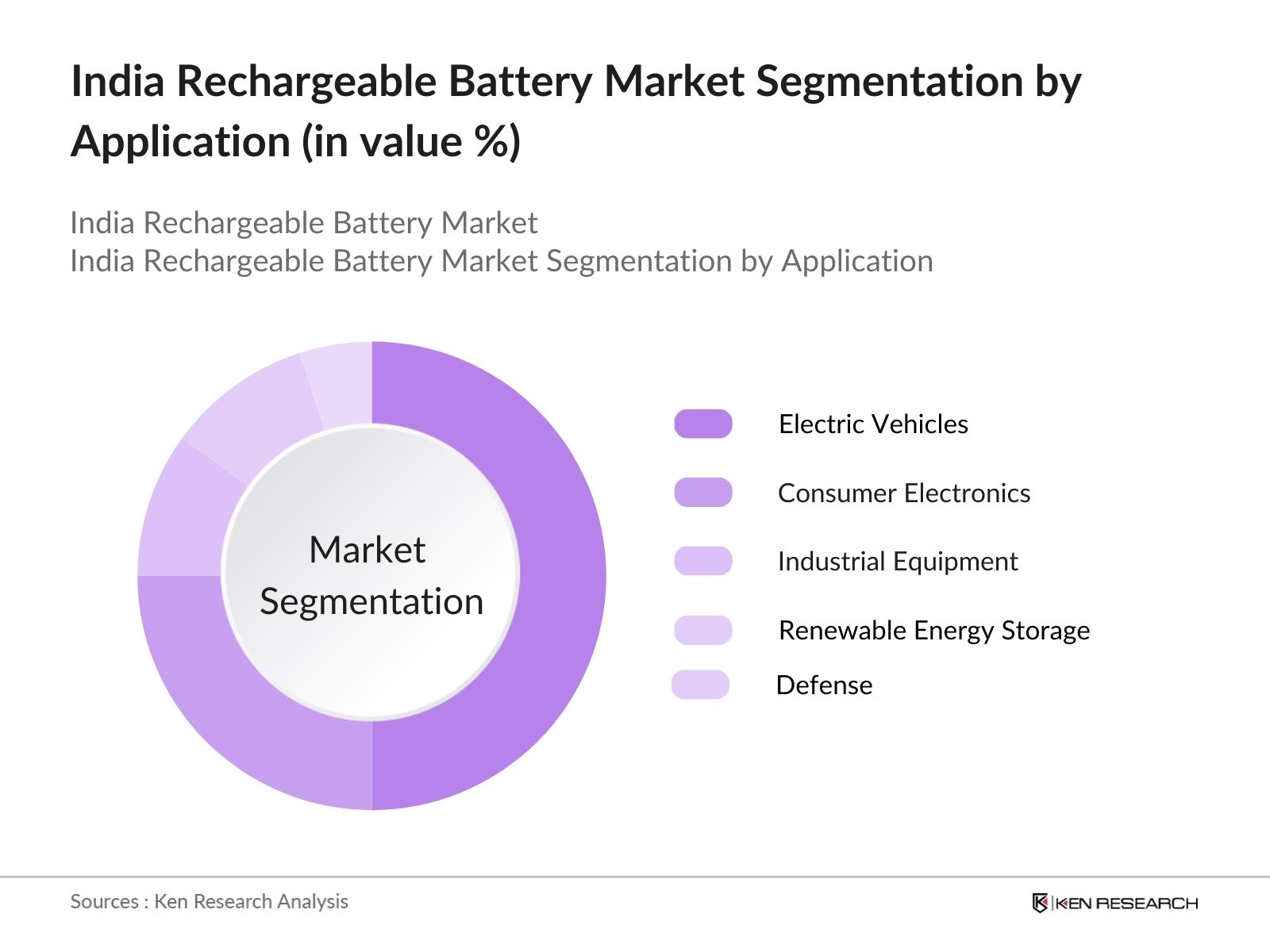
- By Application: The market is also segmented by application into electric vehicles (EVs), consumer electronics, industrial equipment, renewable energy storage, and defense. Electric vehicles (EVs) have the highest market share due to Indias government-backed initiatives to promote electric mobility, reducing carbon emissions and reliance on fossil fuels. The governments policy measures, such as tax rebates on EVs and the construction of EV charging infrastructure, have significantly propelled this sub-segment. EVs are seen as a crucial part of the national strategy for cleaner transportation, further elevating the demand for rechargeable batteries.
India Rechargeable Battery Market Competitive Landscape
The India rechargeable battery market is dominated by a few key players, including local manufacturers like Exide Industries Ltd. and Amara Raja Batteries, alongside global giants such as LG Chem Ltd. and Panasonic Corporation. These companies leverage their technological advancements, scale of production, and established distribution networks to maintain a strong market position. The competitive landscape is shaped by these companies ability to produce at scale while innovating in battery chemistries and energy storage solutions.
|
Company Name |
Establishment Year |
Headquarters |
Battery Technology |
R&D Investment |
Manufacturing Facilities |
Partnerships |
Revenue (USD Mn) |
Domestic Presence |
|
Exide Industries Ltd. |
1947 |
Kolkata, India |
||||||
|
Amara Raja Batteries Ltd. |
1985 |
Tirupati, India |
||||||
|
Panasonic Corporation |
1918 |
Osaka, Japan |
||||||
|
LG Chem Ltd. |
1947 |
Seoul, South Korea |
||||||
|
Tata Chemicals |
1939 |
Mumbai, India |
India Rechargeable Battery Market Analysis
Growth Drivers
- Rise in Renewable Energy Projects: India has seen a significant surge in renewable energy capacity, reaching 175 GW by 2023, with 50 GW coming from solar and wind energy projects. The National Institute of Solar Energy (NISE) aims to add another 60 GW of solar capacity by 2025. This rise in renewable energy initiatives is creating a demand for efficient energy storage systems, which is fueling the growth of the rechargeable battery market, especially for grid stability and energy storage projects. Batteries are increasingly critical for energy storage solutions tied to these projects, positioning India as a growing hub for battery production.
- Increasing Demand for Electric Vehicles: The Indian governments push for electric vehicles (EVs) aims to have 30% of vehicles on the road as electric by 2030. In 2023, the country had over 1 million registered EVs, primarily in urban areas like Delhi, Maharashtra, and Karnataka. This rapid increase is escalating the demand for rechargeable lithium-ion batteries. With major automakers like Tata Motors producing EVs locally, battery demand has increased significantly, supported by the EV charging infrastructure expansion to over 2,900 charging stations nationwide. This provides a strong foundation for the rechargeable battery market.
- Government Subsidies and Initiatives: Government schemes like the Faster Adoption and Manufacturing of Hybrid and Electric Vehicles (FAME) and Production Linked Incentive (PLI) scheme have provided a direct boost to battery manufacturing. For example, the PLI scheme allocates USD 2.5 billion to promote the manufacturing of advanced chemistry cells (ACCs) and batteries, with plans to establish 50 GWh of domestic battery manufacturing capacity. This will help reduce dependence on imports and strengthen India's battery manufacturing ecosystem, offering significant support for the rechargeable battery market
Market Challenges
- Dependence on Imported Raw Materials: India heavily relies on imports for raw materials like lithium, cobalt, and nickel, which are essential for battery production. In 2023, over 60% of the lithium required was imported from countries like Australia and Chile, making supply chains vulnerable to global price fluctuations and geopolitical tensions. This dependency poses a significant challenge for the rechargeable battery market, increasing costs and complicating manufacturing scalability.
- Recycling and Disposal Challenges: India faces significant challenges in recycling lithium-ion batteries, with less than 5% of used batteries being recycled in 2023. Proper disposal of these batteries is crucial, given the environmental risks associated with hazardous materials. The Ministry of Environment, Forest and Climate Change (MoEFCC) has introduced e-waste regulations, but the lack of efficient recycling infrastructure hampers the growth of the rechargeable battery market. This presents a challenge to sustainability efforts and increases pressure on manufacturers to create eco-friendly solutions.
India Rechargeable Battery Market Future Outlook
Over the next five years, the India rechargeable battery market is expected to exhibit substantial growth driven by increased government backing, technological advancements in battery chemistry, and the expanding electric vehicle market. The Indian government's push towards cleaner energy solutions, including renewable energy storage and electric vehicle adoption, will further enhance market demand. The anticipated development of new battery technologies, such as solid-state batteries, will also offer significant opportunities for market expansion.
Future Market Opportunities
- Expansion of Indias Solar and Wind Projects: India's focus on renewable energy has led to large-scale solar and wind projects, with a projected addition of 30 GW from renewable sources between 2022-2025. With storage being essential to these projects, demand for high-capacity rechargeable batteries is rapidly increasing. The government's National Solar Mission, which aims for 100 GW of solar capacity, offers opportunities for battery manufacturers to provide energy storage solutions that are critical for grid stability and efficiency.
- Increasing Focus on Domestic Battery Manufacturing (Make in India): The "Make in India" initiative encourages local manufacturing of rechargeable batteries. By 2023, India has seen over 10 battery manufacturing units set up under the PLI scheme, with an additional capacity of 50 GWh expected by 2025. These units are aimed at reducing dependence on imports and establishing India as a hub for global battery exports. The governments initiatives to promote local manufacturing are positioning the country for robust growth in the rechargeable battery market.
Scope of the Report
|
||||
|
By Application |
Electric Vehicles (EVs) Consumer Electronics Industrial Equipment Renewable Energy Storage Defense |
|||
|
By End-User Industry |
Automotive, Consumer Electronics Energy Storage Systems (ESS) Industrial Manufacturing Telecommunications |
|||
|
By Capacity |
|
|||
|
By Region |
North East West South |
Products
Key Target Audience
Battery Manufacturers
Electric Vehicle Manufacturers
Government and Regulatory Bodies (Ministry of New and Renewable Energy, NITI Aayog)
Renewable Energy Project Developers
Consumer Electronics Manufacturers
Industrial Equipment Suppliers
Investors and Venture Capitalist Firms
Automotive OEMs
Companies
Players Mention in the Report:
-
Exide Industries Ltd.
Amara Raja Batteries Ltd.
LG Chem Ltd.
Panasonic Corporation
Tata Chemicals
Samsung SDI Co., Ltd.
Luminous Power Technologies
Okaya Power Pvt Ltd.
Hero Future Energies
Su-Kam Power Systems
HBL Power Systems Ltd.
Reliance New Energy Ltd.
Envision Energy
Tesla India
Godrej & Boyce Manufacturing Co.
Table of Contents
1. India Rechargeable Battery Market Overview
1.1. Definition and Scope
1.2. Market Taxonomy
1.3. Market Growth Rate
1.4. Market Segmentation Overview
2. India Rechargeable Battery Market Size (In USD Mn)
2.1. Historical Market Size
2.2. Year-On-Year Growth Analysis
2.3. Key Market Developments and Milestones
3. India Rechargeable Battery Market Analysis
3.1. Growth Drivers (Renewable Energy Initiatives, EV Adoption, Industrial Demand, Battery Storage Projects)
3.1.1. Rise in Renewable Energy Projects
3.1.2. Increasing Demand for Electric Vehicles
3.1.3. Government Subsidies and Initiatives
3.1.4. Expansion of Consumer Electronics Market
3.2. Market Challenges (Raw Material Shortages, Environmental Concerns, Energy Density Limits)
3.2.1. Dependence on Imported Raw Materials
3.2.2. Recycling and Disposal Challenges
3.2.3. High Manufacturing Costs
3.2.4. Technological Limitations in Battery Efficiency
3.3. Opportunities (Green Energy Investments, Domestic Manufacturing Initiatives, Export Potential)
3.3.1. Expansion of Indias Solar and Wind Projects
3.3.2. Increasing Focus on Domestic Battery Manufacturing (Make in India)
3.3.3. Investment in Lithium-Ion and Solid-State Battery Technologies
3.4. Trends (EV Integration, Energy Storage Solutions, Advanced Battery Chemistries)
3.4.1. Rising Adoption of Energy Storage Systems (ESS)
3.4.2. Integration with Smart Grid and IOT Technologies
3.4.3. Increasing Use of Solid-State Batteries in Automotive Sector
3.5. Government Regulation (PLI Scheme for Battery Manufacturing, Import Regulations, EV Charging Policies)
3.5.1. Production Linked Incentive (PLI) Scheme
3.5.2. Import Tariffs and Duties on Battery Materials
3.5.3. Policies Supporting EV Charging Infrastructure
3.6. SWOT Analysis
3.7. Stakeholder Ecosystem (Battery Manufacturers, Raw Material Suppliers, Government Agencies, End-User Industries)
3.8. Porters Five Forces (Bargaining Power of Suppliers, Threat of Substitutes, Competitive Rivalry, Entry Barriers, Buyer Power)
3.9. Competition Ecosystem
4. India Rechargeable Battery Market Segmentation
4.1. By Battery Type (In Value %)
4.1.1. Lithium-Ion (Li-ion)
4.1.2. Nickel Metal Hydride (NiMH)
4.1.3. Lead-Acid
4.1.4. Solid-State Batteries
4.2. By Application (In Value %)
4.2.1. Electric Vehicles (EVs)
4.2.2. Consumer Electronics
4.2.3. Industrial Equipment
4.2.4. Renewable Energy Storage
4.2.5. Defense
4.3. By End-User Industry (In Value %)
4.3.1. Automotive
4.3.2. Consumer Electronics
4.3.3. Energy Storage Systems (ESS)
4.3.4. Industrial Manufacturing
4.3.5. Telecommunications
4.4. By Capacity (In Value %)
4.4.1. Less than 10 kWh
4.4.2. 10-100 kWh
4.4.3. More than 100 kWh
4.5. By Region (In Value %)
4.5.1. North
4.5.2. South
4.5.3. West
4.5.4. East
5. India Rechargeable Battery Market Competitive Analysis
5.1. Detailed Profiles of Major Companies
5.1.1. Exide Industries Ltd.
5.1.2. Amara Raja Batteries Ltd.
5.1.3. Panasonic Corporation
5.1.4. Samsung SDI Co., Ltd.
5.1.5. LG Chem Ltd.
5.1.6. TATA Chemicals
5.1.7. Luminous Power Technologies
5.1.8. Hero Future Energies
5.1.9. Okaya Power Pvt Ltd.
5.1.10. Reliance New Energy Ltd.
5.1.11. HBL Power Systems Ltd.
5.1.12. Su-Kam Power Systems
5.1.13. Envision Energy
5.1.14. Godrej & Boyce Manufacturing Co.
5.1.15. Tesla India
5.2. Cross Comparison Parameters (Market Cap, Product Portfolio, Regional Presence, Battery Capacity, Manufacturing Facilities, R&D Investment, Partnerships, Green Certifications)
5.3. Market Share Analysis
5.4. Strategic Initiatives
5.5. Mergers and Acquisitions
5.6. Investment Analysis
5.7. Venture Capital Funding
5.8. Government Grants
5.9. Private Equity Investments
6. India Rechargeable Battery Market Regulatory Framework
6.1. Environmental Standards
6.2. Compliance Requirements
6.3. Certification Processes
7. India Rechargeable Battery Market Future Size (In USD Mn)
7.1. Future Market Size Projections
7.2. Key Factors Driving Future Market Growth
8. India Rechargeable Battery Market Future Segmentation
8.1. By Battery Type (In Value %)
8.2. By Application (In Value %)
8.3. By End-User Industry (In Value %)
8.4. By Capacity (In Value %)
8.5. By Region (In Value %)
9. India Rechargeable Battery Market Analysts Recommendations
9.1. TAM/SAM/SOM Analysis
9.2. Customer Cohort Analysis
9.3. Marketing Initiatives
9.4. White Space Opportunity Analysis
Research Methodology
Step 1: Identification of Key Variables
The first stage involves developing a comprehensive map of the India rechargeable battery market, identifying critical stakeholders, including battery manufacturers, energy storage providers, and government bodies. Extensive desk research is conducted using secondary and proprietary databases to collect vital market data and define key variables such as technology trends, regulatory frameworks, and demand drivers.
Step 2: Market Analysis and Construction
In this phase, historical data from the India rechargeable battery market is gathered, focusing on market penetration in various sectors such as electric vehicles, consumer electronics, and industrial applications. Analyzing these variables allows us to understand the revenue generation capabilities and product demand within each segment. Key challenges and opportunities are evaluated based on industry trends and government policies.
Step 3: Hypothesis Validation and Expert Consultation
Market hypotheses are developed and validated through consultations with industry experts, which include representatives from leading battery manufacturers and electric vehicle OEMs. These consultations, conducted via telephonic interviews, help verify the data collected from secondary research and offer valuable insights on market dynamics.
Step 4: Research Synthesis and Final Output
The final step involves synthesizing data from all sources and producing a detailed market report. Multiple battery manufacturers, renewable energy developers, and government bodies are consulted to ensure the reliability of data points. This stage also includes cross-verification of market segmentation data to provide a comprehensive analysis.
Frequently Asked Questions
01. How big is the India Rechargeable Battery Market?
The India rechargeable battery market was valued at USD 7.3 billion, driven by rising demand for electric vehicles, consumer electronics, and renewable energy storage solutions.
02. What are the challenges in the India Rechargeable Battery Market?
Challenges in India rechargeable battery market include a dependence on imported raw materials, high manufacturing costs, and the lack of a recycling infrastructure for spent batteries. Additionally, environmental concerns related to battery disposal are growing.
03. Who are the major players in the India Rechargeable Battery Market?
Key players in the India rechargeable battery market include Exide Industries Ltd., Amara Raja Batteries Ltd., LG Chem Ltd., Panasonic Corporation, and Tata Chemicals. These companies have strong R&D investments and established supply chains.
04. What are the growth drivers of the India Rechargeable Battery Market?
The India rechargeable battery market is driven by increased government support for electric mobility, advancements in battery technologies like lithium-ion and solid-state, and the growing demand for energy storage in renewable energy projects.
05. What is the most popular battery type in the India Rechargeable Battery Market?
Lithium-ion batteries are the most popular battery type due to their widespread use in electric vehicles and consumer electronics, thanks to their higher energy density and longer lifespan.
Why Buy From Us?

What makes us stand out is that our consultants follows Robust, Refine and Result (RRR) methodology. i.e. Robust for clear definitions, approaches and sanity checking, Refine for differentiating respondents facts and opinions and Result for presenting data with story

We have set a benchmark in the industry by offering our clients with syndicated and customized market research reports featuring coverage of entire market as well as meticulous research and analyst insights.

While we don't replace traditional research, we flip the method upside down. Our dual approach of Top Bottom & Bottom Top ensures quality deliverable by not just verifying company fundamentals but also looking at the sector and macroeconomic factors.

With one step in the future, our research team constantly tries to show you the bigger picture. We help with some of the tough questions you may encounter along the way: How is the industry positioned? Best marketing channel? KPI's of competitors? By aligning every element, we help maximize success.

Our report gives you instant access to the answers and sources that other companies might choose to hide. We elaborate each steps of research methodology we have used and showcase you the sample size to earn your trust.

If you need any support, we are here! We pride ourselves on universe strength, data quality, and quick, friendly, and professional service.