
India Textile Market Outlook to 2030
Region:Asia
Author(s):Vijay Kumar
Product Code:KROD2930
December 2024
90
About the Report
India Textile Market Overview
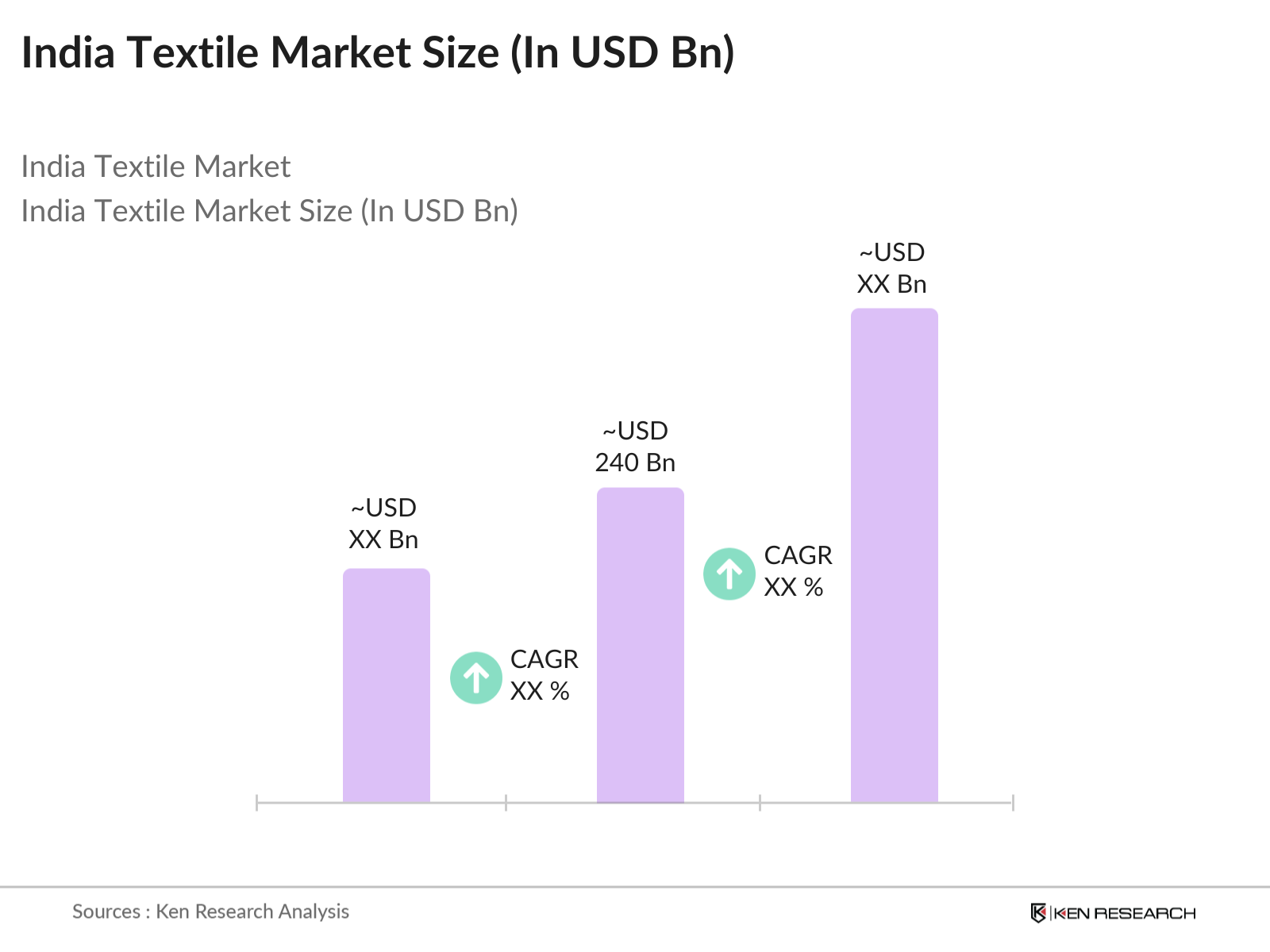
- The India Textile Market reached USD 240 billion in 2023, reflecting substantial growth driven by robust domestic demand and significant export activities. This growth is supported by advancements in textile manufacturing technologies and favorable government policies aimed at boosting production and enhancing competitiveness. Key drivers include the increasing demand for apparel and home textiles in both domestic and international markets, and the expansion of technical textiles into new sectors such as automotive and healthcare.
- Major players in the India Textile Market include Reliance Industries Ltd., Vardhman Textiles, Arvind Limited, Welspun India, and Raymond Group. These companies dominate the market with their extensive production capacities, strong distribution networks, and continuous innovation in product offerings. Their investment in sustainable practices and the development of eco-friendly textiles have enabled them to capture a significant share of the market and drive technological advancements.
- In 2024, Arvind Limited announced a significant expansion in its denim production capacity by 10 million meters annually, backed by an investment of USD 50 million. This expansion aims to cater to the rising demand for sustainable and eco-friendly denim globally. The investment aligns with the companys strategy to strengthen its position in the international market, particularly in the United States and Europe, which are the largest importers of Indian denim fabrics. The company also reported a 15% increase in revenue for Q1 2024 compared to the same period in 2023.
- Mumbai, Surat, Tirupur, and Bengaluru are the dominant cities in the India Textile Market due to their significant production capacities and investments in modern textile technologies. Mumbai, as the financial hub, leads in the textile and apparel manufacturing sector, while Surat is known for its synthetic textiles and diamond industry synergy. Tirupur is a key center for knitwear production, and Bengaluru is emerging as a major garment manufacturing hub due to its skilled labor force and strong logistics infrastructure.
India Textile Market Segmentation
The India Textile Market can be segmented by various factors such as type of Product, Material, and Region.
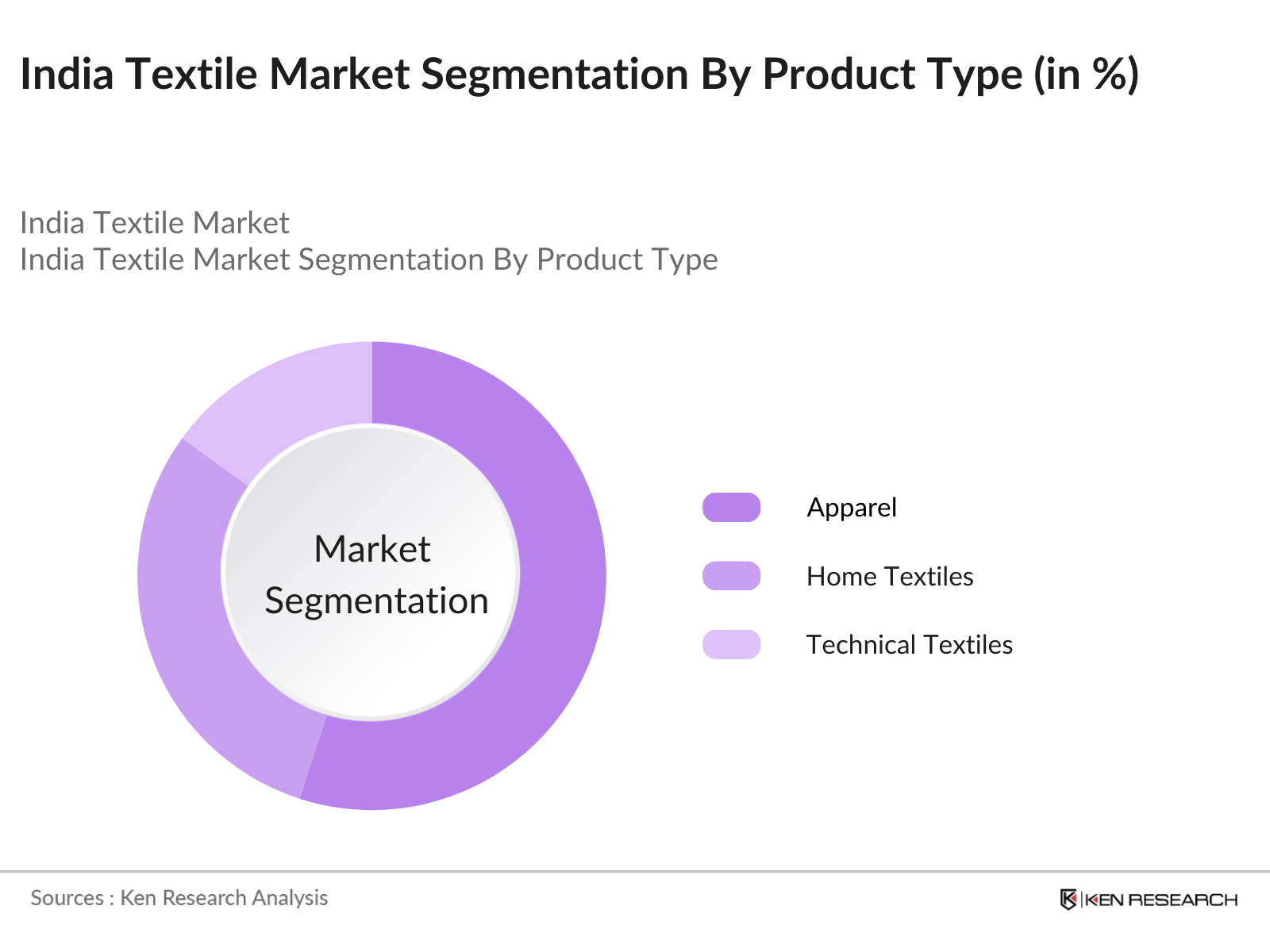
By Product Type: The market is segmented by product type into Apparel, Home Textiles, and Technical Textiles. In 2023, the Apparel segment held the largest market share due to its vast domestic market and export potential. The demand for apparel is driven by increasing fashion consciousness, a growing middle class, and the expansion of e-commerce platforms, which have made fashion more accessible across the country.
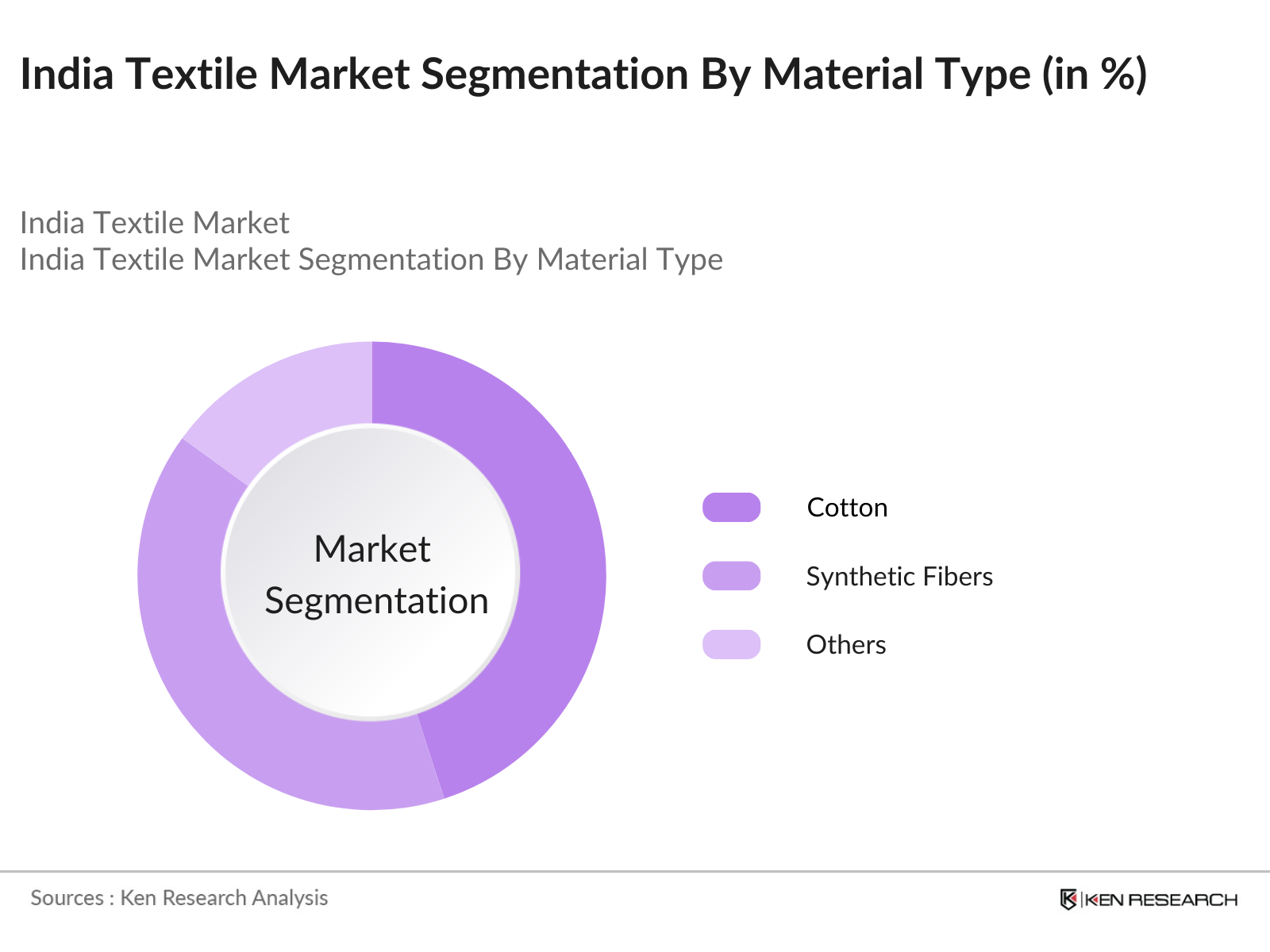
By Material Type: The market is segmented by material type into Cotton, Synthetic Fibers, and Others (including Silk and Wool). In 2023, Cotton dominated the market due to India's favorable climate for cotton cultivation and the government's support through subsidies for cotton farmers. The high demand for cotton in both domestic and international markets, particularly for organic cotton, further solidifies its leading position in the textile industry.
By Region: The market is segmented regionally into North, South, East, and West. In 2023, the South region led the market due to its extensive textile activities and early adoption of modern textile technologies. Tamil Nadu, Karnataka, and Andhra Pradesh are key drivers of market growth in this region, with significant investments in textile manufacturing and exports.
India Textile Market Competitive Landscape
|
Company |
Establishment Year |
Headquarters |
|
Reliance Industries Ltd. |
1973 |
Mumbai, India |
|
Vardhman Textiles |
1965 |
Ludhiana, India |
|
Arvind Limited |
1931 |
Ahmedabad, India |
|
Welspun India |
1985 |
Mumbai, India |
|
Raymond Group |
1925 |
Mumbai, India |
- Reliance Industries Ltd.: In 2024, Reliance Industries announced the expansion of its polyester production capacity by an additional 500,000 metric tonnes per annum at its Jamnagar complex. The expansion, costing approximately USD 200 million, aims to cater to the rising demand for synthetic fibers in both domestic and international markets. Reliance also invested in sustainable practices, launching a new line of eco-friendly polyester made from recycled PET bottles, further enhancing its market presence in the textile sector.
- Vardhman Textiles: Vardhman Textiles, in early 2023, partnered with a leading Japanese company to enhance its capabilities in producing high-quality, eco-friendly yarns. The collaboration focuses on leveraging advanced technology to produce yarns with reduced environmental impact. This initiative is part of Vardhmans broader strategy to position itself as a leader in sustainable textiles, responding to increasing global demand for eco-friendly products, particularly from the European market.
India Textile Market Analysis
India Textile Market Growth Drivers
- Increasing Export Demand: The market is driven by a significant increase in export demand, particularly from markets in the United States and Europe. In 2024, Indias textile exports were valued at USD 45 billion, supported by Free Trade Agreements (FTAs) with key markets. These agreements reduce tariffs and enhance the competitiveness of Indian textiles globally, driving growth in the export segment.
- Rising Demand for Technical Textiles: The demand for technical textiles in India is growing rapidly due to their applications in various industries such as automotive, healthcare, and construction. In 2024, the technical textiles market was valued at USD 5 billion, with significant contributions from the automotive industry. Government initiatives under the National Technical Textiles Mission are promoting the development of high-value technical textiles, further boosting this segment.
- Expansion of E-commerce and Digital Platforms: The expansion of e-commerce and digital platforms has significantly boosted the India Textile Market. In 2024, online sales of textiles and apparel reached USD 10 billion, driven by the growing penetration of smartphones and internet services in Tier 2 and Tier 3 cities. E-commerce platforms like Amazon, Flipkart, and Myntra have expanded their textile offerings, providing greater market access to manufacturers and consumers alike.
India Textile Market Challenges
- High Raw Material Costs: The India Textile Market faces challenges due to high raw material costs, particularly for cotton. In 2024, the average price of cotton rose to INR 68,000 per candy (356 kg), impacting the profitability of textile manufacturers. Fluctuations in raw material prices affect the entire textile value chain, posing a significant challenge to market stability.
- Infrastructural Bottlenecks: Infrastructural bottlenecks and high logistics costs are major challenges for the India Textile Market. In 2024, logistics costs in India accounted for approximately 14% of GDP, which is higher compared to other major textile-producing countries. Poor road and port infrastructure and inadequate warehousing facilities increase costs and delays in shipment, hindering market growth.
India Textile Market Government Initiatives
- PM-MITRA Scheme: The PM-MITRA (Pradhan Mantri Mega Integrated Textile Region and Apparel) scheme, launched in 2023, aims to establish seven world-class textile parks across India. With an investment of USD 1.5 billion, these parks will enhance the textile value chain and attract significant investments, creating over 1 million jobs by 2026. The scheme supports the growth of the textile industry by providing integrated facilities and infrastructure.
- National Technical Textiles Mission: The National Technical Textiles Mission, initiated in 2020, focuses on promoting the development and use of technical textiles in India. With a budget of USD 200 million, the mission aims to reduce import dependency and boost domestic manufacturing. In 2024, the mission supported the establishment of four new research centers and provided subsidies to encourage the adoption of technical textiles, contributing to market growth.
India Textile Market Future Outlook
The India Textile Market is poised for remarkable growth, driven by sustainability, digitalization, and export growth.
Future Market Trends
- Growth of Sustainable Textiles: By 2028, the India Textile Market will see a significant shift towards sustainable textiles and circular economy practices. The market for eco-friendly textiles is projected to reach INR 15,000 crore (USD 1.9 billion), driven by increasing consumer demand for organic and recycled fabrics. Companies will invest in developing sustainable materials and production processes, aligning with global trends toward environmental responsibility and meeting the sustainability criteria of international buyers.
- Expansion of Digital and Smart Textiles: The Indian textile market is expected to witness significant growth in digital and smart textiles by 2028, driven by advancements in technology and increased investment in research and development. Smart textiles, which incorporate electronic components and sensors, will become a major segment, especially in sportswear, healthcare, and defense. The integration of artificial intelligence (AI) and the Internet of Things (IoT) in textile manufacturing will enable real-time monitoring and management of production processes, leading to enhanced efficiency and reduced operational costs.
Scope of the Report
|
By Application |
Clothing Textiles |
|
By Material |
Cotton |
|
By Process |
Woven |
|
By Product Type |
Natural Fibers |
|
By Region |
North India |
Products
Key Target Audience Organizations and Entities Who Can Benefit by Subscribing This Report:
Textile Manufacturers
Apparel Brands and Retailers
Government and Regulatory Bodies (e.g., Ministry of Textiles, India)
Export Houses
Raw Material Suppliers
Machinery and Equipment Manufacturers
Logistics and Supply Chain Companies
E-commerce Platforms
Dye and Chemical Suppliers
Investment and Venture Capitalist Firms
Time Period Captured in the Report
Historical Period: 2018-2023
Base Year: 2023
Forecast Period: 2023-2028
Companies
Players Mentioned in the Report:
Reliance Industries Ltd.
Vardhman Textiles
Arvind Limited
Welspun India
Raymond Group
Alok Industries
Trident Group
Bombay Dyeing
FabIndia
RSWM Limited
Table of Contents
1. India Textile Market Overview
1.1. Definition and Scope
1.2. Market Taxonomy
1.3. Market Growth Rate
1.4. Market Segmentation Overview
2. India Textile Market Size (in USD Bn), 2018-2023
2.1. Historical Market Size
2.2. Year-on-Year Growth Analysis
2.3. Key Market Developments and Milestones
3. India Textile Market Analysis
3.1. Growth Drivers
3.1.1. Increasing Export Demand
3.1.2. Rising Demand for Technical Textiles
3.1.3. Expansion of E-commerce Platforms
3.2. Restraints
3.2.1. High Raw Material Costs
3.2.2. Infrastructural Bottlenecks
3.2.3. Stringent Environmental Regulations
3.3. Opportunities
3.3.1. Growing Demand for Sustainable Textiles
3.3.2. Technological Innovations in Textile Manufacturing
3.3.3. Expansion into Non-traditional Markets
3.4. Trends
3.4.1. Adoption of Digital and Smart Textiles
3.4.2. Shift Towards Sustainable and Eco-friendly Fabrics
3.4.3. Growth in Online and Omnichannel Retail
3.5. Government Regulations
3.5.1. PM-MITRA Scheme
3.5.2. National Technical Textiles Mission
3.5.3. Production Linked Incentive (PLI) Scheme
3.5.4. New Environmental Regulations
3.6. SWOT Analysis
3.7. Stakeholder Ecosystem
3.8. Competitive Ecosystem
4. India Textile Market Segmentation, 2023
4.1. By Product Type (in Value %)
4.1.1. Apparel
4.1.2. Home Textiles
4.1.3. Technical Textiles
4.2. By Material Type (in Value %)
4.2.1. Cotton
4.2.2. Synthetic Fibers
4.2.3. Others (Silk, Wool, etc.)
4.3. By Region (in Value %)
4.3.1. North
4.3.2. South
4.3.3. East
4.3.4. West
5. India Textile Market Cross Comparison
5.1. Detailed Profiles of Major Companies
5.1.1. Reliance Industries Ltd.
5.1.2. Vardhman Textiles
5.1.3. Arvind Limited
5.1.4. Welspun India
5.1.5. Raymond Group
5.1.6. Alok Industries
5.1.7. Trident Group
5.1.8. Bombay Dyeing
5.1.9. FabIndia
5.1.10. RSWM Limited
5.1.11. Gokaldas Exports
5.1.12. Nahar Spinning Mills
5.1.13. KPR Mill
5.1.14. Sutlej Textiles
5.1.15. Page Industries
5.2. Cross Comparison Parameters (No. of Employees, Headquarters, Inception Year, Revenue)
6. India Textile Market Competitive Landscape
6.1. Market Share Analysis
6.2. Strategic Initiatives
6.3. Mergers and Acquisitions
6.4. Investment Analysis
6.4.1. Venture Capital Funding
6.4.2. Government Grants
6.4.3. Private Equity Investments
7. India Textile Market Regulatory Framework
7.1. Environmental Standards
7.2. Compliance Requirements
7.3. Certification Processes
8. India Textile Market Future Size (in USD Bn), 2023-2028
8.1. Future Market Size Projections
8.2. Key Factors Driving Future Market Growth
9. India Textile Market Future Segmentation, 2028
9.1. By Product Type (in Value %)
9.2. By Material Type (in Value %)
9.3. By Region (in Value %)
10. India Textile Market Analysts Recommendations
10.1. TAM/SAM/SOM Analysis
10.2. Customer Cohort Analysis
10.3. Marketing Initiatives
10.4. White Space Opportunity Analysis
Disclaimer
Contact Us
Research Methodology
Step 1: Identifying Key Variables
The research begins with creating an ecosystem map of all significant players and stakeholders in the India Textile Market. This involves comprehensive desk research using multiple secondary and proprietary databases to gather industry-level information. Key variables include market definition, scope, taxonomy, and growth drivers. This step provides a foundational understanding of market dynamics, including key players, market segmentation, and technological advancements.
Step 2: Market Building
Historical and current statistics on the India Textile Market are gathered and analyzed, focusing on market size, growth trends, and penetration of textile solutions in various sectors. This includes evaluating revenue generation, market shares of various textile products, and service provider ratios. Additionally, adoption rates and technological innovations are reviewed to ensure the accuracy and reliability of the data points shared, establishing a solid basis for market projections.
Step 3: Validating and Finalizing
Market hypotheses are built and validated through Computer-Assisted Telephone Interviews (CATIs) with industry experts, textile technology providers, and key stakeholders. This step is essential for confirming the accuracy of the collected data and gaining insights into operational practices, financial performance, and market challenges. Feedback from these interviews is integrated into the market analysis to refine and verify the statistics and projections.
Step 4: Research Output
The research team engages with leading textile companies and technology providers in India to gather detailed information about product segments, sales trends, consumer preferences, and market dynamics. This bottom-up approach ensures that the data and projections are accurate and relevant, providing a comprehensive and reliable analysis of the India Textile Market.
Frequently Asked Questions
1. How big is the India Textile Market?
The India Textile Market reached USD 240 billion in 2023, reflecting substantial growth driven by robust domestic demand and significant export activities. This growth is supported by advancements in textile manufacturing technologies and favorable government policies aimed at boosting production and enhancing competitiveness.
2. What are the challenges in the India Textile Market?
The India Textile Market faces challenges such as high raw material costs, particularly for cotton, infrastructural bottlenecks, and stringent environmental regulations. These issues impact profitability and hinder the growth and competitiveness of the market.
3. Who are the major players in the India Textile Market?
Major players in the India Textile Market include Reliance Industries Ltd., Vardhman Textiles, Arvind Limited, Welspun India, and Raymond Group. These companies dominate due to their extensive production capacities, strong distribution networks, and innovative product offerings.
4. What are the growth drivers of the India Textile Market?
The market is driven by increasing export demand, rising demand for technical textiles, and the expansion of e-commerce platforms. These factors contribute to the market's growth by enhancing production capabilities and expanding access to domestic and international markets.
Why Buy From Us?

What makes us stand out is that our consultants follows Robust, Refine and Result (RRR) methodology. i.e. Robust for clear definitions, approaches and sanity checking, Refine for differentiating respondents facts and opinions and Result for presenting data with story

We have set a benchmark in the industry by offering our clients with syndicated and customized market research reports featuring coverage of entire market as well as meticulous research and analyst insights.

While we don't replace traditional research, we flip the method upside down. Our dual approach of Top Bottom & Bottom Top ensures quality deliverable by not just verifying company fundamentals but also looking at the sector and macroeconomic factors.

With one step in the future, our research team constantly tries to show you the bigger picture. We help with some of the tough questions you may encounter along the way: How is the industry positioned? Best marketing channel? KPI's of competitors? By aligning every element, we help maximize success.

Our report gives you instant access to the answers and sources that other companies might choose to hide. We elaborate each steps of research methodology we have used and showcase you the sample size to earn your trust.

If you need any support, we are here! We pride ourselves on universe strength, data quality, and quick, friendly, and professional service.