
India Toilet Paper Market Outlook to 2030
Region:Asia
Author(s):Yogita Sahu
Product Code:KROD7416
Region:Asia
Author(s):Yogita Sahu
Product Code:KROD7416
November 2024
98
By Product Type: The market is segmented by product type into standard toilet paper, jumbo rolls, wet wipes, flushable paper, and recycled toilet paper. Standard toilet paper holds a dominant market share due to its widespread availability and affordability. It is a staple product in both residential and commercial sectors, particularly favored by the cost-conscious Indian consumer. The products market share is boosted by the growing middle class, who are increasingly inclined towards convenient and hygienic products for daily use.

By Distribution Channel: The market is also segmented by distribution channel into supermarkets/hypermarkets, convenience stores, online retailers, and institutional sales. Supermarkets and hypermarkets dominate this segment due to the convenience of bulk purchasing and the growing presence of organized retail outlets in urban areas. These stores offer a variety of products, including both local and international brands, which attracts a wide range of consumers looking for hygiene solutions. The ability to see and feel the product before purchase also contributes to this channels dominance.

The market is characterized by the presence of both domestic and international players. Key players dominate the market due to their extensive distribution networks, strong brand presence, and continuous innovation in product lines.
|
Company Name |
Year of Establishment |
Headquarters |
Market Share |
No. of Employees |
Product Portfolio |
R&D Investment |
Annual Revenue |
Market Reach |
Brand Recognition |
|
Kimberly-Clark Corporation |
1872 |
Dallas, USA |
|||||||
|
Procter & Gamble |
1837 |
Cincinnati, USA |
|||||||
|
ITC Limited |
1910 |
Kolkata, India |
|||||||
|
Emami Paper Mills |
1982 |
Kolkata, India |
|||||||
|
Century Pulp & Paper |
1984 |
Uttarakhand, India |
Over the next five years, the India toilet paper Industry is expected to witness robust growth. The increasing awareness of personal hygiene, coupled with government initiatives promoting cleanliness, will drive market expansion.
|
Product Type |
Standard Toilet Paper Jumbo Rolls Wet Wipes Flushable Paper Recycled Toilet Paper |
|
End User |
Residential Commercial Public Institutions |
|
Distribution Channel |
Supermarkets/Hypermarkets Convenience Stores Online Retailers Institutional Sales |
|
Material Type |
Virgin Pulp Toilet Paper Recycled Pulp Toilet Paper Bamboo-based Paper |
|
Region |
North India South India East India West India |
1.1. Definition and Scope
1.2. Market Taxonomy
1.3. Market Growth Rate
1.4. Market Segmentation Overview
2.1. Historical Market Size
2.2. Year-on-Year Growth Analysis
2.3. Key Market Developments and Milestones
3.1. Growth Drivers
3.1.1. Government Initiatives in Sanitation (Swachh Bharat Abhiyan, etc.)
3.1.2. Increasing Awareness about Hygiene and Sanitation
3.1.3. Rise in Public and Private Infrastructure (hotels, malls, etc.)
3.1.4. Expanding Retail Distribution Channels
3.2. Market Challenges
3.2.1. Competition from Alternative Sanitary Products
3.2.2. Fluctuations in Raw Material Prices (Pulp)
3.2.3. Environmental Concerns about Paper Usage
3.2.4. Regional Variability in Demand (Urban vs. Rural)
3.3. Opportunities
3.3.1. Growth of E-commerce Channels
3.3.2. Sustainable and Eco-friendly Product Lines
3.3.3. Introduction of Premium Products
3.3.4. Government Support for MSMEs in Paper Industry
3.4. Trends
3.4.1. Emergence of Recycled Toilet Paper
3.4.2. Customization and Branding in Public Spaces
3.4.3. Increased Consumer Spending on Hygiene Products
3.4.4. Expansion of Private Label Brands
3.5. Government Regulation
3.5.1. Environmental Regulations on Paper Production
3.5.2. Import/Export Duties on Raw Material (Pulp)
3.5.3. Incentives for Environmentally Friendly Manufacturing
3.5.4. GST Impacts on Paper Goods
3.6. SWOT Analysis
3.7. Stake Ecosystem
3.8. Porters Five Forces
3.9. Competition Ecosystem
4.1. By Product Type (In Value %)
4.1.1. Standard Toilet Paper
4.1.2. Jumbo Rolls
4.1.3. Wet Wipes and Flushable Paper
4.1.4. Recycled Toilet Paper
4.2. By End User (In Value %)
4.2.1. Residential
4.2.2. Commercial (Hotels, Malls, Hospitals, etc.)
4.2.3. Public Institutions (Government Buildings, etc.)
4.3. By Distribution Channel (In Value %)
4.3.1. Supermarkets/Hypermarkets
4.3.2. Convenience Stores
4.3.3. Online Retailers
4.3.4. Institutional Sales
4.4. By Material Type (In Value %)
4.4.1. Virgin Pulp Toilet Paper
4.4.2. Recycled Pulp Toilet Paper
4.4.3. Bamboo-based Paper
4.5. By Region (In Value %)
4.5.1. North India
4.5.2. South India
4.5.3. East India
4.5.4. West India
5.1. Detailed Profiles of Major Companies
5.1.1. Kimberly-Clark Corporation
5.1.2. Procter & Gamble
5.1.3. Georgia-Pacific
5.1.4. Unilever
5.1.5. Essity AB
5.1.6. Sofidel Group
5.1.7. Asia Pulp and Paper Group
5.1.8. The Navigator Company
5.1.9. Cascades Inc.
5.1.10. Kruger Products L.P.
5.1.11. APP (Asia Pulp & Paper) India
5.1.12. Emami Paper Mills
5.1.13. ITC Limited (Paperboards & Specialty Papers Division)
5.1.14. Century Pulp and Paper
5.1.15. Pudumjee Paper Products Ltd.
5.2. Cross Comparison Parameters (No. of Employees, Headquarters, Product Portfolio, Revenue)
5.3. Market Share Analysis
5.4. Strategic Initiatives
5.5. Mergers and Acquisitions
5.6. Investment Analysis
5.7. Venture Capital Funding
5.8. Government Grants
5.9. Private Equity Investments
6.1. Environmental Standards
6.2. Compliance Requirements
6.3. Certification Processes
7.1. Future Market Size Projections
7.2. Key Factors Driving Future Market Growth
8.1. By Product Type (In Value %)
8.2. By End User (In Value %)
8.3. By Distribution Channel (In Value %)
8.4. By Material Type (In Value %)
8.5. By Region (In Value %)
9.1. TAM/SAM/SOM Analysis
9.2. Customer Cohort Analysis
9.3. Marketing Initiatives
9.4. White Space Opportunity Analysis
The first step in our research methodology involved mapping out the key stakeholders in the India toilet paper market. This included extensive desk research from secondary sources such as industry reports, government publications, and proprietary databases to gather crucial information on market dynamics and variables influencing the market.
We analyzed historical market data to understand market penetration, consumer behavior, and revenue generation in the India toilet paper market. This process included evaluating the supply chain and distribution network, which contributed to the accuracy of our market size and revenue projections.
In this phase, we developed market hypotheses based on our analysis and validated them through interviews with industry experts, manufacturers, and distributors. These consultations provided valuable insights into operational efficiencies, product preferences, and pricing strategies, further enhancing our market understanding.
The final phase involved synthesizing the research findings and engaging directly with manufacturers to validate the data. This included a bottom-up analysis, wherein manufacturers provided product-specific insights, which we cross-referenced with industry data to ensure accuracy.
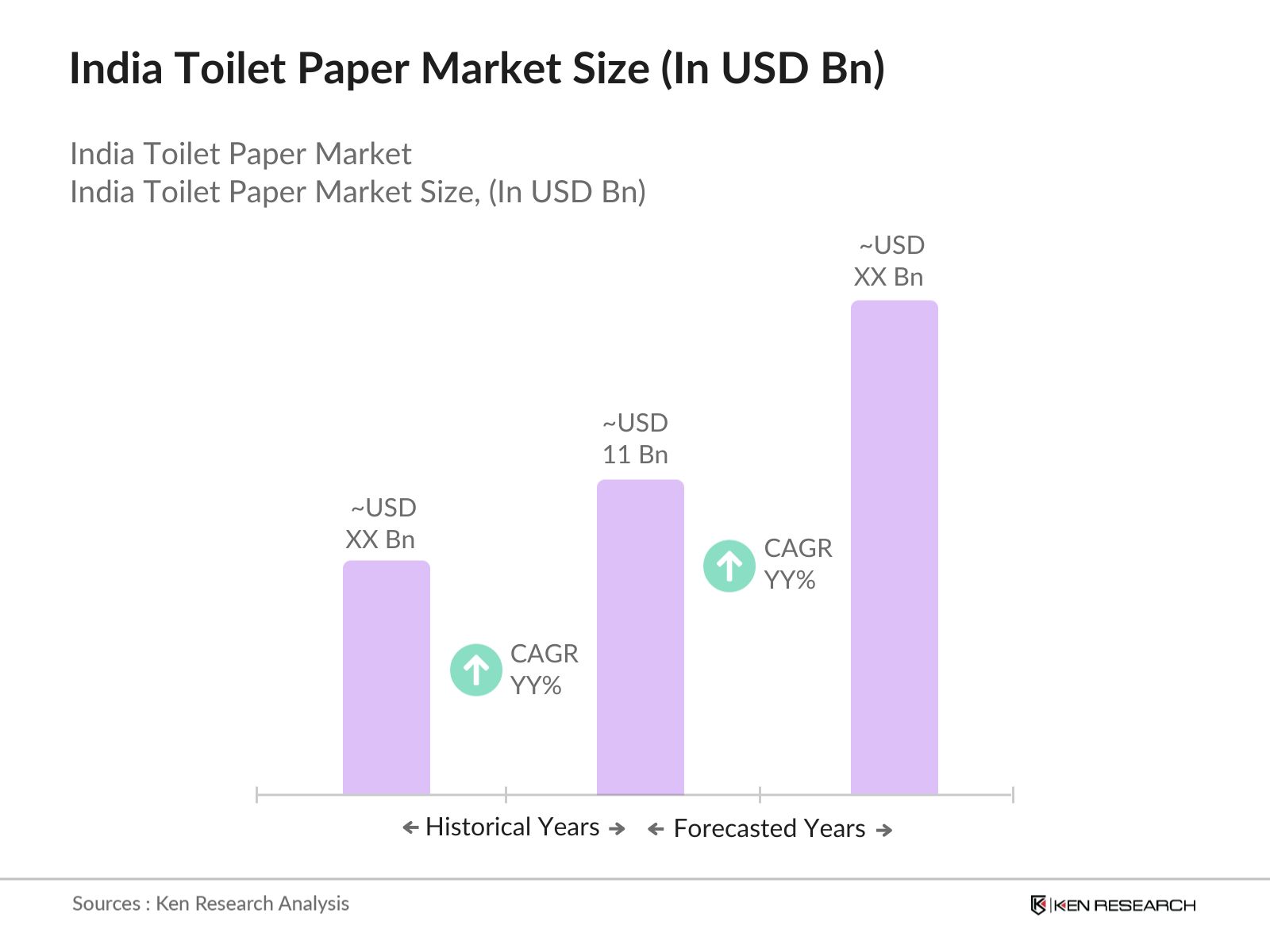
The India toilet paper market is valued at USD 11 billion, driven by increasing hygiene awareness, urbanization, and government sanitation initiatives.
Challenges in the India toilet paper market include competition from alternative hygiene products, fluctuating raw material costs, and environmental concerns over paper usage, which may limit growth.
Key players in the India toilet paper market include Kimberly-Clark Corporation, Procter & Gamble, ITC Limited, and Emami Paper Mills, dominating through strong distribution networks and brand presence.
The India toilet paper market is driven by government initiatives such as Swachh Bharat Abhiyan, increasing awareness of hygiene, and the growing adoption of toilet paper in both urban and semi-urban areas.
The India toilet paper market is expected to grow in the coming years, driven by e-commerce expansion, rising disposable income, and increased demand for eco-friendly products.

What makes us stand out is that our consultants follows Robust, Refine and Result (RRR) methodology. i.e. Robust for clear definitions, approaches and sanity checking, Refine for differentiating respondents facts and opinions and Result for presenting data with story

We have set a benchmark in the industry by offering our clients with syndicated and customized market research reports featuring coverage of entire market as well as meticulous research and analyst insights.

While we don't replace traditional research, we flip the method upside down. Our dual approach of Top Bottom & Bottom Top ensures quality deliverable by not just verifying company fundamentals but also looking at the sector and macroeconomic factors.

With one step in the future, our research team constantly tries to show you the bigger picture. We help with some of the tough questions you may encounter along the way: How is the industry positioned? Best marketing channel? KPI's of competitors? By aligning every element, we help maximize success.

Our report gives you instant access to the answers and sources that other companies might choose to hide. We elaborate each steps of research methodology we have used and showcase you the sample size to earn your trust.

If you need any support, we are here! We pride ourselves on universe strength, data quality, and quick, friendly, and professional service.