
India Washing Machines Market Outlook to 2030
Region:Asia
Author(s):Yogita Sahu
Product Code:KROD5485
November 2024
97
About the Report
India Washing Machines Market Overview
- The India Washing Machines Market is valued at USD 4.5 billion, based on a five-year historical analysis. The market's growth is driven by increasing consumer awareness of hygiene and convenience, urbanization, and a rise in dual-income households. The affordability of semi-automatic washing machines continues to attract first-time buyers, while demand for fully automatic machines is growing in urban areas due to convenience and technology features like IoT integration.

- Delhi, Mumbai, and Bangalore are dominant cities in the market due to their higher income levels, larger urban populations, and greater awareness of technological advancements. These cities experience higher consumption of fully automatic and front-load washing machines, driven by consumers' preference for modern appliances that offer enhanced efficiency and features.
- To promote energy conservation, the government has introduced subsidies for energy-efficient home appliances, including washing machines. By 2024, over 2 million energy-efficient washing machines have been sold under this scheme. The Bureau of Energy Efficiency (BEE) has also mandated stricter star ratings, with washing machines achieving higher sales among energy-conscious consumers due to the rebates and energy savings they offer.
India Washing Machines Market Segmentation
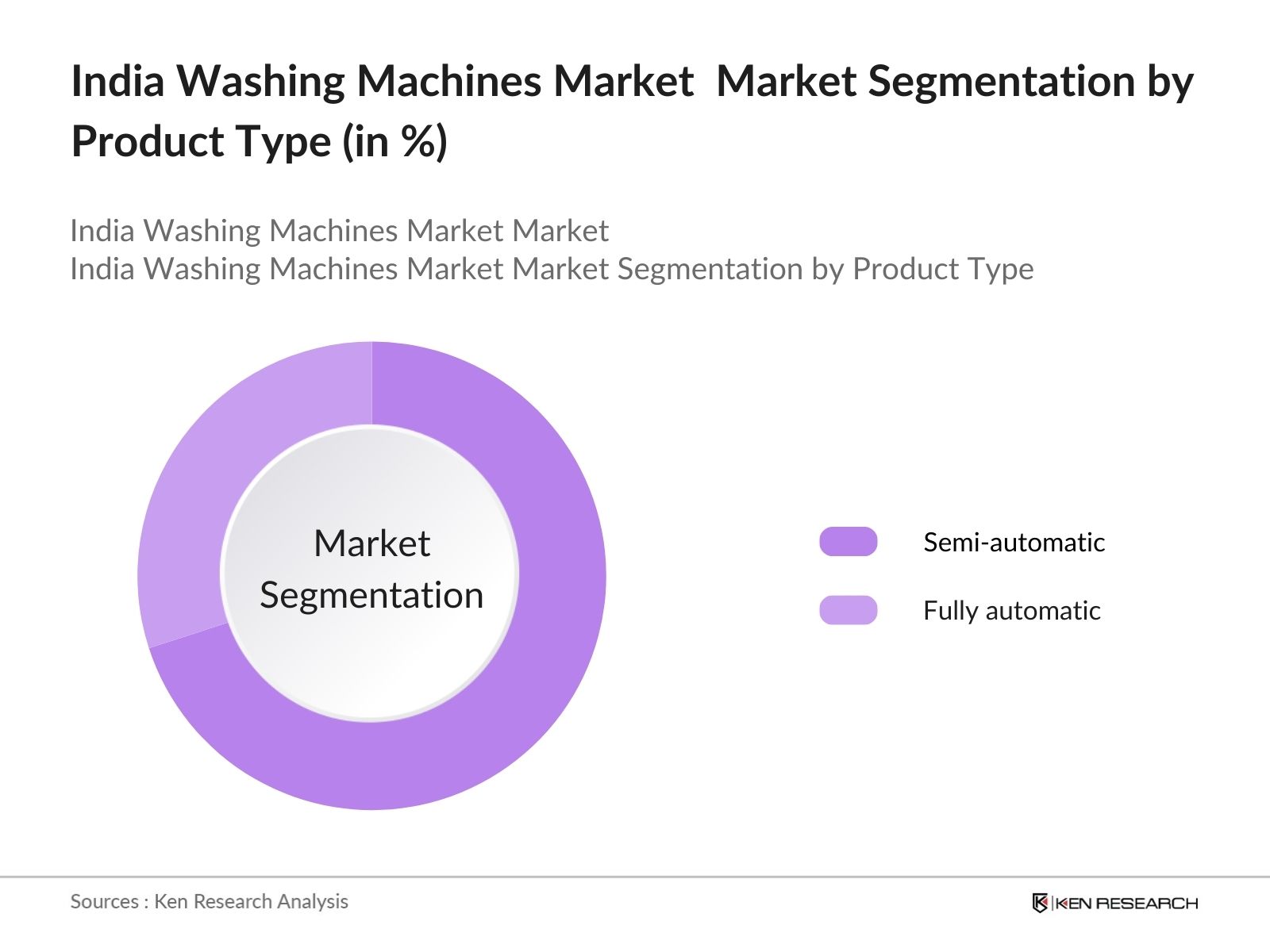
By Product Type: The market is segmented by product type into semi-automatic and fully automatic washing machines. Fully automatic washing machines hold a dominant market share, primarily due to the increasing demand for convenience and technological advancements in urban areas. The incorporation of features such as water-saving technologies, inverter motors, and smart control systems appeals to a growing middle class seeking modern home appliances. Brands like LG and Samsung lead in this category, driving the market with innovative models.
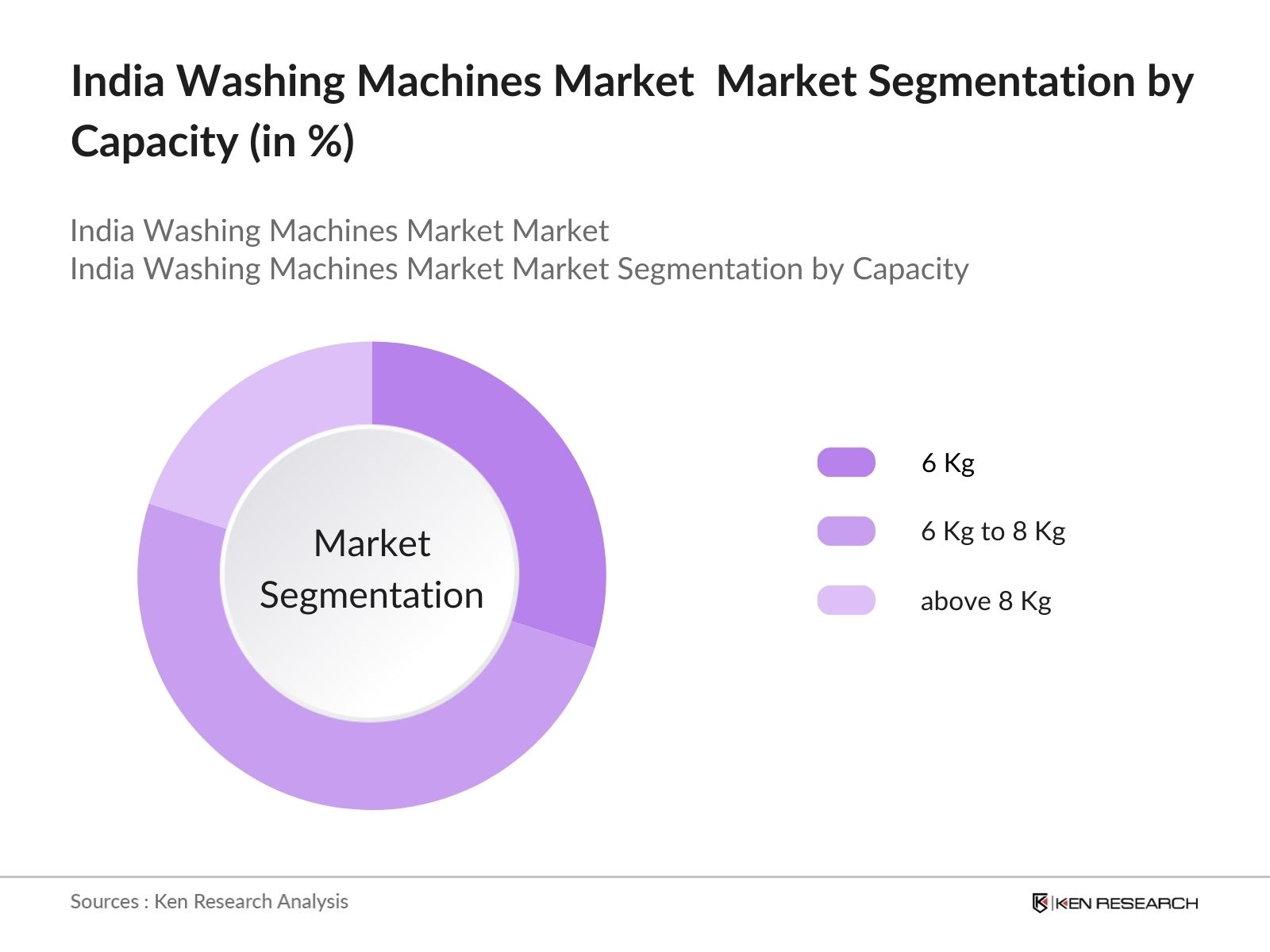
By Capacity: The market in India is segmented by capacity into below 6 Kg, 6 Kg to 8 Kg, and above 8 Kg. The segment of 6 Kg to 8 Kg dominates the market, as it caters to the average household size in India, balancing affordability and utility. Consumers prefer this range for its efficiency and ability to handle regular laundry loads. Additionally, this segment is where most promotional efforts by major brands are focused, further driving its market share.
India Washing Machines Market Competitive Landscape
The market is characterized by a mix of multinational and domestic companies. The competitive landscape is dominated by large corporations that leverage technological advancements, strong distribution networks, and marketing campaigns. Key players include LG, Samsung, Whirlpool, and Godrej, among others.
|
Company Name |
Year of Establishment |
Headquarters |
Product Range |
Distribution Network |
R&D Investment |
Customer Base |
Market Share |
|
LG Electronics |
1958 |
Seoul, South Korea |
|||||
|
Samsung Electronics |
1969 |
Seoul, South Korea |
|||||
|
Whirlpool India |
1911 |
Michigan, USA |
|||||
|
IFB Industries |
1974 |
Kolkata, India |
|||||
|
Godrej Appliances |
1897 |
Mumbai, India |
India Washing Machines Market Analysis
Market Growth Drivers
- Expansion of Rural Electrification Programs: The Indian government's aggressive efforts to electrify rural areas under schemes like Deendayal Upadhyaya Gram Jyoti Yojana have increased the electricity access to over 300 million rural households by 2024. This electrification surge is expected to drive washing machine sales, as access to electricity in new regions enables first-time buyers to purchase essential appliances like washing machines.
- Rising Middle-Class Population in Tier 2 and Tier 3 Cities: India is expected to see a massive surge in middle-class households, with projections showing an additional 80 million households entering the middle-income bracket by 2025. This demographic is a key growth driver for washing machines, as middle-class families have higher disposable incomes and greater access to modern consumer goods.
- Governments "Make in India" Initiative: The government's push for local manufacturing has led to the establishment of more washing machine production plants, reducing import dependency. As of 2024, major global and domestic companies, including Samsung and LG, have established or expanded their manufacturing facilities in India, contributing to the growth of the washing machine industry. Around 4 new washing machine manufacturing units are expected to be operational by 2026, supported by favorable tax incentives under "Make in India."
Market Challenges
- Lack of Penetration in Rural Markets: Despite rural electrification efforts, the penetration of washing machines in rural India remains low, with less than 20% of rural households owning washing machines as of 2024. This is due to cultural preferences for handwashing and the high upfront cost of machines, which are often considered luxury goods. The lack of awareness campaigns or targeted marketing efforts to educate rural consumers further exacerbates this challenge.
- Import Dependency on Key Components: Although the "Make in India" initiative has increased local production, the industry still relies on imported components like motors and electronic controls, primarily sourced from China and Southeast Asia. This import dependency has led to price fluctuations and supply chain disruptions, with prices increasing in recent years due to global supply chain issues. These factors create challenges in maintaining cost-effective production.
India Washing Machines Market Future Outlook
Over the next five years, the India Washing Machines industry is expected to grow, driven by rapid urbanization, increased penetration of fully automatic washing machines, and rising consumer awareness of energy-efficient appliances. The integration of smart technologies like IoT and AI in washing machines, combined with increased purchasing power, is expected to drive further growth.
Future Market Opportunities
- Shift Towards Environmentally Friendly Products: As environmental awareness grows, washing machine manufacturers are expected to focus on developing eco-friendly products, utilizing materials that reduce water and energy consumption. By 2028, washing machines that use eco-friendly technologies, such as water recycling and low-detergent cycles, are expected to account for a substantial portion of the market. Government initiatives focused on sustainability will further support this trend.
- Expansion in Rural Markets: Over the next five years, washing machine manufacturers will increasingly target rural markets, where penetration remains low. With over 100 million rural households gaining access to electricity and affordable home loans by 2027, companies are expected to launch more affordable, entry-level models designed specifically for rural consumers. This expansion could lead to over 10 million additional washing machines sold in rural India by 2029.
Scope of the Report
|
Type |
Semi-Automatic Fully Automatic Front Load Top Load |
|
Technology |
Inverter Technology Non-Inverter Technology |
|
Capacity |
Below 6 Kg 6 Kg to 8 Kg Above 8 Kg |
|
Distribution Channel |
Online Offline |
|
End User |
Residential Commercial |
|
Region |
North |
Products
Key Target Audience Organizations and Entities Who Can Benefit by Subscribing This Report:
Washing Machine Manufacturers
Consumer Electronics Companies
Venture Capital Firms and Investment Bodies
Government and Regulatory Bodies (Bureau of Energy Efficiency)
E-commerce Platforms (Flipkart, Amazon)
OEM Suppliers and Component Manufacturers
Banks and Financial Institution
Companies
Players Mentioned in the Report:
LG Electronics India Pvt. Ltd.
Samsung India Electronics Pvt. Ltd.
Whirlpool of India Ltd.
IFB Industries Ltd.
Godrej Appliances
Haier Appliances India Pvt. Ltd.
Panasonic India Pvt. Ltd.
Bosch Home Appliances
Voltas Beko
Onida Electronics
Electrolux
Lloyd (Havells India)
Videocon Industries
Intex Technologies India Ltd.
Midea Group
Table of Contents
India Washing Machines Market Overview
Definition and Scope
Market Taxonomy
Market Growth Rate
Market Segmentation Overview
India Washing Machines Market Size (In USD Mn)
Historical Market Size
Year-On-Year Growth Analysis
Key Market Developments and Milestones
India Washing Machines Market Analysis
Growth Drivers [Rising Urbanization, Changing Consumer Preferences, Water and Energy Efficiency Demand, Increasing Affordability]
Market Challenges [High Initial Costs, Power Consumption, Maintenance Costs, Limited Infrastructure in Rural Areas]
Opportunities [Expansion into Rural Markets, Integration of Smart Technologies, E-Commerce Growth, Sustainable Products]
Trends [Adoption of IoT-enabled Machines, Demand for Fully Automatic Machines, Shift Towards Front Load Machines, Eco-Friendly Washing Solutions]
Government Regulations [Energy Efficiency Standards, GST Impact, Make in India Policy, Import Duties]
SWOT Analysis
Stakeholder Ecosystem
Porters Five Forces Analysis
Competitive Landscape
India Washing Machines Market Segmentation
By Type (In Value %)
Semi-Automatic Washing Machines
Fully Automatic Washing Machines
Front Load Machines
Top Load Machines
By Technology (In Value %)
Inverter Technology
Non-Inverter Technology
By Capacity (In Value %)
Below 6 Kg
6 Kg to 8 Kg
Above 8 Kg
By Distribution Channel (In Value %)
Online
Offline
By End User (In Value %)
Residential
Commercial
By Region (In Value %)
4.6.1 North
4.6.2 East
4.6.3 West
4.6.4 South
India Washing Machines Market Competitive Analysis
Detailed Profiles of Major Companies
LG Electronics India Pvt. Ltd.
Samsung India Electronics Pvt. Ltd.
Whirlpool of India Ltd.
IFB Industries Ltd.
Panasonic India Pvt. Ltd.
Haier Appliances India Pvt. Ltd.
Godrej Appliances
Bosch Home Appliances
Voltas Beko
Onida Electronics
Electrolux
Midea Group
Lloyd (Havells India)
Videocon Industries
Intex Technologies India Ltd.
Cross Comparison Parameters [Revenue, Employee Count, Market Share, Product Range, R&D Investment, Customer Satisfaction Ratings, Distribution Network, Market Positioning]
Market Share Analysis
Strategic Initiatives
Mergers and Acquisitions
Investment Analysis
Venture Capital Funding
Private Equity Investments
India Washing Machines Market Regulatory Framework
Energy Efficiency Standards
Import Regulations and Duties
Environmental Compliance
Certification Processes
India Washing Machines Future Market Size (In USD Mn)
Future Market Size Projections
Key Factors Driving Future Market Growth
India Washing Machines Future Market Segmentation
By Type (In Value %)
By Technology (In Value %)
By Capacity (In Value %)
By Distribution Channel (In Value %)
By End User (In Value %)
India Washing Machines Market Analysts Recommendations
TAM/SAM/SOM Analysis
Customer Cohort Analysis
Marketing Initiatives
White Space Opportunity Analysis
Disclaimer Contact UsResearch Methodology
Step 1: Identification of Key Variables
The initial phase involves constructing an ecosystem map encompassing all major stakeholders within the India Washing Machines Market. This step is underpinned by extensive desk research utilizing secondary and proprietary databases to gather comprehensive industry-level information. The primary objective is to identify and define the critical variables that influence market dynamics.
Step 2: Market Analysis and Construction
In this phase, historical data on market penetration, product adoption, and revenue generation are analyzed. Additionally, an evaluation of the relationship between market demand and the level of innovation within washing machine products is conducted to assess growth potential and revenue outcomes.
Step 3: Hypothesis Validation and Expert Consultation
Market hypotheses will be validated through consultations with industry experts via computer-assisted telephone interviews (CATIs). These experts represent various companies operating in the market and will provide valuable insights into product trends, operational challenges, and consumer preferences, contributing to data refinement.
Step 4: Research Synthesis and Final Output
The final phase involves direct engagement with manufacturers and retailers to obtain insights into product performance and consumer demand. This ensures a validated analysis of market trends, providing accurate insights into the future outlook of the India Washing Machines Market.
Frequently Asked Questions
01. How big is the India Washing Machines Market?
The India Washing Machines Market is valued at USD 4.5 billion, driven by rising consumer demand for energy-efficient and automated appliances in both urban and semi-urban areas.
02. What are the challenges in the India Washing Machines Market?
Key challenges in the India Washing Machines Market include high initial costs for fully automatic models, limited infrastructure for servicing in rural areas, and the high energy consumption of older models.
03. Who are the major players in the India Washing Machines Market?
Major players in the India Washing Machines Market include LG Electronics India, Samsung India Electronics, Whirlpool of India, IFB Industries, and Godrej Appliances, with each company leveraging technological innovation and wide distribution networks.
04. What are the growth drivers of the India Washing Machines Market?
Growth in the India Washing Machines Market is driven by rapid urbanization, rising disposable incomes, and increasing consumer awareness of modern, energy-efficient home appliances. Additionally, the rise in dual-income households contributes to the market expansion.
05. What trends are emerging in the India Washing Machines Market?
Emerging trends in the India Washing Machines Market include the adoption of IoT-enabled washing machines, a shift towards fully automatic and front-load models, and the growing importance of energy efficiency and water conservation in product design.
Why Buy From Us?

What makes us stand out is that our consultants follows Robust, Refine and Result (RRR) methodology. i.e. Robust for clear definitions, approaches and sanity checking, Refine for differentiating respondents facts and opinions and Result for presenting data with story

We have set a benchmark in the industry by offering our clients with syndicated and customized market research reports featuring coverage of entire market as well as meticulous research and analyst insights.

While we don't replace traditional research, we flip the method upside down. Our dual approach of Top Bottom & Bottom Top ensures quality deliverable by not just verifying company fundamentals but also looking at the sector and macroeconomic factors.

With one step in the future, our research team constantly tries to show you the bigger picture. We help with some of the tough questions you may encounter along the way: How is the industry positioned? Best marketing channel? KPI's of competitors? By aligning every element, we help maximize success.

Our report gives you instant access to the answers and sources that other companies might choose to hide. We elaborate each steps of research methodology we have used and showcase you the sample size to earn your trust.

If you need any support, we are here! We pride ourselves on universe strength, data quality, and quick, friendly, and professional service.