
India Water Bottle Market Outlook to 2030
Region:Asia
Author(s):Shubham Kashyap
Product Code:KROD8316
December 2024
81
About the Report
India Water Bottle Market Overview
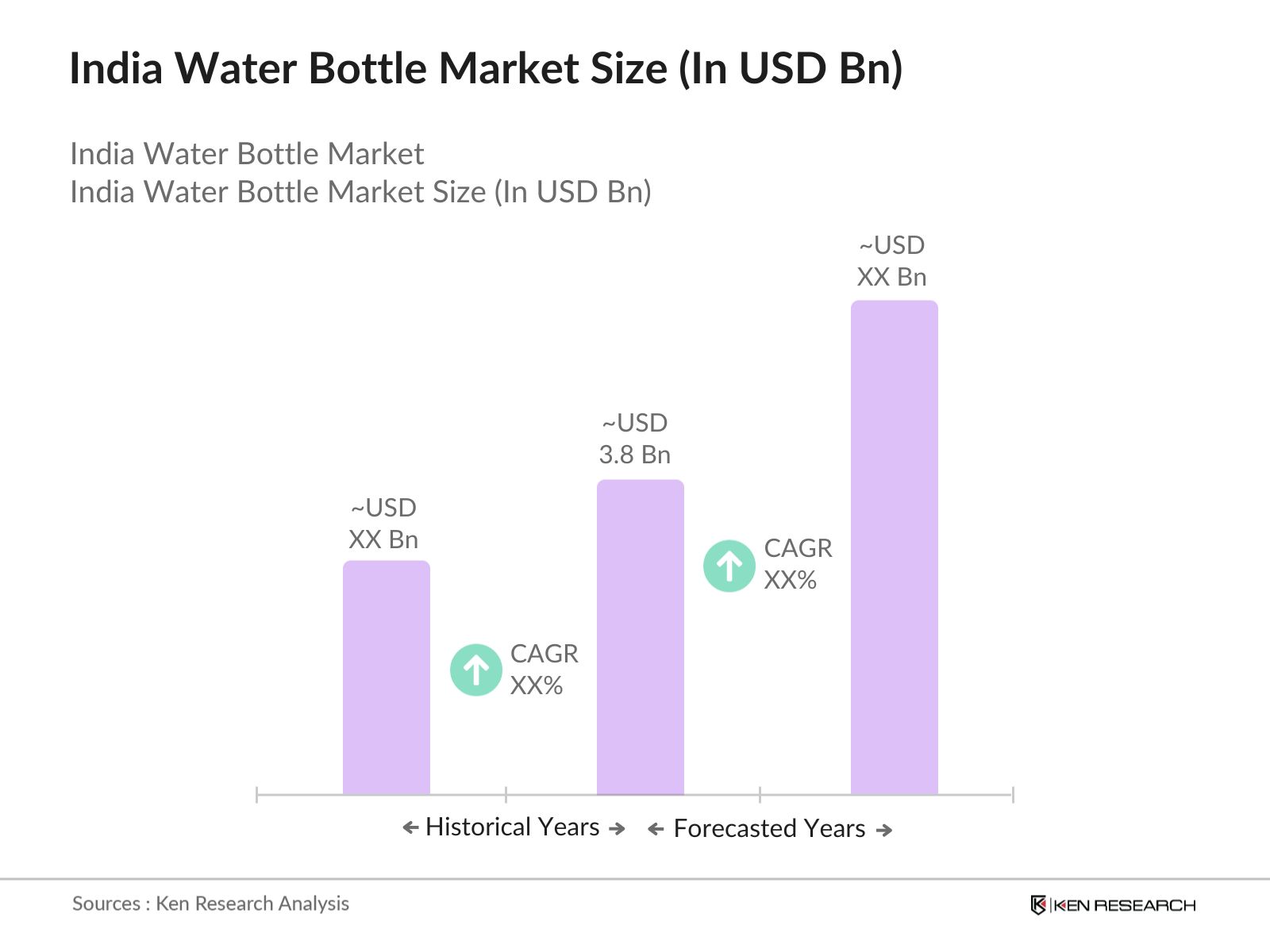
- The India Water Bottle Market, valued at USD 3.8 billion, is witnessing significant growth due to increasing consumer awareness around health, hydration, and environmental sustainability. This market expansion is primarily driven by a shift towards reusable and eco-friendly bottles, with consumers favoring materials such as stainless steel and glass over traditional plastic. The Bureau of Indian Standards (BIS) continues to implement material safety and quality standards, which are expected to further encourage the use of sustainable bottle options among consumers.
- Major metropolitan areas like Mumbai, Delhi, and Bengaluru dominate the India Water Bottle Market, thanks to higher disposable income, an environmentally-conscious consumer base, and well-established retail networks. These cities are key markets for premium and sustainable water bottles, where urban consumers display a preference for innovative designs and durable materials. The rising demand in these urban centers aligns with increased environmental awareness and the governments focus on reducing single-use plastic, driving further adoption of sustainable water bottles.
- BIS compliance is mandatory for bottled products, ensuring consumer safety and material quality. As per BIS data, over 10,000 manufacturers in the water bottle sector are subjected to BIS standards. This regulation enforces safety and quality, positioning certified products favorably within the market. It is crucial for companies to align with these standards to retain consumer trust and ensure product acceptance.
India Water Bottle Market Segmentation
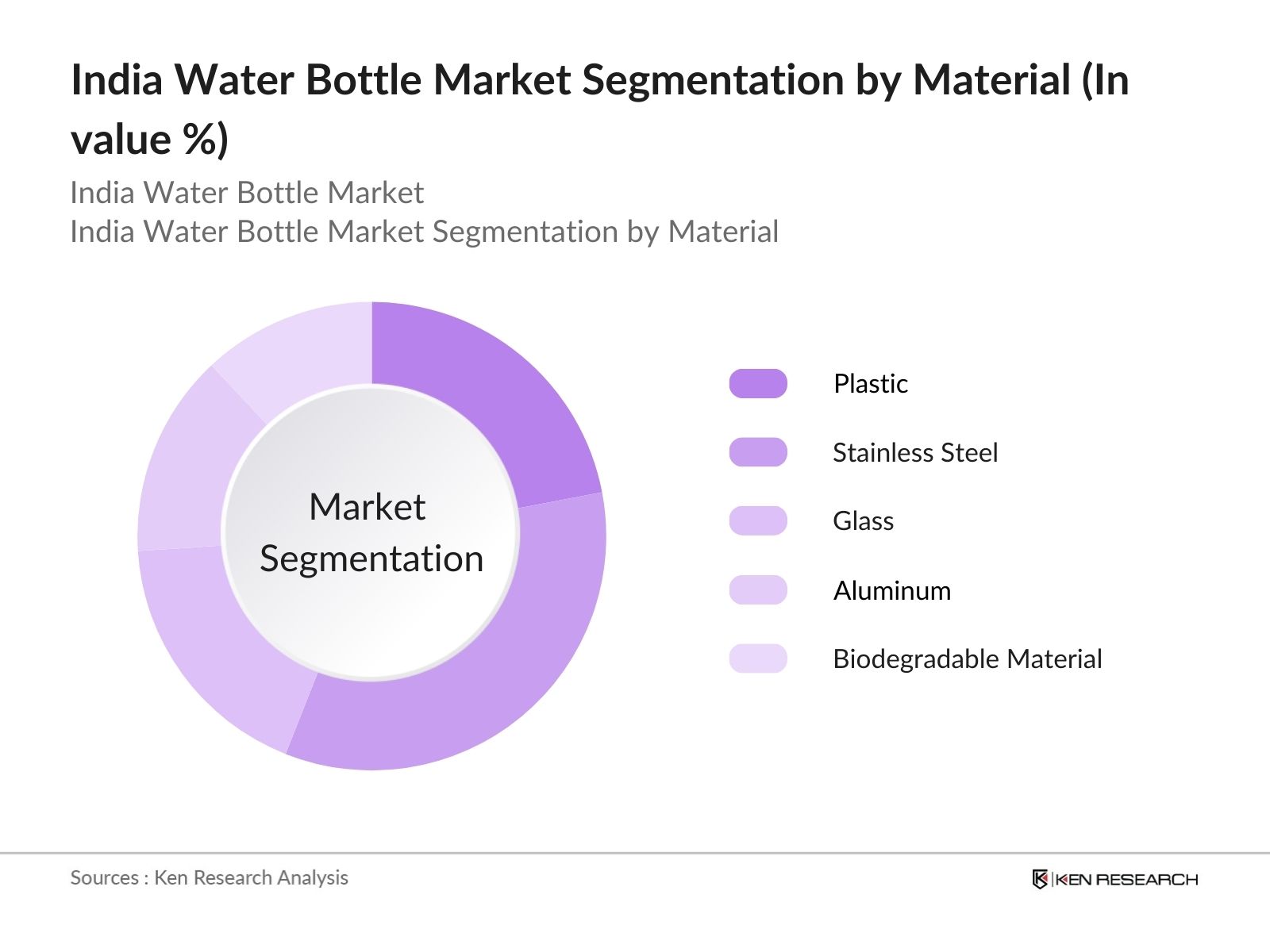
- By Material Type: The Market is segmented by material type into plastic, stainless steel, glass, aluminum, and biodegradable materials. Recently, stainless steel bottles hold a dominant market share within this segmentation due to their durability, non-toxic properties, and sustainable appeal. Consumers are increasingly aware of the harmful effects of plastic, leading them to prefer stainless steel as a safe and long-lasting alternative. Stainless steel bottles also align well with eco-friendly initiatives and offer superior temperature retention, making them popular among urban and outdoor-focused consumers.
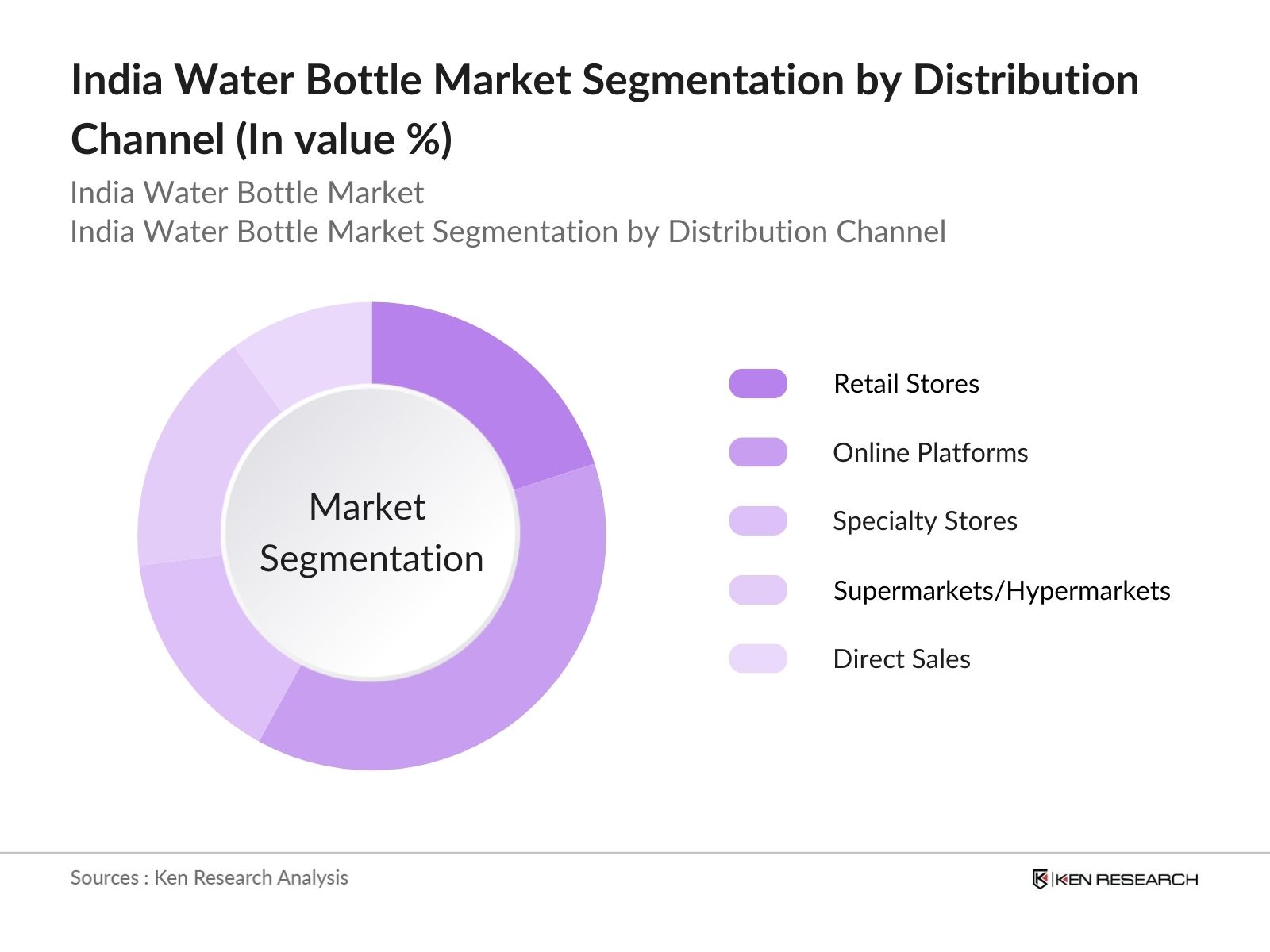
- By Distribution Channel: In the Market, distribution channels include retail stores, online platforms, specialty stores, supermarkets/hypermarkets, and direct sales. Online platforms hold the dominant position due to the convenience of home delivery, access to a wide range of options, and frequent discounts. E-commerce giants like Amazon and Flipkart have made it easier for consumers across both urban and rural areas to purchase high-quality water bottles, with options for customization and brand variety, leading to enhanced online penetration in the market.
India Water Bottle Market Competitive Landscape
The India Water Bottle Market is highly competitive, featuring a mix of domestic and international brands that emphasize innovation, brand loyalty, and sustainable practices. Leading players, such as Bisleri, Aquafina, and Kinley, leverage extensive distribution networks and consumer loyalty to maintain a competitive edge. This competitive landscape reflects a combination of strategic pricing, product variety, and brand reputation, with companies increasingly focusing on eco-friendly materials and appealing designs to capture the interest of environmentally conscious consumers. 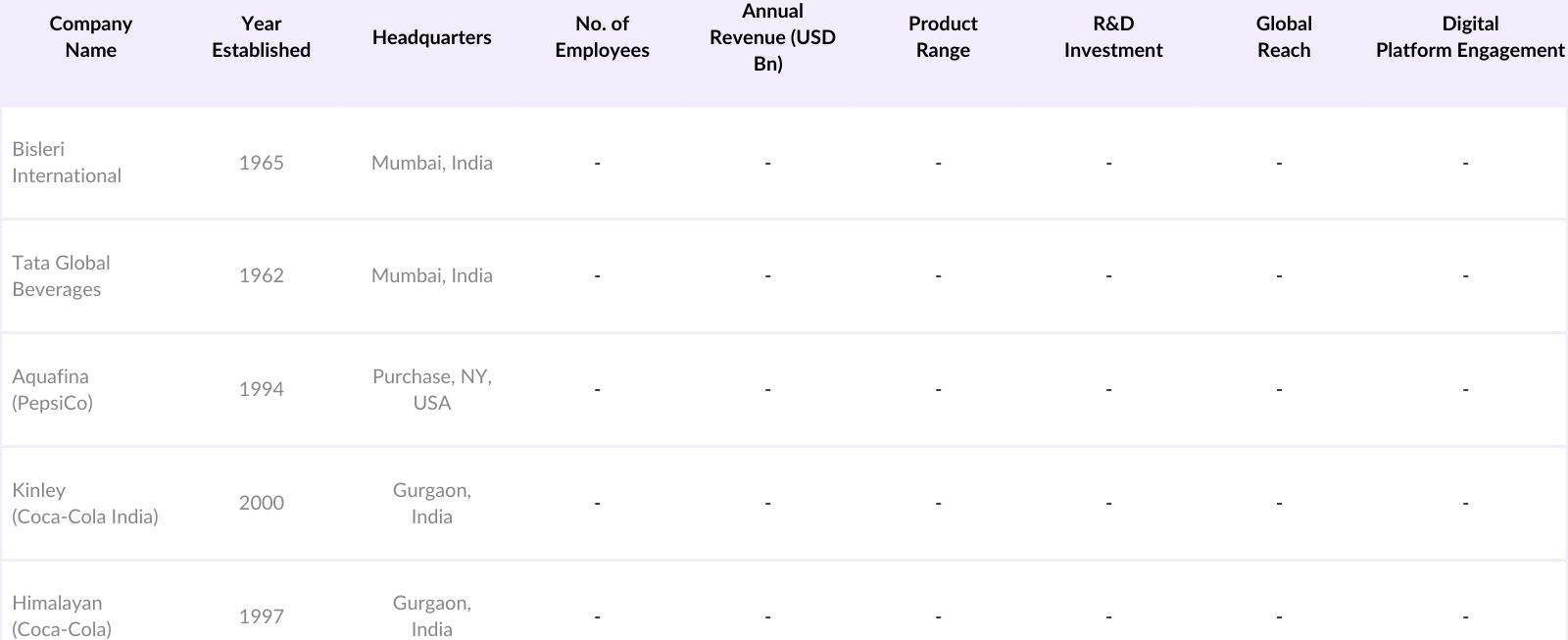
India Water Bottle Market Analysis
Growth Drivers
- Shift Towards Health-Conscious Lifestyles: A notable rise in health consciousness is driving demand for water bottles in India as consumers prioritize hydration and wellness. The World Bank indicates that India has seen a substantial increase in urban gym memberships since 2022, reflecting an increased focus on health and fitness. This trend is pushing demand for portable, health-centric products like water bottles. Furthermore, studies by the Ministry of Health show that millions of urban Indians are adopting regular hydration habits, which correlates with higher sales of personal water containers.
- Rising Disposable Income: Rising disposable income among Indian consumers, particularly in urban areas, has influenced purchasing habits towards more durable and premium reusable bottles. According to Indias Ministry of Finance, average annual income in urban regions increased by 1600 INR in 2023 compared to 2022. This increment has empowered a larger segment of the population to opt for durable, eco-friendly options. Increased earnings also drive demand for premium and designer water bottles that cater to individual preferences, providing a significant boost to the industry.
- Urbanization and Increased Mobility: Indias rapid urbanization, with 34% of the population now residing in cities, has heightened the need for portable hydration solutions. Urban centers like Delhi and Mumbai report a commuter population of over 10 million each, necessitating the use of portable water containers. This demand aligns with projections from the United Nations indicating further urban expansion, reinforcing sustained demand for water bottles that cater to mobility needs. As the need for on-the-go hydration increases, so too does demand in this market.
Market Challenges
- High Competition from Unorganized Sector: The presence of unorganized market players supplying inexpensive bottles poses significant challenges for branded manufacturers. Unorganized vendors hold a substantial share of the water bottle sector, creating market fragmentation that affects organized brands. Consumers in tier-2 and rural regions often opt for lower-priced options, intensifying the competition. This high competition from unorganized sectors impacts the adoption rate of premium reusable bottles, limiting the reach of established brands.
- Regulatory Compliance (Material Safety Standards): Stringent regulatory standards for materials used in water bottles present additional challenges for manufacturers. The Bureau of Indian Standards (BIS) mandates compliance on materials like plastic and stainless steel, affecting a large number of businesses in the sector. Adhering to these standards entails compliance costs and frequent audits, which increase operational expenses, particularly impacting smaller manufacturers. This challenge highlights the need for sustained investment in regulatory adherence.
India Water Bottle Market Future Outlook
The India Water Bottle Market is expected to experience strong growth as consumers increasingly favor sustainable and reusable bottles. Continuous product innovation, focusing on materials and temperature retention technology, is anticipated to drive demand among health-conscious and environmentally aware consumers. As companies invest in expanding distribution networks and eco-friendly products, the market is poised for further expansion. Additionally, regulatory frameworks promoting sustainable packaging are likely to encourage the adoption of alternative materials.
Future Market Opportunities
- Sustainable and Biodegradable Bottle Solutions: With growing environmental consciousness, there is an opportunity for biodegradable and sustainable bottles in the market. Data from the Ministry of Environment reports that majority of urban consumers are willing to pay a premium for eco-friendly products. This willingness supports the growth of biodegradable bottle options, as manufacturers introduce products made from bamboo and compostable plastics. The shift creates a promising niche within the Indian market.
- Expanding Rural Market Penetration: The rural sector offers untapped potential, with only 10% of the rural population currently using reusable bottles, as per the Rural Development Ministrys 2023 report. This demographic represents a significant opportunity for market expansion, as rural incomes rise and awareness about reusable options grows. Manufacturers can leverage distribution channels in these regions to introduce low-cost, durable bottles and cater to the increasing demand.
Scope of the Report
|
By Material Type |
Plastic |
|
By Distribution Channel |
Retail Stores |
|
By End-User |
Residential |
|
By Capacity |
Less than 500 ml |
|
By Region |
North |
Products
Key Target Audience
Manufacturers of Reusable Bottles
Retailers and E-commerce Platforms
Investors and Venture Capitalist Firms
Government and Regulatory Bodies (e.g., Bureau of Indian Standards, Ministry of Environment)
Corporate Offices and Institutions
Banks and Financial Institutions
Hospitality and Tourism Sectors
Consumer Associations and NGOs
Companies
Players Mentioned in the Report
Bisleri International Pvt. Ltd.
Tata Global Beverages
Aquafina (PepsiCo)
Kinley (Coca-Cola India)
Himalayan (Coca-Cola India)
Kingfisher (United Breweries Group)
Manikchand Oxyrich
Evian (Danone)
Qua (Tata Group)
Vedica (Bisleri)
Veen Waters
Parle Agro
Oceanic Beverages
Pure Life (Nestl)
Mount Everest Mineral Water Ltd.
Table of Contents
1. India Water Bottle Market Overview
1.1 Definition and Scope
1.2 Market Taxonomy
1.3 Market Structure Analysis
1.4 Market Segmentation Overview
2. India Water Bottle Market Size (In USD Million)
2.1 Historical Market Size
2.2 Year-On-Year Growth Analysis
2.3 Key Market Developments and Milestones
3. India Water Bottle Market Analysis
3.1 Growth Drivers
- 3.1.1 Shift Towards Health-Conscious Lifestyles
- 3.1.2 Rising Disposable Income
- 3.1.3 Urbanization and Increased Mobility
- 3.1.4 Environmental Awareness and Preference for Reusable Bottles
3.2 Market Challenges
- 3.2.1 High Competition from Unorganized Sector
- 3.2.2 Regulatory Compliance (Material Safety Standards)
- 3.2.3 Price Sensitivity Among Consumers
- 3.2.4 Limited Recycling Infrastructure
3.3 Opportunities
- 3.3.1 Sustainable and Biodegradable Bottle Solutions
- 3.3.2 Expanding Rural Market Penetration
- 3.3.3 Rise of Premium and Customizable Bottles
- 3.3.4 Partnership with Eco-Friendly Initiatives
3.4 Trends
- 3.4.1 Use of Recycled Materials (PET Bottles)
- 3.4.2 Technological Integration (Smart Water Bottles)
- 3.4.3 Growing E-commerce and Direct-to-Consumer Sales
- 3.4.4 Innovative Designs Targeting Specific Lifestyles
3.5 Government Regulation
- 3.5.1 Bureau of Indian Standards (BIS) Compliance
- 3.5.2 Plastic Waste Management Rules
- 3.5.3 Single-Use Plastic Restrictions
- 3.5.4 Tax Incentives for Sustainable Manufacturing
3.6 SWOT Analysis
3.7 Stakeholder Ecosystem
3.8 Porters Five Forces Analysis
3.9 Competitive Ecosystem
4. India Water Bottle Market Segmentation
4.1 By Material Type (In Value %)
- 4.1.1 Plastic
- 4.1.2 Stainless Steel
- 4.1.3 Glass
- 4.1.4 Aluminum
- 4.1.5 Biodegradable Material
4.2 By Distribution Channel (In Value %)
- 4.2.1 Retail Stores
- 4.2.2 Online Platforms
- 4.2.3 Specialty Stores
- 4.2.4 Supermarkets/Hypermarkets
- 4.2.5 Direct Sales
4.3 By End-User (In Value %)
- 4.3.1 Residential
- 4.3.2 Commercial
- 4.3.3 Industrial
- 4.3.4 Sports & Outdoor Activities
- 4.3.5 Educational Institutes
4.4 By Capacity (In Value %)
- 4.4.1 Less than 500 ml
- 4.4.2 500 ml - 1 liter
- 4.4.3 1 - 2 liters
- 4.4.4 Above 2 liters
4.5 By Region (In Value %)
- 4.5.1 North
- 4.5.2 South
- 4.5.3 East
- 4.5.4 West
5. India Water Bottle Market Competitive Analysis
5.1 Detailed Profiles of Major Competitors
- 5.1.1 Tata Chemicals Limited
- 5.1.2 Bisleri International Pvt. Ltd.
- 5.1.3 Himalayan Water (Coca-Cola India)
- 5.1.4 Aquafina (PepsiCo)
- 5.1.5 Kinley (The Coca-Cola Company)
- 5.1.6 Manikchand Oxyrich
- 5.1.7 Kingfisher (United Breweries Group)
- 5.1.8 Evian (Danone)
- 5.1.9 Qua (Tata Group)
- 5.1.10 Vedica (Bisleri)
- 5.1.11 Veen Waters
- 5.1.12 Oceanic Beverages
- 5.1.13 Parle Agro
- 5.1.14 Pure Life (Nestl)
- 5.1.15 Mount Everest Mineral Water Ltd.
5.2 Cross Comparison Parameters (No. of Employees, Revenue, Headquarters, Inception Year, Product Portfolio, Sustainability Initiatives, Distribution Reach, Market Share)
5.3 Market Share Analysis
5.4 Strategic Initiatives
5.5 Mergers and Acquisitions
5.6 Investment Analysis
5.7 Joint Ventures & Collaborations
5.8 R&D Focus Areas
6. India Water Bottle Market Regulatory Framework
6.1 Environmental Regulations
6.2 Compliance Requirements for Reusable and Single-Use Bottles
6.3 Certification Processes (BIS, ISO, FDA)
6.4 Industry Safety Standards
7. India Water Bottle Future Market Size (In USD Million)
7.1 Future Market Size Projections
7.2 Key Factors Driving Future Market Growth
8. India Water Bottle Future Market Segmentation
8.1 By Material Type (In Value %)
8.2 By Distribution Channel (In Value %)
8.3 By End-User (In Value %)
8.4 By Capacity (In Value %)
8.5 By Region (In Value %)
9. India Water Bottle Market Analysts Recommendations
9.1 TAM/SAM/SOM Analysis
9.2 Customer Cohort Analysis
9.3 Marketing Initiatives
9.4 White Space Opportunity Analysis
Disclaimer Contact UsResearch Methodology
Step 1: Identification of Key Variables
The initial phase entails mapping out all major stakeholders in the India Water Bottle Market, including manufacturers, retailers, and environmental agencies. Key market drivers, such as sustainability trends and material preferences, are identified through secondary data sources.
Step 2: Market Analysis and Data Collection
In this phase, historical and current data on material usage, distribution channels, and consumer behavior are analyzed. This includes detailed examination of demand trends and preferences for eco-friendly water bottle materials.
Step 3: Hypothesis Validation and Expert Interviews
Key hypotheses regarding growth factors, such as the rise of premium and sustainable bottles, are validated through interviews with industry experts. These insights provide a deeper understanding of consumer preferences and market challenges.
Step 4: Data Validation and Final Output
Data obtained from secondary sources is validated by cross-referencing with primary sources and sales data. This ensures accuracy and reliability in the final analysis, presenting a comprehensive view of the India Water Bottle Market.
Frequently Asked Questions
How big is the India Water Bottle Market?
The India Water Bottle Market was valued at USD 3.8 billion, driven by the shift towards eco-friendly products and increasing consumer awareness of environmental issues.
What are the challenges in the India Water Bottle Market?
Challenges in the India Water Bottle Market include high price sensitivity and limited recycling infrastructure, which pose barriers to wider adoption of sustainable bottles.
Who are the major players in the India Water Bottle Market?
Major players in the India Water Bottle Market include Bisleri International, Aquafina, Kinley, Tata Global Beverages, and Himalayan, known for their extensive distribution and sustainability efforts.
What drives growth in the India Water Bottle Market?
Growth in the India Water Bottle Market is primarily driven by the rising demand for eco-friendly materials, increasing consumer health awareness, and the adoption of premium water bottles in urban areas.
Why Buy From Us?

What makes us stand out is that our consultants follows Robust, Refine and Result (RRR) methodology. i.e. Robust for clear definitions, approaches and sanity checking, Refine for differentiating respondents facts and opinions and Result for presenting data with story

We have set a benchmark in the industry by offering our clients with syndicated and customized market research reports featuring coverage of entire market as well as meticulous research and analyst insights.

While we don't replace traditional research, we flip the method upside down. Our dual approach of Top Bottom & Bottom Top ensures quality deliverable by not just verifying company fundamentals but also looking at the sector and macroeconomic factors.

With one step in the future, our research team constantly tries to show you the bigger picture. We help with some of the tough questions you may encounter along the way: How is the industry positioned? Best marketing channel? KPI's of competitors? By aligning every element, we help maximize success.

Our report gives you instant access to the answers and sources that other companies might choose to hide. We elaborate each steps of research methodology we have used and showcase you the sample size to earn your trust.

If you need any support, we are here! We pride ourselves on universe strength, data quality, and quick, friendly, and professional service.