
India Water Purifiers Market Outlook to 2030
Region:India
Author(s):Shreya Garg
Product Code:KROD6583
Region:India
Author(s):Shreya Garg
Product Code:KROD6583
December 2024
97
By Product Type: The market is segmented by product type into Reverse Osmosis (RO), Ultraviolet (UV), Ultra-Filtration (UF), Activated Carbon Filters, and Gravity-Based Purifiers. RO purifiers dominate the market under this segmentation due to their ability to remove a wide range of contaminants, including dissolved salts, heavy metals, and microorganisms. Urban consumers prefer RO purifiers, especially in regions with high total dissolved solids (TDS) levels in water. The growing adoption of smart RO systems with IoT-enabled monitoring features also contributes to the dominance of this segment. 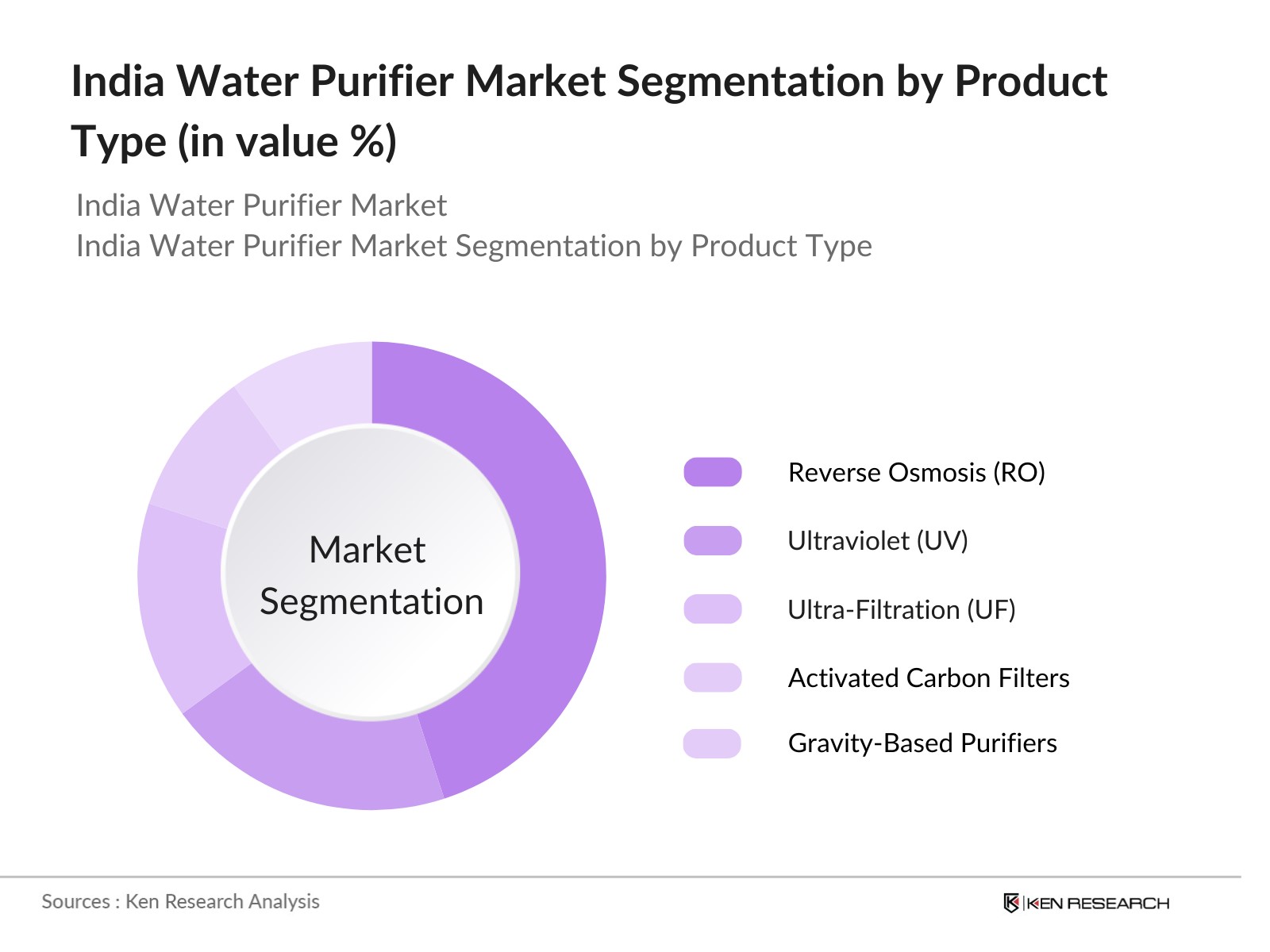
By Distribution Channel: The distribution channel for water purifiers is segmented into Online Retail, Offline Retail, and Direct Sales. Offline Retail has the highest market share, accounting for over half of total sales. Consumers prefer purchasing from physical stores due to the ability to physically inspect the products and receive personalized advice from sales representatives. However, Online Retail is rapidly growing due to the rise of e-commerce platforms like Amazon and Flipkart, which offer attractive deals, easy home delivery, and detailed product comparisons. 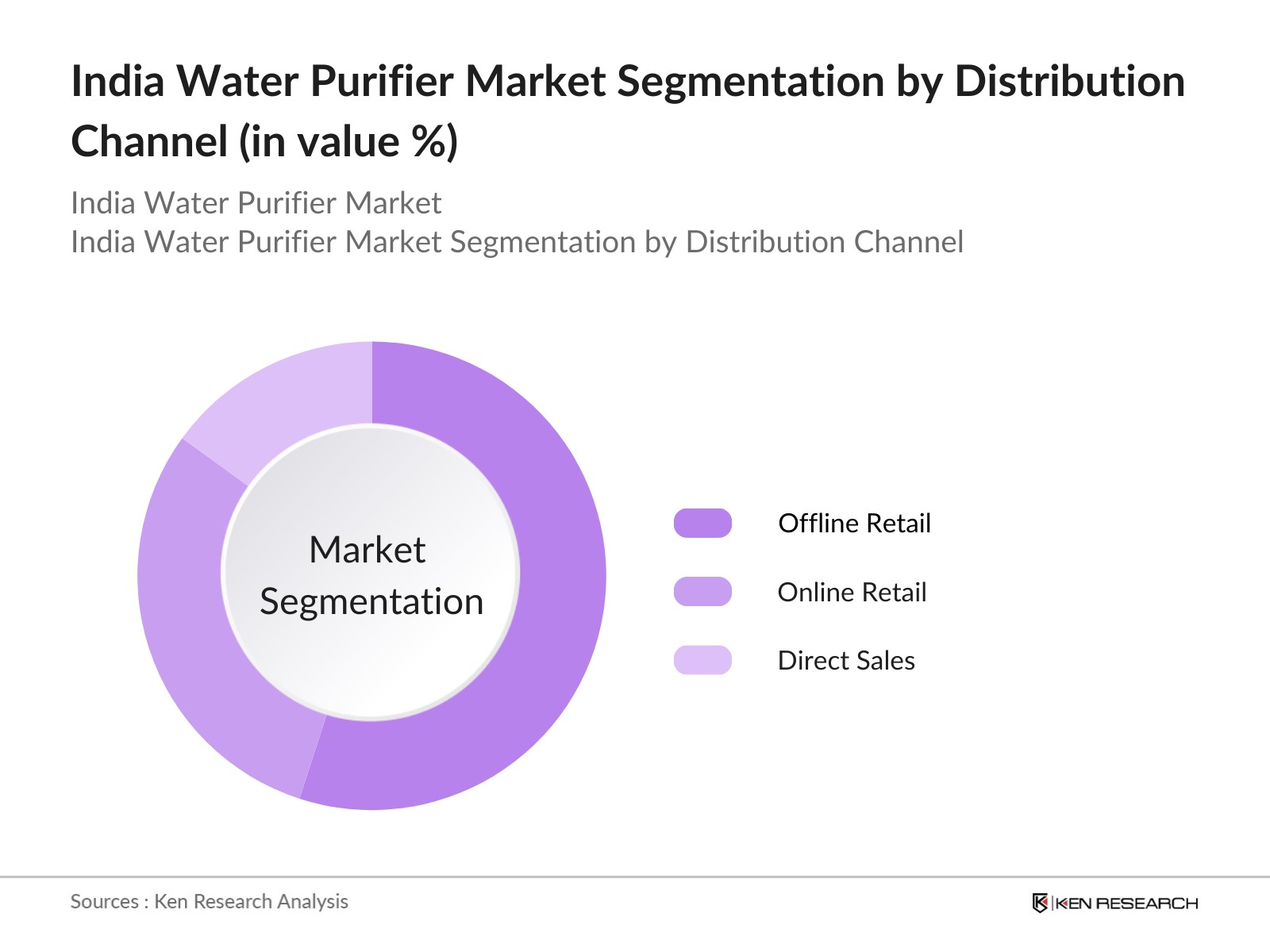
The India Water Purifier Market is characterized by intense competition among domestic and international players. Major players like Kent RO Systems and Eureka Forbes lead the market with their extensive product portfolios and strong distribution networks. Global players such as AO Smith and LG Electronics are increasingly focusing on expanding their presence in the Indian market through technological innovations and consumer-centric strategies. Additionally, companies are investing in after-sales services and smart water purification technologies to differentiate themselves from competitors.
|
Company Name |
Established |
Headquarters |
Product Range |
Revenue (USD Mn) |
R&D Investment (%) |
Market Presence |
Technological Innovation |
Distribution Reach |
|
Kent RO Systems |
1999 |
Noida, India |
||||||
|
Eureka Forbes |
1982 |
Mumbai, India |
||||||
|
AO Smith |
1874 |
Milwaukee, USA |
||||||
|
LG Electronics |
1958 |
Seoul, South Korea |
||||||
|
Livpure |
2012 |
Gurgaon, India |
Over the next five years, the India Water Purifier market is expected to experience significant growth driven by increasing consumer awareness, advancements in water purification technologies, and government initiatives aimed at providing clean drinking water. With the rise of smart home solutions, manufacturers are expected to introduce more IoT-enabled water purifiers that allow real-time monitoring of water quality. The expansion of e-commerce platforms is also expected to drive market growth as consumers increasingly turn to online platforms for purchasing convenience.
|
By Product Type |
Reverse Osmosis (RO) Ultraviolet (UV) Ultra-Filtration (UF) Activated Carbon Filters Gravity-Based Purifiers |
|
By Distribution Channel |
Online Retail Offline Retail Direct Sales |
|
By End User |
Residential Commercial Industrial |
|
By Technology |
RO+UV RO+UF Multi-Stage Filtration Nano Filtration |
|
By Region |
North South East West |
1.1. Definition and Scope
1.2. Market Taxonomy
1.3. Market Growth Rate (Market Demand Growth, Urban and Rural Penetration, Technological Adoption)
1.4. Market Segmentation Overview
2.1. Historical Market Size (Growth Trends, Annual Market Turnover)
2.2. Year-On-Year Growth Analysis (Consumer Demand, Purchasing Power, Regional Growth Trends)
2.3. Key Market Developments and Milestones (Product Launches, Government Initiatives, Infrastructure Expansion)
3.1. Growth Drivers
3.1.1. Rapid Urbanization and Industrialization
3.1.2. Increasing Awareness About Water Contamination
3.1.3. Government Policies Supporting Clean Water Initiatives (e.g., Swachh Bharat Mission, Jal Jeevan Mission)
3.1.4. Technological Advancements in Filtration Technologies (RO, UV, UF)
3.2. Market Challenges
3.2.1. High Initial Setup and Maintenance Costs
3.2.2. Lack of Awareness in Rural Areas
3.2.3. Availability of Unorganized and Low-Cost Products
3.3. Opportunities
3.3.1. Expansion of E-Commerce Channels
3.3.2. Growing Middle-Class Population and Disposable Income
3.3.3. Integration of IoT in Water Purifiers
3.4. Trends
3.4.1. Adoption of Smart Water Purifiers
3.4.2. Rising Demand for Point-of-Use Water Purifiers
3.4.3. Green and Energy-Efficient Technologies
3.5. Government Regulations
3.5.1. National Water Quality Standards (Bureau of Indian Standards)
3.5.2. Subsidies and Financial Incentives for Clean Water Projects
3.5.3. Public-Private Partnerships in Water Infrastructure
3.6. SWOT Analysis (Market Strengths, Weaknesses, Opportunities, Threats Specific to Indias Water Purifier Market)
3.7. Stake Ecosystem (Key Stakeholders, Including Manufacturers, Distributors, Installers, and Maintenance Providers)
3.8. Porters Five Forces Analysis (Market Bargaining Power, Threats, Industry Rivalry)
3.9. Competition Ecosystem (Market Dynamics Among Key Players, Market Concentration, and Fragmentation)
4.1. By Product Type (In Value %)
4.1.1. Reverse Osmosis (RO) Purifiers
4.1.2. Ultraviolet (UV) Purifiers
4.1.3. Ultra-Filtration (UF) Purifiers
4.1.4. Activated Carbon Filters
4.1.5. Gravity-Based Purifiers
4.2. By Distribution Channel (In Value %)
4.2.1. Online Retail (E-Commerce Platforms)
4.2.2. Offline Retail (Exclusive Brand Stores, Multi-Brand Retailers)
4.2.3. Direct Sales (Door-to-Door Sales and Company Direct Sales)
4.3. By End User (In Value %)
4.3.1. Residential
4.3.2. Commercial (Offices, Schools, Hospitals, Restaurants)
4.3.3. Industrial (Factories, Large Scale Water Treatment Plants)
4.4. By Technology (In Value %)
4.4.1. RO+UV Technology
4.4.2. RO+UF Technology
4.4.3. Multi-Stage Filtration
4.4.4. Nano Filtration
4.5. By Region (In Value %)
4.5.1. North
4.5.2. South
4.5.3. East
4.5.4. West
5.1 Detailed Profiles of Major Companies
5.1.1. Kent RO Systems
5.1.2. Eureka Forbes
5.1.3. HUL Pureit
5.1.4. Livpure
5.1.5. Blue Star
5.1.6. AO Smith
5.1.7. Tata Swach
5.1.8. LG Electronics
5.1.9. Whirlpool India
5.1.10. Panasonic India
5.1.11. Nasaka
5.1.12. Ion Exchange (India)
5.1.13. Havells India
5.1.14. Aquaguard
5.1.15. ZeroB
5.2 Cross Comparison Parameters (Product Portfolios, Manufacturing Capacity, Distribution Reach, Sustainability Initiatives, Market Penetration, Brand Equity, Customer Service, Innovation in Filtration Technology)
5.3. Market Share Analysis (Brand Performance, Market Concentration Ratios)
5.4. Strategic Initiatives (Marketing Strategies, Expansion Plans, Joint Ventures, New Product Development)
5.5. Mergers and Acquisitions (Company Takeovers, Strategic Partnerships)
5.6. Investment Analysis (Market Inflow, Investment from Private Equity)
5.7 Venture Capital Funding (Startups and Emerging Players)
5.8. Government Grants (Funding for Research and Development, Rural Water Purification Projects)
5.9. Private Equity Investments (Notable Investments in Water Purification Technology)
6.1. National Drinking Water Quality Standards
6.2. Certification Processes (Bureau of Indian Standards, ISO Certifications)
6.3. Compliance Requirements (Environmental Compliance, Energy Efficiency Standards)
7.1. Future Market Size Projections (Growth Potential, Key Influencing Factors)
7.2. Key Factors Driving Future Market Growth (Technological Innovations, Increasing Government Focus, Rising Health Awareness)
8.1. By Product Type (In Value %)
8.2. By End User (In Value %)
8.3. By Distribution Channel (In Value %)
8.4. By Technology (In Value %)
8.5. By Region (In Value %)
9.1. TAM/SAM/SOM Analysis
9.2. Consumer Cohort Analysis (Behavioral Patterns, Purchasing Preferences)
9.3. Marketing Initiatives (Target Market, Positioning, Branding Strategies)
9.4. White Space Opportunity Analysis (Untapped Markets, Product Differentiation)
The initial stage involves building an ecosystem map of all stakeholders, including manufacturers, distributors, and government bodies, within the India Water Purifier Market. Through secondary research utilizing government data and proprietary databases, critical variables affecting the market dynamics were identified.
This step focuses on compiling historical market data, including revenue generation from various segments and evaluating the penetration of water purifiers in both urban and rural areas. An analysis of key regions with high TDS levels and government programs targeting water purification was conducted.
Through consultations with industry experts via computer-assisted telephone interviews (CATI), hypotheses regarding growth trends and consumer preferences were validated. These expert insights were pivotal in refining market estimates.
The final synthesis stage incorporated primary data from manufacturers and distributors to corroborate market data derived from the bottom-up analysis. This ensured a comprehensive and accurate depiction of the India Water Purifier Market.
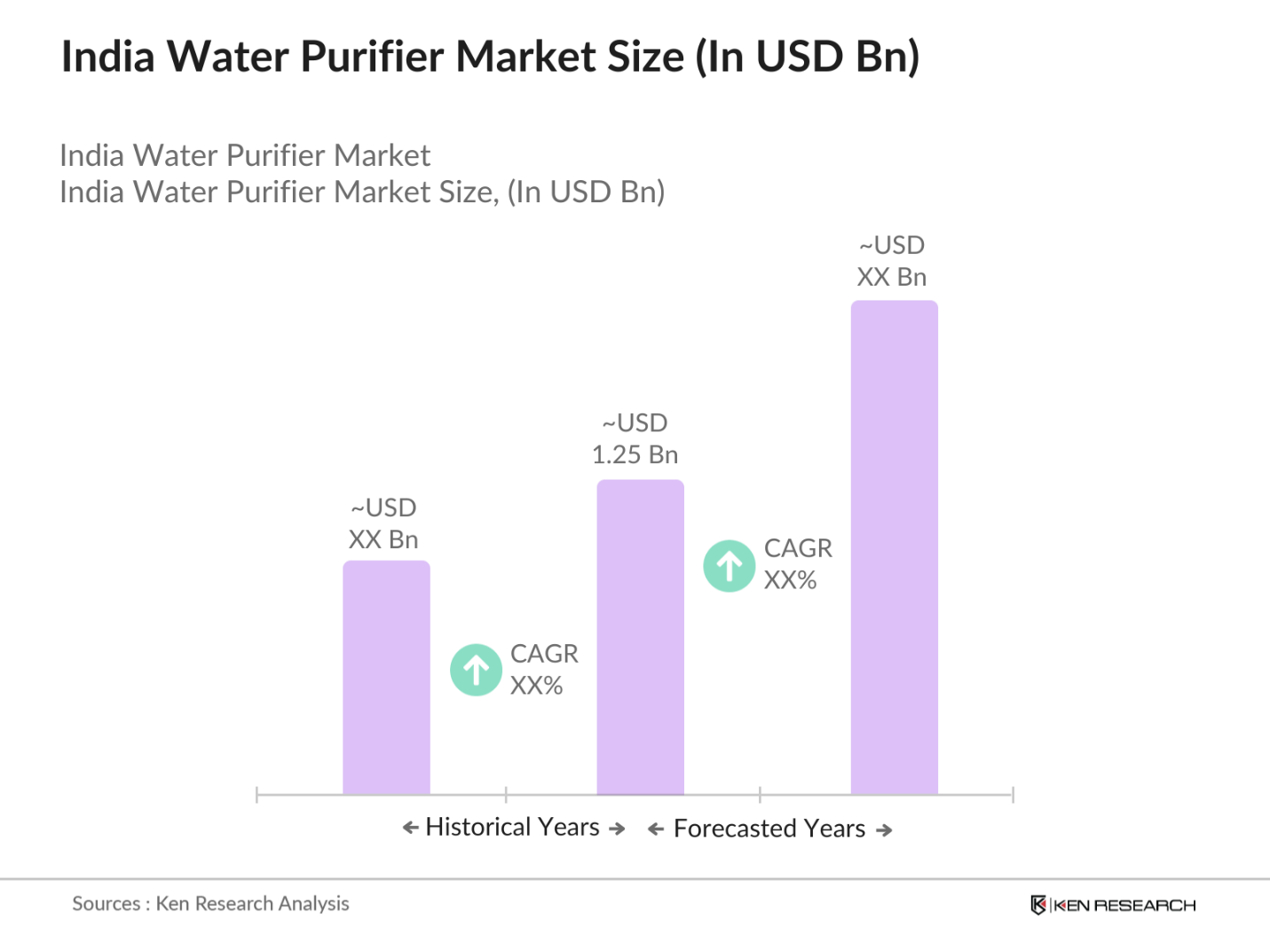
The India Water Purifier Market is valued at USD 1.25 billion, driven by increasing demand for clean drinking water, urbanization, and technological advancements in purification systems.
Key challenges include the high cost of maintenance and replacement of filters, lack of consumer awareness in rural areas, and competition from low-cost, unorganized players.
Leading players include Kent RO Systems, Eureka Forbes, AO Smith, LG Electronics, and Livpure, who dominate the market through extensive product portfolios and distribution networks.
Growth drivers include government initiatives such as Jal Jeevan Mission, rising health awareness, increasing disposable income, and advancements in RO and UV purification technologies.
RO purifiers hold the dominant share of the market, due to their effectiveness in removing dissolved salts, heavy metals, and microorganisms from water.

What makes us stand out is that our consultants follows Robust, Refine and Result (RRR) methodology. i.e. Robust for clear definitions, approaches and sanity checking, Refine for differentiating respondents facts and opinions and Result for presenting data with story

We have set a benchmark in the industry by offering our clients with syndicated and customized market research reports featuring coverage of entire market as well as meticulous research and analyst insights.

While we don't replace traditional research, we flip the method upside down. Our dual approach of Top Bottom & Bottom Top ensures quality deliverable by not just verifying company fundamentals but also looking at the sector and macroeconomic factors.

With one step in the future, our research team constantly tries to show you the bigger picture. We help with some of the tough questions you may encounter along the way: How is the industry positioned? Best marketing channel? KPI's of competitors? By aligning every element, we help maximize success.

Our report gives you instant access to the answers and sources that other companies might choose to hide. We elaborate each steps of research methodology we have used and showcase you the sample size to earn your trust.

If you need any support, we are here! We pride ourselves on universe strength, data quality, and quick, friendly, and professional service.