
India Water Treatment Chemicals Market Outlook to 2030
Region:Asia
Author(s):Yogita Sahu
Product Code:KROD5143
October 2024
94
About the Report
India Water Treatment Chemicals Market Overview
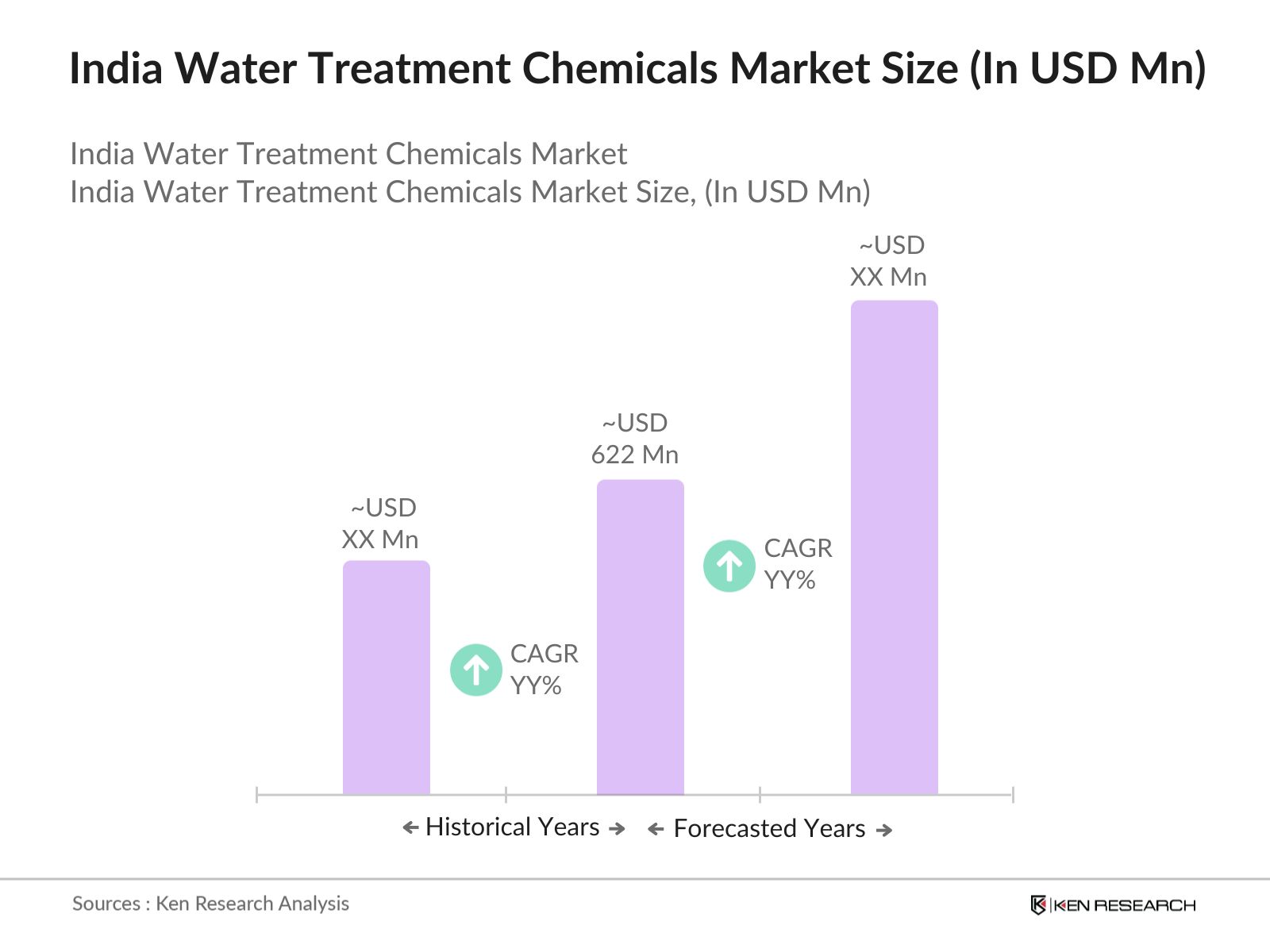
- The India water treatment chemicals market is valued at USD 622 million, driven primarily by the rising demand for clean water across urban and rural areas. The water treatment industry is propelled by government initiatives such as the Jal Jeevan Mission, which aims to provide piped water to households, and by the increasing requirement for effective water management systems in industrial sectors.
- Cities like Mumbai, Delhi, Chennai, and Ahmedabad are dominant in the market. These cities have large industrial sectorstextiles, food processing, and petrochemicalswhere water treatment is a critical requirement. The growth in these regions is also influenced by water scarcity issues and government regulations mandating stricter controls on water usage and effluent discharge.
- The Indian government has committed substantial resources towards cleaning the Ganga River under the National Mission for Clean Ganga. As of 2024, the NMCG has allocated INR 20,000 crores to enhance sewage treatment capacity, targeting the treatment of over 3 billion liters of wastewater per day by 2025. This has led to a surge in demand for water treatment chemicals, particularly in the municipal wastewater treatment sector.
India Water Treatment Chemicals Market Segmentation
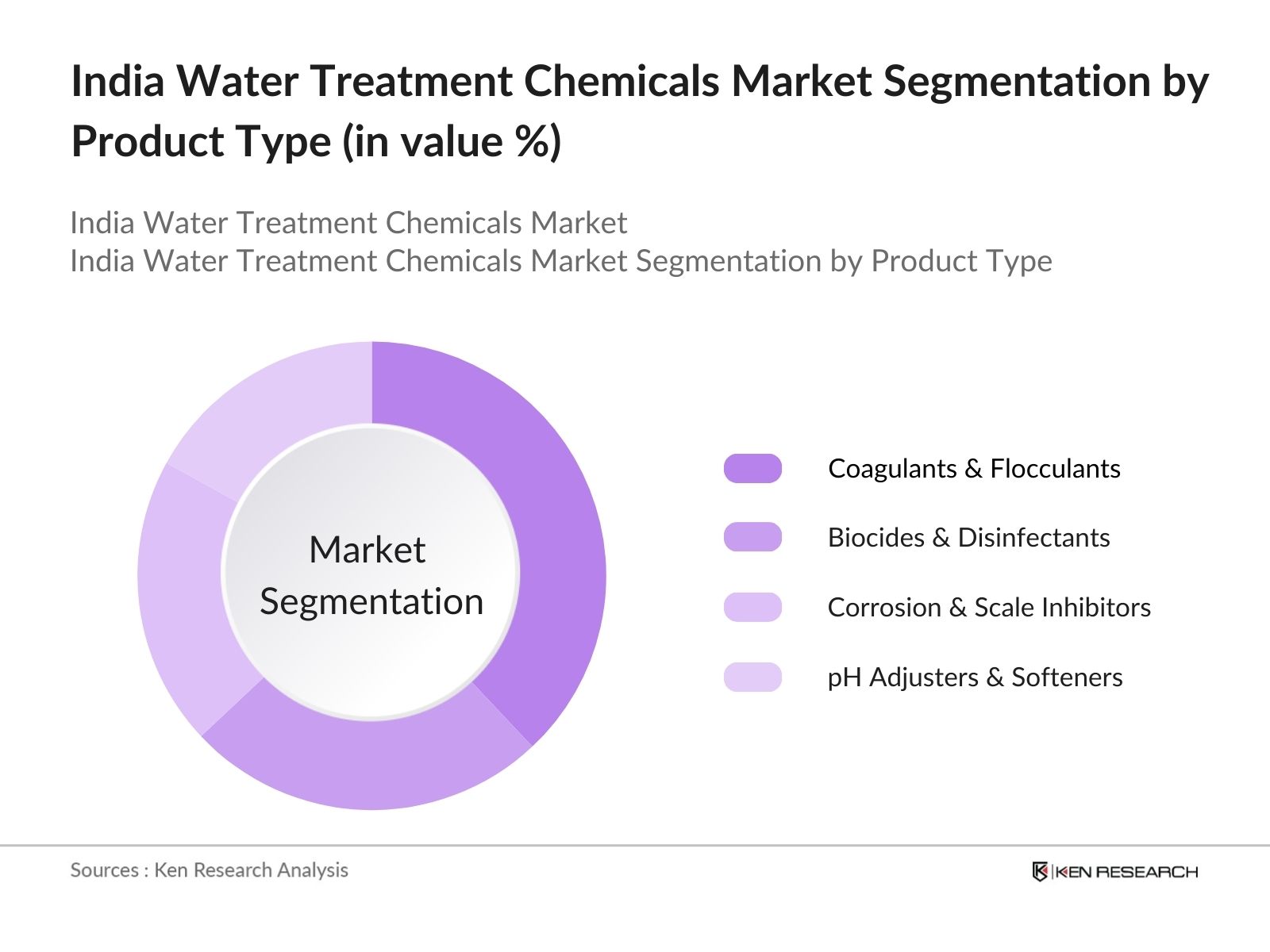
By Product Type: The market is segmented by product type into coagulants & flocculants, biocides & disinfectants, corrosion & scale inhibitors, and pH adjusters & softeners. Coagulants & flocculants have emerged as the dominant segment due to their extensive use in both industrial and municipal water treatment. These chemicals are critical for solid-liquid separation processes, especially in industries like textiles, paper, and food & beverages, where large volumes of wastewater are generated.
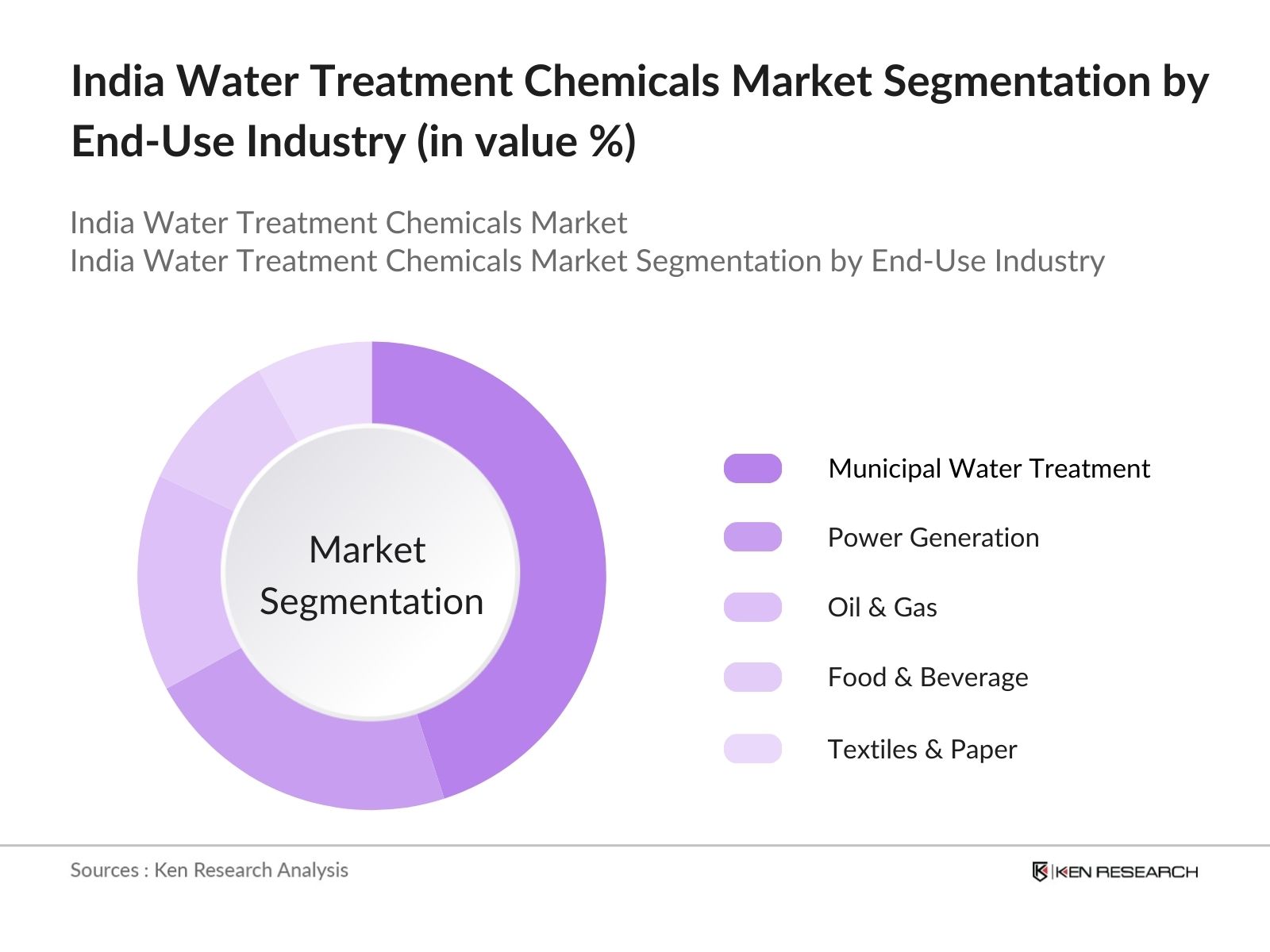
By End-Use Industry: The market is segmented by end-use industry into municipal water treatment, power generation, oil & gas, food & beverage, and textiles & paper. The municipal water treatment sector dominates due to the rising demand for safe drinking water and effective wastewater management. Government-backed initiatives for clean water supply and enhanced sanitation facilities across urban and rural regions are further boosting the need for water treatment chemicals.
India Water Treatment Chemicals Market Competitive Landscape
The market is moderately consolidated, with key players holding market shares due to their wide product offerings and strong distribution networks. The market is dominated by both domestic companies and global firms operating through subsidiaries or joint ventures.
|
Company Name |
Established Year |
Headquarters |
No. of Employees |
Revenue (INR Bn) |
Product Portfolio |
Geographic Reach |
Key Clients |
|
Ion Exchange India Ltd. |
1964 |
Mumbai, India |
|||||
|
Thermax Limited |
1980 |
Pune, India |
|||||
|
GE Water & Process Technologies |
2002 |
New York, USA |
|||||
|
SUEZ Water Technologies |
2000 |
Paris, France |
|||||
|
Pentair Plc |
1966 |
London, UK |
India Water Treatment Chemicals Market Analysis
Market Growth Drivers
- Government Push for Clean Drinking Water Initiatives: The Indian government has increased its investment in water treatment as part of its clean water initiatives, including the "Jal Jeevan Mission." The mission aims to provide piped water to every rural household by 2024. The government has allocated over INR 3.6 trillion for water supply schemes, creating opportunities for the water treatment chemicals market to cater to both municipal and rural projects aimed at water purification and ensuring potable water standards.
- Rise in Demand for Desalination Projects: India is increasingly turning to desalination to meet its growing water demands, especially in coastal areas. Tamil Nadu has already planned desalination plants capable of treating 1.2 billion liters of seawater per day by 2026. The high volume of saline water treatment increases the demand for specialized water treatment chemicals such as antiscalants and corrosion inhibitors, further boosting the market.
- Increased Focus on Industrial Wastewater Reuse: Due to tightening wastewater discharge regulations and increasing freshwater scarcity, industries are focusing on wastewater recycling. Large-scale industries such as textiles and oil & gas are leading in adopting zero-liquid discharge (ZLD) technologies, driving the need for advanced water treatment chemicals. For instance, industrial sectors are expected to treat and recycle 50 billion cubic meters of water annually by 2025, which will drive the consumption of chemicals such as flocculants, coagulants, and biocides for wastewater treatment.
Market Challenges
- High Costs of Specialized Chemicals: The cost of advanced water treatment chemicals, particularly for niche applications such as reverse osmosis and desalination, remains prohibitive for small and medium-sized industries. For instance, specialized chemicals like membrane cleaners can cost INR 4,500 per kilogram, making their adoption challenging for smaller players who require cost-effective solutions. This cost sensitivity is limiting the market expansion, particularly among cost-conscious industries.
- Complex Regulatory Environment: The regulatory framework governing the water treatment sector in India is complex, with multiple agencies involved, including the Central Pollution Control Board (CPCB) and the Bureau of Indian Standards (BIS). Regulatory compliance is cumbersome, especially for smaller enterprises, which often lack the resources to meet stringent water quality and discharge norms.
India Water Treatment Chemicals Market Future Outlook
Over the next five years, the India water treatment chemicals industry is expected to witness growth. Key drivers include government initiatives for clean water access, increasing environmental regulations, and rising investments in industrial water treatment infrastructure. With increasing water scarcity, industries are focusing more on water reuse and recycling, which is expected to create substantial demand for specialized water treatment chemicals.
Future Market Opportunities
- Expansion of Industrial Water Reuse: By 2029, industrial water reuse is expected to grow exponentially, with industries like textiles and pharmaceuticals aiming to recycle 70 billion liters of water annually. This will drive the demand for advanced treatment chemicals such as biocides, coagulants, and antiscalants that are critical for maintaining water quality in closed-loop systems.
- Introduction of Smart Water Treatment Technologies: The market will see the integration of IoT-based smart water treatment technologies by 2028, with an estimated 30,000 smart water management devices being deployed. These systems will require innovative chemical formulations to ensure precise dosing and optimization of water quality across various industries and municipal projects.
Scope of the Report
|
Product Type |
Coagulants & Flocculants Biocides & Disinfectants Corrosion & Scale Inhibitors pH Adjusters & Softeners |
|
End-Use Industry |
Municipal Water Treatment Power Generation Oil & Gas Food & Beverage Textile & Paper |
|
Source |
Synthetic Chemicals Natural Chemicals |
|
Technology |
Membrane Filtration UV Disinfection Ion Exchange, Electrodialysis |
|
Region |
North India South India West India East India |
Products
Key Target Audience Organizations and Entities Who Can Benefit by Subscribing This Report:
Industrial Water Management Companies
Government and Regulatory Bodies (Central Pollution Control Board, Bureau of Indian Standards)
Oil & Gas Companies
Power Generation Companies
Food & Beverage Manufacturers
Textile & Paper Industry
Investments and Venture Capitalist Firms
Companies
Players Mentioned in the Report:
Ion Exchange India Ltd.
Thermax Limited
GE Water & Process Technologies
SUEZ Water Technologies
Pentair Plc
Ecolab India
Chembond Chemicals Ltd.
Solvay S.A.
NALCO Water (An Ecolab Company)
Vasu Chemicals
Kemira Oyj
SNF Floerger
BASF SE
Dow Chemical Company
Kurita Water Industries Ltd.
Table of Contents
1. India Water Treatment Chemicals Market Overview
1.1. Definition and Scope
1.2. Market Taxonomy
1.3. Market Growth Rate
1.4. Market Segmentation Overview
2. India Water Treatment Chemicals Market Size (In USD Mn)
2.1. Historical Market Size
2.2. Year-On-Year Growth Analysis
2.3. Key Market Developments and Milestones
3. India Water Treatment Chemicals Market Analysis
3.1. Growth Drivers (Market-specific drivers such as demand from industrial water reuse, tightening effluent treatment norms, and increasing population)
3.1.1. Stringent Regulatory Framework
3.1.2. Rising Demand for Clean Water in Urban Areas
3.1.3. Growing Awareness of Water Conservation
3.1.4. Expansion of Industrial & Power Sector
3.2. Market Challenges (Key roadblocks like high R&D costs, lack of skilled workforce for chemical management, and fragmented market structure)
3.2.1. High Raw Material Costs
3.2.2. Logistics and Distribution Challenges
3.2.3. Fragmented Supply Chain
3.3. Opportunities (Opportunities specific to the Indian market, such as sustainable chemicals, innovation in eco-friendly solutions)
3.3.1. Adoption of Green Chemicals
3.3.2. Rising Investment in Municipal Water Treatment
3.3.3. Technological Innovations in Water Treatment Systems
3.4. Trends (Focus on emerging trends such as digitization of water management, AI-based treatment systems, and circular economy initiatives)
3.4.1. Increasing Adoption of Digital Water Treatment Solutions
3.4.2. Focus on Circular Economy in Water Management
3.4.3. Shift to Eco-Friendly Chemicals
3.5. Government Regulations (Relevant regulations, such as Indias National Water Mission, BIS standards, and environmental water safety laws)
3.5.1. BIS and CPCB Standards
3.5.2. Water Conservation and Reuse Policies
3.5.3. Industrial Effluent Treatment Norms
3.6. SWOT Analysis
3.7. Stakeholder Ecosystem (Key players across the value chain, including chemical manufacturers, distributors, and water utilities)
3.8. Porters Five Forces Analysis
3.9. Competitive Landscape Overview
4. India Water Treatment Chemicals Market Segmentation
4.1. By Product Type (In Value %)
4.1.1. Coagulants & Flocculants
4.1.2. Biocides & Disinfectants
4.1.3. Corrosion & Scale Inhibitors
4.1.4. pH Adjusters & Softeners
4.2. By End-Use Industry (In Value %)
4.2.1. Municipal Water Treatment
4.2.2. Power Generation
4.2.3. Oil & Gas
4.2.4. Food & Beverage
4.2.5. Textile & Paper
4.3. By Source (In Value %)
4.3.1. Synthetic Chemicals
4.3.2. Natural Chemicals
4.4. By Technology (In Value %)
4.4.1. Membrane Filtration
4.4.2. UV Disinfection
4.4.3. Ion Exchange
4.4.4. Electrodialysis
4.5. By Region (In Value %)
4.5.1. North India
4.5.2. South India
4.5.3. West India
4.5.4. East India
5. India Water Treatment Chemicals Market Competitive Analysis
5.1 Detailed Profiles of Major Competitors
5.1.1. Ion Exchange India Ltd.
5.1.2. Thermax Limited
5.1.3. GE Water & Process Technologies
5.1.4. SUEZ Water Technologies
5.1.5. Pentair Plc
5.1.6. Ecolab India
5.1.7. Chembond Chemicals Ltd.
5.1.8. Solvay S.A.
5.1.9. NALCO Water (An Ecolab Company)
5.1.10. Vasu Chemicals
5.1.11. Kemira Oyj
5.1.12. SNF Floerger
5.1.13. BASF SE
5.1.14. Dow Chemical Company
5.1.15. Kurita Water Industries Ltd.
5.2 Cross Comparison Parameters (Headquarters, Inception Year, No. of Employees, Revenue, Product Portfolio, Geographic Reach, Major End-Use Sectors, R&D Expenditure)
5.3 Market Share Analysis
5.4 Strategic Initiatives
5.5 Mergers and Acquisitions
5.6 Investment Analysis
5.7 Private Equity & Venture Capital Investments
5.8 Government Grants and Subsidies
6. India Water Treatment Chemicals Market Regulatory Framework
6.1 Environmental Standards & Compliance
6.2 Certifications and Approval Processes
6.3 Health, Safety, and Environmental Regulations
7. India Water Treatment Chemicals Future Market Size (In USD Mn)
7.1 Future Market Size Projections
7.2 Key Factors Driving Future Market Growth (Increasing water scarcity, government projects like Jal Jeevan Mission)
8. India Water Treatment Chemicals Future Market Segmentation
8.1 By Product Type (In Value %)
8.2 By End-Use Industry (In Value %)
8.3 By Source (In Value %)
8.4 By Technology (In Value %)
8.5 By Region (In Value %)
9. India Water Treatment Chemicals Market Analysts Recommendations
9.1 TAM/SAM/SOM Analysis
9.2 White Space Opportunity Identification
9.3 Customer Segmentation Analysis
9.4 Strategic Growth Recommendations
Disclaimer Contact UsResearch Methodology
Step 1: Identification of Key Variables
In this phase, extensive desk research is conducted to gather detailed industry-level information, focusing on the stakeholders in the India water treatment chemicals market. Secondary databases are used to pinpoint the critical variables influencing market growth.
Step 2: Market Analysis and Construction
In this step, historical data on market penetration, regional demand, and revenue generation is analyzed. Detailed assessments of service providers and industrial water treatment chemicals' penetration are also made to ensure data accuracy.
Step 3: Hypothesis Validation and Expert Consultation
Hypotheses on market trends are validated through discussions with industry experts and practitioners. These consultations provide insights on market operations, future demand, and the evolving regulatory landscape.
Step 4: Research Synthesis and Final Output
In this final step, insights from water treatment chemical manufacturers and suppliers are synthesized to create a comprehensive analysis of the market. Data collected is verified for reliability and aligned with expert consultations for accuracy.
Frequently Asked Questions
01. How big is India Water Treatment Chemicals Market?
The India water treatment chemicals market is valued at USD 622 million, driven by growing urbanization, industrial expansion, and increasing environmental regulations on water treatment.
02. What are the challenges in India Water Treatment Chemicals Market?
The major challenges in the India water treatment chemicals market include high raw material costs, lack of skilled workforce, and a fragmented supply chain. Additionally, logistics and distribution present a significant hurdle due to the vast geography of India.
03. Who are the major players in the India Water Treatment Chemicals Market?
Key players in the India water treatment chemicals market include Ion Exchange India Ltd., Thermax Limited, GE Water & Process Technologies, SUEZ Water Technologies, and Pentair Plc, among others. These companies lead due to their innovative product offerings and large distribution networks.
04. What are the growth drivers of the India Water Treatment Chemicals Market?
Key drivers in the India water treatment chemicals market include increasing demand for clean water, government policies promoting water treatment, and rising industrialization. The adoption of environmentally friendly water treatment chemicals is also pushing market growth.
05. What trends are shaping the India Water Treatment Chemicals Market?
The India water treatment chemicals market is witnessing trends such as the adoption of green chemicals, digitization of water management processes, and circular economy initiatives in water treatment solutions.
Why Buy From Us?

What makes us stand out is that our consultants follows Robust, Refine and Result (RRR) methodology. i.e. Robust for clear definitions, approaches and sanity checking, Refine for differentiating respondents facts and opinions and Result for presenting data with story

We have set a benchmark in the industry by offering our clients with syndicated and customized market research reports featuring coverage of entire market as well as meticulous research and analyst insights.

While we don't replace traditional research, we flip the method upside down. Our dual approach of Top Bottom & Bottom Top ensures quality deliverable by not just verifying company fundamentals but also looking at the sector and macroeconomic factors.

With one step in the future, our research team constantly tries to show you the bigger picture. We help with some of the tough questions you may encounter along the way: How is the industry positioned? Best marketing channel? KPI's of competitors? By aligning every element, we help maximize success.

Our report gives you instant access to the answers and sources that other companies might choose to hide. We elaborate each steps of research methodology we have used and showcase you the sample size to earn your trust.

If you need any support, we are here! We pride ourselves on universe strength, data quality, and quick, friendly, and professional service.