
Indonesia Autonomous & Sensor Technology Market Outlook to 2030
Region:Asia
Author(s):Yogita Sahu
Product Code:KROD6661
November 2024
90
About the Report
Indonesia Autonomous & Sensor Technology Market Overview
- The Indonesia Autonomous & Sensor Technology market is valued at USD 340 million based on a five-year historical analysis. The market's rapid growth is primarily driven by the surge in demand for automation across industries such as manufacturing, logistics, and smart cities. Additionally, the expansion of IoT and AI technologies has bolstered the adoption of advanced sensors, especially for autonomous systems.
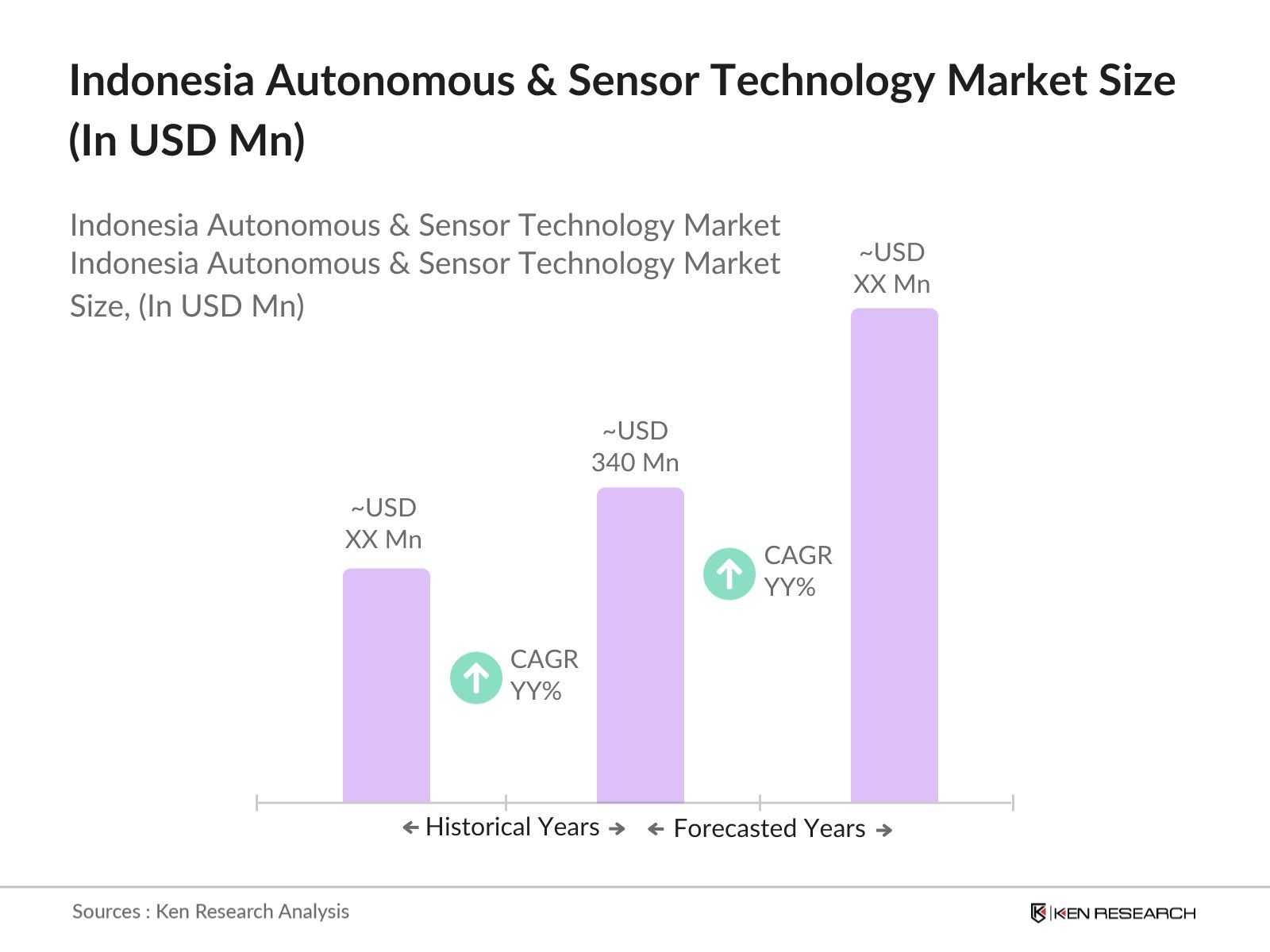
- In terms of geographical dominance, cities such as Jakarta, Surabaya, and Bandung are leading the market due to their advanced industrial infrastructure and extensive adoption of automation technologies. These regions have attracted foreign investments, making them hotspots for technological development.
- The Indonesian governments flagship industrial policy, "Making Indonesia 4.0," allocates over 200 trillion IDR toward integrating advanced technologies, including autonomous systems and sensors, across key industries such as manufacturing and agriculture. By 2024, the government plans to upgrade more than 5,000 industrial plants with smart sensors and automation systems to boost productivity and competitiveness.
Indonesia Autonomous & Sensor Technology Market Segmentation
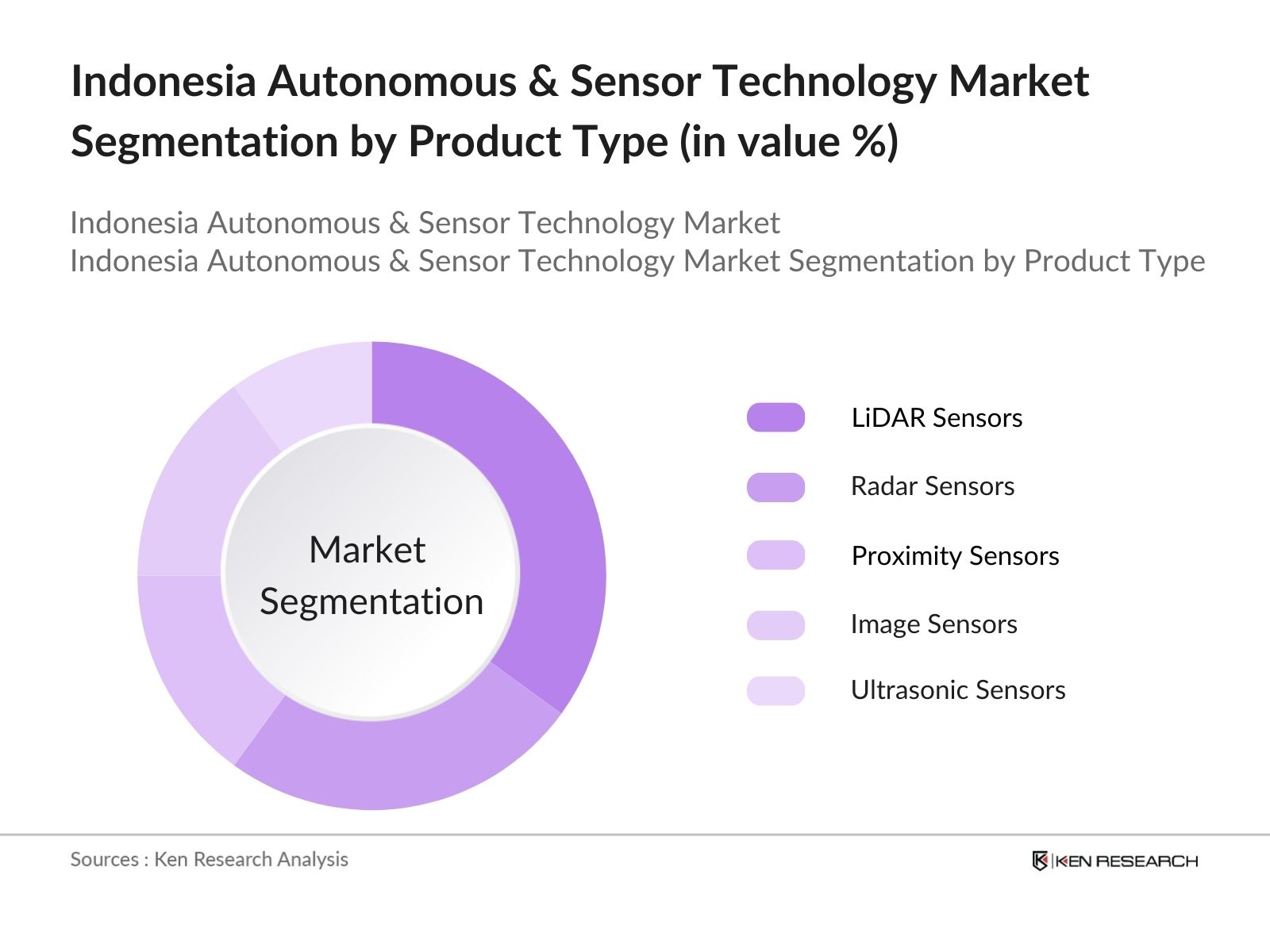
By Product Type: The market is segmented by product type into LiDAR Sensors, Radar Sensors, Proximity Sensors, Image Sensors, and Ultrasonic Sensors. Recently, LiDAR sensors have gained a dominant market share in the product type segmentation, largely due to their critical role in autonomous vehicles and smart city applications. LiDAR's ability to provide precise, real-time 3D mapping makes it indispensable for navigation in autonomous systems, which has driven its adoption across various industries. The increasing investments in autonomous transportation and delivery systems further contribute to its market share.
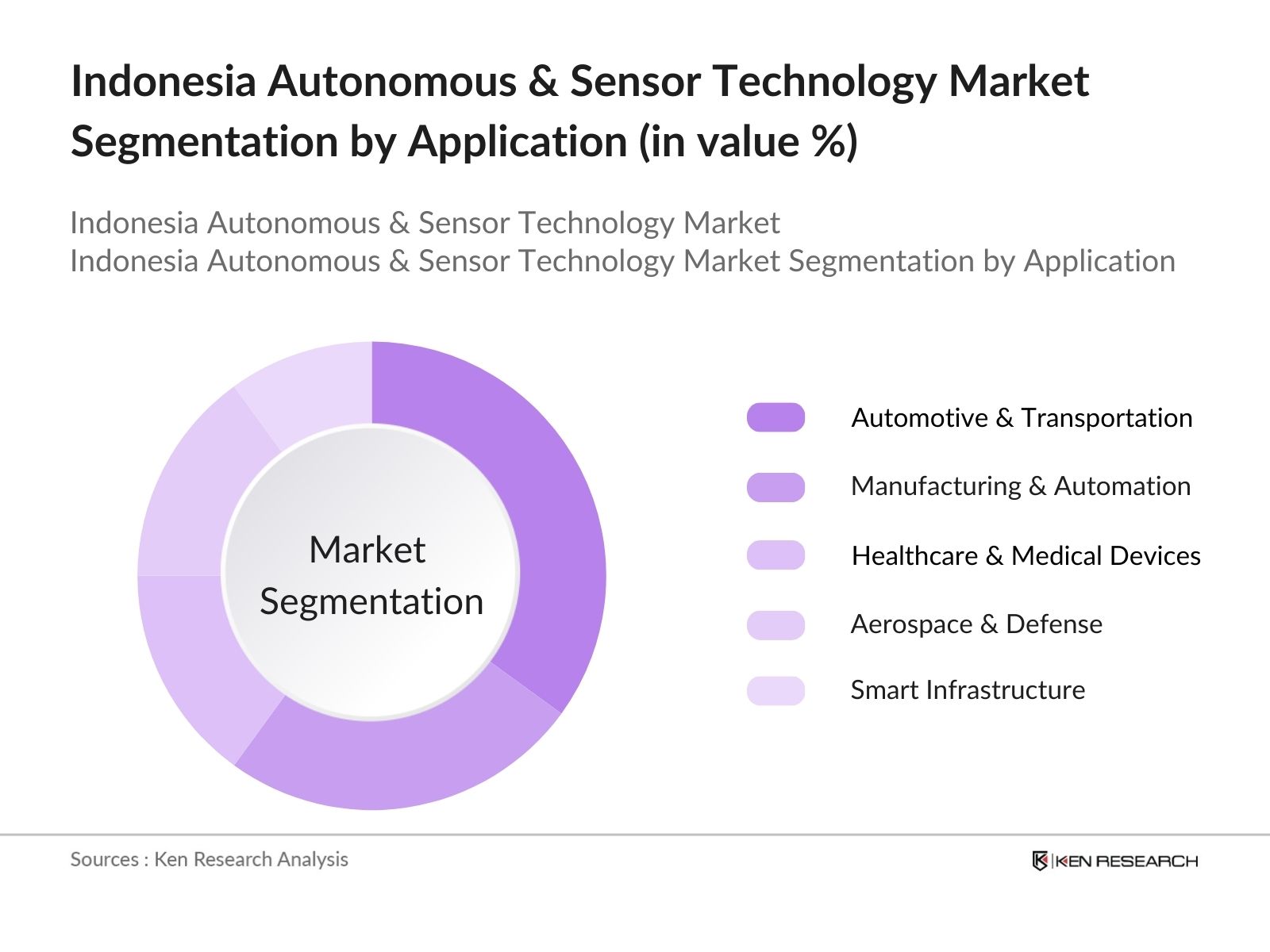
By Application: The market is also segmented by application into Automotive & Transportation, Manufacturing & Industrial Automation, Healthcare & Medical Devices, Aerospace & Defense, and Smart Infrastructure & Buildings. The Automotive & Transportation segment currently holds a dominant market share, driven by the rapid integration of autonomous driving technologies. Indonesias robust automotive sector and increasing investments in electric and autonomous vehicles have positioned this sub-segment as a leader. The surge in demand for real-time sensing solutions in autonomous fleets, especially for urban transportation, has further enhanced the importance of sensors in this segment.
Indonesia Autonomous & Sensor Technology Market Competitive Landscape
The market is dominated by several key players, both local and international. These companies have established their market dominance through strategic investments, product innovation, and strong customer relationships. Below is a brief overview of the competitive landscape, highlighting five major players in the market:
|
Company |
Establishment Year |
Headquarters |
Key Products |
Revenue (USD Bn) |
No. of Employees |
R&D Expenditure |
Regional Presence |
Key Clients |
Product Launches |
|
Bosch Sensortec GmbH |
2005 |
Germany |
|||||||
|
Denso Corporation |
1949 |
Japan |
|||||||
|
Infineon Technologies AG |
1999 |
Germany |
|||||||
|
Qualcomm Technologies, Inc. |
1985 |
USA |
|||||||
|
STMicroelectronics N.V. |
1987 |
Switzerland |
Indonesia Autonomous & Sensor Technology Market Analysis
Market Growth Drivers
- Rising Government Investment in Smart Infrastructure: In 2024, the Indonesian government has committed over 280 trillion IDR to infrastructure development, particularly focusing on smart cities and digital infrastructure. These developments have spurred demand for autonomous technologies and sensor systems to enhance urban management and public safety. For example, Jakarta's ongoing smart city initiative has already integrated over 50,000 sensor nodes to monitor traffic, air quality, and energy usage, which is a significant growth driver for sensor technology in the country.
- Expansion of the Automotive Industry with Advanced Driver-Assistance Systems (ADAS): Indonesia's automotive sector is rapidly adopting sensor technology for autonomous driving features. In 2024, the nation produced over 1.25 million vehicles, with an increasing number being equipped with ADAS features, such as LiDAR and radar sensors. The governments electric vehicle (EV) roadmap, targeting the production of 2 million EVs by 2030, includes subsidies for vehicles equipped with autonomous features, thus driving the demand for sensor technologies in the automotive sector.
- Surge in E-commerce Leading to Increased Adoption of Autonomous Delivery Solutions: Indonesias e-commerce market is growing, with logistics challenges spurring the adoption of autonomous delivery solutions. Major e-commerce players like Tokopedia and Gojek are testing autonomous drones and ground vehicles that rely heavily on advanced sensor technology. This growing reliance on automated systems is expected to drive significant investments in sensor development to ensure safe and reliable last-mile delivery solutions across urban and rural areas.
Market Challenges
- Lack of Skilled Workforce for Autonomous Technology Management: Indonesias labor market, with over 140 million workers, lacks adequate technical training in managing and operating autonomous systems. While the government has launched several skill development initiatives, fewer than 5% of vocational training programs focus on autonomous and sensor technology. The limited availability of skilled personnel is a critical bottleneck for industries looking to scale up their autonomous technology capabilities.
- Regulatory Hurdles in Deploying Autonomous Vehicles: Regulatory restrictions on autonomous vehicle testing and deployment are slowing market expansion. Indonesias transportation ministry has stringent guidelines on autonomous vehicles, requiring over 5,000 hours of real-world testing in controlled environments before being approved for public use. This stringent regulation, while aimed at ensuring public safety, hampers the pace at which companies can deploy fully autonomous vehicles and sensors in real-world conditions.
Indonesia Autonomous & Sensor Technology Market Future Outlook
Over the next five years, the Indonesia Autonomous & Sensor Technology industry is expected to exhibit robust growth. This growth will be propelled by ongoing government support for smart city initiatives, the expansion of the Internet of Things (IoT), and the rapid integration of AI into autonomous systems.
Market Future Opportunities
- Expansion of Autonomous Farming Equipment: Over the next five years, the adoption of autonomous farming equipment in Indonesia will accelerate, particularly in regions like Sumatra and Java, where large-scale agricultural operations dominate. By 2029, over 100,000 autonomous tractors and drones equipped with smart sensors will be deployed to enhance crop monitoring and yield optimization, significantly reducing operational costs in the agricultural sector.
- Integration of 5G-Enabled Sensors in Smart Cities: The rollout of 5G networks across Indonesia by 2027 will enable the deployment of over 100,000 5G-enabled sensors in smart city projects. These sensors will facilitate real-time monitoring of critical urban infrastructure such as traffic systems, waste management, and air quality, leading to more efficient city management and improved quality of life for residents.
Scope of the Report
|
By Product Type |
LiDAR Sensors Radar Sensors Proximity Sensors Image Sensors Ultrasonic Sensors |
|
By Application |
Automotive & Transportation Manufacturing & Industrial Automation Healthcare & Medical Devices Aerospace & Defense Smart Infrastructure & Buildings |
|
By Technology |
Autonomous Systems AI-Enabled Sensors IoT-Based Sensing Solutions MEMS Sensors |
|
By Industry Vertical |
Transportation & Logistics Manufacturing Agriculture & Forestry Energy & Utilities Retail & E-Commerce |
|
By Region |
North East West South |
Products
Key Target Audience Organizations and Entities Who Can Benefit by Subscribing This Report:
Autonomous vehicle manufacturers
Banks and Financial Institution
Sensor technology providers
Investors and venture capitalist firms
Automotive OEMs (Original Equipment Manufacturers)
Government and regulatory bodies (Ministry of Industry, Ministry of Transportation)
Healthcare technology companies
Companies
Players Mentioned in the Report:
Bosch Sensortec GmbH
Denso Corporation
STMicroelectronics N.V.
Texas Instruments Incorporated
Infineon Technologies AG
TE Connectivity
Qualcomm Technologies, Inc.
Murata Manufacturing Co., Ltd.
TDK Corporation
Valeo SA
Table of Contents
1. Indonesia Autonomous & Sensor Technology Market Overview
1.1. Definition and Scope
1.2. Market Taxonomy
1.3. Market Growth Rate
1.4. Market Segmentation Overview
2. Indonesia Autonomous & Sensor Technology Market Size (In USD Mn)
2.1. Historical Market Size
2.2. Year-On-Year Growth Analysis
2.3. Key Market Developments and Milestones
3. Indonesia Autonomous & Sensor Technology Market Analysis
3.1. Growth Drivers
3.1.1. Rise in Smart Manufacturing (IoT integration)
3.1.2. Expansion of Autonomous Vehicles
3.1.3. Government Support for Industrial Automation
3.1.4. Increased Investment in Infrastructure (5G Connectivity)
3.2. Market Challenges
3.2.1. High Cost of Sensor Technology
3.2.2. Cybersecurity Concerns in Autonomous Systems
3.2.3. Lack of Skilled Workforce for Automation Integration
3.3. Opportunities
3.3.1. Growth in Smart Cities Initiatives
3.3.2. Potential in Healthcare Automation
3.3.3. Demand for Autonomous Logistics and Delivery Systems
3.4. Trends
3.4.1. Increasing Deployment of Edge Computing in Autonomous Systems
3.4.2. Collaboration with AI for Predictive Maintenance
3.4.3. Advanced Sensors for Environmental Monitoring
3.5. Government Regulation
3.5.1. Indonesia Smart Industry Roadmap
3.5.2. National Digital Transformation Strategy
3.5.3. Public-Private Partnerships in Automation Adoption
3.5.4. Data Privacy and Protection Laws
3.6. SWOT Analysis
3.7. Stakeholder Ecosystem
3.8. Porters Five Forces
3.9. Competition Ecosystem
4. Indonesia Autonomous & Sensor Technology Market Segmentation
4.1. By Product Type (In Value %)
4.1.1. LiDAR Sensors
4.1.2. Radar Sensors
4.1.3. Proximity Sensors
4.1.4. Image Sensors
4.1.5. Ultrasonic Sensors
4.2. By Application (In Value %)
4.2.1. Automotive & Transportation
4.2.2. Manufacturing & Industrial Automation
4.2.3. Healthcare & Medical Devices
4.2.4. Aerospace & Defense
4.2.5. Smart Infrastructure & Buildings
4.3. By Technology (In Value %)
4.3.1. Autonomous Systems
4.3.2. AI-Enabled Sensors
4.3.3. IoT-Based Sensing Solutions
4.3.4. MEMS Sensors
4.4. By Industry Vertical (In Value %)
4.4.1. Transportation & Logistics
4.4.2. Manufacturing
4.4.3. Agriculture & Forestry
4.4.4. Energy & Utilities
4.4.5. Retail & E-Commerce
4.5. By Region (In Value %)
4.5.1. North
4.5.2. East
4.5.3. West
4.5.4. South
5. Indonesia Autonomous & Sensor Technology Market Competitive Analysis
5.1. Detailed Profiles of Major Companies
5.1.1. Bosch Sensortec GmbH
5.1.2. Denso Corporation
5.1.3. Infineon Technologies AG
5.1.4. STMicroelectronics N.V.
5.1.5. Qualcomm Technologies, Inc.
5.1.6. Murata Manufacturing Co., Ltd.
5.1.7. TE Connectivity
5.1.8. Texas Instruments Incorporated
5.1.9. NXP Semiconductors
5.1.10. Analog Devices, Inc.
5.1.11. TDK Corporation
5.1.12. Robert Bosch GmbH
5.1.13. Valeo SA
5.1.14. Delphi Technologies
5.1.15. Omron Corporation
5.2. Cross Comparison Parameters
5.2.1. Number of Employees
5.2.2. Global Headquarters
5.2.3. Revenue (In USD Bn)
5.2.4. Inception Year
5.2.5. Product Portfolio Breadth
5.2.6. Regional Presence in Indonesia
5.2.7. Key Clients and Partnerships
5.2.8. Research and Development Expenditure
5.3. Market Share Analysis
5.4. Strategic Initiatives
5.5. Mergers and Acquisitions
5.6. Investment Analysis
5.7. Venture Capital Funding
5.8. Government Grants
5.9. Private Equity Investments
6. Indonesia Autonomous & Sensor Technology Market Regulatory Framework
6.1. National Standards for Sensor Technologies
6.2. Compliance Requirements for Autonomous Systems
6.3. Certification Processes for Sensors in Critical Sectors
7. Indonesia Autonomous & Sensor Technology Future Market Size (In USD Mn)
7.1. Future Market Size Projections
7.2. Key Factors Driving Future Market Growth
8. Indonesia Autonomous & Sensor Technology Future Market Segmentation
8.1. By Product Type (In Value %)
8.2. By Application (In Value %)
8.3. By Technology (In Value %)
8.4. By Industry Vertical (In Value %)
8.5. By Region (In Value %)
9. Indonesia Autonomous & Sensor Technology Market Analysts Recommendations
9.1. TAM/SAM/SOM Analysis
9.2. Customer Cohort Analysis
9.3. Marketing Initiatives
9.4. White Space Opportunity Analysis
Research Methodology
Step 1: Identification of Key Variables
The first step in the research methodology involves creating an exhaustive ecosystem map that captures all relevant stakeholders within the Indonesia Autonomous & Sensor Technology Market. This step is supported by comprehensive desk research using a mix of secondary and proprietary sources to define market-driving variables.
Step 2: Market Analysis and Construction
This phase focuses on gathering and analyzing historical data for the Indonesia Autonomous & Sensor Technology market. The analysis includes evaluating the penetration of autonomous systems and the growth in sensor technology, providing a thorough breakdown of revenue and market dynamics.
Step 3: Hypothesis Validation and Expert Consultation
To validate the market hypotheses, interviews are conducted with industry experts and professionals across various market segments. These consultations provide insights into key operational trends, pricing strategies, and product development efforts.
Step 4: Research Synthesis and Final Output
In the final stage, the data from multiple sources is synthesized to form a comprehensive market report. This involves verifying the findings through direct interaction with manufacturers, validating product performance, market trends, and sales forecasts.
Frequently Asked Questions
01. How big is the Indonesia Autonomous & Sensor Technology Market?
The Indonesia Autonomous & Sensor Technology market is valued at USD 340 million. This valuation reflects the rapid technological advancements and growing demand for automation solutions across industries.
02. What are the challenges in the Indonesia Autonomous & Sensor Technology Market?
Challenges in the Indonesia Autonomous & Sensor Technology market include the high costs associated with sensor technologies, a shortage of skilled professionals for automation, and concerns around data security and privacy in autonomous systems.
03. Who are the major players in the Indonesia Autonomous & Sensor Technology Market?
Key players in the Indonesia Autonomous & Sensor Technology market include Bosch Sensortec GmbH, Denso Corporation, STMicroelectronics N.V., Texas Instruments Incorporated, and Infineon Technologies AG. These companies lead due to their innovative product offerings, technological advancements, and strong industry presence.
04. What are the growth drivers of the Indonesia Autonomous & Sensor Technology Market?
Growth in the Indonesia Autonomous & Sensor Technology market is driven by rising investments in smart cities, government incentives for industrial automation, and the increasing demand for IoT and AI-integrated sensor solutions in diverse sectors.
05. What is the future of the Indonesia Autonomous & Sensor Technology Market?
The Indonesia Autonomous & Sensor Technology market is expected to continue growing rapidly, driven by the proliferation of autonomous vehicles, smart infrastructure projects, and advancements in sensor technology that enhance automation across various industries.
Why Buy From Us?

What makes us stand out is that our consultants follows Robust, Refine and Result (RRR) methodology. i.e. Robust for clear definitions, approaches and sanity checking, Refine for differentiating respondents facts and opinions and Result for presenting data with story

We have set a benchmark in the industry by offering our clients with syndicated and customized market research reports featuring coverage of entire market as well as meticulous research and analyst insights.

While we don't replace traditional research, we flip the method upside down. Our dual approach of Top Bottom & Bottom Top ensures quality deliverable by not just verifying company fundamentals but also looking at the sector and macroeconomic factors.

With one step in the future, our research team constantly tries to show you the bigger picture. We help with some of the tough questions you may encounter along the way: How is the industry positioned? Best marketing channel? KPI's of competitors? By aligning every element, we help maximize success.

Our report gives you instant access to the answers and sources that other companies might choose to hide. We elaborate each steps of research methodology we have used and showcase you the sample size to earn your trust.

If you need any support, we are here! We pride ourselves on universe strength, data quality, and quick, friendly, and professional service.