















Indonesia E-bikes Market Outlook to 2030
Region:Asia
Author(s):Mukul
Product Code:KROD8921
October 2024
85
About the Report
Indonesia E-bikes Market Overview
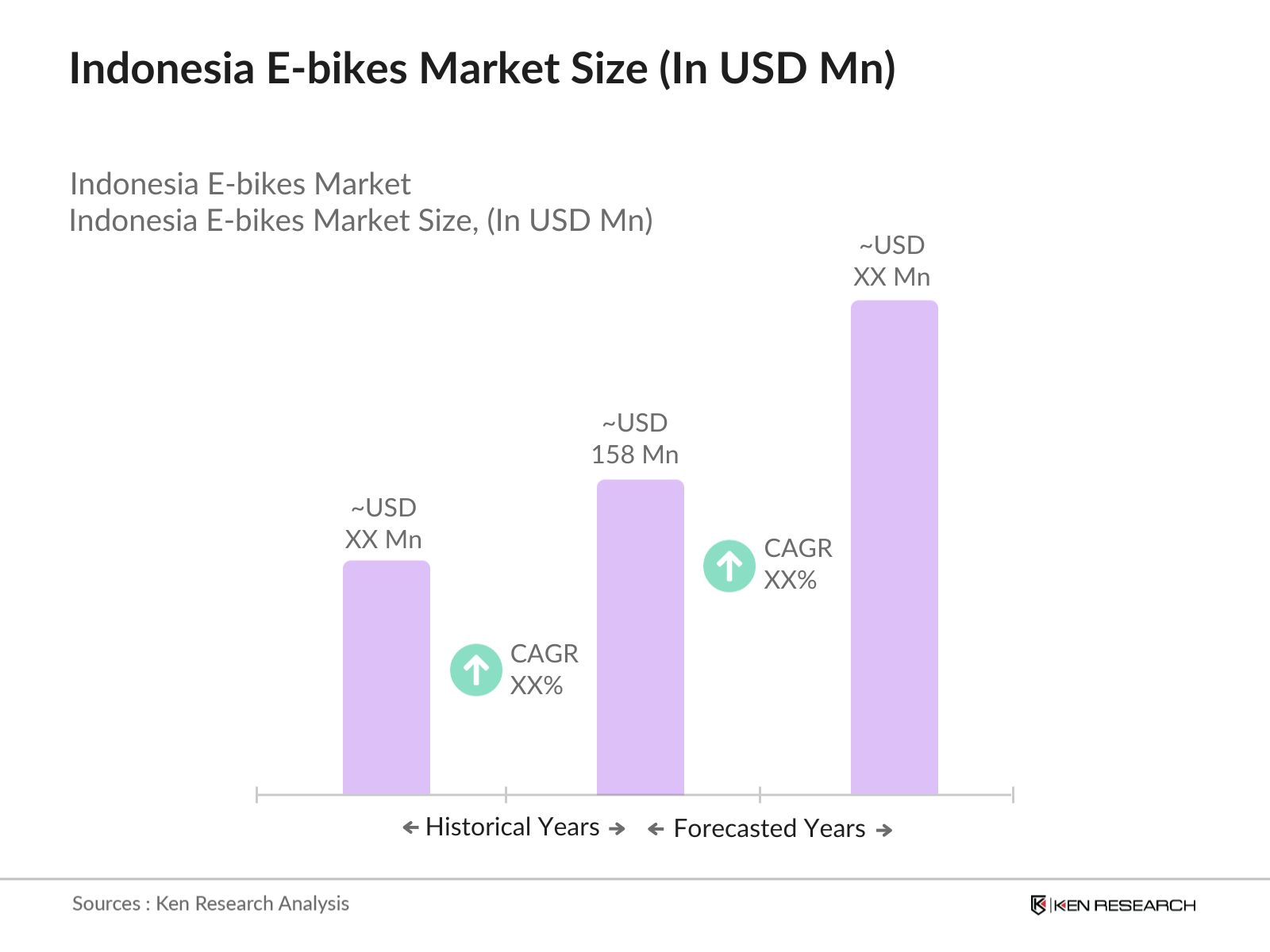
- The Indonesia E-bikes market is valued at USD 158 million, driven by increased urbanization, rising environmental concerns, and government incentives promoting the use of electric vehicles. The surge in fuel prices and the growing awareness of sustainable mobility options have further fueled the adoption of E-bikes. These factors, along with advancements in battery technology and expanding charging infrastructure, are expected to maintain steady demand, making E-bikes a preferred choice for urban commuting in the country.
- The market is dominated by cities such as Jakarta, Surabaya, and Bandung. Jakarta, being the capital city, leads due to its high population density and traffic congestion, pushing the need for affordable and efficient personal transportation. Surabaya and Bandung follow closely due to their industrial growth, higher disposable incomes, and increased focus on reducing air pollution. The strong presence of key manufacturers and infrastructure development in these regions also contribute to their dominance in the market.
- Indonesia imposes import tariffs on various e-bike components, including batteries and motors, which can drive up production costs. However, the government has reduced these tariffs to stimulate local production and make e-bikes more competitive in the domestic market. According to the Ministry of Trade, in 2024, tariffs on electric bike components have been reduced by 20%, making it more affordable for local manufacturers to source the necessary materials and parts.
Indonesia E-bikes Market Segmentation
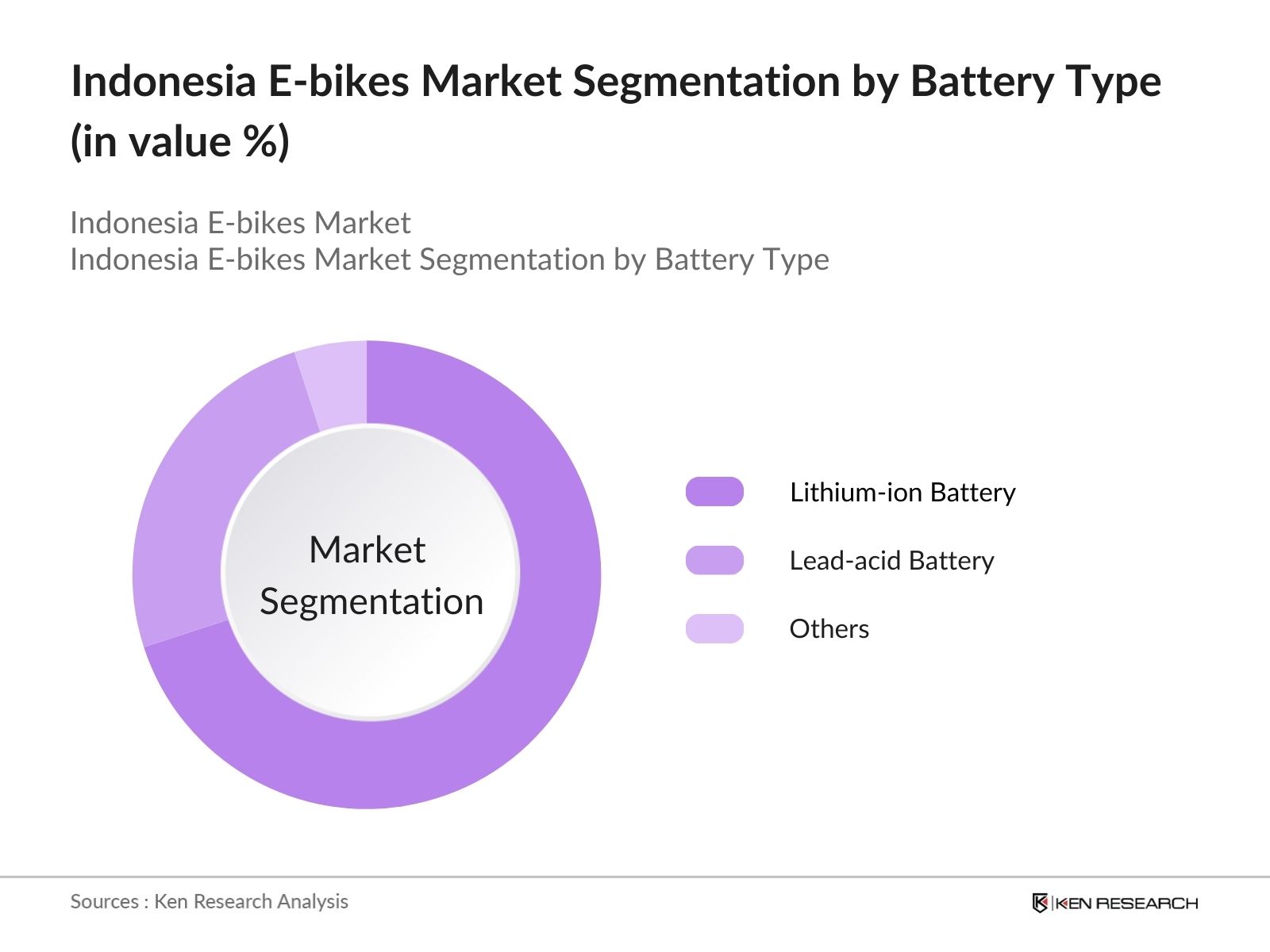
- By Battery Type: The Indonesia E-bikes market is segmented by battery type into Lithium-ion battery, Lead-acid battery, and Others (Nickel-Cadmium, Solid-state). Among these, Lithium-ion batteries dominate the market share due to their superior energy density, longer lifespan, and faster charging times. Lithium-ion batteries also offer better performance and efficiency, making them the preferred choice for urban commuters who rely on long-range, low-maintenance E-bikes. The reduction in lithium-ion battery prices over recent years has further boosted their adoption, outpacing traditional lead-acid batteries.
- By Mode of Operation: The E-bikes market in Indonesia is also segmented by mode of operation into Pedal-assist and Throttle-assist. Pedal-assist models hold the dominant market share due to their higher energy efficiency and widespread appeal among consumers who seek a balance between traditional cycling and electric-powered assistance. Pedal-assist bikes are favored by commuters for their ability to cover longer distances without exerting too much physical effort. This hybrid functionality makes them particularly popular in traffic-congested cities, where riders can switch between manual pedaling and motor assistance as needed.

Indonesia E-bikes Market Competitive Landscape
The Indonesia E-bikes market is dominated by a few key players, both domestic and international, who have established themselves through strong distribution networks and continuous innovation. The market shows a growing trend of strategic partnerships between E-bike manufacturers and battery suppliers, aiming to improve battery efficiency and reduce costs. This competitive consolidation highlights the influence of these key players in shaping market trends.
|
Company Name |
Established Year |
Headquarters |
Key Products |
No. of Employees |
R&D Investment |
Distribution Network |
Revenue (2023) |
Battery Innovation |
Customer Reach |
|
Trek Bicycle Corporation |
1976 |
United States |
|||||||
|
Giant Manufacturing Co. |
1972 |
Taiwan |
|||||||
|
Hero Electric |
1956 |
India |
|||||||
|
Yamaha Motor Co. |
1955 |
Japan |
|||||||
|
Pedego Electric Bikes |
2008 |
United States |
Indonesia E-bikes Industry Analysis
Growth Drivers
- Growing Environmental Concerns: Indonesia's government is actively working to reduce emissions, driven by its commitments to the Paris Agreement and ongoing environmental concerns. According to the Ministry of Energy and Mineral Resources, transportation accounts for 25% of Indonesia's carbon emissions. E-bikes offer a green alternative to petrol-powered vehicles, helping to mitigate environmental damage. The promotion of electric vehicles (EVs) is now part of Indonesia's green mobility strategies. In 2024, e-bikes represent a key part of this shift towards sustainable transport solutions, encouraging further adoption.
- Government Support for Electric Vehicles: The Indonesian government has implemented a series of incentives to promote the use of electric vehicles, including e-bikes. Policies include reduced taxes and direct subsidies for electric vehicle purchases, as outlined by the Ministry of Industry. For 2024, Indonesia has allocated nearly IDR 5 trillion to support the adoption of EVs, providing citizens with financial relief for purchasing e-bikes. This initiative is in line with the countrys goal to electrify 20% of its transport sector by 2025.
- Increasing Demand for Affordable Personal Transport: As economic conditions fluctuate, many Indonesians seek more cost-effective personal transportation. E-bikes have become popular due to their low operational costs and the fact that they do not require petrol. With a minimum wage in Jakarta around IDR 4.6 million per month, e-bikes offer an attractive alternative to conventional vehicles for individuals in lower-income brackets. E-bikes also reduce transportation costs by nearly 60% compared to motorcycles, contributing to their rising demand among urban dwellers.
Market Restraints
- Lack of Charging Infrastructure: One of the main barriers to e-bike adoption in Indonesia is the insufficient charging infrastructure. As of 2024, there are only 500 public EV charging stations across the country, mainly concentrated in major cities, according to the Ministry of Energy and Mineral Resources. This poses a significant challenge for widespread adoption in suburban and rural areas. The governments plan to expand this infrastructure by 2030 aims to address this gap, but for now, limited access to charging remains a challenge.
- High Initial Costs Compared to Conventional Bikes: E-bikes require a higher upfront investment than conventional bikes, which is a deterrent for some consumers. According to data from the Indonesian Bureau of Statistics, an average e-bike costs between IDR 8 million and IDR 20 million, depending on its features, while a conventional motorcycle can be purchased for as little as IDR 4 million. These higher upfront costs slow down adoption, particularly among lower-income segments that may not benefit from government subsidies.
Indonesia E-bikes Market Future Outlook
Over the next few years, the Indonesia E-bikes market is expected to experience significant growth, driven by increasing government support for electric vehicles, advancements in battery technology, and growing consumer demand for cost-effective and eco-friendly transportation solutions. The expansion of urban infrastructure and the rising trend of shared mobility platforms will further boost the adoption of E-bikes. With the integration of smart features and the expansion of e-commerce platforms for E-bike sales, the market is set to evolve rapidly, with new opportunities emerging in suburban and rural areas.
Market Opportunities
- Advances in Battery Technology: Significant progress in battery technology has opened new possibilities for the e-bike market in Indonesia. New-generation lithium-ion batteries, which are lighter and more efficient, are being developed by local companies. these innovations could extend the average e-bike range by up to 30%, improving their appeal to a broader audience. In 2024, technological advancements are expected to lower maintenance costs and increase battery life, providing greater convenience and cost savings to consumers.
- Entry into Rural and Suburban Markets: Rural and suburban regions in Indonesia present a significant growth opportunity for e-bike manufacturers. While e-bike penetration has been limited in these areas due to charging and infrastructure issues, government initiatives to expand charging networks are making these regions more accessible. According to the Ministry of Rural Development, more than 35% of the population lives in rural areas, highlighting untapped potential for e-bike adoption. E-bikes, with their lower operational costs, offer a practical alternative to motorcycles in these communities.
Scope of the Report
|
Battery Type |
- Lithium-ion Battery |
|
- Lead-acid Battery |
|
|
- Others (Nickel-Cadmium, Solid-state) |
|
|
Mode of Operation |
- Pedal-assist |
|
- Throttle-assist |
|
|
Application |
- Commuting |
|
- Leisure |
|
|
- Cargo |
|
|
Sales Channel |
- Online Retail |
|
- Offline Retail |
|
|
Region |
- Java |
|
- Sumatra |
|
|
- Kalimantan |
|
|
- Sulawesi |
|
|
- Bali and Nusa Tenggara |
Products
Key Target Audience
E-bike Manufacturers
Battery Suppliers
Electric Vehicle Infrastructure Developers
Investors and Venture Capitalist Firms
Government and Regulatory Bodies (Ministry of Transportation, Ministry of Energy and Mineral Resources)
Urban Planning and Development Agencies
Retailers and Distributors of E-bikes
Automotive Technology Startups
Companies
Players Mentioned in the Report:
Trek Bicycle Corporation
Giant Manufacturing Co.
Hero Electric
Yamaha Motor Co.
Pedego Electric Bikes
Merida Industry Co.
Yadea Technology Group Co.
Riese & Mller GmbH
Aima Technology Group
Accell Group
Rad Power Bikes
Shimano Inc.
Specialized Bicycle Components
VanMoof
Bafang Electric (Suzhou) Co., Ltd.
Table of Contents
1. Indonesia E-bikes Market Overview
1.1. Definition and Scope
1.2. Market Taxonomy
1.3. Market Growth Rate
1.4. Market Segmentation Overview
2. Indonesia E-bikes Market Size (In USD Mn)
2.1. Historical Market Size
2.2. Year-On-Year Growth Analysis
2.3. Key Market Developments and Milestones
3. Indonesia E-bikes Market Analysis
3.1. Growth Drivers (Urbanization, Green Mobility, Cost Efficiency)
3.1.1. Urbanization
3.1.2. Growing Environmental Concerns
3.1.3. Government Support for Electric Vehicles
3.1.4. Increasing Demand for Affordable Personal Transport
3.2. Market Challenges (Infrastructure, Cost Barriers, Consumer Perception)
3.2.1. Lack of Charging Infrastructure
3.2.2. High Initial Costs Compared to Conventional Bikes
3.2.3. Limited Awareness Among Consumers
3.2.4. Battery Efficiency and Range Limitations
3.3. Opportunities (Technological Advancements, New Markets)
3.3.1. Advances in Battery Technology
3.3.2. Entry into Rural and Suburban Markets
3.3.3. Expansion of E-commerce Channels for Sales
3.3.4. Collaboration with Ride-sharing Platforms
3.4. Trends (Sustainability, Consumer Preferences)
3.4.1. Adoption of Smart Connectivity in E-bikes
3.4.2. Integration of Renewable Energy Sources for Charging
3.4.3. Customizable E-bike Features
3.5. Government Regulation (Subsidies, Emission Standards, Import Duties)
3.5.1. Government Subsidies and Incentives for E-bikes
3.5.2. Regulations on Emission Reductions
3.5.3. Import Tariffs on E-bikes Components
3.6. SWOT Analysis
3.7. Stakeholder Ecosystem
3.8. Porters Five Forces
3.9. Competition Ecosystem
4. Indonesia E-bikes Market Segmentation
4.1. By Battery Type (In Value %)
4.1.1. Lithium-ion Battery
4.1.2. Lead-acid Battery
4.1.3. Others (Nickel-Cadmium, Solid-state)
4.2. By Mode of Operation (In Value %)
4.2.1. Pedal-assist
4.2.2. Throttle-assist
4.3. By Application (In Value %)
4.3.1. Commuting
4.3.2. Leisure
4.3.3. Cargo
4.4. By Sales Channel (In Value %)
4.4.1. Online Retail
4.4.2. Offline Retail
4.5. By Region (In Value %)
4.5.1. Java
4.5.2. Sumatra
4.5.3. Kalimantan
4.5.4. Sulawesi
4.5.5. Bali and Nusa Tenggara
5. Indonesia E-bikes Market Competitive Analysis
5.1. Detailed Profiles of Major Companies
5.1.1. Trek Bicycle Corporation
5.1.2. Giant Manufacturing Co.
5.1.3. Merida Industry Co.
5.1.4. Yadea Technology Group Co.
5.1.5. Riese & Mller GmbH
5.1.6. Aima Technology Group
5.1.7. Accell Group
5.1.8. Pedego Electric Bikes
5.1.9. Hero Electric
5.1.10. Specialized Bicycle Components
5.1.11. Yamaha Motor Co., Ltd.
5.1.12. Bafang Electric (Suzhou) Co., Ltd.
5.1.13. VanMoof
5.1.14. Rad Power Bikes
5.1.15. Shimano Inc.
5.2. Cross Comparison Parameters (No. of Employees, Headquarters, Inception Year, Revenue, R&D Investment, Product Portfolio, Market Share, Distribution Networks)
5.3. Market Share Analysis
5.4. Strategic Initiatives
5.5. Mergers and Acquisitions
5.6. Investment Analysis
5.7. Venture Capital Funding
5.8. Government Grants
5.9. Private Equity Investments
6. Indonesia E-bikes Market Regulatory Framework
6.1. National Electric Vehicle Roadmap
6.2. Compliance Requirements for Manufacturing
6.3. Battery Safety Standards
6.4. Charging Infrastructure Guidelines
7. Indonesia E-bikes Future Market Size (In USD Mn)
7.1. Future Market Size Projections
7.2. Key Factors Driving Future Market Growth
8. Indonesia E-bikes Future Market Segmentation
8.1. By Battery Type (In Value %)
8.2. By Mode of Operation (In Value %)
8.3. By Application (In Value %)
8.4. By Sales Channel (In Value %)
8.5. By Region (In Value %)
9. Indonesia E-bikes Market Analysts Recommendations
9.1. TAM/SAM/SOM Analysis
9.2. Customer Cohort Analysis
9.3. Marketing Initiatives
9.4. White Space Opportunity Analysis
Disclaimer
Contact Us
Research Methodology
Step 1: Identification of Key Variables
The initial phase involves constructing an ecosystem map of the Indonesia E-bikes Market, identifying key stakeholders such as manufacturers, battery suppliers, government agencies, and retailers. This desk research relies on secondary data from reputable sources like government reports, market databases, and industry publications.
Step 2: Market Analysis and Construction
In this phase, historical data on market penetration, consumer preferences, and sales performance are compiled and analyzed. This includes assessing market dynamics such as product development trends, pricing strategies, and distribution channels. Additionally, a comparative analysis is performed to verify data accuracy.
Step 3: Hypothesis Validation and Expert Consultation
Market assumptions and trends are validated through consultations with industry experts, including manufacturers, suppliers, and government officials. These insights provide firsthand knowledge of market challenges, growth opportunities, and operational strategies, ensuring reliable and up-to-date information.
Step 4: Research Synthesis and Final Output
The final phase consolidates data gathered from desk research and expert consultations to produce a comprehensive analysis. This stage involves synthesizing statistical insights, product segment performance, and strategic initiatives to provide actionable recommendations for stakeholders.
Frequently Asked Questions
1. How big is the Indonesia E-bikes Market?
The Indonesia E-bikes market is valued at USD 158 million, driven by increased urbanization, government incentives for electric vehicles, and the rising cost of fuel, which has pushed demand for alternative modes of transport.
2. What are the challenges in the Indonesia E-bikes Market?
Challenges include the lack of charging infrastructure, high initial costs of E-bikes compared to traditional bicycles, and consumer hesitancy due to limited awareness of electric vehicles and their benefits.
3. Who are the major players in the Indonesia E-bikes Market?
Key players in the market include Trek Bicycle Corporation, Giant Manufacturing Co., Hero Electric, Yamaha Motor Co., and Pedego Electric Bikes. These companies have established dominance through strong distribution networks and innovative battery technologies.
4. What are the growth drivers of the Indonesia E-bikes Market?
Growth is driven by urbanization, increased environmental awareness, government incentives for electric vehicles, and advancements in battery technology, making E-bikes a cost-effective and eco-friendly transportation option.
Why Buy From Us?

What makes us stand out is that our consultants follows Robust, Refine and Result (RRR) methodology. i.e. Robust for clear definitions, approaches and sanity checking, Refine for differentiating respondents facts and opinions and Result for presenting data with story

We have set a benchmark in the industry by offering our clients with syndicated and customized market research reports featuring coverage of entire market as well as meticulous research and analyst insights.

While we don't replace traditional research, we flip the method upside down. Our dual approach of Top Bottom & Bottom Top ensures quality deliverable by not just verifying company fundamentals but also looking at the sector and macroeconomic factors.

With one step in the future, our research team constantly tries to show you the bigger picture. We help with some of the tough questions you may encounter along the way: How is the industry positioned? Best marketing channel? KPI's of competitors? By aligning every element, we help maximize success.

Our report gives you instant access to the answers and sources that other companies might choose to hide. We elaborate each steps of research methodology we have used and showcase you the sample size to earn your trust.

If you need any support, we are here! We pride ourselves on universe strength, data quality, and quick, friendly, and professional service.