Indonesia Server Market Outlook to 2030

Region:Asia

Author(s):Sanjeev

Product Code:KROD3866

Published On

November 2024

Total pages

92

About the Report

Indonesia Server Market Overview

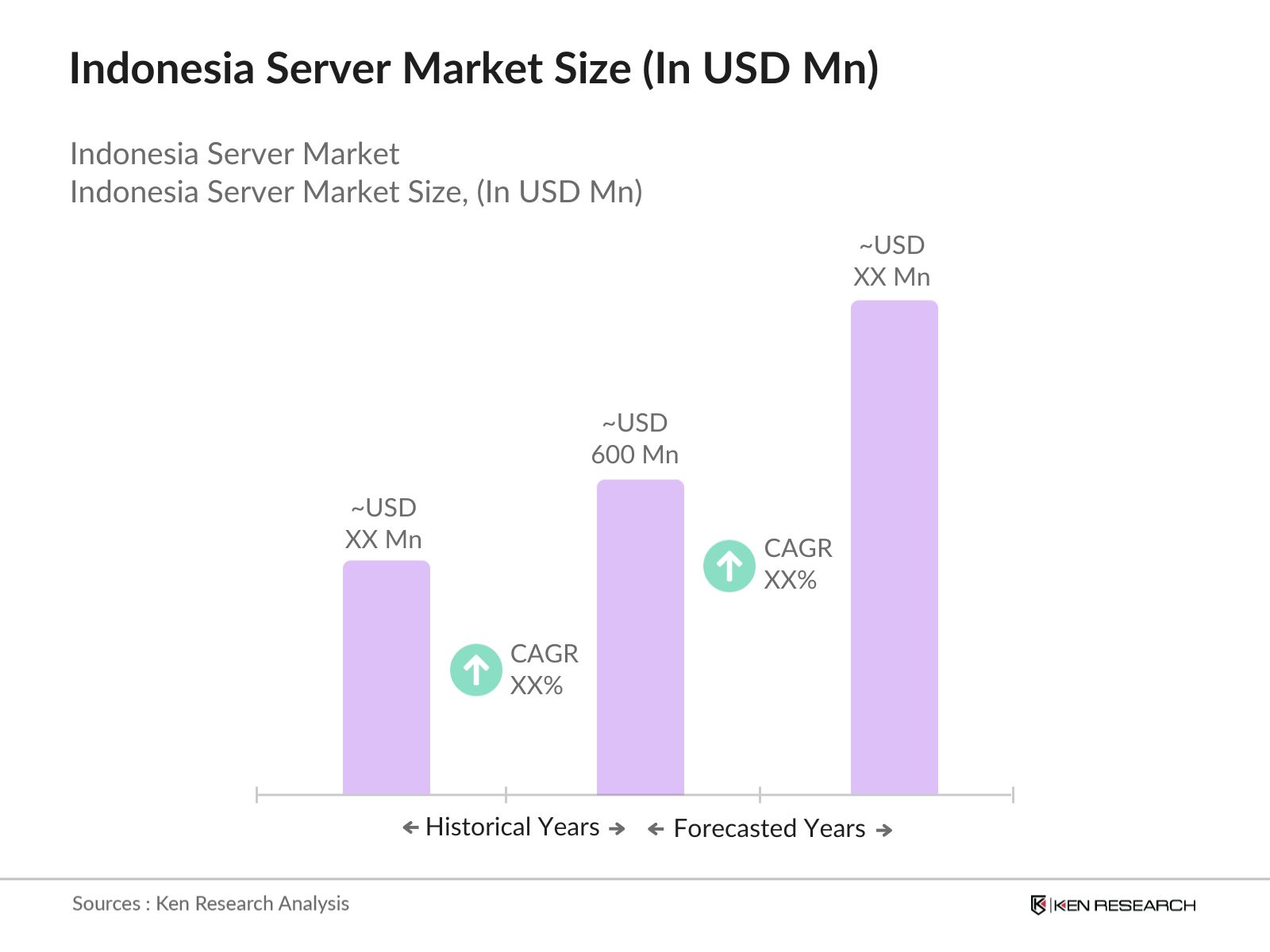
  • The Indonesia Server Market is valued at USD 600 million, driven by the increasing demand for digital transformation across industries. The rapid adoption of cloud computing, data analytics, and edge computing technologies has contributed significantly to the growth of server infrastructure in Indonesia. Expansion of data centers, particularly in Jakarta and surrounding regions, further supports the rising demand for advanced servers capable of handling high workloads. Investment in IT infrastructure by both the private and public sectors has also fueled market growth.
  • Jakarta, the capital city, dominates the Indonesia server market due to its role as the central hub for data centers and IT infrastructure. The city hosts numerous international companies, telecommunications providers, and cloud service vendors, making it the primary location for server deployment. Additionally, Batam and Surabaya are emerging as key regions for server installations, driven by industrial expansion and increasing demand for localized data centers to support regional business operations.
  • The Indonesian government offers various tax incentives for IT and digital infrastructure investments, which are directly benefitting the server market. In 2023, the government introduced tax holidays and allowances for technology companies investing in cloud infrastructure, data centers, and servers. These incentives aim to attract foreign direct investments (FDIs) and accelerate the growth of the countrys IT sector. The Ministry of Finance offers up to 50% tax reductions on capital investments exceeding IDR 1 trillion, creating significant opportunities for server manufacturers and infrastructure providers.

market overviews

Indonesia Server Market Segmentation

  • By Product Type: The market is segmented by product type into rack servers, blade servers, tower servers, and microservers. Among these, rack servers hold the dominant market share due to their scalability, high processing power, and ability to efficiently handle large-scale data center requirements. Rack servers are favored by large enterprises and cloud service providers, given their optimal balance of performance and cost-efficiency. The growing demand for cloud-based services and data analytics further strengthens the preference for rack servers.market overviews
  • By End-User Industry: Themarket in Indonesia is also segmented by end-user industries, including BFSI, IT and Telecom, Healthcare, Retail, and Government. The IT and Telecom sector dominates due to the growing reliance on digital communication platforms, data management, and cloud computing services. The rapid digitalization of Indonesias economy, combined with the need for enhanced data security and efficient storage solutions, has prompted IT and telecom companies to invest heavily in server infrastructure, further driving the segments growth.

market overviews

Indonesia Server Market Competitive Landscape

The Indonesia server market is characterized by the presence of both international and domestic players. Key market leaders focus on offering innovative server technologies to meet the growing demands of data centers and cloud service providers. The market is dominated by companies that provide a wide range of servers, from high-performance rack servers to energy-efficient blade servers.

Company Name

Establishment Year

Headquarters

Product Portfolio

R&D Investment

Cloud Partnerships

Dell Technologies

1984

Texas, USA


Hewlett Packard Enterprise

1939

California, USA


Lenovo Group

1984

Beijing, China


Huawei Technologies

1987

Shenzhen, China


Cisco Systems

1984

California, USA


Indonesia Server Industry Analysis

Growth Drivers

  • Increasing Demand for Cloud Computing: The increasing demand for cloud computing in Indonesia has significantly boosted server market growth. As of 2023, Indonesia's digital economy is valued at USD 70 billion, with cloud computing serving as a critical enabler for various sectors like e-commerce, fintech, and manufacturing. The rapid digitization of small and medium-sized enterprises (SMEs) has further driven the demand for cloud infrastructure. Government initiatives to digitize public services, such as Indonesia's e-Government program, are also creating higher demand for cloud-based services, which directly supports server deployments.
  • Rising Adoption of Edge Computing: Edge computing is becoming increasingly vital in Indonesia as industries move towards decentralized data processing. The country's tech market has witnessed a sharp rise in edge deployments, driven by industries such as telecommunications and manufacturing. Companies are seeking low-latency solutions to process data locally. Indonesias Ministry of Communications and Information Technology has backed these developments with plans to improve digital infrastructure by 2025. Edge computing is being used to support Internet of Things (IoT) applications, such as smart cities, which is boosting demand for servers that enable data processing at the edge.
  • Expansion of Data Centers (Tier Classification, Capacity): Indonesia is rapidly expanding its data center infrastructure to meet growing cloud and internet traffic demands. Data center capacity in Indonesia is expected to reach 350 MW by the end of 2024. Leading companies are building facilities across Jakarta and other cities, emphasizing Tier III and IV data centers that ensure high uptime. This expansion is driven by the needs of cloud service providers and hyperscalers like Google and Amazon Web Services. Additionally, Indonesias growing focus on data sovereignty and local regulations has led to a surge in localized data centers, driving the demand for advanced servers.

Market Challenges

  • High Capital Expenditure: Setting up and maintaining servers in Indonesia comes with a high capital expenditure. Companies face large upfront costs for hardware, software, and cooling systems. Additionally, energy costs in Indonesia are among the highest in Southeast Asia, which significantly impacts operational expenses. Despite government support in the form of tax breaks, the high CAPEX continues to be a challenge for enterprises planning to expand or upgrade their server infrastructure.
  • Data Security Concerns: Data security remains a critical challenge in Indonesias server market. The country has introduced new data privacy laws under the Personal Data Protection Law, which impose strict penalties for breaches. However, the implementation of robust cybersecurity measures requires significant investment in hardware and specialized personnel. Enterprises must continuously upgrade servers to adhere to global and local compliance standards, increasing operational costs.

Indonesia Server Market Future Outlook

The Indonesia server market is poised for remarkable growth in the coming years. The continued rise of cloud computing, edge computing, and data-driven decision-making will drive the demand for robust server infrastructure. Indonesias government initiatives to improve the nations IT infrastructure, along with increased investment from global technology companies, are expected to further boost market expansion. Moreover, the growing presence of regional data centers and increased digital transformation across industries will sustain the demand for servers. As businesses increasingly adopt hybrid and multi-cloud solutions, the need for scalable and energy-efficient servers will become more pronounced.

Market Opportunities

  • Growth in Hybrid Cloud Solutions: Hybrid cloud solutions present a growth opportunity in Indonesia's server market. Many companies, particularly in the banking and healthcare sectors, are adopting hybrid cloud models to comply with local data sovereignty laws while leveraging the scalability of public cloud platforms. With nearly 70% of enterprises in Indonesia planning to implement hybrid cloud solutions by 2025, the demand for both private and public cloud servers is increasing. These hybrid models allow for better data control and optimization, leading to the requirement for more sophisticated server technologies in the country.
  • Adoption of AI and Machine Learning in Data Centers: Artificial intelligence (AI) and machine learning (ML) technologies are increasingly being integrated into Indonesian data centers to optimize server performance and energy efficiency. By 2024, over 35% of large-scale data centers in Indonesia are expected to implement AI-driven solutions to monitor server health, manage workloads, and predict potential failures. The demand for AI-optimized servers is also rising in sectors like e-commerce and fintech, where large data sets are analyzed in real-time to enhance customer experience and operational efficiency.

Scope of the Report

By Product Type

Rack Servers

Blade Servers

Tower Servers

Micro Servers

By Operating System

Linux Servers

Windows Servers

UNIX Servers

By End-User Industry

BFSI, IT and Telecom

Government

Healthcare

Retail and E-commerce

By Server Size

Small Enterprise

Medium Enterprise

Large Enterprise

By Region

Java

Sumatra

Sulawesi

Kalimantan

Papua

Products

Key Target Audience

  • IT Infrastructure Providers

  • Cloud Service Providers

  • Data Center Operators

  • Telecommunications Companies

  • BFSI Sector

  • Banks and Financial Institutes

  • Government and Regulatory Bodies (Kominfo, BSSN)

  • Investment and Venture Capitalist Firms

  • Manufacturing and Industrial Firms

Companies

List of Major Players

  • Dell Technologies

  • Hewlett Packard Enterprise (HPE)

  • Lenovo Group

  • Huawei Technologies

  • Cisco Systems

  • IBM Corporation

  • Fujitsu Limited

  • Oracle Corporation

  • Super Micro Computer Inc.

  • Inspur Group

  • NEC Corporation

  • Quanta Computer

  • Wistron Corporation

  • ASUS (Asustek Computer Inc.)

  • Hitachi, Ltd.

Table of Contents

1. Indonesia Server Market Overview

1.1. Definition and Scope
1.2. Market Taxonomy
1.3. Market Growth Rate
1.4. Market Segmentation Overview

2. Indonesia Server Market Size (In USD Bn)

2.1. Historical Market Size
2.2. Year-On-Year Growth Analysis
2.3. Key Market Developments and Milestones

3. Indonesia Server Market Analysis

3.1. Growth Drivers
3.1.1. Increasing Demand for Cloud Computing
3.1.2. Rising Adoption of Edge Computing
3.1.3. Expansion of Data Centers (Tier Classification, Capacity)
3.1.4. Growing IT Infrastructure Investments
3.2. Market Challenges
3.2.1. High Capital Expenditure
3.2.2. Data Security Concerns
3.2.3. Limited Availability of Skilled Workforce (Talent Shortage, Localization Barriers)
3.3. Opportunities
3.3.1. Growth in Hybrid Cloud Solutions
3.3.2. Adoption of AI and Machine Learning in Data Centers
3.3.3. Regional Expansion in Emerging Markets
3.4. Trends
3.4.1. Increasing Use of ARM-Based Servers
3.4.2. Virtualization and Containerization
3.4.3. Sustainability and Energy-Efficient Servers
3.5. Government Regulation
3.5.1. Local Data Sovereignty Laws
3.5.2. Tax Incentives for IT Investments
3.5.3. Cybersecurity Regulations (Data Privacy, Compliance)
3.6. SWOT Analysis
3.7. Stake Ecosystem (System Integrators, Vendors, Service Providers)
3.8. Porters Five Forces
3.9. Competition Ecosystem

4. Indonesia Server Market Segmentation
4.1. By Product Type (In Value %)
4.1.1. Rack Servers
4.1.2. Blade Servers
4.1.3. Tower Servers
4.1.4. Micro Servers
4.2. By Operating System (In Value %)
4.2.1. Linux Servers
4.2.2. Windows Servers
4.2.3. UNIX Servers
4.3. By End-User Industry (In Value %)
4.3.1. BFSI
4.3.2. IT and Telecom
4.3.3. Government
4.3.4. Healthcare
4.3.5. Retail and E-commerce
4.4. By Server Size (In Value %)
4.4.1. Small Enterprise
4.4.2. Medium Enterprise
4.4.3. Large Enterprise
4.5. By Region (In Value %)
4.5.1. Java
4.5.2. Sumatra
4.5.3. Sulawesi
4.5.4. Kalimantan
4.5.5. Papua

5. Indonesia Server Market Competitive Analysis

5.1 Detailed Profiles of Major Companies
5.1.1. Dell Technologies
5.1.2. Hewlett Packard Enterprise (HPE)
5.1.3. Lenovo Group
5.1.4. IBM Corporation
5.1.5. Cisco Systems
5.1.6. Huawei Technologies
5.1.7. Super Micro Computer Inc.
5.1.8. Inspur Group
5.1.9. Fujitsu Limited
5.1.10. Oracle Corporation
5.1.11. Quanta Computer
5.1.12. Wistron Corporation
5.1.13. NEC Corporation
5.1.14. ASUS (Asustek Computer Inc.)
5.1.15. Hitachi, Ltd.
5.2 Cross Comparison Parameters (Revenue, Product Portfolio, R&D Investments, Cloud Partnerships, Server Technology)
5.3. Market Share Analysis
5.4. Strategic Initiatives (Partnerships, Joint Ventures, New Product Launches)
5.5. Mergers And Acquisitions
5.6. Investment Analysis
5.6.1. Private Equity and Venture Capital Funding
5.6.2. Government Funding
5.7. Key Innovations in the Market

6. Indonesia Server Market Regulatory Framework

6.1. Data Sovereignty and Compliance Standards
6.2. Certification Requirements (Uptime Institute, TIA-942)
6.3. Energy Efficiency Standards (Green Data Centers, PUE Standards)

7. Indonesia Server Market Future Market Size (In USD Bn)

7.1. Future Market Size Projections
7.2. Key Factors Driving Future Market Growth

8. Indonesia Server Market Future Segmentation

8.1. By Product Type (In Value %)
8.2. By Operating System (In Value %)
8.3. By End-User Industry (In Value %)
8.4. By Server Size (In Value %)
8.5. By Region (In Value %)

9. Indonesia Server Market Analysts Recommendations

9.1. TAM/SAM/SOM Analysis
9.2. Customer Cohort Analysis
9.3. Marketing and Sales Strategy
9.4. Strategic Partnerships Recommendations

Disclaimer Contact Us

Research Methodology

Step 1: Identification of Key Variables

In the first step, we construct an ecosystem map that identifies all significant stakeholders in the Indonesia Server Market. We utilize a mix of secondary research, leveraging proprietary and public databases, to gather detailed industry insights. The goal is to define key factors that impact market dynamics, such as server technology innovations, cloud adoption rates, and regulatory policies.

Step 2: Market Analysis and Construction

The second phase involves analyzing historical data related to the Indonesia Server Market. This includes evaluating the growth of server installations, data center expansions, and revenue generation trends. We also assess the ratio of server suppliers to end-user industries to understand market penetration levels.

Step 3: Hypothesis Validation and Expert Consultation

We develop initial market hypotheses and validate them through in-depth interviews with industry experts. These interviews are conducted with server manufacturers, data center operators, and cloud service providers, using computer-assisted telephone interviews (CATI) to obtain insights into market strategies, product preferences, and future trends.

Step 4: Research Synthesis and Final Output

The final phase synthesizes the data gathered from all sources. We consolidate the findings from primary and secondary research, ensuring the accuracy and reliability of the market data. This process includes engaging with key server vendors to obtain insights into server performance, sales trends, and customer preferences, thereby delivering a comprehensive analysis of the Indonesia Server Market.

Frequently Asked Questions

01. How big is the Indonesia Server Market?

The Indonesia Server Market is valued at USD 600 million, driven by the growing demand for cloud computing, data analytics, and the expansion of data centers across the country.

02. What are the challenges in the Indonesia Server Market?

Challenges in the market include high capital expenditure, data security concerns, and a lack of skilled workforce to manage and operate advanced server infrastructure.

03. Who are the major players in the Indonesia Server Market?

Key players in the market include Dell Technologies, Hewlett Packard Enterprise, Lenovo Group, Huawei Technologies, and Cisco Systems, among others.

04. What are the growth drivers of the Indonesia Server Market?

The growth is driven by the increasing adoption of cloud computing, edge computing, and the expansion of data centers in major cities like Jakarta and Batam, along with rising digital transformation initiatives by businesses.

05. What are the trends in the Indonesia Server Market?

Trends include the growing use of ARM-based servers, increased focus on energy-efficient server technologies, and the adoption of AI-optimized server solutions for data-intensive operations.

Why Buy From Us?

RRR
Refine Robust Result (RRR) Framework

What makes us stand out is that our consultants follows Robust, Refine and Result (RRR) methodology. i.e. Robust for clear definitions, approaches and sanity checking, Refine for differentiating respondents facts and opinions and Result for presenting data with story

Our Reach Is Unmatched

We have set a benchmark in the industry by offering our clients with syndicated and customized market research reports featuring coverage of entire market as well as meticulous research and analyst insights.

Research
Shifting the Research Paradigm

While we don't replace traditional research, we flip the method upside down. Our dual approach of Top Bottom & Bottom Top ensures quality deliverable by not just verifying company fundamentals but also looking at the sector and macroeconomic factors.

Insite
More Insights-Better Decisions

With one step in the future, our research team constantly tries to show you the bigger picture. We help with some of the tough questions you may encounter along the way: How is the industry positioned? Best marketing channel? KPI's of competitors? By aligning every element, we help maximize success.

Trust
Transparency and Trust

Our report gives you instant access to the answers and sources that other companies might choose to hide. We elaborate each steps of research methodology we have used and showcase you the sample size to earn your trust.

support
Round the Clock Support

If you need any support, we are here! We pride ourselves on universe strength, data quality, and quick, friendly, and professional service.

Why Client Choose Us?

400000+ Reports in repository
150+ Consulting project a year
100+ Analysts
8000+ Client Queries in 2022