
Indonesia Smart Cities Market Outlook to 2030
Region:Indonesia
Author(s):Shreya
Product Code:KROD3482
Region:Indonesia
Author(s):Shreya
Product Code:KROD3482
November 2024
81
Indonesia Smart Cities Market Overview
The Indonesia Smart Cities market is valued at USD 580 million, driven by a combination of urbanization, government initiatives, and increasing digital adoption in urban management. As the country focuses on enhancing infrastructure and services, the demand for smart technologiesranging from IoT-based traffic management systems to smart gridshas surged. With rapid urban expansion, cities like Jakarta, Surabaya, and Bandung are key drivers of smart city initiatives, each implementing tailored solutions to improve connectivity, mobility, and sustainability.
Dominant cities in the market, such as Jakarta and Surabaya, lead due to their high population density, economic importance, and government-backed smart city projects. Jakarta's integration of smart traffic systems and Surabaya's green smart city initiatives have set benchmarks for other cities in Indonesia. These cities have higher tech infrastructure investments, positioning them as leaders in the smart city landscape.
Indonesias National Smart City Masterplan outlines the framework for smart city development, with a focus on digital infrastructure, sustainable urban planning, and citizen engagement. The plan, endorsed in 2023, covers over 100 cities and includes guidelines for integrating IoT, AI, and data analytics into public services. As part of this initiative, the government aims to enhance urban resilience through technology-driven solutions, including smart grids, intelligent transport systems, and e-governance platforms. The plan also seeks to promote public-private partnerships and attract foreign investment to accelerate smart city development.
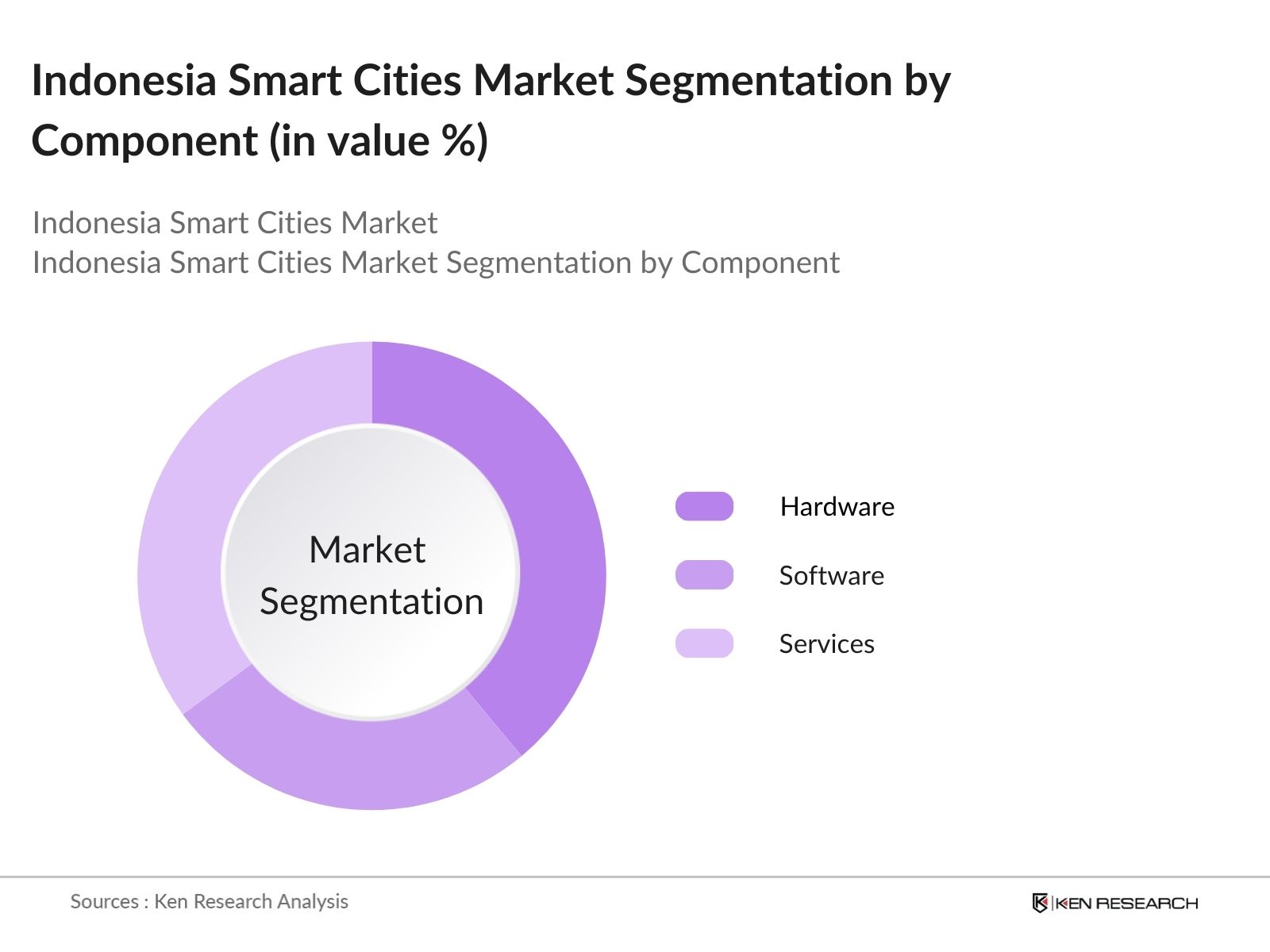
By Component: The market is segmented by components into hardware, software, and services. Among these, hardware dominates the market due to the essential infrastructure it provides for smart cities, such as sensors, communication devices, and data centers. This component is critical for enabling IoT and AI-based solutions, which require robust physical infrastructure to function efficiently. The growing demand for smart streetlights, traffic systems, and security cameras further strengthens hardware's market presence.
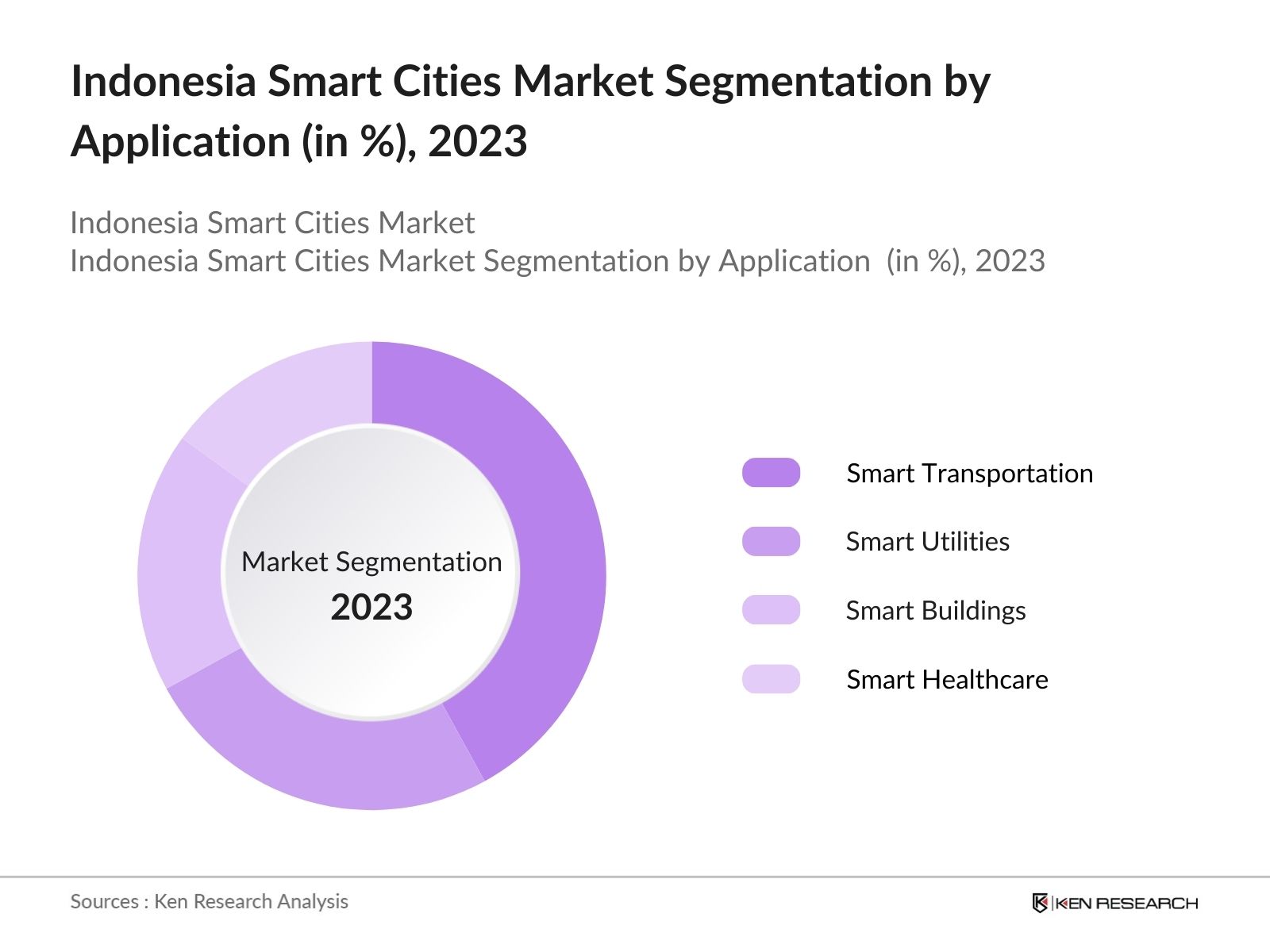
By Application: The market is segmented by application into smart transportation, smart utilities, smart buildings, and smart healthcare. Smart transportation holds a dominant market share in this segment. The reason behind this dominance is the country's pressing need to address urban traffic congestion, especially in Jakarta. IoT-based traffic systems, e-mobility solutions, and integrated public transport systems are gaining traction, making smart transportation a crucial part of Indonesias smart city projects.
The Indonesia Smart Cities market is characterized by a few key players with substantial influence due to their technology portfolios and government partnerships. The major companies dominating the market have made significant investments in IoT, AI, and smart infrastructure solutions, positioning themselves as strategic players in Indonesia's ongoing urban transformation. Domestic players such as Telkom Indonesia also play a crucial role, leveraging local market knowledge and strong governmental ties.
|
Company |
Year of Establishment |
Headquarters |
Market Penetration |
R&D Investments |
Smart City Partnerships |
Regional Presence |
Technology Focus |
Digital Solutions |
|---|---|---|---|---|---|---|---|---|
|
Cisco Systems Inc. |
1984 |
San Jose, USA |
||||||
|
Siemens AG |
1847 |
Munich, Germany |
||||||
|
IBM Corporation |
1911 |
New York, USA |
||||||
|
Telkom Indonesia |
1965 |
Jakarta, Indonesia |
||||||
|
Huawei Technologies |
1987 |
Shenzhen, China |
Urbanization: Indonesia's rapid urbanization is a critical factor driving the smart cities market. As of 2024, over 56% of the population resides in urban areas, up from 50% a decade ago, with an expected increase to over 60% by 2030 according to World Bank data. This urban migration intensifies the need for smarter infrastructure to manage transportation, waste, and public services efficiently. Indonesia's government is actively addressing urban sprawl challenges by promoting smart city initiatives, such as the "100 Smart Cities Movement," which aims to tackle overcrowding through sustainable solutions.
Government Initiatives for Smart Infrastructure: The Indonesian government is investing heavily in smart infrastructure, with over $32 billion allocated to smart city programs across major cities by 2025, as per official government statements. These initiatives include digital services for public transportation, waste management, and public safety. The governments National Medium-Term Development Plan (RPJMN) emphasizes smart city development as part of its broader goal to integrate digital solutions across urban areas, improving efficiency in public services and governance. The move towards smart infrastructure is expected to mitigate the pressures of urbanization while improving citizen engagement.
Public-Private Partnerships: Public-private partnerships (PPPs) are pivotal in advancing Indonesias smart city agenda, with over 150 PPP projects launched by the end of 2023, according to Indonesias Ministry of Finance. These partnerships focus on infrastructure projects such as smart lighting, intelligent traffic systems, and digital city platforms. Key examples include the collaboration between local governments and global tech companies like Cisco and Microsoft, which are providing the technology backbone for smart city applications. Such partnerships are crucial for sustaining the financial and technical resources required to scale smart city initiatives nationwide.
High Capital Investment (Funding and ROI): High capital investment is one of the major challenges in Indonesia's smart cities market. Developing smart infrastructure requires substantial funding, with initial investment costs for projects such as smart grids and intelligent transport systems exceeding $500 million in key cities like Jakarta. Many investors and stakeholders are concerned about the return on investment (ROI) timeframe, which can extend beyond 10 years in some cases, according to data from the Ministry of Finance. This deters smaller municipalities from implementing large-scale smart city projects.
Lack of Interoperability Between Technologies: In Indonesia, smart city projects often rely on diverse platforms, making it difficult for cities to integrate data from transportation, energy, and waste management systems. According to a report by the Ministry of Communication and Informatics, over 60% of cities in Indonesia face integration challenges, slowing the implementation of holistic smart city solutions. This challenge necessitates the development of unified platforms that can accommodate a range of technologies for seamless city management.
Over the next five years, the Indonesia Smart Cities market is expected to experience growth due to the government's commitment to improving urban living conditions through smart technology adoption. Government policies, such as the "100 Smart Cities" initiative, along with advancements in IoT, AI, and 5G networks, are anticipated to drive growth. The integration of smart transportation systems, smart utilities, and public safety solutions will further accelerate market expansion. Additionally, increasing foreign investments and partnerships with global tech giants are projected to strengthen Indonesias smart city ecosystem.
Expansion of 5G Networks: The expansion of 5G networks across Indonesia presents an opportunity for the smart cities market. As of 2023, the Indonesian government had allocated over $2 billion to roll out 5G infrastructure, with deployment in major urban areas like Jakarta, Surabaya, and Bandung. These high-speed networks will enable more reliable and faster connectivity for IoT devices and data analytics systems, which are critical for real-time monitoring and automation in smart cities. Enhanced 5G coverage is expected to improve urban services such as traffic management, waste disposal, and public safety systems.
IoT and Big Data Analytics Integration: The integration of IoT and big data analytics into smart city systems is creating new opportunities for enhanced urban management. As of 2023, over 200 cities in Indonesia have started using IoT devices for monitoring urban infrastructure, according to the Ministry of Communication and Informatics. These devices collect vast amounts of data that, when combined with big data analytics, can predict and manage traffic flow, energy consumption, and public safety. This integration is enabling cities to become more proactive in addressing issues like congestion and pollution.
|
Segment |
Sub-Segments |
|---|---|
|
By Component |
Hardware Software Services |
|
By Application |
Smart Transportation Smart Governance Smart Utilities Smart Healthcare Smart Buildings |
|
By Technology |
IoT AI Blockchain Cloud Computing 5G Connectivity |
|
By Deployment Model |
On-Premise Cloud-Based |
|
By Region |
Java Sumatra Kalimantan Sulawesi Bali Nusa Tenggara |
Major Players in the Indonesia Smart Cities Market
Key Target Audience
1.1 Definition and Scope
1.2 Market Taxonomy
1.3 Market Growth Rate
1.4 Market Segmentation Overview
2.1 Historical Market Size
2.2 Year-On-Year Growth Analysis
2.3 Key Market Developments and Milestones
3.1 Growth Drivers
3.1.1 Urbanization
3.1.2 Government Initiatives for Smart Infrastructure
3.1.3 Increasing IoT Adoption
3.1.4 Public-Private Partnerships
3.1.5 Smart Mobility Solutions
3.2 Market Challenges
3.2.1 High Capital Investment (Funding and ROI)
3.2.2 Cybersecurity Risks
3.2.3 Lack of Interoperability Between Technologies
3.2.4 Limited Digital Literacy
3.3 Opportunities
3.3.1 Expansion of 5G Networks
3.3.2 IoT and Big Data Analytics Integration
3.3.3 Collaboration with Global Technology Providers
3.3.4 Growth in Renewable Energy Integration
3.4 Trends
3.4.1 Smart Transportation and Mobility
3.4.2 Adoption of AI for Predictive City Management
3.4.3 Focus on Sustainable and Green Smart Cities
3.4.4 Blockchain Integration for Data Security
3.5 Government Regulation
3.5.1 National Smart City Masterplan
3.5.2 Policies on Data Privacy and Smart Technology Deployment
3.5.3 Public Infrastructure Upgradation Programs
3.5.4 Local Government Collaboration with Tech Firms
3.6 SWOT Analysis
3.7 Stake Ecosystem
3.8 Porters Five Forces Analysis
3.9 Competition Ecosystem
4.1 By Component (in Value %)
4.1.1 Hardware
4.1.2 Software
4.1.3 Services
4.2 By Application (in Value %)
4.2.1 Smart Transportation
4.2.2 Smart Governance and Education
4.2.3 Smart Utilities (Energy, Water, Waste Management)
4.2.4 Smart Healthcare
4.2.5 Smart Buildings
4.3 By Technology (in Value %)
4.3.1 Internet of Things (IoT)
4.3.2 Artificial Intelligence (AI)
4.3.3 Blockchain
4.3.4 Cloud Computing
4.3.5 5G Connectivity
4.4 By Deployment Model (in Value %)
4.4.1 On-Premise
4.4.2 Cloud-Based
4.5 By Region (in Value %)
4.5.1 Java
4.5.2 Sumatra
4.5.3 Kalimantan
4.5.4 Sulawesi
4.5.5 Bali and Nusa Tenggara
5.1 Detailed Profiles of Major Companies
5.1.1 Cisco Systems Inc.
5.1.2 Siemens AG
5.1.3 Schneider Electric SE
5.1.4 IBM Corporation
5.1.5 Hitachi Ltd.
5.1.6 Huawei Technologies Co. Ltd.
5.1.7 Microsoft Corporation
5.1.8 Oracle Corporation
5.1.9 Ericsson AB
5.1.10 NEC Corporation
5.1.11 Honeywell International Inc.
5.1.12 ABB Ltd.
5.1.13 Intel Corporation
5.1.14 Fujitsu Ltd.
5.1.15 Google LLC
5.2 Cross Comparison Parameters (Revenue, No. of Employees, R&D Investments, Product Portfolio, Smart City Partnerships, Market Share, Regional Presence, Technology Adoption Rate)
5.3 Market Share Analysis
5.4 Strategic Initiatives (Smart City Partnerships, New Product Developments, Market Expansions)
5.5 Mergers and Acquisitions
5.6 Investment Analysis
5.7 Government Grants
5.8 Private Equity and Venture Capital Funding
6.1 Data Security and Privacy Regulations
6.2 Smart Infrastructure Standards
6.3 National and Local Government Compliance Requirements
6.4 Environmental and Sustainability Regulations
7.1 Future Market Size Projections
7.2 Key Factors Driving Future Market Growth
8.1 By Component (in Value %)
8.2 By Application (in Value %)
8.3 By Technology (in Value %)
8.4 By Deployment Model (in Value %)
8.5 By Region (in Value %)
9.1 TAM/SAM/SOM Analysis
9.2 Market Penetration Strategy
9.3 Key Customer Segmentation and Marketing Initiatives
9.4 White Space Opportunity Analysis
The research began with the identification of key variables, focusing on major stakeholders within the Indonesia Smart Cities Market. This phase utilized a combination of secondary data from credible databases and industry reports, ensuring a comprehensive understanding of the market dynamics.
In this phase, historical data was compiled, covering aspects such as smart city investments, government initiatives, and private sector involvement. A detailed analysis of infrastructure projects, technological adoption rates, and the role of public-private partnerships was also conducted.
Market hypotheses were validated through expert consultations with industry leaders, urban planners, and smart city technology providers. These interviews provided insights into market trends, regulatory hurdles, and technological advancements shaping the market.
The final stage involved synthesizing the collected data into a coherent market analysis, ensuring that the report accurately reflected current market trends and future growth prospects. This included cross-verifying findings with key stakeholders and refining market projections.
The Indonesia Smart Cities Market is valued at USD 580 million, driven by rapid urbanization, digital transformation, and government-backed infrastructure development programs.
Key challenges in the Indonesia Smart Cities Market include high capital investment, cybersecurity risks, and the lack of interoperability between different technologies. Additionally, regulatory hurdles and infrastructure bottlenecks remain significant barriers.
Key players in the Indonesia Smart Cities Market include Cisco Systems Inc., Siemens AG, IBM Corporation, Telkom Indonesia, and Huawei Technologies. These companies are driving innovation and investment in smart city solutions across Indonesia.
Growth in the Indonesia Smart Cities Market is driven by government initiatives like the "100 Smart Cities" project, the increasing adoption of IoT and AI, and the demand for smart infrastructure to manage urban challenges such as traffic congestion and energy consumption.
Major trends in the Indonesia Smart Cities Market include the adoption of 5G networks, the integration of AI and big data for predictive city management, and the shift toward green and sustainable smart city solutions.

What makes us stand out is that our consultants follows Robust, Refine and Result (RRR) methodology. i.e. Robust for clear definitions, approaches and sanity checking, Refine for differentiating respondents facts and opinions and Result for presenting data with story

We have set a benchmark in the industry by offering our clients with syndicated and customized market research reports featuring coverage of entire market as well as meticulous research and analyst insights.

While we don't replace traditional research, we flip the method upside down. Our dual approach of Top Bottom & Bottom Top ensures quality deliverable by not just verifying company fundamentals but also looking at the sector and macroeconomic factors.

With one step in the future, our research team constantly tries to show you the bigger picture. We help with some of the tough questions you may encounter along the way: How is the industry positioned? Best marketing channel? KPI's of competitors? By aligning every element, we help maximize success.

Our report gives you instant access to the answers and sources that other companies might choose to hide. We elaborate each steps of research methodology we have used and showcase you the sample size to earn your trust.

If you need any support, we are here! We pride ourselves on universe strength, data quality, and quick, friendly, and professional service.