
Decoding Employer Perception of ITIs and Vocational Training in India
Region:India
Author(s):Geetanshi Chugh
Product Code:KR1546
Region:India
Author(s):Geetanshi Chugh
Product Code:KR1546
October 2025
90
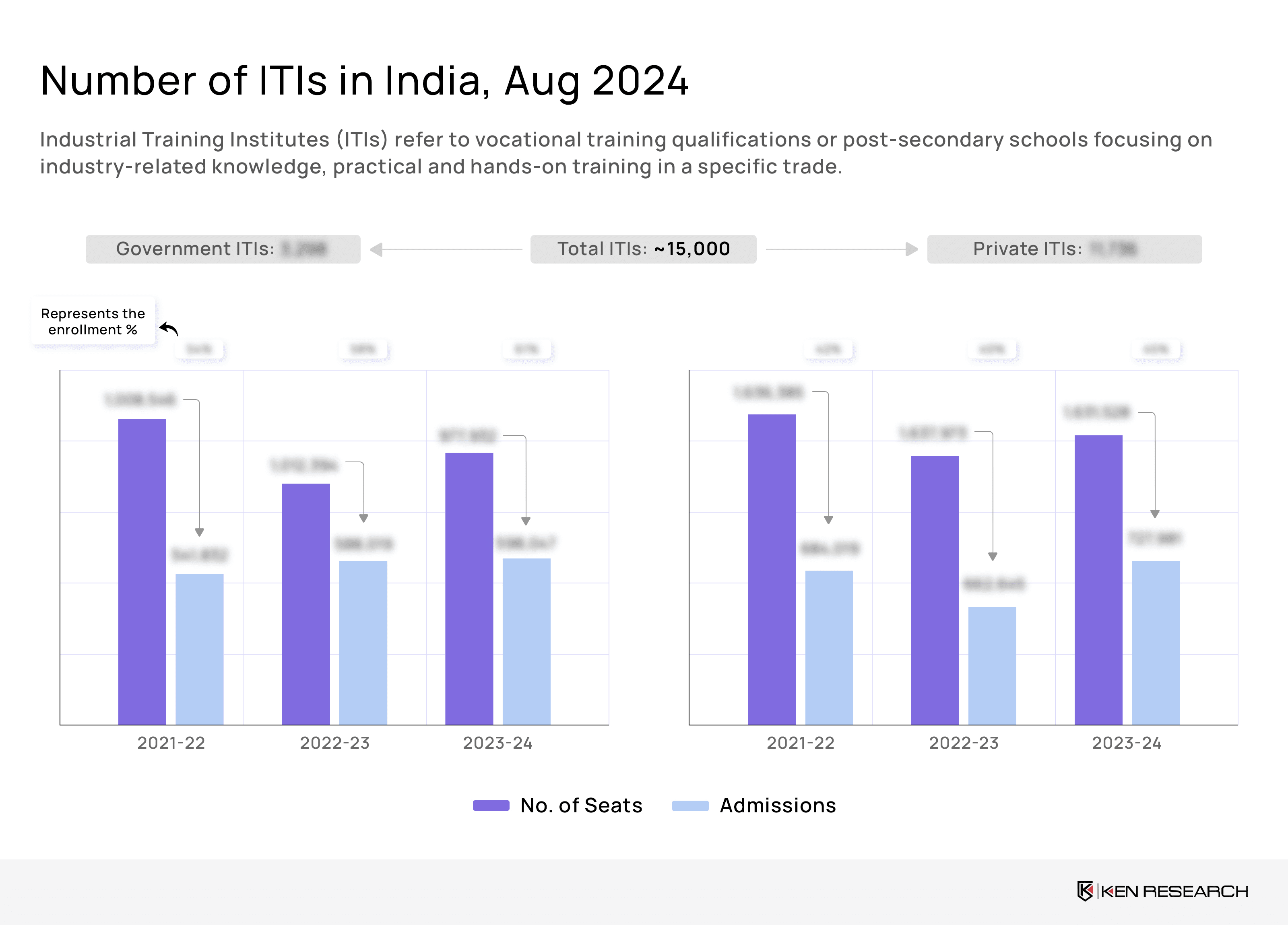
India runs ~15,000 ITIs with ~26 lakh seats, but enrolment hovers near ~13 lakh—an under-utilization of ~50%. The footprint is concentrated: Uttar Pradesh, Rajasthan, and Bihar together host >40% of ITIs, shaping local supply and placement dynamics. Across ~165 NSQF trades (6 months–2 years), curricula remain practice-heavy (~70% practical / ~30% theory).
This analysis draws on Ken Research’s “Decoding Employer Perception of ITIs and Vocational Training in India” survey of ~120 employers in Gujarat, Haryana, Tamil Nadu, and Delhi. Priority sectors mirror state clusters—Manufacturing, Electrical, Automotive—with others spanning IT/ITES, Construction, Electronics & Hardware, Textile & Apparel, Chemical, Healthcare, and Fabrication.
Admissions skew to Electrician, Fitter, and COPA/IT Support. Average enrolment sits around ~56% in engineering trades and ~53% in non-engineering—signaling clear demand clusters where seat planning, industry tie-ups, and capacity utilization can be sharpened.
From an initial scan of 50+ countries, a multi-stage shortlist using macro and VET criteria (GDP and industrial depth, education penetration, youth unemployment <~5%, vocational participation >~15%, system flexibility, infrastructure, and policy/industry support) narrowed to four reference models: Germany, Switzerland, Republic of Korea, and Australia. These systems pair strong labour-market linkages with structured pathways and predictable funding/quality assurance—useful anchors for India’s ITI reforms.
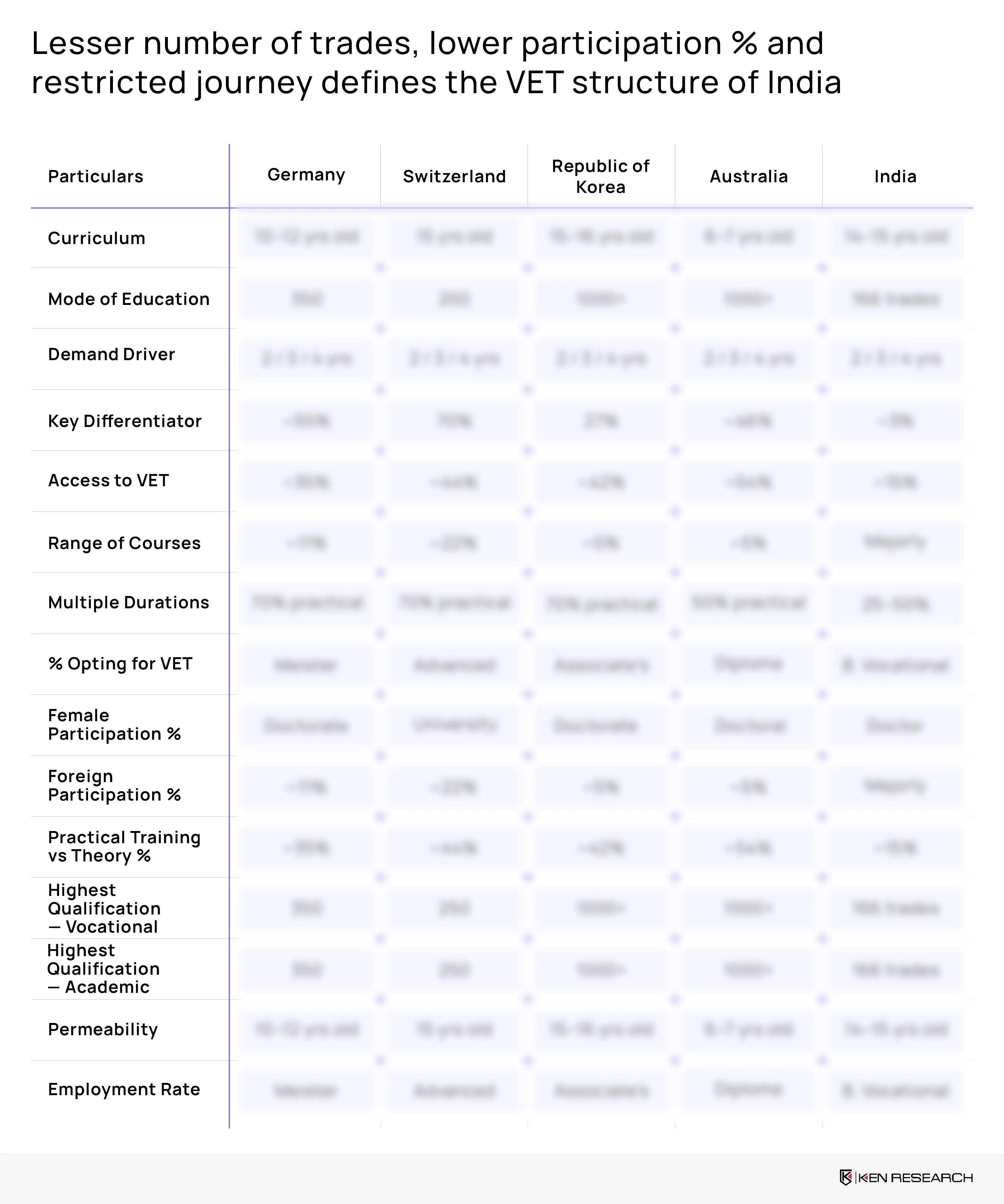
Germany: A mature dual system with a majority work-based component and school learning, paid apprenticeships, early vocational entry, and easy switching between academic and vocational tracks—driving high VET uptake and employer trust.
Switzerland: Labour-market–accepted professional routes with a dual-track (3–4 days practice / 1–2 days theory), progressive stipends, fallback 2-year federal VET certificate, and a broad occupation menu, leading to strong wage and employment outcomes.
Republic of Korea: Tight industry collaboration (internships/co-op), multiple specialized school pathways (incl. Meister), high employment rates for VET graduates, and a culture of lifelong learning that keeps skills current with tech change.
Australia: Early vocational exposure (Certificates I–IV), flexible pathways that allow switching between academic/vocational streams, and embedded workplace learning via internships/co-op—supporting smoother school-to-work transitions.
India’s VET pathway typically begins later (?14–15 years) and spans ~165 broadly framed trades. Uptake is modest (~3%), practical exposure is lighter, and vocational progression usually caps earlier than in dual-system leaders. Employer co-ownership, stipends, and QA are improving but uneven, and women’s participation remains comparatively lower—placing India at an evolving, consolidation stage versus mature global models.
Across states, the strongest employer–ITI pipelines emerge where structured placement programs and active STRIVE–IAI clusters are in place. Tamil Nadu and Delhi exemplify this with marquee OEM tie-ups and state-led pathways; Gujarat scales through Flexi-MoUs and GIDC enablement, while Haryana emphasizes entrepreneurship, assessment dashboards, and overseas linkages.
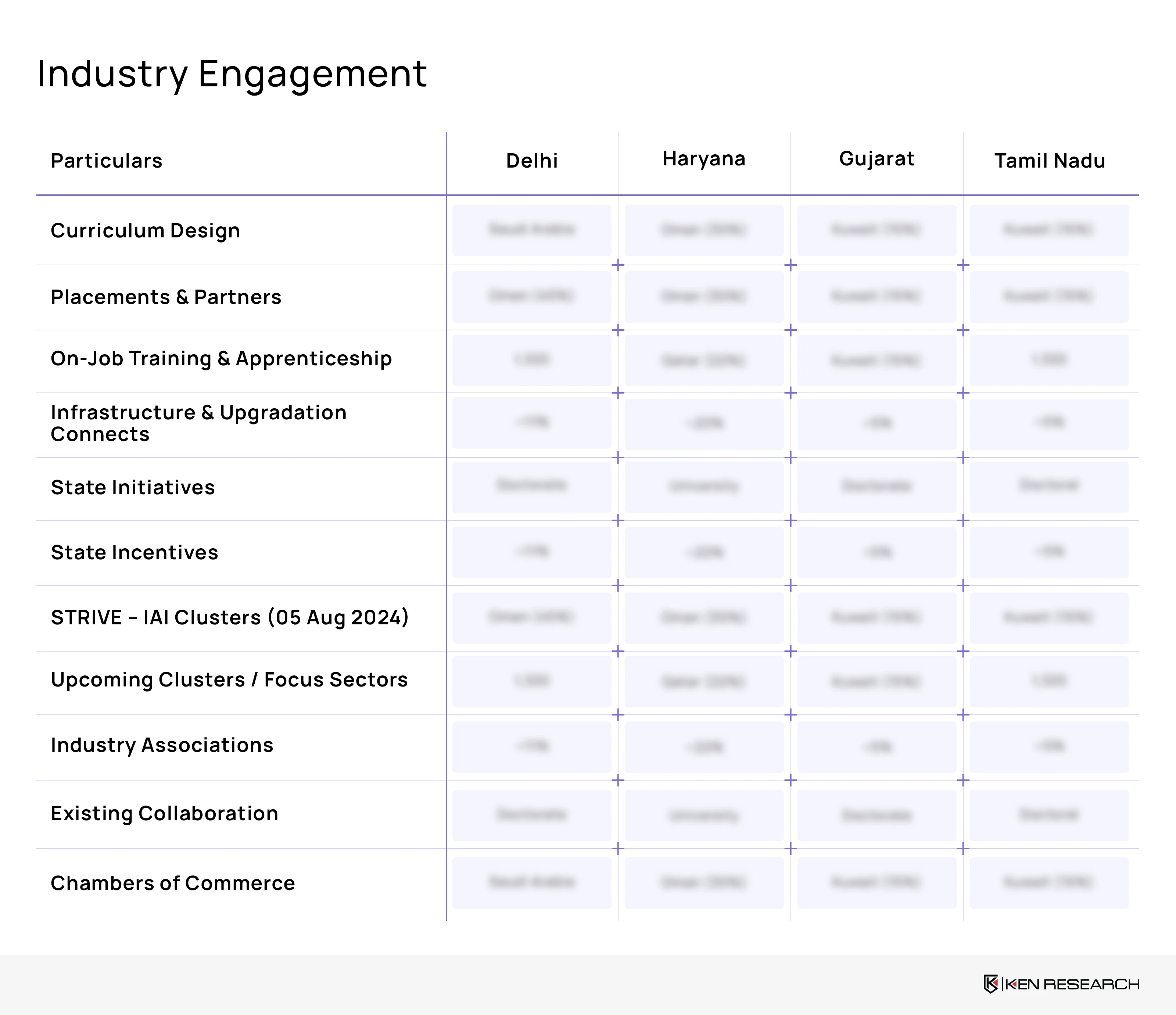
Employer–industry linkage is tightening: Delhi is rolling out TECOS and a Transformative Placement Strategy to systematize outreach, trainer upskilling, and centralized campus drives, while Haryana advances Udhyami Haryana with a State ITI Assessment Dashboard to embed entrepreneurship and track outcomes.
Access-to-employment is widening as Gujarat scales Kaushalya Vardhan Kendra (doorstep skilling) and the Employment Extension Bureau, creating a clearer bridge from training to jobs and improving first-job visibility.
Delivery quality is rising in Tamil Nadu through an Internship Training Scheme (?5,500 trainees in 2024) alongside Virtual Classrooms/Training Simulators, strengthening sustained shop-floor exposure and day-one readiness.
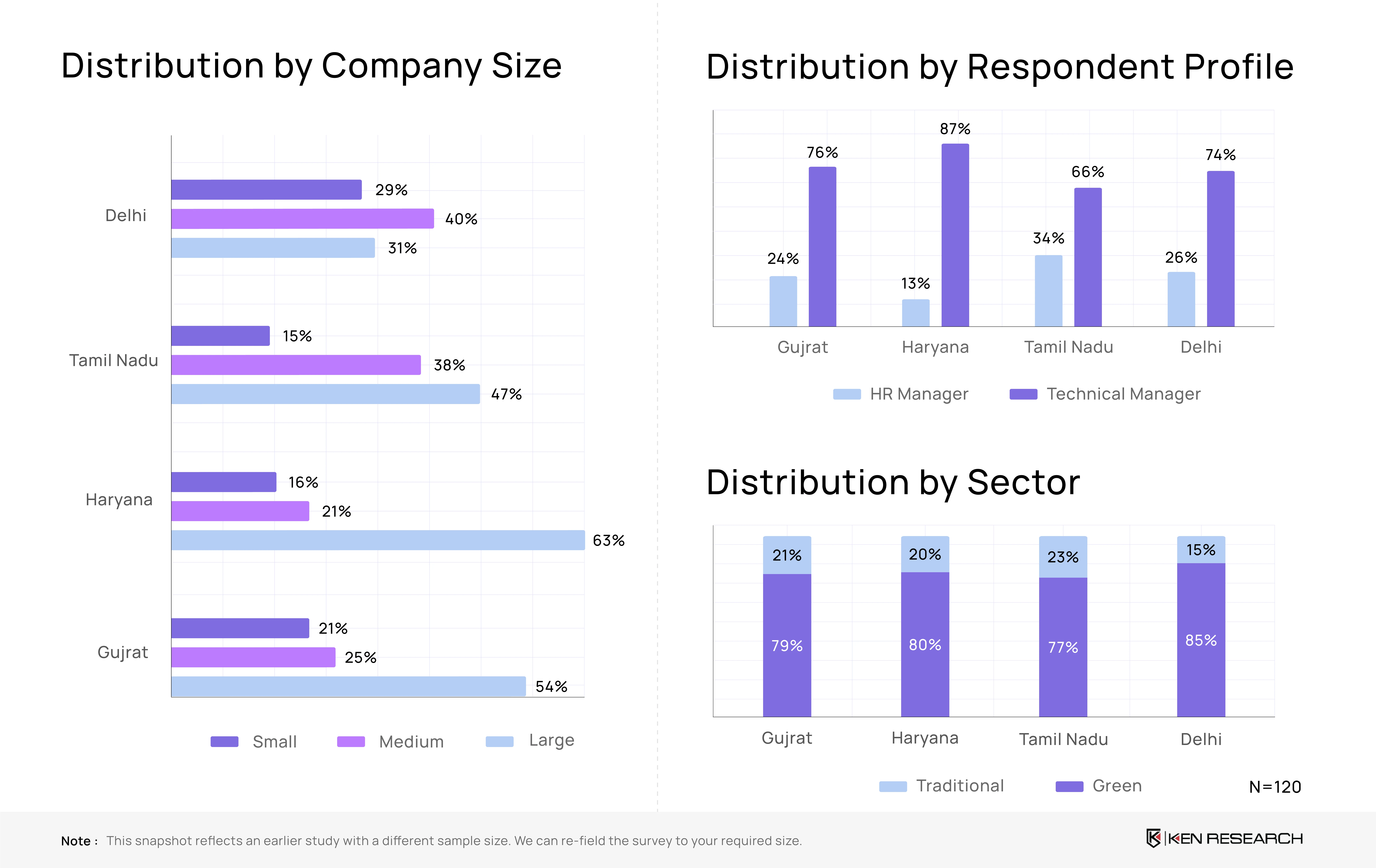
With capex steady in core industries, responses skew to larger firms (~40–63%) and HR decision-makers (~66–87%). Hiring remains anchored in traditional roles (?77–85%), while green jobs (~15–23%) are rising from a small base as SMEs balance cost and retraining needs.
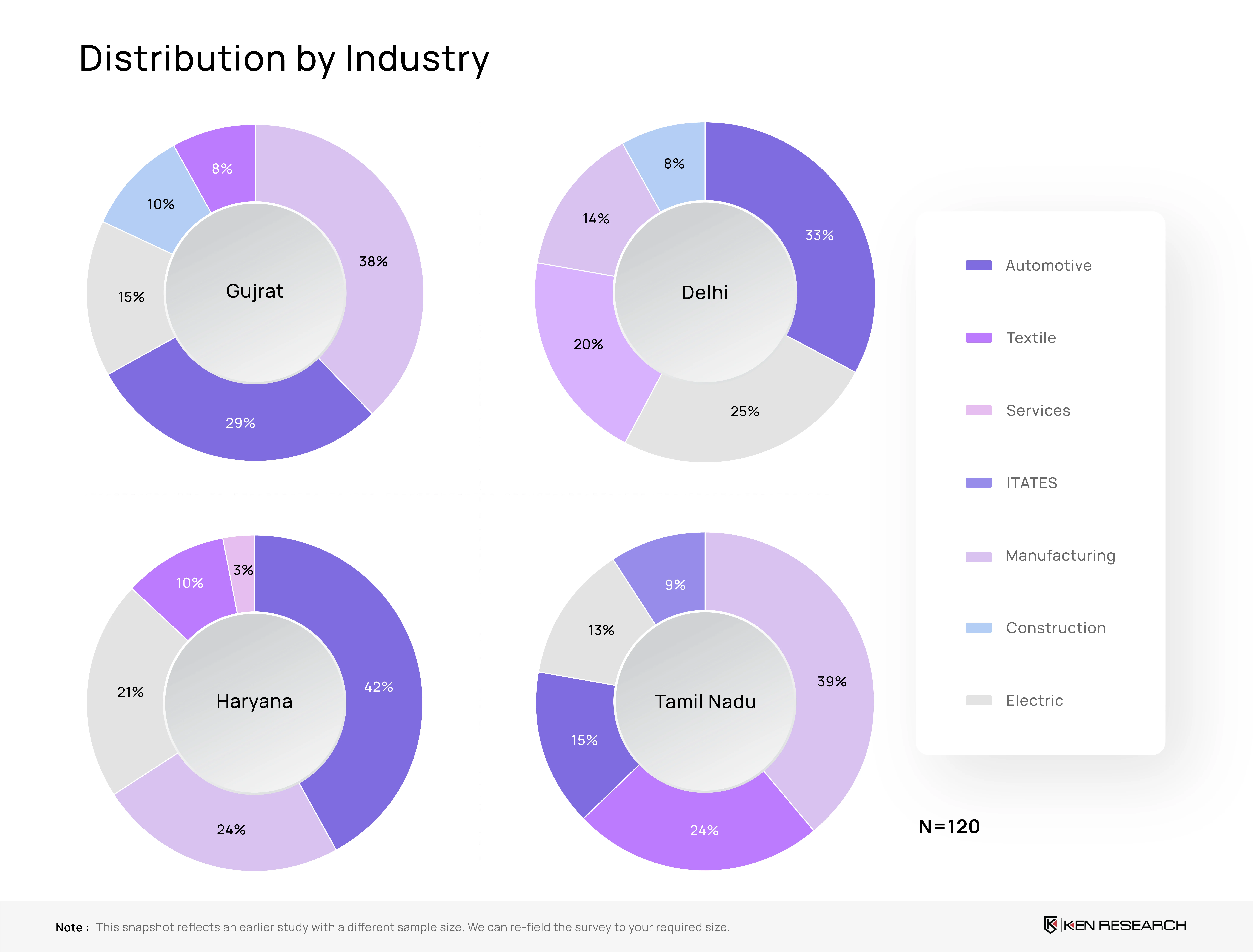
Demand tracks state industrial bases—manufacturing in Gujarat/Tamil Nadu, automotive in Haryana, and IT/ITES with construction/services in Delhi. Near term, recruitment stays plant-oriented (production, quality, maintenance), with gradual lift in EV/clean-energy roles where partnerships and labs are active.
According to the survey, Ken Research analyzed the evidence and provided actionable insights, suggesting the needful steps to the client.
Align courses to demand: re-map trades/seat mix to local industry needs and run cluster-based placement drives.
Strengthen apprenticeships: expand OJT/apprentice slots with industry co-delivery and short, structured induction.
Upgrade enablers: improve dashboards/portals (NCVT, apprenticeship, alumni–employer) and add basic digital/communication modules with women-friendly facilities.
To dipstick on types of vocational training models (Global best practices vs Domestic best practices) across top 5 industries
Program Curriculum
Demand Drivers
Mode of Programs (hybrid / online)
Enrollments – Hyperlocal vs National vs International
Evaluating ITI Partnerships in Gujarat, Tamil Nadu, Delhi and Haryana (Engagement Levels, Strengths, Weaknesses, Best Practices, Key Industry Clusters in terms of Major Industry Bodies and Existing Partnerships, Industry Contributions)
Assess state incentives for employers, focusing on tax benefits, subsidies, and OJT/apprenticeships, especially for female ITI graduates
<Telephonic Discussions / Surveys across States – Delhi, Haryana, Gujarat, Tamil Nadu>
Key attributes to focus are awareness, perception analysis, hiring expectations, challenges, retention and performance and gender diversity and employer commitment
Examining industry engagements with gig workers/self-employment
Mapping green job providers across energy, mobility, construction industries
Strategies for industry engagement
Proposing training programs to match current and emerging industry needs
Methods to boost industry engagement
Governance and incentive structure
Strategies to improve state govt. incentives
Proposing govt. frameworks
Providing insights to state DET on improving industry engagements
1.1 Objective of the Study
1.2 Methodology Overview
1.3 Key Findings and Insights
1.4 Strategic Implications
2.1 ITI Landscape: Institutions, Seats, and Enrolment
2.2 State Concentration and Trade Distribution
2.3 Curriculum Structure and NSQF Framework
2.4 Sectoral Coverage and Employer Survey Details
2.5 Enrolment Patterns by Trade and Discipline
3.1 Methodology for Country Selection
3.2 Benchmarking Parameters
3.2.1 VET Participation and Employment Outcomes
3.2.2 System Flexibility and Policy Support
3.2.3 Education Penetration and Youth Unemployment Criteria
3.3 Comparative Framework
3.3.1 Germany
3.3.2 Switzerland
3.3.3 Republic of Korea
3.3.4 Australia
3.3.5 India
3.4 Key Differentiators and System Attributes
3.4.1 Curriculum and Mode of Education
3.4.2 Demand Drivers and Funding Mechanisms
3.4.3 Permeability, Employment Rate, and Practical Exposure
3.4.4 Gender and Foreign Participation
3.5 Summary: Where India Stands
4.1 Overview of Industry–ITI Collaboration Landscape
4.2 Comparative State Analysis
4.2.1 Delhi
4.2.2 Haryana
4.2.3 Gujarat
4.2.4 Tamil Nadu
4.3 Key Evaluation Parameters
4.3.1 Curriculum Design and Modernization
4.3.2 Placement Mechanisms & Partner Ecosystems
4.3.3 On-Job Training & Apprenticeships
4.3.4 Infrastructure & Upgradation Connects
4.3.5 State Initiatives and Incentives
4.3.6 STRIVE–IAI Cluster Engagements (as of Aug 2024)
4.3.7 Upcoming Clusters and Focus Sectors
4.3.8 Industry Associations and Chambers of Commerce
4.4 Key Takeaways
4.4.1 Employer–Industry Linkage Evolution
4.4.2 Access-to-Employment Pathways
4.4.3 Delivery Quality Enhancements
5.1 Market Context and Hiring Lens
5.1.1 Employer Profile and Firm Size Distribution
5.1.2 Hiring Roles: Traditional vs Green Jobs
5.2 State Demand and Near-Term Hiring Outlook
5.2.1 Gujarat & Tamil Nadu – Manufacturing Focus
5.2.2 Haryana – Automotive and Maintenance Roles
5.2.3 Delhi – IT/ITES, Construction, and Services
5.3 Emerging Trends
5.3.1 EV and Clean Energy Job Creation
6.1 Align Courses to Local Demand
6.2 Strengthen Apprenticeships and Industry Co-Delivery
6.3 Upgrade Enablers and Digital Capabilities
6.4 Enhance State–Industry Partnerships and Monitoring
6.5 Introduce Incentive Frameworks for Employers and Trainers
7.1 Assessment & Comparison of Training Models
7.1.1 Global vs Domestic Best Practices
7.1.2 Curriculum, Demand Drivers, and Enrolment Patterns
7.2 Ecosystem Partnerships
7.2.1 State-wise Engagement and Incentive Analysis
7.2.2 Industry Contributions and Cluster Strengths
7.3 Voice of Employers
7.3.1 Awareness, Hiring Expectations, and Gender Diversity
7.3.2 Engagement with Gig and Green Job Providers
7.4 Key Insights & Recommendations
7.4.1 Governance and Incentive Structure
7.4.2 Frameworks for Improved State–Industry Collaboration

What makes us stand out is that our consultants follows Robust, Refine and Result (RRR) methodology. i.e. Robust for clear definitions, approaches and sanity checking, Refine for differentiating respondents facts and opinions and Result for presenting data with story

We have set a benchmark in the industry by offering our clients with syndicated and customized market research reports featuring coverage of entire market as well as meticulous research and analyst insights.

While we don't replace traditional research, we flip the method upside down. Our dual approach of Top Bottom & Bottom Top ensures quality deliverable by not just verifying company fundamentals but also looking at the sector and macroeconomic factors.

With one step in the future, our research team constantly tries to show you the bigger picture. We help with some of the tough questions you may encounter along the way: How is the industry positioned? Best marketing channel? KPI's of competitors? By aligning every element, we help maximize success.

Our report gives you instant access to the answers and sources that other companies might choose to hide. We elaborate each steps of research methodology we have used and showcase you the sample size to earn your trust.

If you need any support, we are here! We pride ourselves on universe strength, data quality, and quick, friendly, and professional service.