















KSA Computer Vision Market Outlook to 2030
Region:Middle East
Author(s):Samanyu
Product Code:KROD5004
November 2024
93
About the Report
KSA Computer Vision Market Overview
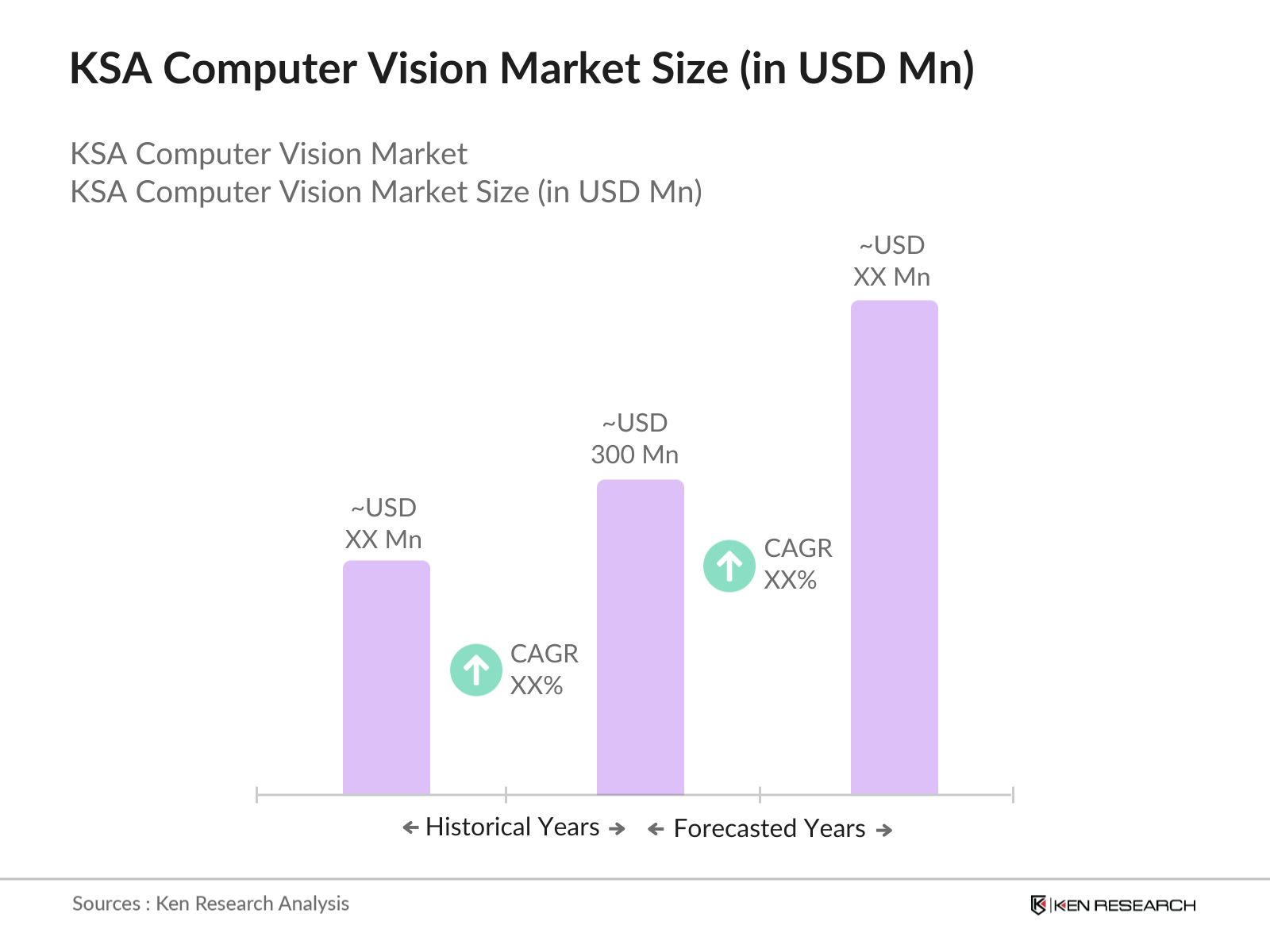
- The KSA Computer Vision market is valued at USD 300 million, based on a five-year historical analysis. This market is primarily driven by advancements in augmented reality (AR) and virtual reality (VR) technologies, along with the increasing demand for enhanced 3D visualization in industries such as healthcare, defense, and entertainment. With the growing focus on interactive display technologies, volumetric displays are becoming a key solution for real-time data visualization and immersive experiences, especially in sectors like medical imaging and automotive design.
- The market dominance is notably concentrated in Riyadh and Jeddah, driven by the robust presence of large-scale industrial operations and smart city initiatives. Riyadh, being the capital and business hub, attracts investments in cutting-edge technologies like AI and computer vision. Meanwhile, Jeddah, as a major commercial port city, facilitates a high volume of logistics and manufacturing activities where computer vision applications are pivotal for automation and operational efficiency. Additionally, these cities benefit from government-sponsored innovation hubs and advanced technological infrastructure.
- Industry-specific standards play a critical role in the adoption of computer vision technologies in Saudi Arabia. The Kingdoms regulatory bodies, including the Saudi Food and Drug Authority (SFDA) and the Ministry of Industry and Mineral Resources, have introduced guidelines for AI applications in sectors like manufacturing, healthcare, and retail. In 2024, the SFDA implemented a new AI regulation requiring medical devices using computer vision for diagnostics to undergo rigorous testing. These regulations ensure that companies adopt best practices, creating a more secure and transparent environment for AI-driven technologies.
KSA Computer Vision Market Segmentation
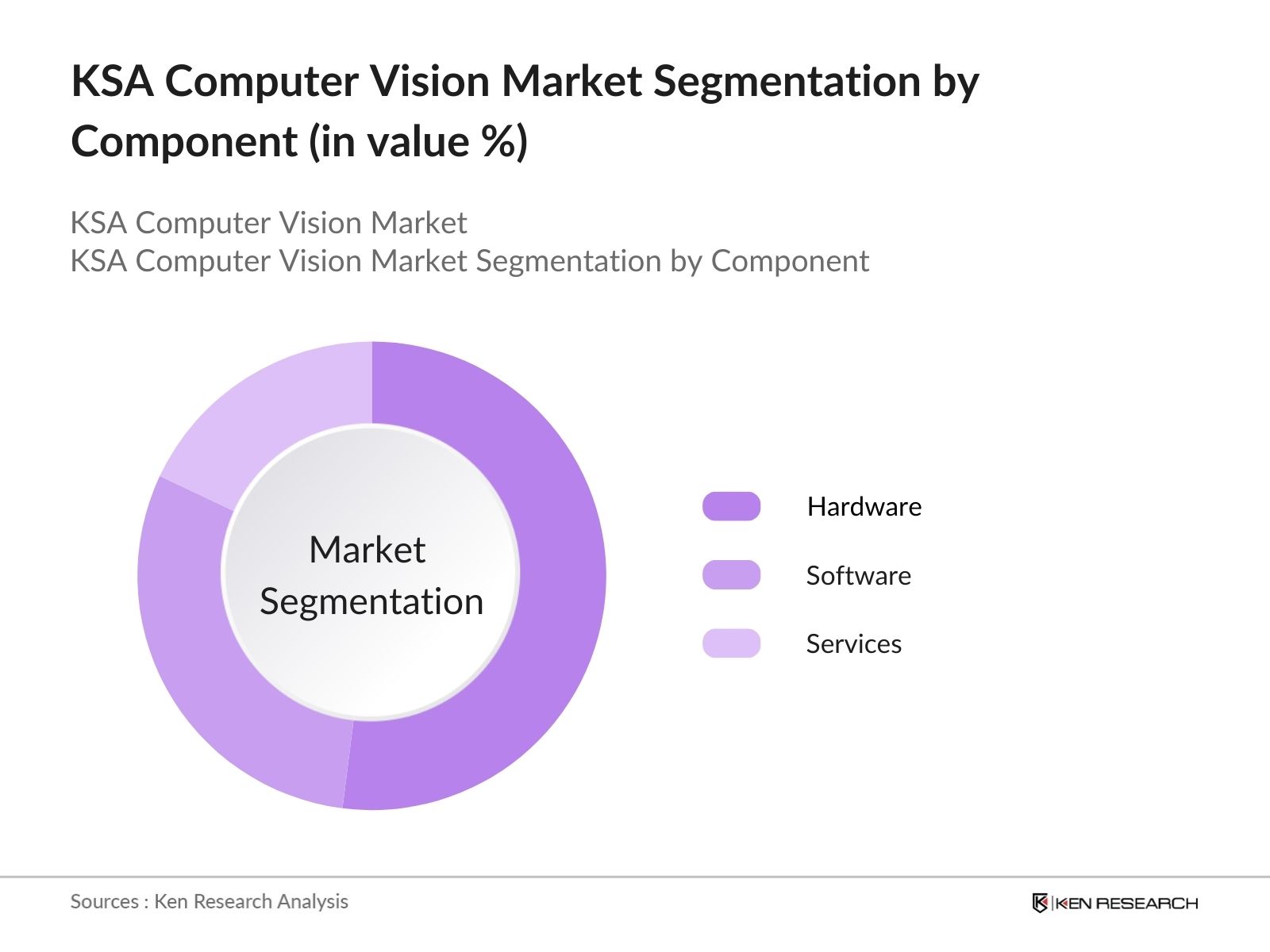
By Component: The KSA Computer Vision market is segmented by component into hardware, software, and services. Hardware, which includes cameras, sensors, and processors, holds the dominant market share. This is because hardware components form the backbone of any computer vision system, with industries such as manufacturing, automotive, and healthcare requiring advanced imaging sensors and high-performance processors for real-time image processing and analytics. Additionally, the continuous advancements in 3D imaging sensors and edge computing solutions have bolstered the demand for computer vision hardware across various sectors.
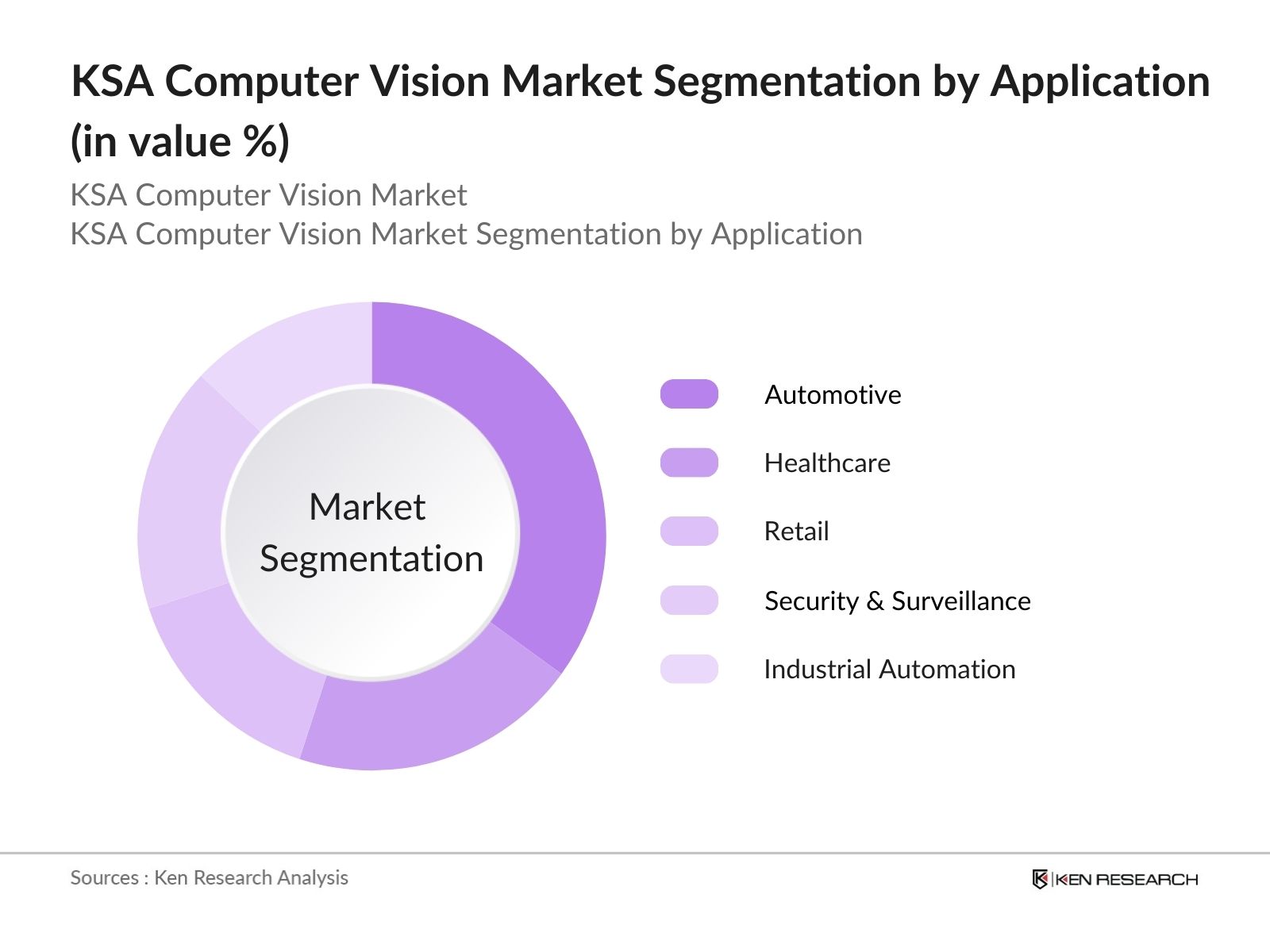
By Application: The market is also segmented by application into automotive, healthcare, retail, security & surveillance, and industrial automation. The automotive segment dominates due to the increasing adoption of autonomous vehicles and advanced driver-assistance systems (ADAS). These systems rely heavily on computer vision technologies for tasks such as object detection, lane keeping, and obstacle avoidance. As Saudi Arabia pushes towards smart mobility solutions, the demand for ADAS and related technologies is expected to drive the automotive application segments continued dominance.
KSA Computer Vision Market Competitive Landscape
The KSA Computer Vision Market is dominated by a mix of global tech giants and regional players. This market consolidation highlights the significant influence of established companies that have a foothold in sectors such as automotive, healthcare, and industrial automation. Major players continually innovate and expand their product offerings to maintain competitive advantages in this highly technological landscape.
|
Company Name |
Established Year |
Headquarters |
No. of Employees |
Annual Revenue |
Product Portfolio |
AI Integration |
M&A Activity |
R&D Expenditure |
|
Cognex Corporation |
1981 |
USA |
||||||
|
Intel Corporation |
1968 |
USA |
||||||
|
NVIDIA Corporation |
1993 |
USA |
||||||
|
Honeywell International |
1906 |
USA |
||||||
|
Hikvision Digital Technology |
2001 |
China |
KSA Computer Vision Industry Analysis
Growth Drivers
- Government Initiatives: Saudi Arabia's Vision 2030 is a driving force behind the adoption of computer vision technologies across various sectors. Under the National Industrial Development and Logistics Program (NIDLP), the government has allocated $450 billion to bolster AI and automation projects in the Kingdom. The Saudi Authority for Data and Artificial Intelligence (SDAIA) is implementing these initiatives, focusing on smart city projects, including NEOM, where computer vision is integral to AI-powered urban infrastructure. This level of funding demonstrates the Kingdom's commitment to becoming a leader in AI and related technologies by enhancing industrial efficiency and urban development.
- Rising Use in Healthcare: The healthcare sector in Saudi Arabia is rapidly embracing AI-driven computer vision technologies, particularly for medical imaging and diagnostics. The Ministry of Health has allocated $42 billion towards modernizing healthcare services, which includes the integration of AI for diagnostic imaging systems. These systems can analyze medical data more efficiently, enabling faster diagnostics for conditions like cancer and cardiovascular diseases. With a national target to reduce diagnostic time by 30%, the use of computer vision in radiology departments is expected to transform medical workflows across public hospitals and clinics.
- Expansion in Retail & Manufacturing: Saudi Arabia's retail and manufacturing sectors are increasingly leveraging computer vision for automation and robotics applications. The Kingdom's industrial output has grown by 12% in 2024, spurred by automation technologies such as AI-powered robots, which are being used in assembly lines and warehouse operations. Leading retail chains in Saudi Arabia, including Panda and Othaim Markets, have also integrated computer vision for inventory management and customer analytics, supported by investments from the Industrial Fund, which allocated $7 billion towards advanced manufacturing technologies to meet global standards.
Market Challenges
- Data Storage and Security Challenges: Data privacy and security remain significant concerns in the implementation of computer vision systems in Saudi Arabia. With the introduction of the Personal Data Protection Law (PDPL) in 2022, businesses are required to comply with stringent data handling and storage regulations. According to SDAIA, 85% of businesses surveyed in 2024 expressed concerns over the security of large-scale data collected through AI-driven systems.
- Limited Skilled Workforce in AI & Computer Vision: A shortage of skilled professionals in AI and computer vision technology is a barrier to widespread adoption in Saudi Arabia. The Kingdom currently has only 11 AI specialists per 100,000 employees, compared to the global average of 30. Government programs are in place to bridge this gap, with 20,000 AI specialists expected to graduate by 2025 under initiatives such as the SDAIA Academy. However, the current workforce shortfall is slowing down the deployment of computer vision in key industries like healthcare and manufacturing.
KSA Computer Vision Market Future Outlook
Over the next five years, the KSA Computer Vision Market is expected to experience significant growth due to several factors, including the increasing integration of AI and machine learning in key industries such as automotive, retail, and healthcare. The Saudi governments Vision 2030 initiative, which emphasizes technological innovation and digital transformation, will further drive demand for computer vision applications. As industries transition to smart systems, there will be an increased reliance on vision technology for automation, security, and enhanced productivity, positioning this market for robust expansion.
Future Market Opportunities
- Rising Adoption of Edge Computing Solutions: Edge computing is gaining traction in Saudi Arabias industrial sectors, providing a key opportunity for the computer vision market. By 2024, 37% of industrial plants in Saudi Arabia are expected to deploy edge computing solutions to reduce latency and improve data processing efficiency. The Saudi government is supporting these efforts with the launch of local data centers, such as the $1 billion data hub established by the Saudi Telecom Company (STC). These centers provide the necessary infrastructure to support AI and computer vision applications in real-time data processing, driving further adoption of these technologies.
- Growing Demand for AI-Powered Surveillance: Saudi Arabia's growing demand for AI-powered surveillance, particularly for enhancing public safety, presents a significant opportunity for the computer vision market. The Kingdom has installed over 500,000 AI-driven cameras across major cities like Riyadh and Jeddah, primarily for traffic monitoring, law enforcement, and crowd management during events such as Hajj. Backed by a $300 million investment from the Ministry of Interior in 2024, these AI-powered systems leverage computer vision to analyze large volumes of video data in real time, improving response times and security measures across the nation.
Scope of the Report
|
By Component |
Hardware Software Services |
|
By Application |
Automotive Healthcare Retail Security & Surveillance Industrial Automation |
|
By Technology |
Deep Learning Machine Learning Augmented Reality (AR) Virtual Reality (VR) |
|
By End-User |
Manufacturing Retail & E-commerce Healthcare Automotive Defense & Security |
|
By Region |
Riyadh Jeddah Dammam Makkah Madinah |
Products
Key Target Audience
AI & Machine Learning Companies
Automotive Manufacturers (ADAS, Autonomous Vehicles)
Healthcare Providers (Medical Imaging, Diagnostics)
Industrial Automation Firms
Security & Surveillance Companies
Investments and Venture Capitalist Firms
Banks and Financial Institutes
Retail and E-commerce Companies
Government and Regulatory Bodies (Saudi Data & AI Authority)
Companies
Major Players
Cognex Corporation
Intel Corporation
NVIDIA Corporation
Microsoft Corporation
Google LLC
Honeywell International
Basler AG
Allied Vision Technologies
Hikvision Digital Technology
Qualcomm Technologies
IBM Corporation
Amazon Web Services (AWS)
Samsung Electronics Co. Ltd.
Omron Corporation
Teledyne Technologies Inc.
Table of Contents
1. KSA Computer Vision Market Overview
1.1 Definition and Scope (Market Definition, Boundaries)
1.2 Market Taxonomy (AI/ML Integration, Use-Cases)
1.3 Market Growth Rate (CAGR, Market Trends)
1.4 Market Segmentation Overview (Industry Applications, End-User Types)
2. KSA Computer Vision Market Size (In USD Bn)
2.1 Historical Market Size (Value, Adoption Rates)
2.2 Year-On-Year Growth Analysis (Technological Advances, Investment Trends)
2.3 Key Market Developments and Milestones (Product Launches, New Partnerships)
3. KSA Computer Vision Market Analysis
3.1 Growth Drivers (AI Adoption, Industrial Automation, Smart City Projects)
3.1.1 Government Initiatives (Vision 2030, Innovation Grants)
3.1.2 Rising Use in Healthcare (AI-Driven Imaging, Diagnostics)
3.1.3 Expansion in Retail & Manufacturing (Automation, Robotics)
3.2 Restraints (Data Privacy Issues, High Initial Setup Costs)
3.2.1 Data Storage and Security Challenges
3.2.2 Limited Skilled Workforce in AI & Computer Vision
3.3 Opportunities (Emerging Startups, International Collaborations)
3.3.1 Rising Adoption of Edge Computing Solutions
3.3.2 Growing Demand for AI-Powered Surveillance
3.3.3 Increasing Applications in Autonomous Vehicles
3.4 Trends (Deep Learning Integration, Edge AI, Video Analytics)
3.4.1 Adoption of 3D Vision Technology
3.4.2 Expansion into Smart Manufacturing Solutions
3.4.3 Use of Augmented Reality in Retail
3.5 Government Regulation (Data Protection, AI Regulatory Guidelines)
3.5.1 Saudi Data & AI Authority Regulations
3.5.2 Compliance with Industry-Specific Standards
3.5.3 National AI Strategy Impact
3.6 SWOT Analysis (Market Positioning, Risk Analysis)
3.7 Stakeholder Ecosystem (Suppliers, Distributors, AI Solution Providers)
3.8 Porters Five Forces (Competitive Landscape)
3.9 Competition Ecosystem (Market Dynamics, Competitive Advantage)
4. KSA Computer Vision Market Segmentation
4.1 By Component (In Value %)
4.1.1 Hardware (Cameras, Sensors, Processors)
4.1.2 Software (AI Algorithms, SDKs, Analytics Platforms)
4.1.3 Services (Consulting, System Integration, Maintenance)
4.2 By Application (In Value %)
4.2.1 Automotive (Autonomous Vehicles, Driver Assistance)
4.2.2 Healthcare (Medical Imaging, Diagnostics)
4.2.3 Retail (Visual Search, In-Store Analytics)
4.2.4 Security & Surveillance (Facial Recognition, Threat Detection)
4.2.5 Industrial Automation (Robotics, Quality Control)
4.3 By Technology (In Value %)
4.3.1 Deep Learning (Neural Networks, Image Recognition)
4.3.2 Machine Learning (Pattern Recognition, Data Training)
4.3.3 Augmented Reality (AR) and Virtual Reality (VR) (Smart Glasses, Object Detection)
4.4 By End-User (In Value %)
4.4.1 Manufacturing
4.4.2 Retail & E-commerce
4.4.3 Healthcare
4.4.4 Automotive
4.4.5 Defense & Security
4.5 By Region (In Value %)
4.5.1 Riyadh
4.5.2 Jeddah
4.5.3 Dammam
4.5.4 Makkah
4.5.5 Madinah
5. KSA Computer Vision Market Competitive Analysis
5.1 Detailed Profiles of Major Companies
5.1.1 Cognex Corporation
5.1.2 Intel Corporation
5.1.3 NVIDIA Corporation
5.1.4 Qualcomm Technologies
5.1.5 Microsoft Corporation
5.1.6 IBM Corporation
5.1.7 Amazon Web Services (AWS)
5.1.8 Google LLC
5.1.9 Honeywell International
5.1.10 Basler AG
5.1.11 Allied Vision Technologies
5.1.12 Hikvision Digital Technology
5.1.13 Omron Corporation
5.1.14 Samsung Electronics Co. Ltd.
5.1.15 Teledyne Technologies Inc.
5.2 Cross Comparison Parameters (No. of Employees, Headquarters, Technology Leadership, Revenue, Market Share, Product Range, M&A Activity)
5.3 Market Share Analysis (Region-Wise, Segment-Wise)
5.4 Strategic Initiatives (Partnerships, Product Development)
5.5 Mergers and Acquisitions (Recent, Historical Deals)
5.6 Investment Analysis (Venture Capital, Private Equity)
5.7 Government Grants and Funding (Incentives for AI Growth)
5.8 Private Equity Investments (Recent Trends)
6. KSA Computer Vision Market Regulatory Framework
6.1 Data Privacy Regulations (Compliance, Challenges)
6.2 AI Ethical Guidelines (Government Stipulations)
6.3 Certification and Compliance Processes (Standardizations)
7. KSA Computer Vision Market Future Size (In USD Mn)
7.1 Future Market Size Projections (CAGR, Revenue Growth)
7.2 Key Factors Driving Future Market Growth (AI Penetration, Smart Cities Expansion)
8. KSA Computer Vision Market Future Segmentation
8.1 By Component (In Value %)
8.2 By Application (In Value %)
8.3 By Technology (In Value %)
8.4 By End-User (In Value %)
8.5 By Region (In Value %)
9. KSA Computer Vision Market Analysts Recommendations
9.1 TAM/SAM/SOM Analysis
9.2 Customer Cohort Analysis
9.3 Go-to-Market Strategies
9.4 White Space Opportunity Analysis
Disclaimer Contact UsResearch Methodology
Step 1: Identification of Key Variables
The first step in our research involves mapping the entire KSA Computer Vision Market ecosystem. By utilizing desk research and proprietary databases, we have identified key variables that influence the market, such as the growing adoption of AI technologies, government initiatives, and industry-specific use cases.
Step 2: Market Analysis and Construction
This step involves gathering historical data related to the KSA Computer Vision Market. We analyze market penetration rates across various applications and industries, assessing the technological landscape and calculating revenue estimates. This phase also involves reviewing industry reports and technological trends to provide a comprehensive analysis.
Step 3: Hypothesis Validation and Expert Consultation
Market hypotheses are developed and validated through in-depth interviews with industry experts, including executives from key market players. These consultations help refine our data and provide real-time insights into market dynamics, company strategies, and industry trends.
Step 4: Research Synthesis and Final Output
The final step involves synthesizing the data collected and presenting a complete report. We validate our findings through further consultations with stakeholders and manufacturers in the computer vision space, ensuring accuracy and comprehensiveness in our final output.
Frequently Asked Questions
01. How big is the KSA Computer Vision Market?
The KSA Computer Vision Market is valued at USD 300 Mn, driven by advancements in AI technologies, increased automation, and government support for innovation.
02. What are the challenges in the KSA Computer Vision Market?
Challenges in KSA Computer Vision Market include the high cost of implementation, lack of skilled workforce in AI-related fields, and concerns around data privacy and security in computer vision applications.
03. Who are the major players in the KSA Computer Vision Market?
Key players in KSA Computer Vision Market include Cognex Corporation, NVIDIA Corporation, Intel Corporation, and Honeywell International, with these companies leading in AI integration and hardware innovation.
04. What are the growth drivers of the KSA Computer Vision Market?
Growth in KSA Computer Vision Market is driven by the increased use of AI in automation, government initiatives promoting technological innovation, and the rising adoption of smart systems in key industries such as automotive and healthcare.
Why Buy From Us?

What makes us stand out is that our consultants follows Robust, Refine and Result (RRR) methodology. i.e. Robust for clear definitions, approaches and sanity checking, Refine for differentiating respondents facts and opinions and Result for presenting data with story

We have set a benchmark in the industry by offering our clients with syndicated and customized market research reports featuring coverage of entire market as well as meticulous research and analyst insights.

While we don't replace traditional research, we flip the method upside down. Our dual approach of Top Bottom & Bottom Top ensures quality deliverable by not just verifying company fundamentals but also looking at the sector and macroeconomic factors.

With one step in the future, our research team constantly tries to show you the bigger picture. We help with some of the tough questions you may encounter along the way: How is the industry positioned? Best marketing channel? KPI's of competitors? By aligning every element, we help maximize success.

Our report gives you instant access to the answers and sources that other companies might choose to hide. We elaborate each steps of research methodology we have used and showcase you the sample size to earn your trust.

If you need any support, we are here! We pride ourselves on universe strength, data quality, and quick, friendly, and professional service.