















KSA Cosmeceuticals Market Outlook to 2030
Region:Middle East
Author(s):Shubham Kashyap
Product Code:KROD3769
November 2024
80
About the Report
KSA Cosmeceuticals Market Overview
The KSA cosmeceuticals market is valued at USD 5.20 billion, driven by a growing awareness of skincare and healthcare benefits. The increased focus on personal care products combining cosmetic and pharmaceutical qualities has been a significant driver in this growth. The rise of disposable income, especially in urban areas, along with growing consumer demand for anti-aging, sun protection, and skin brightening products, has fueled market expansion. This sector is seeing substantial investments and product innovations from both local and international players, making cosmeceuticals one of the fastest-growing markets in the beauty and healthcare sectors.
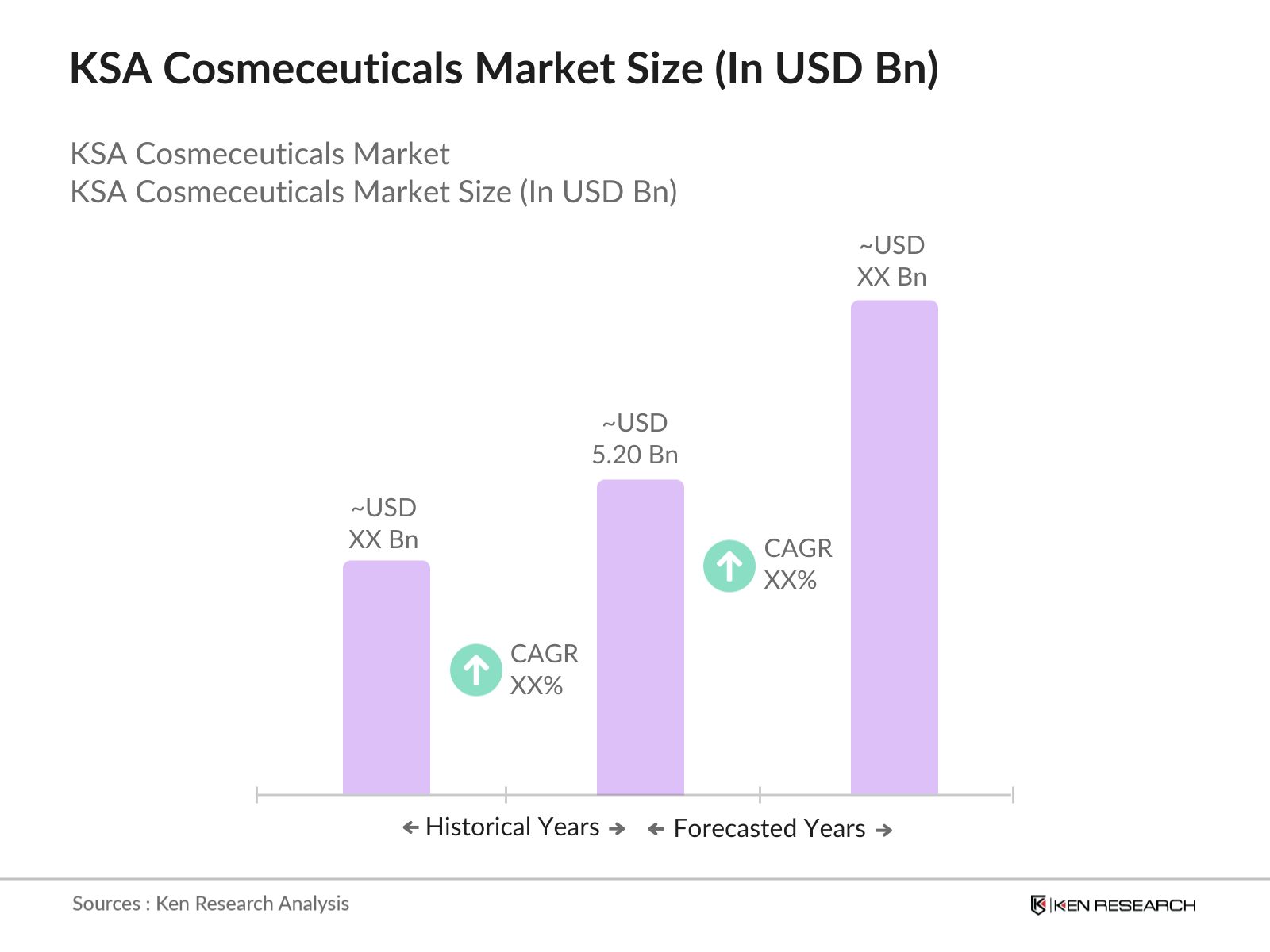
- Major demand hubs for cosmeceuticals in Saudi Arabia include Riyadh, Jeddah, and the Eastern Province, driven by the country's high-income population and increasing demand for premium skincare and haircare solutions. The governments Vision 2030, aimed at improving lifestyle and healthcare standards, further supports the demand for cosmeceutical products, particularly those offering anti-aging, sun protection, and skin brightening benefits.
- The SFDA sets stringent regulatory standards for cosmeceutical products to ensure safety and efficacy. In 2024, the SFDA approved over 5,800 cosmeceutical product registrations, with a focus on compliance with labeling, ingredient transparency, and product claims. Brands that fail to meet these standards face product recalls and penalties. The regulatory framework is designed to protect consumers and maintain high product quality, making SFDA approval a critical factor for market entry and sustainability.
KSA Cosmeceuticals Market Segmentation
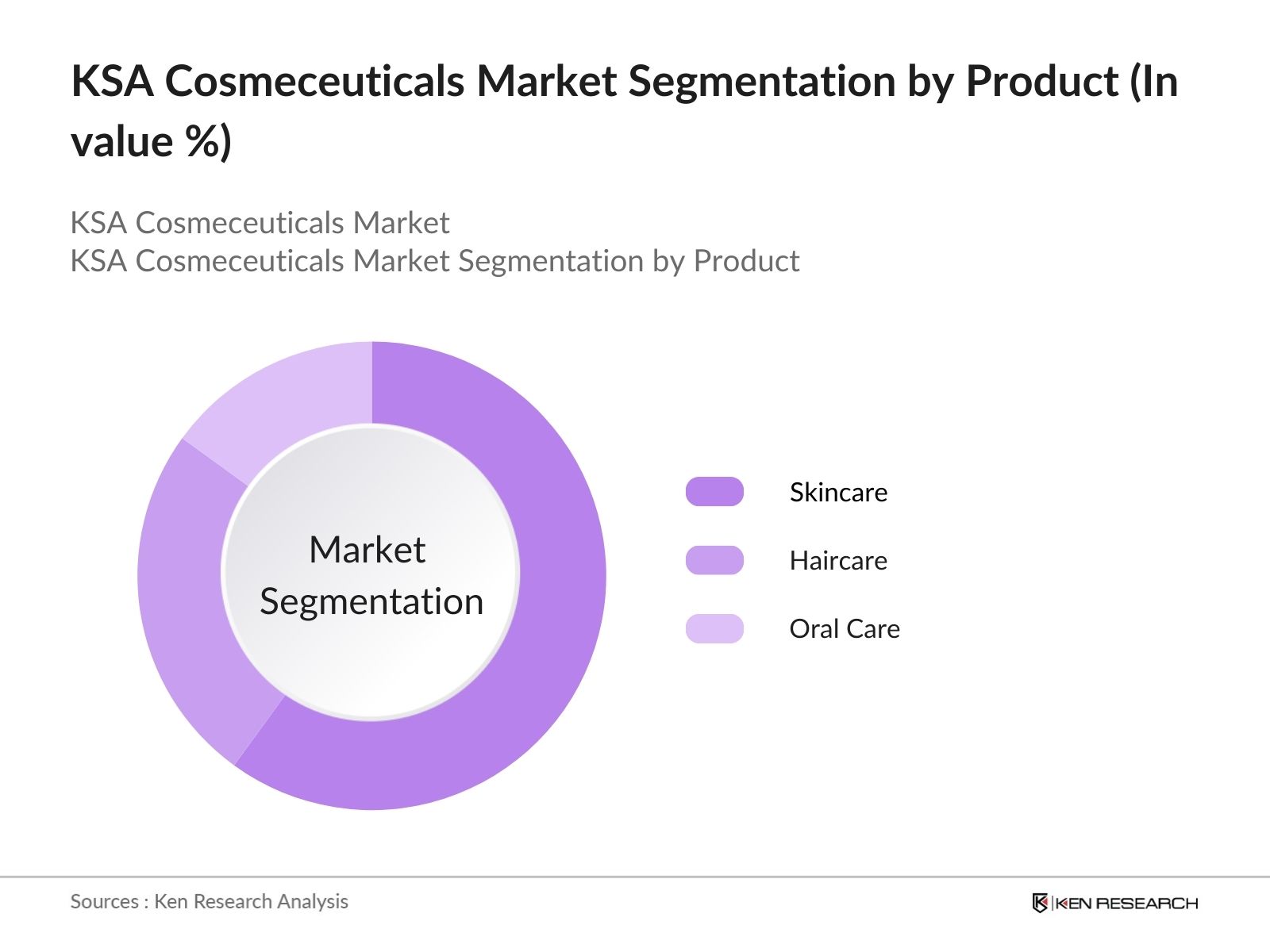
By Product Type: The market is segmented by product type into skincare, haircare, and oral care products. Skincare products dominate the market, holding the majority of the share. The demand for anti-aging creams, sunscreens, and skin-brightening serums is consistently high among consumers. This dominance is driven by the significant awareness among consumers about skincare routines and the availability of advanced dermatology products tailored for different skin conditions, including hyperpigmentation and acne. Brands offering medical-grade skincare formulations such as retinoids and peptides are particularly strong performers in this segment.
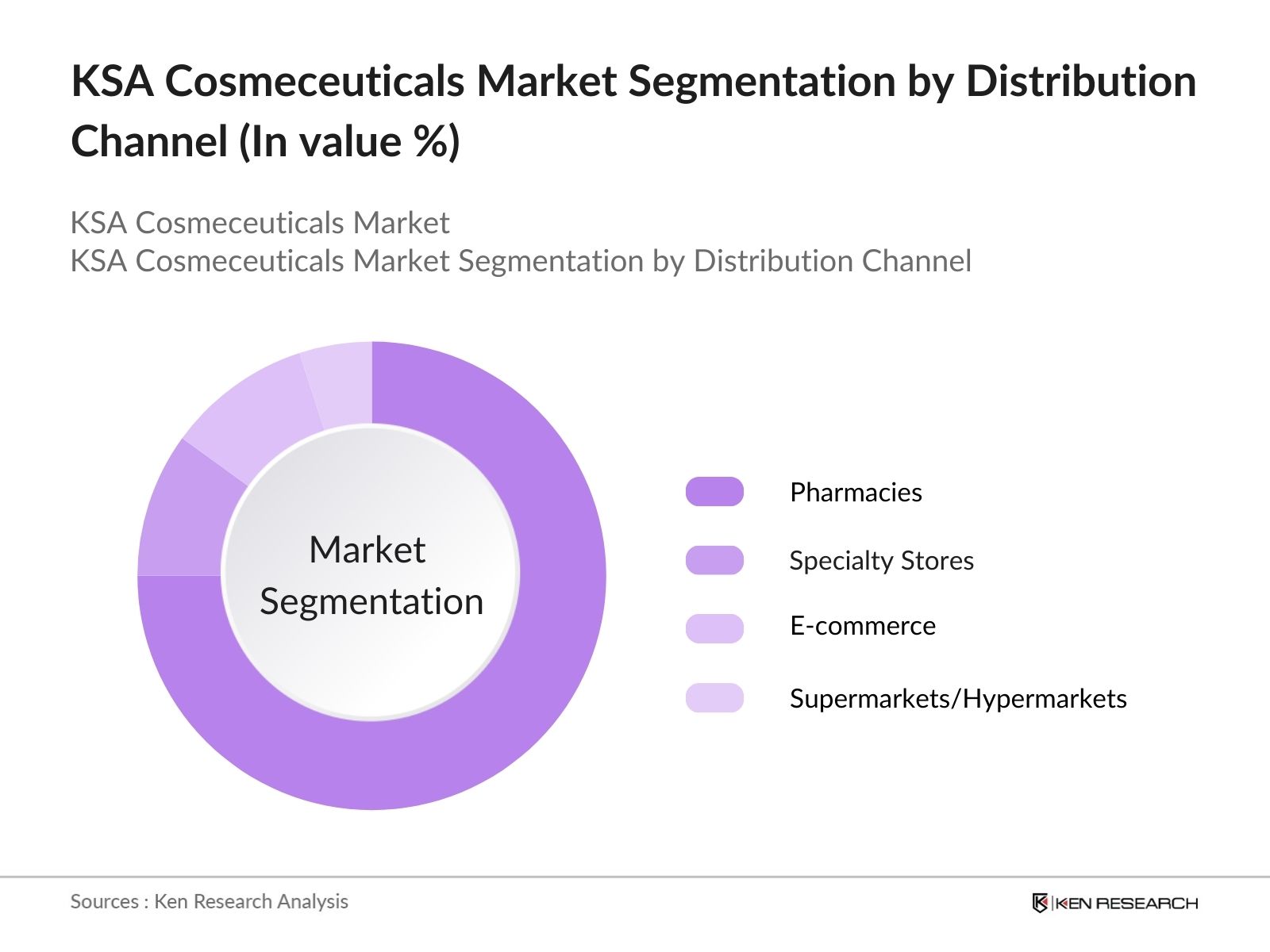
- By Distribution Channel: The market is also segmented by distribution channels into pharmacies, specialty stores, e-commerce platforms, and supermarkets/hypermarkets. Pharmacies lead the distribution channels in 2023. This is largely because consumers in Saudi Arabia prefer purchasing medical-grade and dermatology-backed skincare products from trusted pharmacy chains. E-commerce platforms are rapidly growing, especially after the pandemic, as consumers increasingly opt for online purchases due to the convenience of home delivery and exclusive offers on premium cosmeceutical products.
KSA Cosmeceuticals Market Competitive Landscape
The KSA cosmeceuticals market is highly competitive, featuring both multinational companies and local brands. Major international players such as L'Oral, Este Lauder, and Johnson & Johnson dominate the market, offering a wide array of cosmeceutical products tailored to the specific skincare needs of Saudi consumers. These companies focus heavily on innovation, product diversification, and targeted marketing to retain their market share.
Local companies such as Saudi Medical Group and Jamjoom Pharma are also key players, leveraging their understanding of local consumer preferences to introduce products that address specific skin and hair concerns prevalent in the region, such as hyperpigmentation and hair thinning.
|
Company Name |
Establishment Year |
Headquarters |
Revenue (2023) |
Employees |
Key Product |
R&D Investment |
Key Clients |
Partnerships |
|
L'Oral |
1909 |
France |
||||||
|
Este Lauder |
1946 |
USA |
||||||
|
Johnson & Johnson |
1886 |
USA |
||||||
|
Saudi Medical Group |
1990 |
Saudi Arabia |
||||||
|
Jamjoom Pharma |
1994 |
Saudi Arabia |
KSA Cosmeceuticals Industry Analysis
Growth Drivers:
- Increasing Demand for Anti-aging and Skin Health Products: The demand for anti-aging and skin health products in Saudi Arabia has been on the rise due to changing consumer preferences and a growing awareness of skincare among individuals over 30 years of age. With over 13.4 million people in Saudi Arabia aged 30 and above in 2024 (General Authority for Statistics), the market for anti-aging products has witnessed a significant increase in demand. The Kingdom's middle-class population is rapidly expanding, with disposable income levels contributing to consumer willingness to invest in premium skincare products to combat ageing and maintain skin health.
- Technological Advancements in Skincare Formulations: Technological innovations in skincare have improved the efficacy of cosmeceuticals, with nanotechnology and bioactive ingredient delivery systems becoming more prevalent. In 2022, Saudi Arabia imported over 80% of its beauty products worth USD 999 Mn, advancements in product formulations through collaboration with international markets have boosted the demand for technologically superior products. The influx of products utilizing advanced peptides and plant stem cells has resulted in higher product efficacy and consumer confidence, driving the market forward. Around a major portion of imported skincare products now incorporate such advancements, according to the Saudi Food and Drug Authority (SFDA).
- Rising Disposable Income Among Middle-Class Consumers: Saudi Arabias household income per capita increased by 15.4% between 2020 and 2024 reaching USD 33040 in 2024, as per World Bank data. This rise in disposable income has allowed middle-class consumers to increase their spending on personal care products, including cosmeceuticals. With the Saudi Vision 2030 initiatives encouraging private sector growth and job creation, a major portion of Saudi households have reported higher purchasing power, further boosting demand for premium skincare and beauty solutions. The expanding middle class, which constitutes over 44% of the population, is a significant driver of this trend.
Market Challenges:
- High Cost of Premium Cosmeceuticals: Premium cosmeceuticals in Saudi Arabia come with a high price tag, limiting accessibility to only a portion of the population. The cost of imported, high-end cosmeceutical products is significantly higher due to tariffs and transportation costs, which is one of the major challenges in expanding the market to the broader population. For lower-income families, this can make premium products less attainable, creating a market divide. The high costs associated with premium products also impact the competitiveness of local brands as they try to compete with well-established international brands.
- Stringent Regulatory Requirements by SFDA: The Saudi Food and Drug Authority (SFDA) imposes strict regulations on cosmeceutical products entering the market. Importers and manufacturers are required to meet complex certification and labeling standards, which can delay product launches significantly. The regulatory requirements, while ensuring safety and quality, often lead to increased costs and extended time-to-market for new products. This can pose challenges for brands seeking to introduce innovative products quickly. The rigorous approval process may also limit agility and flexibility for companies looking to expand in a competitive market.
KSA Cosmeceuticals Market Future Outlook
The KSA cosmeceuticals market is projected to continue its upward growth trajectory through 2028, driven by an increasing focus on health-conscious and beauty-aware consumers. The market is expected to witness more localized product offerings, with a growing trend towards halal-certified cosmeceuticals that cater to the specific cultural and religious needs of Saudi consumers.
Future Market Opportunities:
- Increasing Adoption of E-commerce Platforms: With over 35 million internet users in Saudi Arabia, e-commerce platforms have become a critical channel for the distribution of cosmeceuticals. In 2024, online sales accounted for a substantial portion of all personal care product sales, a figure that is expected to grow as more consumers turn to digital platforms for convenience. The rise of platforms such as Noon and Amazon in the region has enabled both local and international brands to reach a wider audience, significantly lowering the barriers to entry for smaller players in the market.
- Local Manufacturing and Product Customization: Saudi Arabias Vision 2030 initiative has provided incentives for local manufacturing, and the cosmeceuticals market is benefiting from this trend. In 2024, local manufacturing in the personal care segment grew exceptionally, reducing dependence on imports and allowing for better customization to suit the preferences of Saudi consumers. This shift towards localized production has also led to the creation of more job opportunities and reduced prices for consumers, making it an attractive opportunity for international brands looking to expand their footprint in the Kingdom.
Scope of the Report
|
By Product |
Skincare Haircare Oral Care |
|
By Active Ingredient |
Retinoids, Peptides, Vitamins (C, E) Alpha Hydroxy Acids (AHAs), Natural Extracts (Aloe Vera, Green Tea) |
|
By End User |
Men Women Unisex |
|
By Distribution Channel |
Pharmacies Specialty Stores E-commerce Supermarkets & Hypermarkets |
|
By Region |
Riyadh Jeddah Eastern Province Central Region Western Region |
Products
Key Target Audience
Cosmeceutical Manufacturers
Skincare Clinics and Dermatology Centers
Pharmacies and Specialty Stores
E-commerce Platforms
Medical Aesthetic Clinics
Investors and Venture Capitalist Firms
Government and Regulatory Bodies (Saudi Food and Drug Authority - SFDA)
Beauty and Wellness Centers
Banks and Financial Institutions
Companies
Major Players Mentioned in the Report
L'Oral
Este Lauder
Johnson & Johnson
Beiersdorf AG
Procter & Gamble
Shiseido
The Ordinary
Olay
Clarins
Bioderma
Jamjoom Pharma
Saudi Medical Group
L'occitane
Dove
Neutrogena
Table of Contents
01 KSA Cosmeceuticals Market Overview
1.1. Definition and Scope
1.2. Market Taxonomy
1.3. Market Growth Rate
1.4. Market Segmentation Overview
02 KSA Cosmeceuticals Market Size (In USD Mn)
2.1. Historical Market Size
2.2. Year-On-Year Growth Analysis
2.3. Key Market Developments and Milestones
03 KSA Cosmeceuticals Market Analysis
3.1. Growth Drivers (Consumer Demand, Technological Innovations, Rising Disposable Income, and Halal Products Demand)
3.1.1. Increasing Demand for Anti-aging and Skin Health Products
3.1.2. Technological Advancements in Skincare Formulations
3.1.3. Rising Disposable Income Among Middle-Class Consumers
3.1.4. Growth of Halal-Certified Cosmeceuticals
3.2. Market Challenges (High Costs, Regulatory Barriers, Market Saturation)
3.2.1. High Prices of Premium Cosmeceuticals
3.2.2. Stringent Regulatory Requirements by SFDA
3.2.3. Market Saturation with Competitive Offerings
3.3. Opportunities (E-commerce Expansion, Localization of Products, Medical Aesthetic Procedures)
3.3.1. Increasing Adoption of E-commerce Platforms
3.3.2. Local Manufacturing and Product Customization
3.3.3. Growing Popularity of Medical Aesthetic Procedures
3.4. Trends (Halal Certifications, Organic Ingredients, Personalized Skincare)
3.4.1. Rising Demand for Halal-Certified Cosmeceuticals
3.4.2. Increased Focus on Organic and Natural Ingredients
3.4.3. Personalized Skincare Solutions Through Technological Innovation
3.5. Government Regulations (SFDA Compliance, Product Certification)
3.5.1. Saudi Food and Drug Authority (SFDA) Regulatory Standards
3.5.2. Certification and Labeling Requirements
3.5.3. Import Regulations for Cosmeceuticals
3.5.4. Government Incentives for Local Manufacturing
3.6. SWOT Analysis
3.7. Stakeholder Ecosystem
3.8. Porters Five Forces
3.9. Competition Ecosystem
04 KSA Cosmeceuticals Market Segmentation
4.1. By Product Type (In Value %)
4.1.1. Skincare (Anti-aging, Sunscreens, Skin Brightening)
4.1.2. Haircare (Shampoos, Serums, Anti-hair Loss)
4.1.3. Oral Care (Whitening Solutions, Sensitive Teeth Treatments)
4.2. By Active Ingredient (In Value %)
4.2.1. Retinoids
4.2.2. Peptides
4.2.3. Vitamins (Vitamin C, Vitamin E)
4.2.4. Alpha Hydroxy Acids (AHAs)
4.2.5. Natural Extracts (Aloe Vera, Green Tea)
4.3. By End User (In Value %)
4.3.1. Men
4.3.2. Women
4.3.3. Unisex
4.4. By Distribution Channel (In Value %)
4.4.1. Pharmacies
4.4.2. Specialty Stores
4.4.3. E-commerce Platforms
4.4.4. Supermarkets and Hypermarkets
4.5. By Region (In Value %)
4.5.1. Riyadh
4.5.2. Jeddah
4.5.3. Eastern Province
4.5.4. Central Region
4.5.5. Western Region
05 KSA Cosmeceuticals Market Competitive Analysis
5.1. Detailed Profiles of Major Companies
5.1.1. L'Oral
5.1.2. Este Lauder
5.1.3. Johnson & Johnson
5.1.4. Beiersdorf AG
5.1.5. Procter & Gamble
5.1.6. Shiseido
5.1.7. The Ordinary
5.1.8. Olay
5.1.9. Clarins
5.1.10. Bioderma
5.1.11. Jamjoom Pharma
5.1.12. Saudi Medical Group
5.1.13. L'occitane
5.1.14. Dove
5.1.15. Neutrogena
5.2. Cross Comparison Parameters
5.2.1. Number of Employees
5.2.2. Headquarters
5.2.3. Year of Establishment
5.2.4. Revenue
5.2.5. Market Share
5.2.6. Product Portfolio
5.2.7. Research & Development Investment
5.2.8. Key Market Clients
06 KSA Cosmeceuticals Market Regulatory Framework
6.1. Cosmetic and Pharmaceutical Product Regulations
6.2. SFDA Compliance and Certifications
6.3. Import & Export Regulations
6.4. Local Manufacturing Incentives
07 KSA Cosmeceuticals Future Market Size (In USD Mn)
7.1. Future Market Size Projections
7.2. Key Factors Driving Future Market Growth
08 KSA Cosmeceuticals Future Market Segmentation
8.1. By Product Type (In Value %)
8.2. By Active Ingredient (In Value %)
8.3. By End User (In Value %)
8.4. By Distribution Channel (In Value %)
8.5. By Region (In Value %)
09 KSA Cosmeceuticals Market Analysts Recommendations
9.1. TAM/SAM/SOM Analysis
9.2. Customer Cohort Analysis
9.3. Marketing Initiatives
9.4. White Space Opportunity Analysis
Research Methodology
Step 1: Identification of Key Variables
The initial phase involves constructing an ecosystem map for the KSA cosmeceuticals market. Extensive desk research, including proprietary databases and secondary sources, was conducted to identify key variables, such as consumer trends, market drivers, and competitor landscapes, shaping the market.
Step 2: Market Analysis and Construction
Historical data pertaining to the KSA cosmeceuticals market was compiled to analyze key growth trends, market penetration, and product adoption rates. The evaluation of product performance across different market segments allowed for accurate revenue and growth projections.
Step 3: Hypothesis Validation and Expert Consultation
Consultations with industry experts and key stakeholders were conducted via computer-assisted telephone interviews (CATIs) to validate market hypotheses. These consultations offered valuable insights on market dynamics, distribution strategies, and emerging trends within the cosmeceuticals sector.
Step 4: Research Synthesis and Final Output
The final phase involved synthesizing the collected data and expert insights to develop comprehensive market insights. Detailed engagement with local cosmeceutical brands helped in verifying product segment data and distribution channels. This synthesis allowed for the validation of the bottom-up analysis approach.
Frequently Asked Questions
01 How big is the KSA Cosmeceuticals Market?
The KSA cosmeceuticals market is valued at USD 5.20 billion, driven by increased consumer awareness and demand for premium skincare and haircare products.
02 What are the challenges in the KSA Cosmeceuticals Market?
Key challenges in the KSA cosmeceuticals market include high costs of premium products, regulatory barriers imposed by SFDA, and the increasing competition from international and local brands.
03 Who are the major players in the KSA Cosmeceuticals Market?
Major players in the KSA cosmeceuticals market include L'Oral, Este Lauder, Johnson & Johnson, Beiersdorf AG, and Jamjoom Pharma, dominating with a wide range of product offerings and robust distribution networks.
04 What are the growth drivers of the KSA Cosmeceuticals Market?
Growth drivers in the KSA cosmeceuticals market include rising disposable income, increasing demand for anti-aging and sun protection products, and the growth of e-commerce platforms offering premium skincare solutions.
Why Buy From Us?

What makes us stand out is that our consultants follows Robust, Refine and Result (RRR) methodology. i.e. Robust for clear definitions, approaches and sanity checking, Refine for differentiating respondents facts and opinions and Result for presenting data with story

We have set a benchmark in the industry by offering our clients with syndicated and customized market research reports featuring coverage of entire market as well as meticulous research and analyst insights.

While we don't replace traditional research, we flip the method upside down. Our dual approach of Top Bottom & Bottom Top ensures quality deliverable by not just verifying company fundamentals but also looking at the sector and macroeconomic factors.

With one step in the future, our research team constantly tries to show you the bigger picture. We help with some of the tough questions you may encounter along the way: How is the industry positioned? Best marketing channel? KPI's of competitors? By aligning every element, we help maximize success.

Our report gives you instant access to the answers and sources that other companies might choose to hide. We elaborate each steps of research methodology we have used and showcase you the sample size to earn your trust.

If you need any support, we are here! We pride ourselves on universe strength, data quality, and quick, friendly, and professional service.