















KSA Data Center Storage Market Outlook to 2030
Region:Middle East
Author(s):Mukul
Product Code:KROD8362
October 2024
99
About the Report
KSA Data Center Storage Market Overview
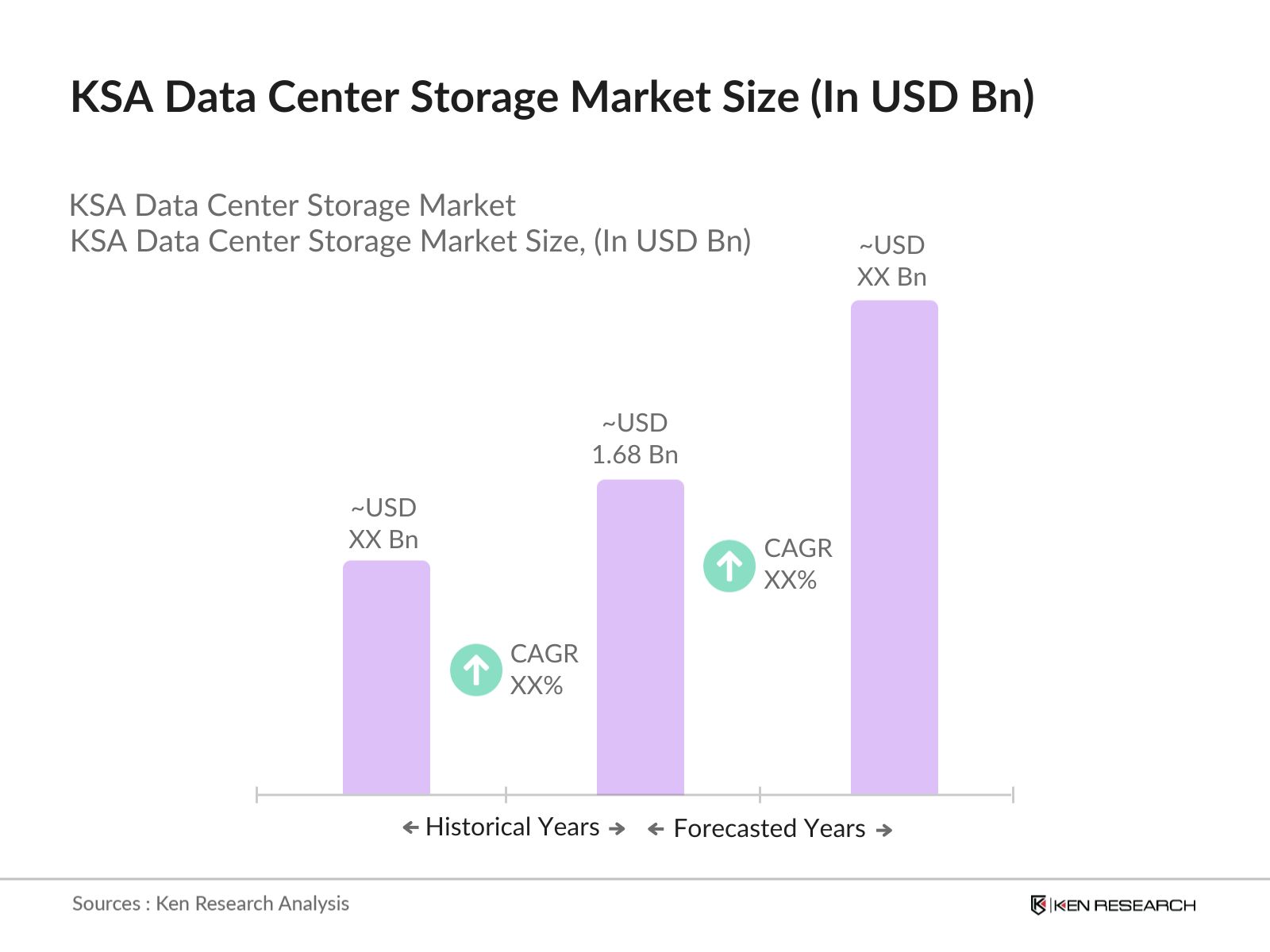
- The KSA Data Center Storage market is valued at USD 1.68 billion, driven by increasing cloud adoption and the Kingdom's ambitious digital transformation goals, particularly in line with Vision 2030. The government's push for economic diversification has accelerated the adoption of advanced data storage infrastructure across various sectors, especially in industries like finance, healthcare, and oil & gas. The rise in digital services, along with the expansion of hyperscale data centers, is further boosting market growth.
- Major cities such as Riyadh, Jeddah, and Dammam dominate the data center storage market in Saudi Arabia. Riyadh serves as a key financial and technological hub, attracting significant investments from both private and public sectors. Jeddah and Dammam are essential due to their strategic geographic positions and the growth of industries such as logistics and oil & gas, which require robust data storage infrastructure to support expanding operations.
- The Saudi governments data localization policies mandate that certain types of data, particularly financial and healthcare records, must be stored within the country. This regulation has driven companies to establish or expand local data centers. For instance, local banks have been required to store sensitive financial data domestically since 2022, resulting in a 30% increase in data center construction by financial institutions in Riyadh and Jeddah.
KSA Data Center Storage Market Segmentation
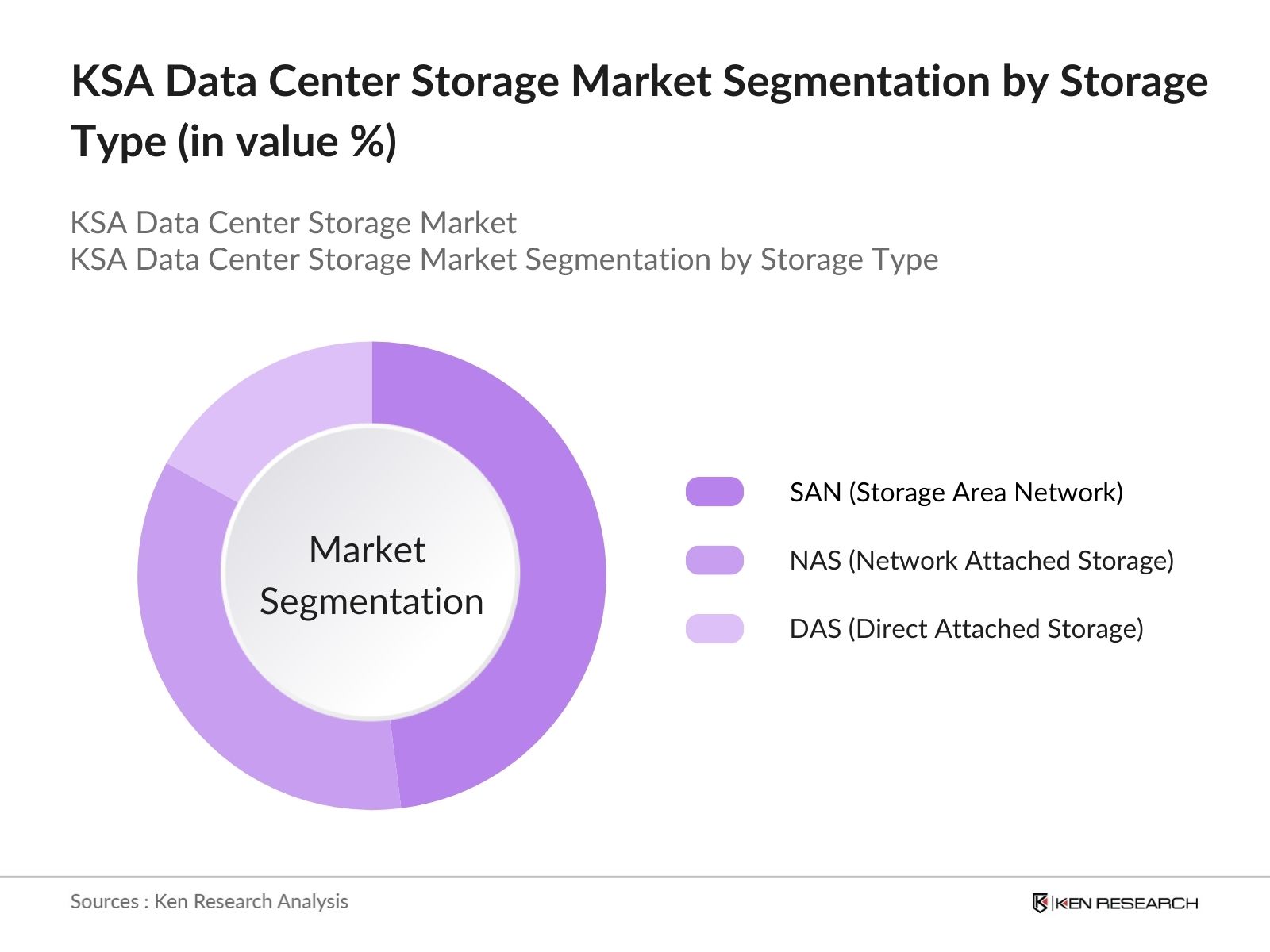
- By Storage Type: The KSA Data Center Storage market is segmented by storage type into SAN (Storage Area Network), NAS (Network Attached Storage), and DAS (Direct Attached Storage). SAN holds a dominant market share due to its high reliability, scalability, and ability to manage large amounts of data, making it the preferred choice for enterprises dealing with mission-critical applications. Organizations in sectors such as finance and healthcare, which handle large volumes of sensitive data, continue to opt for SAN solutions to ensure data security and efficient data management.
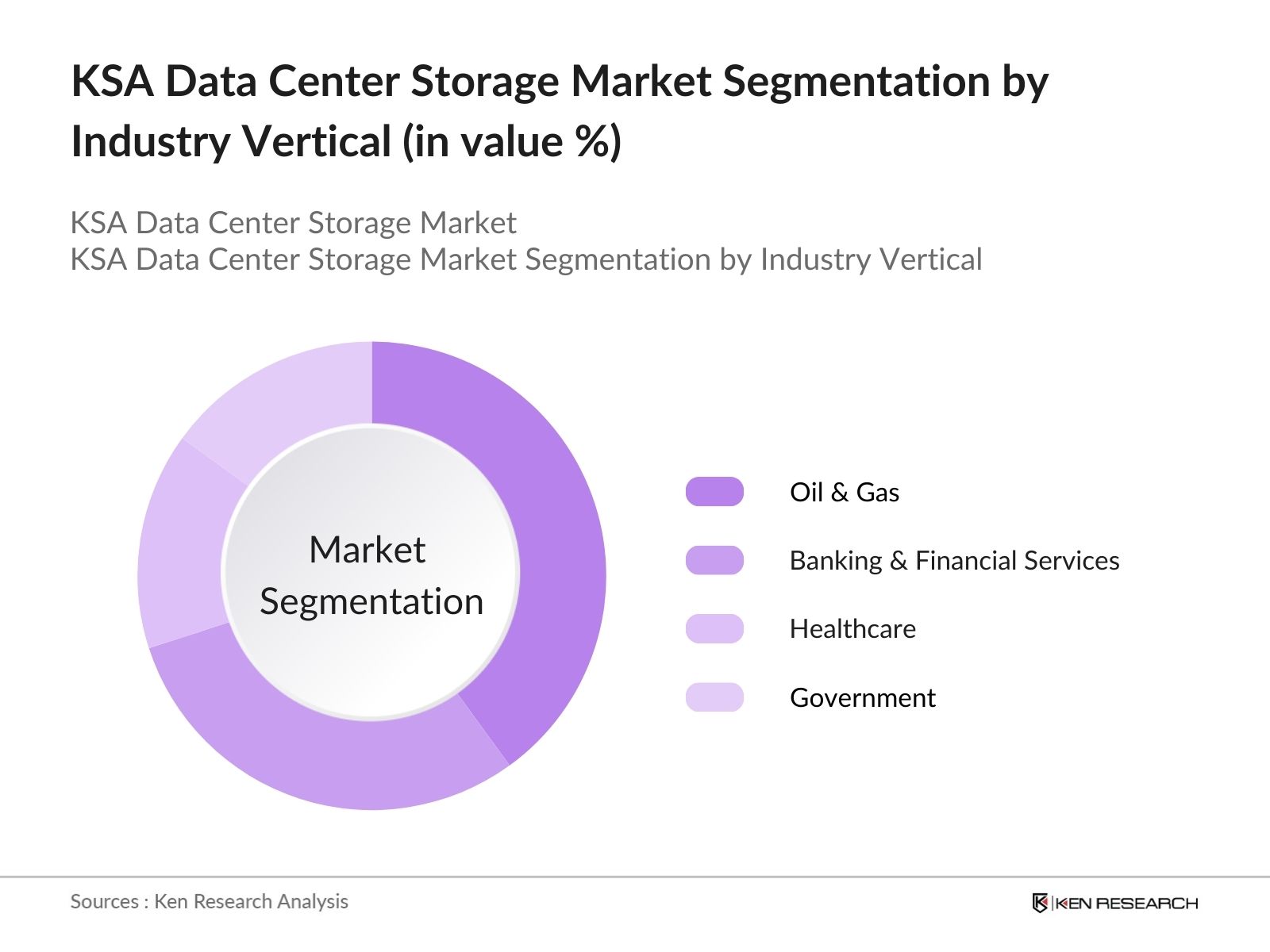
- By Industry Vertical: The market is segmented by industry vertical into oil & gas, banking & financial services, healthcare, government, and telecommunications. The oil & gas sector holds the largest market share, as data storage demands in this sector have surged due to the increasing complexity of operations and the need for advanced data analytics to optimize production processes. Moreover, the storage of large quantities of seismic data and engineering documents further drives the demand for efficient storage solutions in this sector.
KSA Data Center Storage Market Competitive Landscape
The KSA Data Center Storage market is characterized by the presence of both global and regional players, creating a competitive environment. The market is dominated by companies with strong expertise in cloud storage and advanced data management solutions, helping organizations in various sectors to handle growing volumes of digital information securely and efficiently.
|
Company |
Established |
Headquarters |
Cloud Solutions |
Hyperscale Data Centers |
Colocation Partnerships |
Storage Technology |
R&D Investments |
Sustainability Initiatives |
|
IBM |
1911 |
Armonk, USA |
||||||
|
Dell Technologies |
1984 |
Round Rock, USA |
||||||
|
Hewlett Packard Enterprise (HPE) |
2015 |
Houston, USA |
||||||
|
Huawei Technologies |
1987 |
Shenzhen, China |
||||||
|
NetApp |
1992 |
Sunnyvale, USA |
KSA Data Center Storage Industry Analysis
Growth Drivers
- Rising Cloud Adoption: Saudi Arabias cloud market continues to expand as major industries like finance, healthcare, and oil & gas rely heavily on digital platforms for operations. According to government data, cloud adoption rates have risen due to investments in public infrastructure, supported by a $500 million investment by Aramco into cloud solutions. The governments Vision 2030 initiative has also led to substantial cloud infrastructure developments, including the establishment of new data centers across Riyadh and Jeddah, powered by companies like STC and Oracle. The growing number of cloud-based services is driving demand for data center storage solutions in KSA.
- Government Digital Transformation Initiatives (Vision 2030, NTP 2020): Saudi Arabias Vision 2030 and National Transformation Program (NTP) 2020 prioritize digital transformation, emphasizing the development of IT infrastructure, which directly impacts data center growth. Over $15 billion has been allocated by the Saudi government for various digital projects to enhance infrastructure and bolster the digital economy. Vision 2030 also targets building smart cities like NEOM, where data storage demands are expected to rise significantly due to increased data generation from smart devices and IoT systems.
- Expansion of Data-Heavy Industries (Oil & Gas, Finance, Healthcare): Data-heavy industries such as oil & gas, finance, and healthcare are key drivers of storage demand in Saudi Arabia. Aramco, one of the largest global oil producers, generates terabytes of data daily for operational and exploratory purposes. In the finance sector, over 95% of banks in Saudi Arabia have adopted digital banking systems, creating vast data storage requirements. The healthcare sector, driven by electronic medical records (EMR) adoption, has also experienced a surge in data storage needs. The volume of digital data within these industries is expected to reach unprecedented levels, emphasizing the necessity for robust data centers
Market Restraints
- Limited Skilled Workforce: Saudi Arabia faces a shortage of skilled IT professionals needed to manage complex data center operations. A government report indicated that only 27% of the IT workforce in the country possesses the technical expertise required to handle data center infrastructure. Despite investments in training programs, there remains a considerable gap in the talent pool, making it challenging for businesses to scale their data center operations efficiently.
- High CAPEX for Infrastructure Development: Developing data centers in Saudi Arabia requires significant capital investment. Building a state-of-the-art data center with a capacity of 100 MW costs an average of $1.5 billion, making it a high-barrier market. The cost includes the latest storage technologies, cooling systems, and cybersecurity measures. Furthermore, securing real estate in urban centers like Riyadh for data centers adds to the financial burden, with prices ranging from $1,200 to $1,500 per square meter
KSA Data Center Storage Market Future Outlook
Over the next few years, the KSA Data Center Storage market is expected to witness substantial growth due to continued investments in digital transformation, the rapid adoption of cloud-based services, and increased demand from industries such as banking and healthcare. As data-driven decision-making becomes integral to business operations, the need for scalable, secure, and energy-efficient storage solutions will drive further expansion. Government initiatives supporting the localization of data and the establishment of new data centers will also contribute to the market's robust growth.
Market Opportunities
- Shift to Edge Computing: Edge computing is becoming a significant opportunity for Saudi Arabia, as it reduces latency by processing data closer to the source. The demand for edge data centers has risen, with the countrys increasing IoT deployments, especially in the smart city NEOM. Saudi Telecom Company (STC) is setting up several micro-data centers to support edge computing needs across the country. These centers are crucial for supporting real-time applications in healthcare, autonomous vehicles, and financial trading systems.
- Growing Colocation Data Center Market:vThe colocation data center market in Saudi Arabia is witnessing growth as companies opt for shared data center services to reduce CAPEX. This has led to the establishment of over 30 new colocation facilities across Riyadh and Jeddah. The average price per rack in these facilities is around $500 to $1,200 monthly, making them a cost-effective alternative to developing private data centers. Government initiatives to promote digital entrepreneurship are further driving this trend
Scope of the Report
|
By Storage Type |
SAN, NAS, DAS |
|
By Storage Medium |
HDD, SSD, Flash Storage |
|
By Application |
Cloud Service Providers, Enterprise Data Centers, Colocation Data Centers |
|
By Industry Vertical |
Oil & Gas, Banking & Financial Services, Healthcare, Government, Telecommunications |
|
By Region |
Riyadh, Jeddah, Dammam, Makkah |
Products
Key Target Audience
Data Center Operators
Cloud Service Providers
IT Infrastructure Managers
Telecommunications Companies
Banking & Financial Institutions
Government and Regulatory Bodies (CITC, SAMA)
Healthcare Organizations
Investor and Venture Capitalist Firms
Companies
Players Mentioned in the Report:
IBM
Dell Technologies
Hewlett Packard Enterprise (HPE)
Huawei Technologies
NetApp
Western Digital Corporation
Seagate Technology
Pure Storage
Cisco Systems, Inc.
Fujitsu
Hitachi Vantara
Lenovo
Veeam Software
Oracle Corporation
Inspur Group
Table of Contents
1. KSA Data Center Storage Market Overview
1.1 Definition and Scope
1.2 Market Taxonomy
1.3 Market Growth Rate (Data Center Adoption, Digital Transformation, Cloud Migration)
1.4 Market Segmentation Overview
2. KSA Data Center Storage Market Size (In USD Bn)
2.1 Historical Market Size
2.2 Year-On-Year Growth Analysis
2.3 Key Market Developments and Milestones
3. KSA Data Center Storage Market Analysis
3.1 Growth Drivers
3.1.1 Rising Cloud Adoption
3.1.2 Government Digital Transformation Initiatives (Vision 2030, NTP 2020)
3.1.3 Expansion of Data-Heavy Industries (Oil & Gas, Finance, Healthcare)
3.2 Market Challenges
3.2.1 High Energy Costs
3.2.2 Limited Skilled Workforce
3.2.3 High CAPEX for Infrastructure Development
3.3 Opportunities
3.3.1 Shift to Edge Computing
3.3.2 Growing Colocation Data Center Market
3.3.3 Integration of Green Data Centers (Energy-Efficiency, Cooling Tech)
3.4 Trends
3.4.1 Adoption of NVMe Storage Solutions
3.4.2 Increasing Hybrid Cloud Deployments
3.4.3 AI and Machine Learning Storage Demands
3.5 Government Regulation
3.5.1 Data Localization Policies
3.5.2 Compliance with Saudi Cybersecurity Framework
3.5.3 Energy Efficiency Standards
3.6 SWOT Analysis
3.7 Stakeholder Ecosystem
3.8 Porters Five Forces
3.9 Competitive Ecosystem
4. KSA Data Center Storage Market Segmentation
4.1 By Storage Type (In Value %)
4.1.1 SAN (Storage Area Network)
4.1.2 NAS (Network Attached Storage)
4.1.3 DAS (Direct Attached Storage)
4.2 By Storage Medium (In Value %)
4.2.1 HDD (Hard Disk Drive)
4.2.2 SSD (Solid State Drive)
4.2.3 Flash Storage
4.3 By Application (In Value %)
4.3.1 Cloud Service Providers
4.3.2 Enterprise Data Centers
4.3.3 Colocation Data Centers
4.4 By Industry Vertical (In Value %)
4.4.1 Oil & Gas
4.4.2 Banking & Financial Services
4.4.3 Healthcare
4.4.4 Government
4.4.5 Telecommunications
4.5 By Region (In Value %)
4.5.1 Riyadh
4.5.2 Jeddah
4.5.3 Dammam
4.5.4 Makkah
5. KSA Data Center Storage Market Competitive Analysis
5.1 Detailed Profiles of Major Companies
5.1.1. IBM
5.1.2. Dell Technologies
5.1.3. Huawei Technologies Co., Ltd.
5.1.4. Hewlett Packard Enterprise
5.1.5. Oracle Corporation
5.1.6. Cisco Systems, Inc.
5.1.7. NetApp
5.1.8. Fujitsu
5.1.9. Western Digital Corporation
5.1.10. Pure Storage
5.1.11. Inspur Group
5.1.12. Lenovo
5.1.13. Seagate Technology
5.1.14. Hitachi Vantara
5.1.15. Veeam Software
5.2 Cross Comparison Parameters (Headquarters, Inception Year, Revenue, Data Center Storage Offerings, R&D Expenditure, Cloud Storage Solutions, Colocation Partnerships, Market Share)
5.3 Market Share Analysis
5.4 Strategic Initiatives
5.5 Mergers and Acquisitions
5.6 Investment Analysis
5.7 Venture Capital Funding
5.8 Government Grants
5.9 Private Equity Investments
6. KSA Data Center Storage Market Regulatory Framework
6.1 Data Privacy and Localization Laws
6.2 Compliance Requirements
6.3 Certification Processes
7. KSA Data Center Storage Future Market Size (In USD Bn)
7.1 Future Market Size Projections
7.2 Key Factors Driving Future Market Growth
8. KSA Data Center Storage Future Market Segmentation
8.1 By Storage Type (In Value %)
8.2 By Storage Medium (In Value %)
8.3 By Application (In Value %)
8.4 By Industry Vertical (In Value %)
8.5 By Region (In Value %)
9. KSA Data Center Storage Market Analysts' Recommendations
9.1 TAM/SAM/SOM Analysis
9.2 Customer Cohort Analysis
9.3 Marketing Initiatives
9.4 White Space Opportunity Analysis
Disclaimer
Contact Us
Research Methodology
Step 1: Identification of Key Variables
In this step, an ecosystem map was created, covering all the stakeholders in the KSA Data Center Storage Market. Desk research, supported by secondary sources such as government databases and proprietary industry information, was used to identify the key variables driving the market.
Step 2: Market Analysis and Construction
Historical data on the market was gathered to evaluate penetration rates, service providers, and the resulting revenue trends. This data was verified to ensure the accuracy of market estimates and the quality of services delivered.
Step 3: Hypothesis Validation and Expert Consultation
Key market hypotheses were validated by conducting interviews with industry experts, including leading data center operators and IT managers. These discussions provided crucial insights into the operational and financial dynamics of the market.
Step 4: Research Synthesis and Final Output
After the interviews, a final synthesis was conducted to ensure the reliability of the findings. Data from various segments, including product sales and consumer preferences, were cross-referenced with the insights obtained from industry experts to produce the final report.
Frequently Asked Questions
1. How big is the KSA Data Center Storage Market?
The KSA Data Center Storage market is valued at USD 1.68 billion, driven by increasing cloud adoption, government digital transformation efforts, and the growth of hyperscale data centers.
2. What are the key challenges in the KSA Data Center Storage Market?
Challenges include high energy costs, limited skilled workforce, and the significant capital investment required for developing and maintaining advanced data center infrastructure.
3. Who are the major players in the KSA Data Center Storage Market?
Key players include IBM, Dell Technologies, Hewlett Packard Enterprise (HPE), Huawei Technologies, and NetApp, with a focus on cloud solutions and energy-efficient storage.
4. What are the growth drivers of the KSA Data Center Storage Market?
Key drivers include the government's Vision 2030 initiative, increased cloud services demand, data localization policies, and the expansion of industries such as oil & gas, healthcare, and finance.
Why Buy From Us?

What makes us stand out is that our consultants follows Robust, Refine and Result (RRR) methodology. i.e. Robust for clear definitions, approaches and sanity checking, Refine for differentiating respondents facts and opinions and Result for presenting data with story

We have set a benchmark in the industry by offering our clients with syndicated and customized market research reports featuring coverage of entire market as well as meticulous research and analyst insights.

While we don't replace traditional research, we flip the method upside down. Our dual approach of Top Bottom & Bottom Top ensures quality deliverable by not just verifying company fundamentals but also looking at the sector and macroeconomic factors.

With one step in the future, our research team constantly tries to show you the bigger picture. We help with some of the tough questions you may encounter along the way: How is the industry positioned? Best marketing channel? KPI's of competitors? By aligning every element, we help maximize success.

Our report gives you instant access to the answers and sources that other companies might choose to hide. We elaborate each steps of research methodology we have used and showcase you the sample size to earn your trust.

If you need any support, we are here! We pride ourselves on universe strength, data quality, and quick, friendly, and professional service.