
KSA Defense Market Outlook to 2030
Region:Saudi Arabia
Author(s):Shubham Kashyap
Product Code:KROD4327
Region:Saudi Arabia
Author(s):Shubham Kashyap
Product Code:KROD4327
December 2024
88
The KSA defense market is dominated by major international defense contractors and domestic players. The top companies, including Lockheed Martin and BAE Systems, are critical to the Kingdoms defense procurement efforts. These companies maintain a strong presence in Saudi Arabia through strategic partnerships, joint ventures, and localized production initiatives. The consolidation of major players reflects the importance of technological expertise and long-term defense relationships in this market.
|
Company Name |
Establishment Year |
Headquarters |
Military Equipment Production Capacity (Units) |
Revenue (USD Mn) |
No. of Employees |
Defense Initiatives |
Technology Integration |
Market Share (2023, %) |
|
Lockheed Martin |
1993 |
Riyadh |
||||||
|
BAE Systems |
1990 |
Dhahran |
||||||
|
Saudi Arabian Military Industries (SAMI) |
2017 |
Riyadh |
||||||
|
Raytheon Technologies |
1966 |
Jeddah |
||||||
|
Northrop Grumman |
1991 |
Dammam |
Growth Drivers
Market Challenges
The KSA defense market is expected to witness substantial growth, driven by continued investments in military modernization, localization efforts under Vision 2030, and an increased focus on cybersecurity and AI technologies. The development of local defense manufacturing and joint ventures with international defense companies is expected to enhance the Kingdoms defense capabilities, reducing reliance on imports and fostering technological innovation.
Future Market Opportunities
|
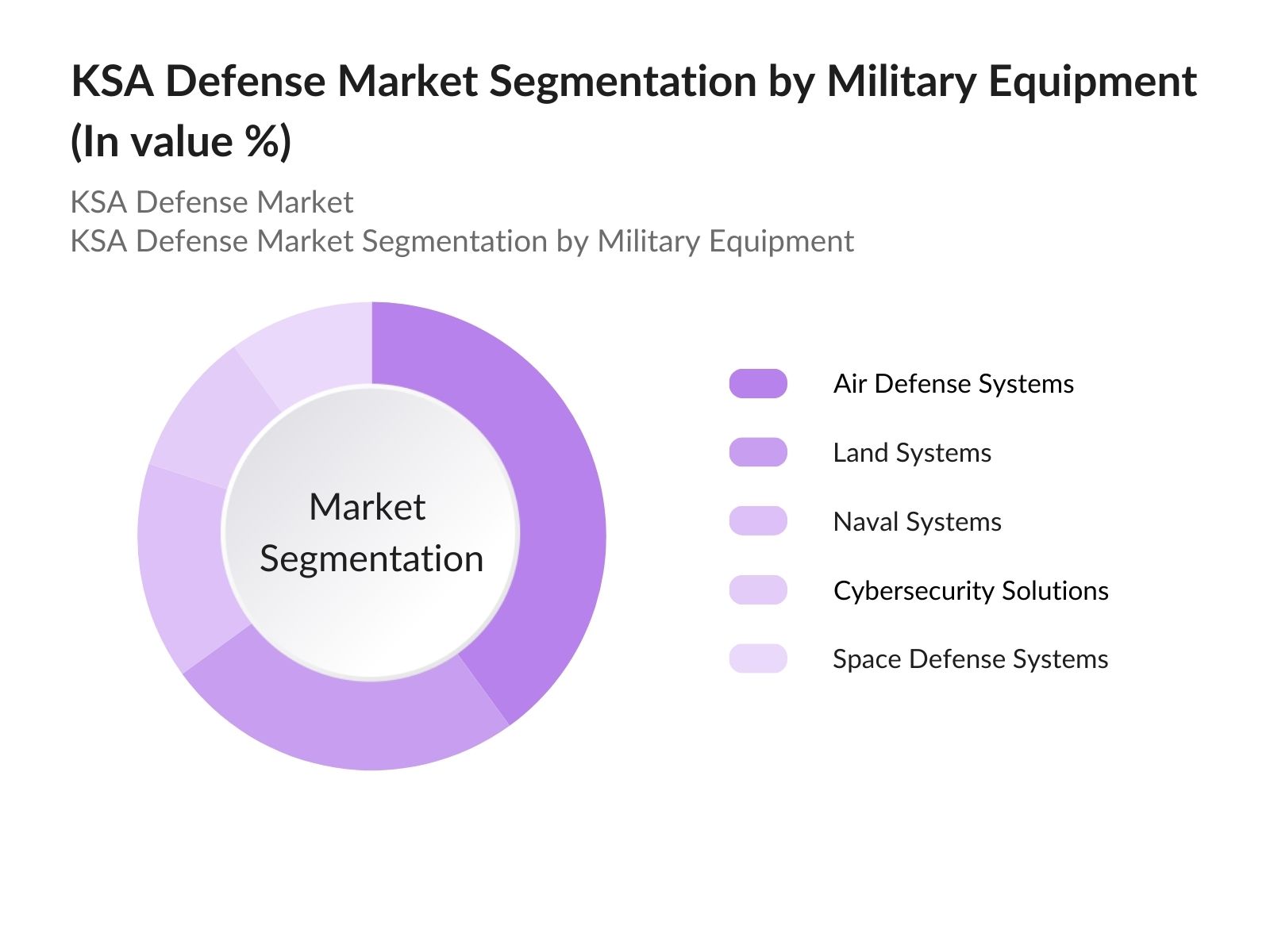
By Military Equipment Type |
Air Defense Systems Land Systems Naval Systems Cybersecurity Space Defense |
|
By Application |
Border Security Homeland Defense Counterterrorism Operations Military Training Maritime Surveillance |
|
By Technology |
AI and Machine Learning Cyber Defense Missile Defense Systems Autonomous Vehicles |
|
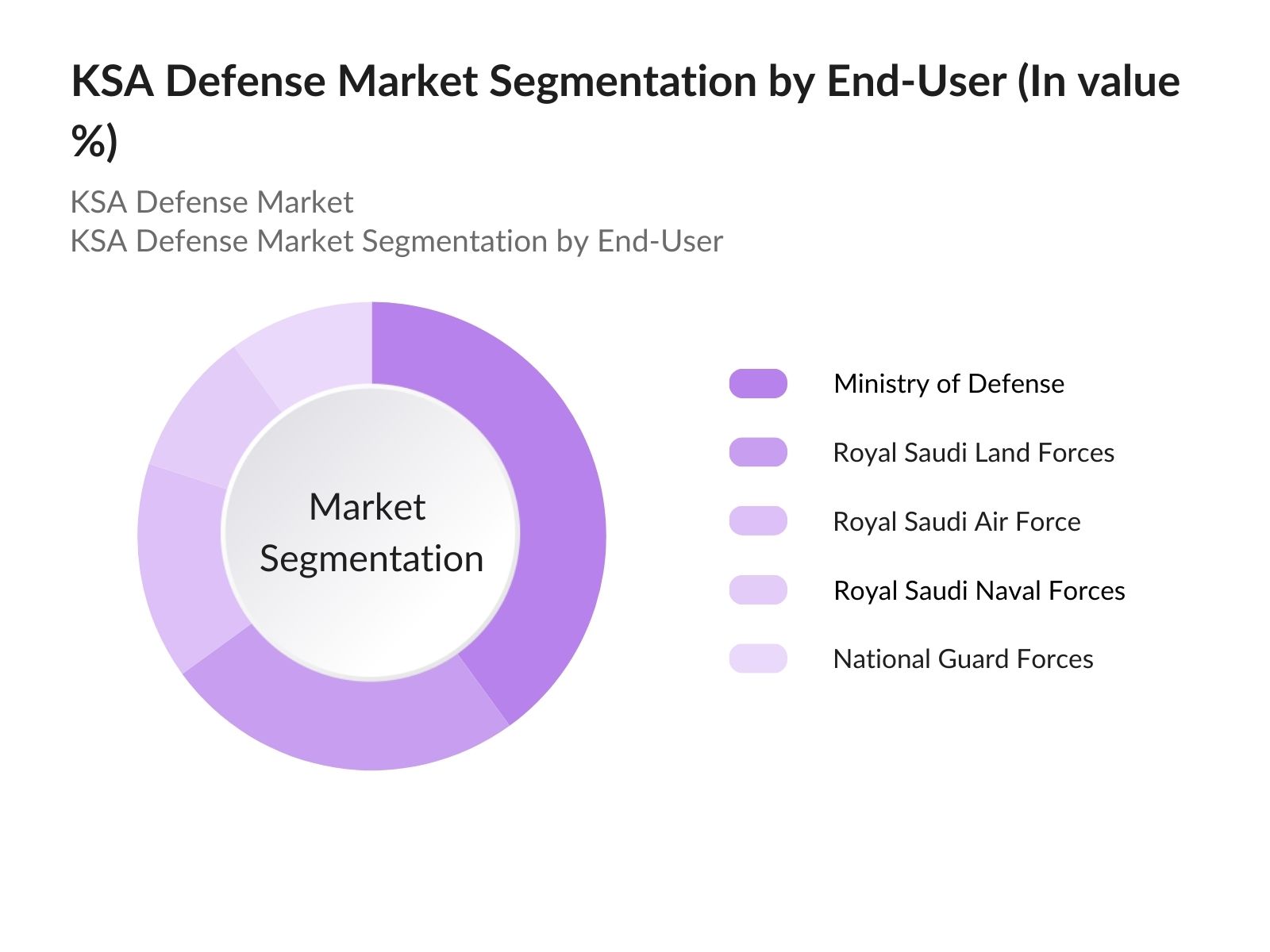
By End-User |
Ministry of Defense Royal Saudi Land Forces Royal Saudi Air Force Saudi Naval Forces National Guard Forces |
|
By Region |
Riyadh Jeddah Dammam Makkah Eastern Province |
1.1. Definition and Scope
1.2. Market Taxonomy
1.3. Market Growth Rate
1.4. Market Segmentation Overview
2.1. Historical Market Size
2.2. Year-On-Year Growth Analysis
2.3. Key Market Developments and Milestones
3.1. Growth Drivers
3.1.1. Increased Government Defense Spending (USD allocated by Ministry of Defense)
3.1.2. Vision 2030 Localization Initiatives (50% defense localization goal)
3.1.3. Rising Geopolitical Tensions (Regional instability in MENA)
3.1.4. Expansion in Cybersecurity & AI Integration (National Cybersecurity Authority initiatives)
3.2. Market Challenges
3.2.1. Dependency on Foreign Military Imports (70% foreign-sourced equipment)
3.2.2. Volatility in Oil Prices (Impact on national budget allocations)
3.2.3. Supply Chain Disruptions (Impact on imports of critical components)
3.2.4. High Operational Costs in Domestic Manufacturing (Cost of technology transfers)
3.3. Opportunities
3.3.1. Growth in Defense Cybersecurity Solutions (AI and threat detection integration)
3.3.2. Development of Local Defense Manufacturing (GAMI incentives and joint ventures)
3.3.3. International Collaborations & Joint Ventures (Strategic alliances with US, UK, France)
3.3.4. Space Defense Investments (Saudi Space Commission programs)
3.4. Trends
3.4.1. AI Integration in Defense Systems (AI-driven unmanned aerial vehicles)
3.4.2. Rise in UAV (Unmanned Aerial Vehicles) Utilization (Border security and surveillance)
3.4.3. Focus on Maritime Security (Expansion of naval capabilities in the Red Sea)
3.4.4. Investment in Missile Defense Systems (Acquisitions of THAAD and Patriot systems)
3.5. Government Regulation
3.5.1. Vision 2030 Defense Policies (Localization, technology transfer requirements)
3.5.2. Military Spending Directives (Allocated budget from the Ministry of Finance)
3.5.3. Cybersecurity Laws (National Cybersecurity Regulations)
3.5.4. Arms Trade Agreements & Compliance (Regulatory framework with major global suppliers)
3.6. SWOT Analysis
3.7. Stake Ecosystem
3.8. Porters Five Forces Analysis
3.9. Competition Ecosystem
4.1. By Military Equipment Type (In Value %)
4.1.1. Air Defense Systems (Missile defense, fighter jets)
4.1.2. Land Systems (Tanks, APCs, artillery)
4.1.3. Naval Systems (Frigates, corvettes, coastal defense vessels)
4.1.4. Cybersecurity and AI Systems (AI-driven cybersecurity and cyber warfare solutions)
4.1.5. Space Defense Systems (Satellite communications, space-based surveillance)
4.2. By Application (In Value %)
4.2.1. Border Security
4.2.2. Homeland Defense
4.2.3. Counterterrorism Operations
4.2.4. Military Training and Simulation
4.2.5. Maritime and Coastal Surveillance
4.3. By Technology (In Value %)
4.3.1. AI and Machine Learning (Autonomous defense systems)
4.3.2. Cyber Defense Technologies (Encryption, threat detection)
4.3.3. Missile Defense Systems (Patriot, THAAD systems)
4.3.4. Autonomous Vehicles (Unmanned aerial and ground vehicles)
4.4. By End-User (In Value %)
4.4.1. KSA Ministry of Defense
4.4.2. Royal Saudi Land Forces
4.4.3. Royal Saudi Air Force
4.4.4. Saudi Naval Forces
4.4.5. National Guard Forces
4.5. By Region (In Value %)
4.5.1. Riyadh
4.5.2. Jeddah
4.5.3. Dammam
4.5.4. Makkah
4.5.5. Eastern Province
5.1. Detailed Profiles of Major Companies
5.1.1. Lockheed Martin
5.1.2. BAE Systems
5.1.3. Raytheon Technologies
5.1.4. Northrop Grumman
5.1.5. Saudi Arabian Military Industries (SAMI)
5.1.6. Boeing Defense, Space & Security
5.1.7. General Dynamics
5.1.8. Leonardo S.p.A
5.1.9. Rheinmetall AG
5.1.10. Airbus Defense and Space
5.1.11. Thales Group
5.1.12. MBDA
5.1.13. L3Harris Technologies
5.1.14. Naval Group
5.1.15. General Electric Aviation
5.2. Cross Comparison Parameters (No. of Employees, Headquarters, Inception Year, Revenue, Military Contracts, Technology Integration, Market Share, Defense Partnerships)
5.3. Market Share Analysis
5.4. Strategic Initiatives
5.5. Mergers And Acquisitions
5.6. Investment Analysis
5.7. Venture Capital Funding
5.8. Government Grants
5.9. Private Equity Investments
6.1. Defense Contracting Regulations
6.2. Localization and Technology Transfer Policies
6.3. Export Control Laws
6.4. Arms Trade Regulations
7.1. Future Market Size Projections
7.2. Key Factors Driving Future Market Growth
8.1. By Military Equipment Type (In Value %)
8.2. By Application (In Value %)
8.3. By Technology (In Value %)
8.4. By End-User (In Value %)
8.5. By Region (In Value %)
9.1. TAM/SAM/SOM Analysis
9.2. Defense Procurement and Spend Analysis
9.3. Joint Venture Opportunities
9.4. Risk Mitigation Strategies
The first step involved mapping the defense ecosystem in Saudi Arabia, which includes all major stakeholders such as defense manufacturers, government agencies, and military forces. Extensive desk research, using credible government reports and defense industry databases, was conducted to identify the primary variables driving market dynamics, such as defense spending, import-export ratios, and localization efforts.
In this phase, historical data from 2018 to 2023 was gathered to assess the defense markets growth patterns. Data was analyzed to determine the penetration of military equipment and technology advancements in the Kingdom. This analysis included an evaluation of KSAs defense imports, spending trends, and the distribution of military contracts.
Market hypotheses, including the anticipated growth in defense spending and localization under Vision 2030, were validated through consultations with defense industry experts. These experts provided insights into procurement strategies, military modernization efforts, and the Kingdom's partnerships with international defense companies.
In the final phase, primary data from defense manufacturers and governmental sources was integrated with secondary research. This ensured the accuracy of the data, particularly for defense contracts, key military purchases, and the impact of regional geopolitics on Saudi Arabias defense spending patterns.
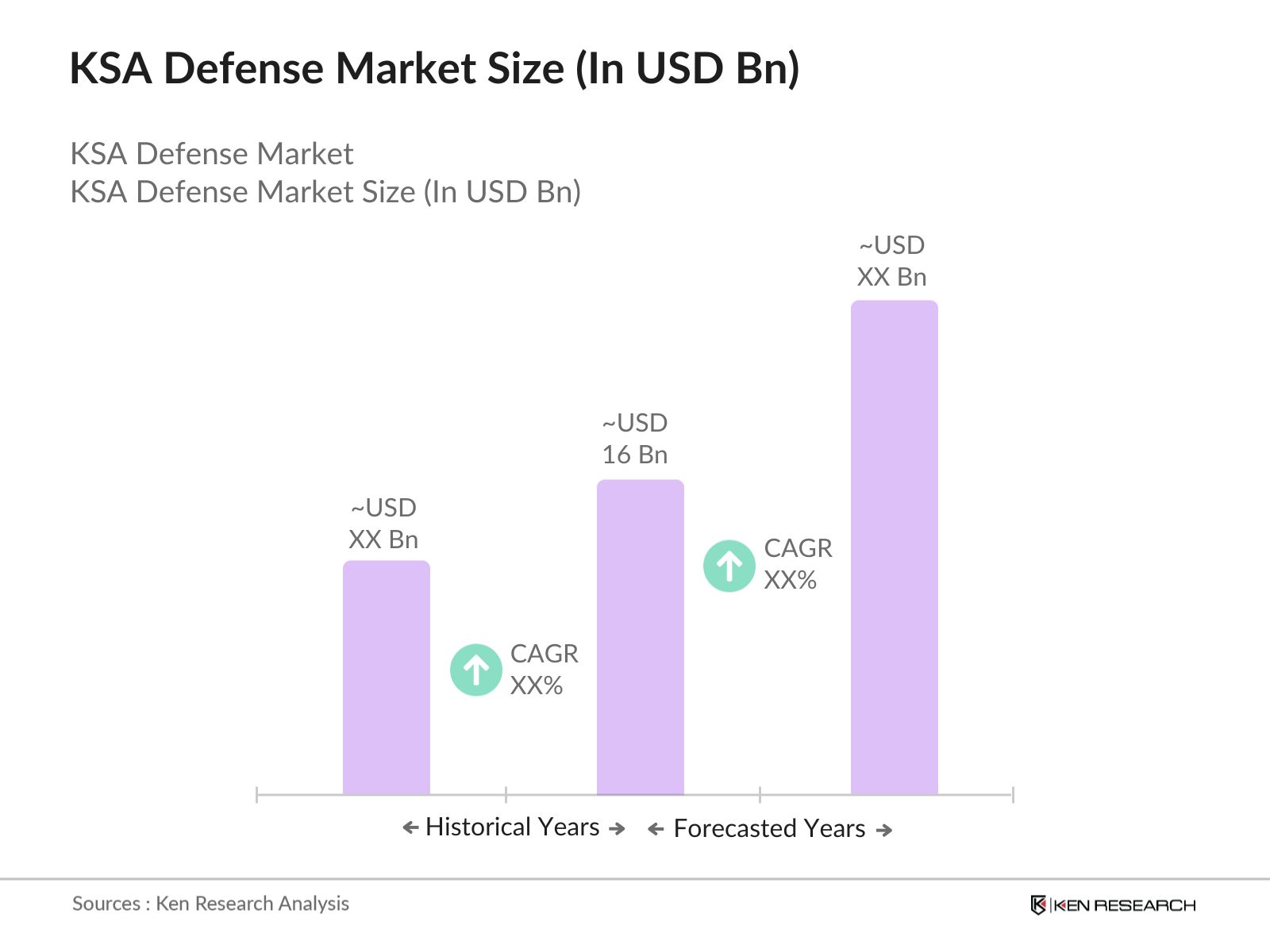
The KSA defense market is valued at USD 16 billion, driven by the Kingdoms investment in military modernization and the Vision 2030 localization initiative.
Challenges in the KSA defense market include the heavy dependency on foreign defense imports, volatile oil prices affecting the national defense budget, and the high costs associated with localizing defense production.
Key players in the KSA defense market include Lockheed Martin, BAE Systems, Raytheon Technologies, and Saudi Arabian Military Industries (SAMI), which dominate due to their expertise in military systems and strong partnerships with the Saudi government.
The KSA defense market is driven by increased defense spending, the need to address regional security threats, and the Saudi government's focus on military modernization and defense localization under Vision 2030.

What makes us stand out is that our consultants follows Robust, Refine and Result (RRR) methodology. i.e. Robust for clear definitions, approaches and sanity checking, Refine for differentiating respondents facts and opinions and Result for presenting data with story

We have set a benchmark in the industry by offering our clients with syndicated and customized market research reports featuring coverage of entire market as well as meticulous research and analyst insights.

While we don't replace traditional research, we flip the method upside down. Our dual approach of Top Bottom & Bottom Top ensures quality deliverable by not just verifying company fundamentals but also looking at the sector and macroeconomic factors.

With one step in the future, our research team constantly tries to show you the bigger picture. We help with some of the tough questions you may encounter along the way: How is the industry positioned? Best marketing channel? KPI's of competitors? By aligning every element, we help maximize success.

Our report gives you instant access to the answers and sources that other companies might choose to hide. We elaborate each steps of research methodology we have used and showcase you the sample size to earn your trust.

If you need any support, we are here! We pride ourselves on universe strength, data quality, and quick, friendly, and professional service.