
KSA Enterprise Software Market Outlook to 2030
Region:Saudi Arabia
Author(s):Shreya Garg
Product Code:KROD5281
Region:Saudi Arabia
Author(s):Shreya Garg
Product Code:KROD5281
November 2024
90
KSA Enterprise Software Market Segmentation
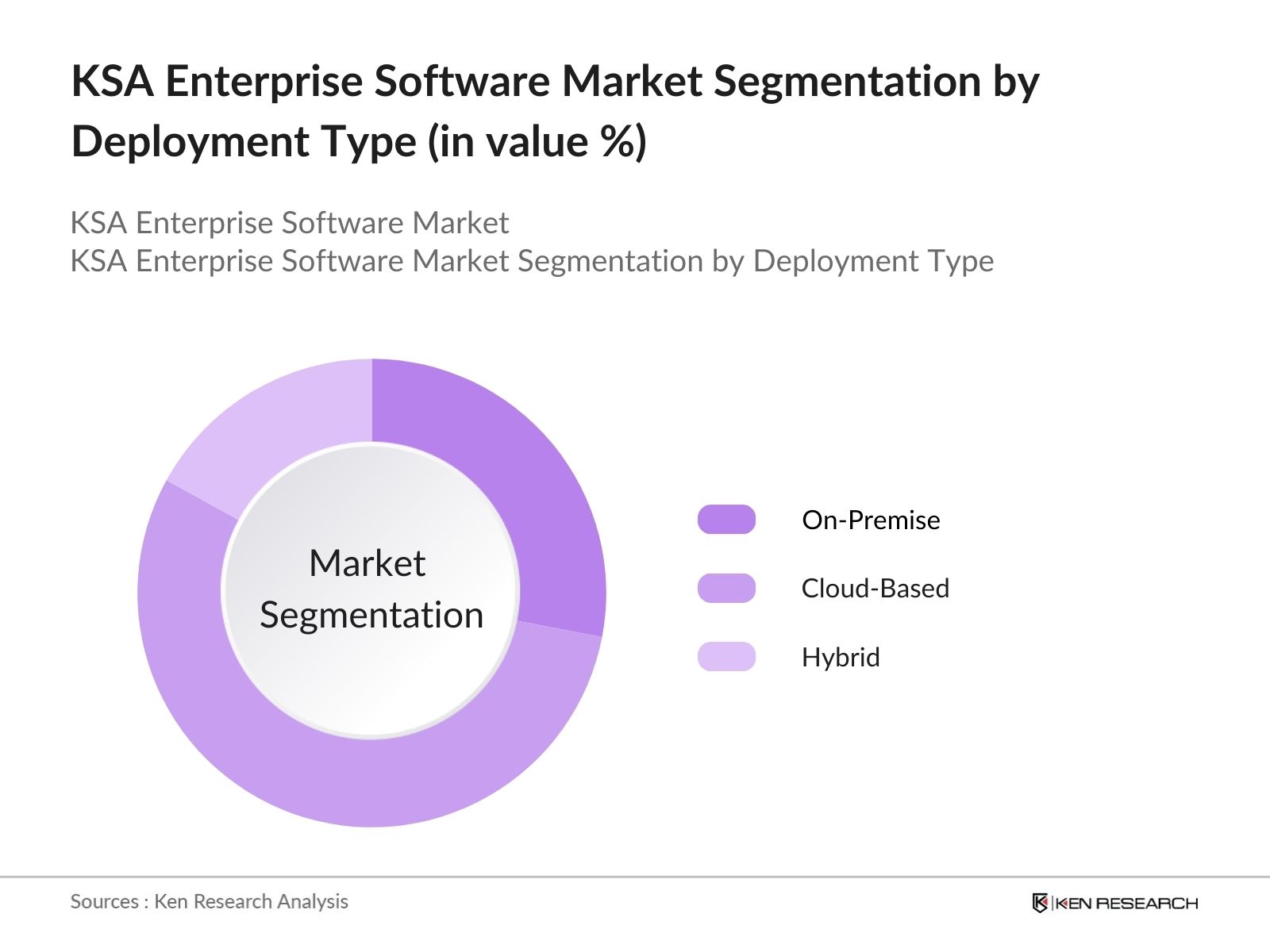
By Deployment Type: The market is segmented by deployment type into On-Premises, Cloud-Based, and Hybrid solutions. Among these, Cloud-Based deployment holds the largest market share due to the rapid adoption of cloud computing in the Kingdom. This shift is influenced by factors such as cost-efficiency, scalability, and the increasing preference for cloud infrastructure by both government and private enterprises. Companies prefer cloud solutions for their flexibility and the lower upfront costs compared to traditional on-premise setups.
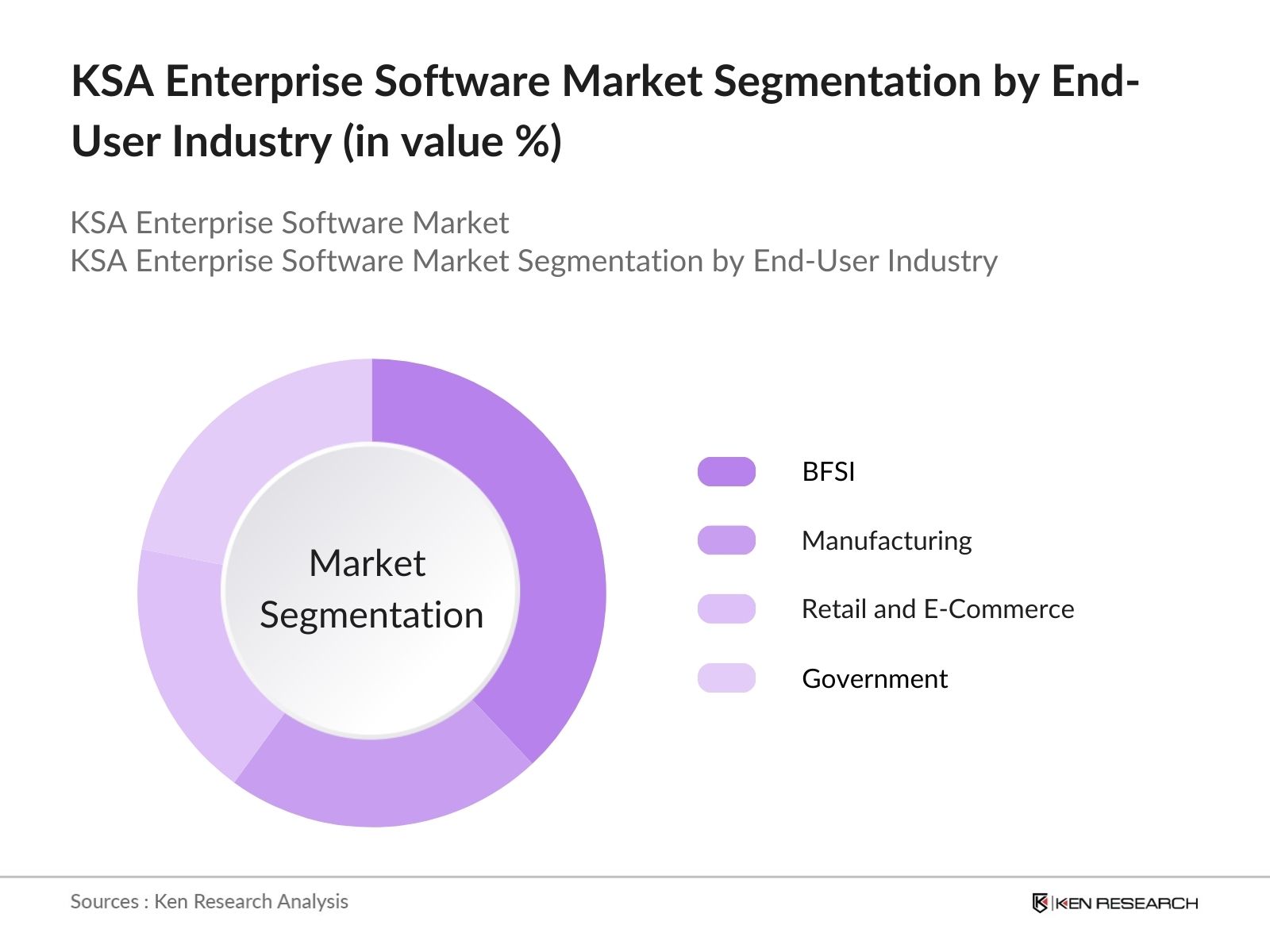
By End-User Industry: The market is also segmented by end-user industry into Banking, Financial Services, and Insurance (BFSI), Manufacturing, Retail and E-Commerce, and Government. The BFSI sector dominates the market due to the increasing reliance on data-driven decision-making and the need for secure, scalable software solutions for financial transactions. Enterprise software solutions are critical for managing operations, customer relations, and financial data in this sector, driving its strong market presence.
The KSA Enterprise Software market is dominated by a few key players, including both international giants and regional players. The competitive landscape reflects a consolidation of market power with major companies focusing on expanding their cloud capabilities and software-as-a-service (SaaS) offerings to meet the growing demand in the Kingdom.
|
Company |
Established Year |
Headquarters |
Revenue |
R&D Investment |
Cloud Solutions |
Partnerships |
Cybersecurity Initiatives |
|
Oracle Corporation |
1977 |
Austin, USA |
|||||
|
SAP SE |
1972 |
Walldorf, Germany |
|||||
|
Microsoft Corporation |
1975 |
Redmond, USA |
|||||
|
IBM Corporation |
1911 |
Armonk, USA |
|||||
|
Infor |
2002 |
New York, USA |
Over the next five years, the KSA Enterprise Software market is poised for significant growth, driven by the governments Vision 2030 initiative, increasing IT investments, and the rise of emerging technologies such as AI, blockchain, and the Internet of Things (IoT). The markets future is also influenced by the accelerated adoption of cloud services and the need for advanced cybersecurity measures, which are becoming more critical for enterprises operating in a digitized economy.
|
Deployment Type |
On-Premise Cloud-Based Hybrid |
|
Enterprise Size |
Small Enterprises Medium Enterprises Large Enterprises |
|
Application |
CRM ERP BI SCM |
|
End-User Industry |
BFSI Manufacturing Retail and E-Commerce Government |
|
Region |
Central Western Eastern Northern |
1.1. Definition and Scope
1.2. Market Taxonomy
1.3. Market Growth Rate
1.4. Market Segmentation Overview
2.1. Historical Market Size
2.2. Year-On-Year Growth Analysis
2.3. Key Market Developments and Milestones
3.1.1. Digital Transformation Initiatives (government policies, Vision 2030 impact)
3.1.2. Cloud Adoption and Infrastructure Expansion (cloud computing demand, SaaS market growth)
3.1.3. Data-Driven Decision Making (AI and analytics integration)
3.1.4. Increased IT Spending (enterprise budgets, regional tech investments)
3.2. Market Challenges
3.2.1. Data Privacy and Security Concerns (regulatory compliance, cybersecurity threats)
3.2.2. Integration Complexities (legacy system migration)
3.2.3. Shortage of Skilled IT Professionals (talent gaps, workforce development)
3.3. Opportunities
3.3.1. AI and Machine Learning Applications (automation, predictive analytics)
3.3.2. Emerging Technologies (blockchain, IoT integration)
3.3.3. Expansion of Small and Medium Enterprises (SMEs digitization demand)
3.4. Trends
3.4.1. Shift Towards Hybrid Cloud Solutions
3.4.2. Adoption of Enterprise Resource Planning (ERP) Systems
3.4.3. Growth of Business Intelligence (BI) Tools
3.4.4. Cybersecurity as a Service (CaaS) adoption
3.5. Government Regulation
3.5.1. KSA Data Protection Law
3.5.2. National Cybersecurity Authority Standards
3.5.3. Cloud-First Policy for Government Services
3.5.4. Vision 2030 Digital Strategy
3.6. SWOT Analysis
3.7. Stakeholder Ecosystem (Vendors, System Integrators, End-Users)
3.8. Porters Five Forces Analysis
3.8.1. Bargaining Power of Buyers
3.8.2. Bargaining Power of Suppliers
3.8.3. Threat of New Entrants
3.8.4. Threat of Substitutes
3.8.5. Competitive Rivalry
3.9. Competitive Landscape (Major players and market competition dynamics)
4.1. By Deployment Type (In Value %)
4.1.1. On-Premise
4.1.2. Cloud-Based
4.1.3. Hybrid
4.2. By Enterprise Size (In Value %)
4.2.1. Small Enterprises
4.2.2. Medium Enterprises
4.2.3. Large Enterprises
4.3. By Application (In Value %)
4.3.1. Customer Relationship Management (CRM)
4.3.2. Enterprise Resource Planning (ERP)
4.3.3. Business Intelligence (BI)
4.3.4. Supply Chain Management (SCM)
4.4. By End-User Industry (In Value %)
4.4.1. Banking, Financial Services, and Insurance (BFSI)
4.4.2. Manufacturing
4.4.3. Retail and E-Commerce
4.4.4. Government
4.5. By Region (In Value %)
4.5.1. Central Region
4.5.2. Western Region
4.5.3. Eastern Region
4.5.4. Northern Region
5.1. Detailed Profiles of Major Companies
5.1.1. Oracle Corporation
5.1.2. SAP SE
5.1.3. Microsoft Corporation
5.1.4. IBM Corporation
5.1.5. Infor
5.1.6. Salesforce.com
5.1.7. Sage Group
5.1.8. Epicor Software
5.1.9. Zoho Corporation
5.1.10. Unit4
5.1.11. ServiceNow
5.1.12. Tally Solutions
5.1.13. Odoo
5.1.14. Huawei Technologies
5.1.15. Cisco Systems
5.2. Cross Comparison Parameters
(Revenue, No. of Employees, Headquarters, R&D Investment, Partnerships, Acquisitions, Cloud vs. On-Premise Solutions, Industry Focus)
5.3. Market Share Analysis
5.4. Strategic Initiatives
5.5. Mergers and Acquisitions
5.6. Investment Analysis
5.7. Venture Capital Funding
5.8. Government Grants
5.9. Private Equity Investments
6.1. Compliance with Data Protection Laws
6.2. Licensing and Certification Requirements
6.3. Cloud Computing Regulations
6.4. Cybersecurity Compliance Standards
7.1. Future Market Size Projections
7.2. Key Factors Driving Future Market Growth
8.1. By Deployment Type (In Value %)
8.2. By Enterprise Size (In Value %)
8.3. By Application (In Value %)
8.4. By End-User Industry (In Value %)
8.5. By Region (In Value %)
9.1. TAM/SAM/SOM Analysis
9.2. Customer Cohort Analysis
9.3. Market Penetration Strategies
9.4. White Space Opportunity Analysis
The first phase involves constructing an ecosystem map of the KSA Enterprise Software Market. This process utilizes secondary research from government and proprietary databases, ensuring comprehensive identification of key market variables that influence enterprise software dynamics.
We analyze historical data on market growth, focusing on the penetration of cloud solutions and on-premise deployments in various sectors. This data is cross-referenced with industry performance metrics to ensure accuracy in the assessment of software adoption trends.
Through consultations with industry experts, insights into operational challenges and growth opportunities are validated. These consultations focus on the specific requirements of Saudi enterprises and their software needs, providing critical feedback for market forecasts.
The final stage synthesizes the insights from interviews and quantitative analysis into a comprehensive report. This ensures that our conclusions are based on both top-down analysis and bottom-up verification of data, leading to a reliable market outlook.
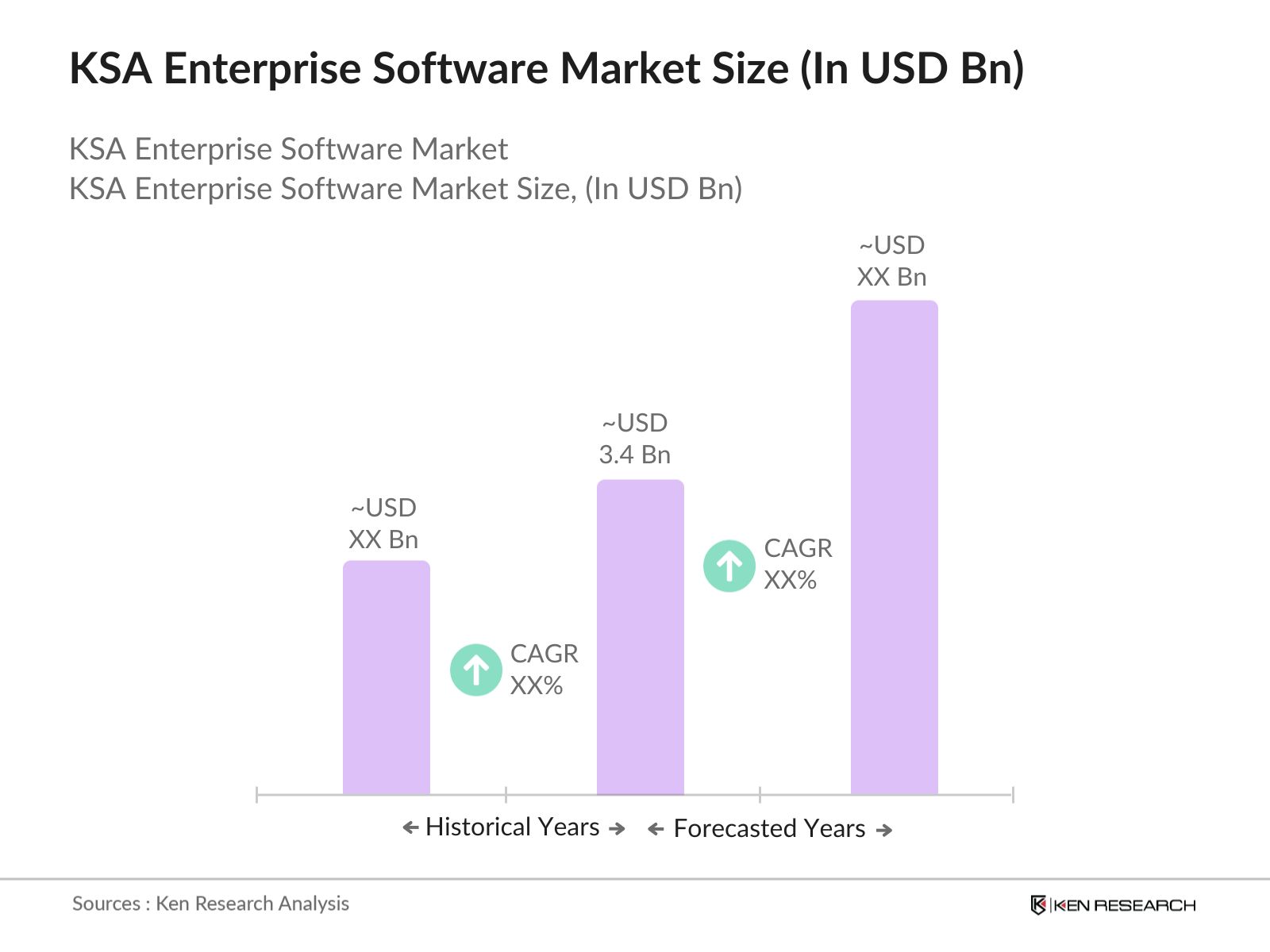
The KSA Enterprise Software market is valued at USD 3.4 billion. This growth is driven by the digital transformation of multiple sectors, including BFSI and government initiatives under Vision 2030.
Key challenges in the KSA Enterprise Software market include data privacy concerns, the complexity of integrating new solutions with legacy systems, and a shortage of skilled IT professionals to meet the growing demand for software deployment and maintenance.
Major players in the KSA Enterprise Software market include Oracle, SAP SE, Microsoft, IBM, and Infor. These companies have established dominance due to their extensive cloud services, innovation in software solutions, and strategic partnerships.
The KSA Enterprise Software market is propelled by strong government support for digital transformation under Vision 2030, the rise of cloud adoption, and the need for advanced enterprise solutions like ERP, CRM, and business intelligence tools.
The KSA Enterprise Software market is expected to grow significantly, driven by continued investments in cloud infrastructure, cybersecurity, and emerging technologies such as AI, blockchain, and IoT.

What makes us stand out is that our consultants follows Robust, Refine and Result (RRR) methodology. i.e. Robust for clear definitions, approaches and sanity checking, Refine for differentiating respondents facts and opinions and Result for presenting data with story

We have set a benchmark in the industry by offering our clients with syndicated and customized market research reports featuring coverage of entire market as well as meticulous research and analyst insights.

While we don't replace traditional research, we flip the method upside down. Our dual approach of Top Bottom & Bottom Top ensures quality deliverable by not just verifying company fundamentals but also looking at the sector and macroeconomic factors.

With one step in the future, our research team constantly tries to show you the bigger picture. We help with some of the tough questions you may encounter along the way: How is the industry positioned? Best marketing channel? KPI's of competitors? By aligning every element, we help maximize success.

Our report gives you instant access to the answers and sources that other companies might choose to hide. We elaborate each steps of research methodology we have used and showcase you the sample size to earn your trust.

If you need any support, we are here! We pride ourselves on universe strength, data quality, and quick, friendly, and professional service.