Ken Research Logo

KSA Food and Beverage Market Outlook to 2030

Region:Middle East

Author(s):Abhinav Kumar

Product Code:KROD1259

Published On

January 2025

Total pages

89

About the Report

KSA Food and Beverage Market Overview

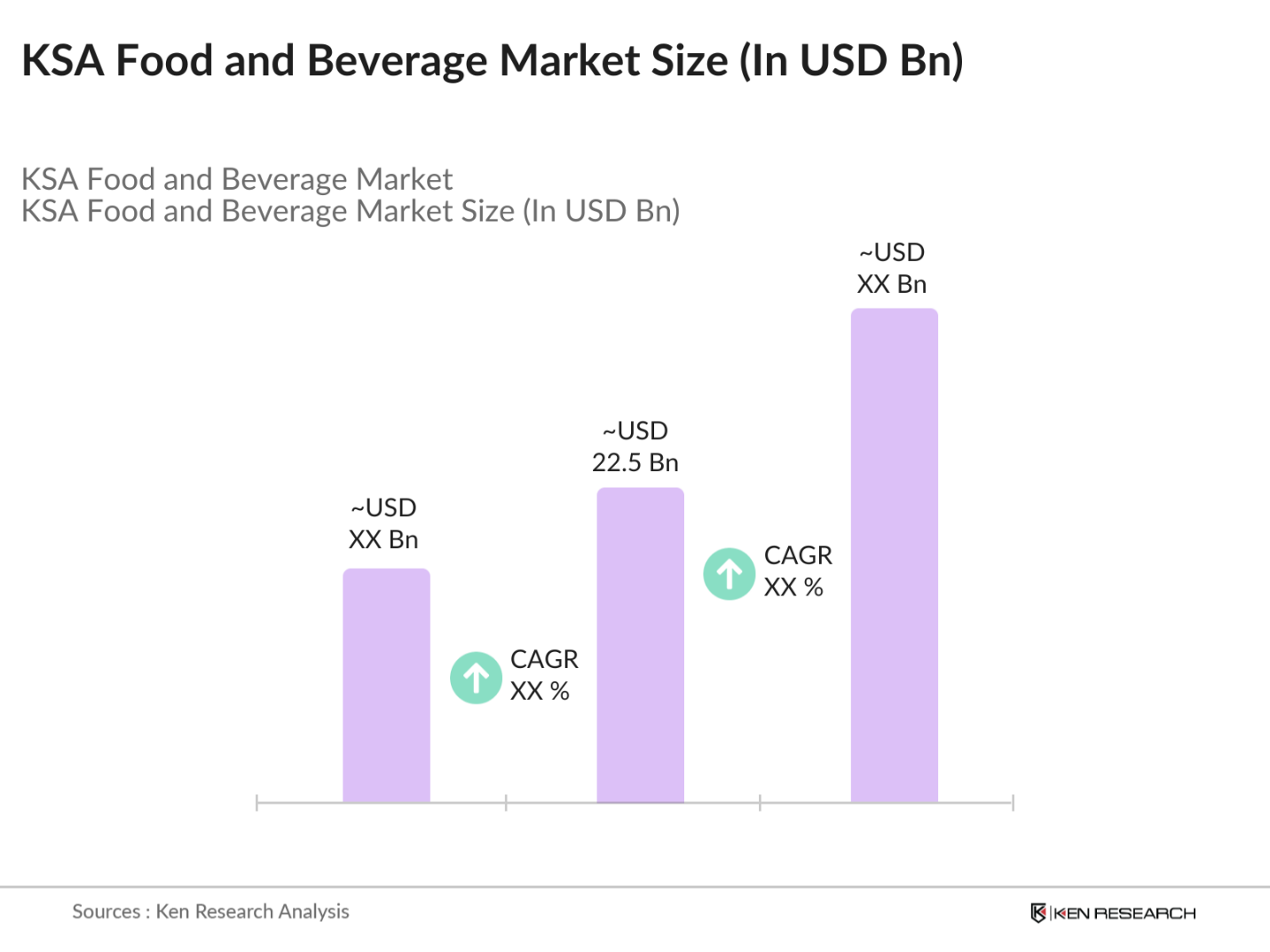
  • The KSA Food and Beverage market reached a valuation of USD 22.5 billion in 2023, driven by increasing urbanization, rising disposable incomes, and a growing preference for diverse and convenient food options. The market's robust growth is also supported by significant investments in food processing and retail infrastructure, which have enhanced production capabilities and distribution networks across the kingdom.
  • The market is characterized by key players such as Almarai, Savola Group, SADAFCO, Nadec, and Albaik. These companies are noted for their extensive distribution networks, strong brand recognition, and continuous innovation in product offerings.
  • Jeddah and Mecca, dominates the food and beverage market. This dominance is attributed to higher population density, significant tourism activities, and substantial investments in food retail infrastructure. The influx of pilgrims and tourists boosts demand for a variety of food products, contributing to the market's growth in this region.
  • In 2023, Almarai announced the launch of a new line of organic dairy products aimed at the Saudi market, focusing on enhancing health and wellness among consumers. This move not only aims to strengthen Almarai's market position but also supports Saudi Arabia's Vision 2030, focusing on economic diversification and food security.

market overviews

KSA Food and Beverage Market Segmentation

The KSA Food and Beverage Market can be segmented by various factors such as Product Type, Distribution Channel, and Region.

By Product Type: The KSA Food and Beverage Market is segmented by product type into dairy products, bakery products, and beverages. In 2023, dairy products dominated this subsegment due to the strong demand for milk, cheese, and yogurt, driven by traditional dietary preferences and increasing health awareness among consumers.

market overviews

By Distribution Channel: The market is also segmented by distribution channel into Supermarkets and Hypermarkets, Convenience Stores, and Online Retail. In 2023, Supermarkets and Hypermarkets held the dominant share, attributed to their extensive reach, wide product range, and the growing trend of one-stop shopping experiences. These large retail chains offer consumers the convenience of purchasing all their food and beverage needs under one roof.

market overviews

By Region: The KSA Food and Beverage Market is segmented by region into North, South, East, and West. In 2023, the Western region held the largest market share due to its large population, significant number of tourists and pilgrims, and well-established food retail infrastructure. The presence of key market players and the region's role as a commercial hub also contribute to its dominance.

KSA Food and Beverage Market Competitive Landscape

Company

Establishment Year

Headquarters

Almarai

1977

Riyadh

Savola Group

1979

Jeddah

SADAFCO

1976

Jeddah

Nadec

1981

Riyadh

Albaik

1974

Jeddah

  • Savola Group: In 2024, Savola Group, a leading Saudi Arabian conglomerate, has announced its intention to distribute its entire 34.52% stake in Almarai. The distribution will be preceded by a SAR 6.0 billion rights issue, which will strengthen Savola's financial position and fund long-term growth opportunities
  • SADAFCO: SADAFCO reported a significant41% increasein net profit for the first quarter of2024, reachingSAR 126.2 million, up fromSAR 89.7 millionin the same period the previous year. This growth reflects the company's strong performance across its product categories, particularly in long-life milk, tomato paste, and ice cream, where it maintains a leading market position.

KSA Food and Beverage Industry Analysis

Market Growth Drivers

  • Increasing Demand for Organic Products: The Saudi Arabian food market is experiencing a significant rise in consumer demand for organic products. The Ministry of Environment, Water, and Agriculture has reported a notable increase in the number of certified organic farms, with a 25% rise from 2021 to 2023. This shift indicates a robust movement towards organic farming practices, aligning with global trends that emphasize health and environmental sustainability.
  • Growth of E-commerce in Food and Beverage: The rise of e-commerce in Saudi Arabia's food and beverage sector is largely driven by changing consumer behaviors. In 2022, online grocery sales reachedSAR 12 billion, reflecting a30% increasefrom the previous year. More individuals are opting for the convenience of online shopping, particularly for food and beverage products.
  • Expansion of Food Service Outlets: The number of food service outlets in Saudi Arabia has been consistently increasing, with approximately 30,000 restaurants and cafes reported in 2023. This growth is supported by a booming tourism sector and a young, urban population seeking diverse dining experiences. The expansion of the food service industry is indicative of changing consumer preferences and a growing economy.

Market Challenges

  • Regulatory Compliance and Food Safety Standards: The food and beverage industry in Saudi Arabia faces stringent regulatory compliance and food safety standards that can pose challenges for new entrants and existing players. In 2023, the Saudi Food and Drug Authority (SFDA) implemented new regulations requiring all food products to meet specific safety and quality standards.
  • Fluctuating Raw Material Prices: The volatility in raw material prices poses significant challenges for the food and beverage sector in Saudi Arabia, particularly concerning essential ingredients like wheat and sugar. In2023, wheat prices surged by15%compared to the previous year, primarily due to global supply chain disruptions stemming from geopolitical tensions, adverse weather conditions, and logistical challenges.

Market Government Initiatives

  • Diversifying the Economy and Reducing Oil Dependence: Saudi Vision 2030, launched in 2016, aims to transform the Saudi economy by diversifying its revenue sources and reducing reliance on oil exports. The food and beverage sector has been identified as a key focus area for growth and investment under this initiative. By promoting the F&B industry, the government seeks to create jobs, attract foreign investment, and enhance the country's food security.
  • Investment in Food Technology (2022): The Saudi government has allocated substantial funding to improve agricultural practices and increase domestic food production capabilities. This includes investments in modern farming techniques, irrigation systems, and crop research to boost yields and efficiency. The target is to raise local food production by30% by 2025, reducing the country's dependence on imports and ensuring a more stable food supply.

KSA Food and Beverage Future Market Outlook

The KSA Food and Beverage Market is poised for substantial growth by 2028, propelled by continuous technological innovations and the strategic expansion of local food production initiatives.

Future Trends

  • Sustainability Focus: By 2028, the KSA Food and Beverage Market is expected to place increased focus on sustainability, with companies adopting eco-friendly practices in production, packaging, and supply chain management. This trend is driven by growing consumer awareness and stricter government regulations aimed at reducing environmental impact.
  • E-commerce Growth and Digital Transformation: By 2028, the rise of e-commerce and online grocery shopping will significantly reshape the KSA Food and Beverage Market. More consumers will turn to digital platforms for their grocery needs, prompting companies to invest heavily in digital infrastructure and logistics to meet the increasing demand for convenience and accessibility.

Scope of the Report

By Product Type

Dairy Products

Bakery Products

Beverages

By Distribution Channel

Supermarkets and Hypermarkets

Convenience Stores

Online Retail

By Region

North

South

East

West

Products

Key Target Audience Organizations and Entities who can benefit by Subscribing This Report:

  • Food Manufacturers

  • Retailers and Wholesalers

  • Foodservice Providers (Restaurants, Cafes)

  • Packaging Companies

  • Agricultural Suppliers

  • Food Safety and Quality Assurance Agencies

  • Logistics and Supply Chain Companies

  • Health and Wellness Organizations

  • Investments and Venture Capitalist Firms

  • Government and Regulatory Bodies (Ministry of Environment, Water and Agriculture, Saudi Food and Drug Authority)

Time Period Captured in the Report

  • Historical Period: 2018-2023

  • Base Year: 2023

  • Forecast Period: 2023-2028

Companies

Players Mentioned in the Report

  • Almarai

  • Savola Group

  • SADAFCO

  • Nadec

  • Albaik

  • Al Othaim Markets

  • Panda Retail Company

  • Tamimi Markets

  • BinDawood Holding

  • Herfy Food Services

Table of Contents

1. KSA Food and Beverage Market Overview

1.1. Definition and Scope

1.2. Market Taxonomy

1.3. Market Growth Rate

1.4. Market Segmentation Overview

2. KSA Food and Beverage Market Size (in USD Bn), 2018-2023

2.1. Historical Market Size

2.2. Year-on-Year Growth Analysis

2.3. Key Market Developments and Milestones

3. KSA Food and Beverage Market Analysis

3.1. Growth Drivers

3.1.1. Increasing Demand for Organic Products

3.1.2. Growth of E-commerce in Food and Beverage

3.1.3. Increased Health Awareness

3.1.4. Expansion of Food Service Outlets

3.2. Restraints

3.2.1. High Operational Costs

3.2.2. Regulatory Challenges

3.2.3. Supply Chain Disruptions

3.3.4 Fluctuating Raw Material Prices

3.3. Opportunities

3.3.1. Expansion in Organic Food Segment

3.3.2. Digitalization in Retail

3.3.3. Growth in E-commerce

3.4. Trends

3.4.1. Rise in Plant-Based Products

3.4.2. Popularity of Convenience Foods

3.4.3. Growth of Halal Food Market

3.5. Government Regulation

3.5.1. Food Safety Standards

3.5.2. Import Tariffs and Duties

3.5.3. Subsidies and Incentives

3.5.4. Localization of Food Production

3.6. SWOT Analysis

3.7. Stake Ecosystem

3.8. Competition Ecosystem

4. KSA Food and Beverage Market Segmentation, 2023

4.1 By Product Type (in Value %)

4.1. Beverages

4.1.2. Dairy Products

4.1.3. Bakery and Confectionery

4.1.4. Processed Foods

4.1.5. Others

4.2. By Distribution Channel (in Value %)

4.2.1. Supermarkets/Hypermarkets

4.2.2. Online Stores

4.2.3. Convenience Stores

4.2.4. Specialty Stores

4.2.5. Others

4.3. By Region (in Value %)

4.3.1. North

4.3.2. South

4.3.3. East

4.3.4. West

5. KSA Food and Beverage Market Cross Comparison

5.1 Detailed Profiles of Major Companies

5.1.1. Almarai

5.1.2. Savola Group

5.1.3. National Food Industries Co.

5.1.4. SADAFCO

5.1.5. Nestl Saudi Arabia

5.1.6. PepsiCo

5.1.7. Al Safi Danone

5.1.8. Nadec

5.1.9. Al Othaim

5.1.10. Herfy

5.1.11. Kraft Heinz Saudi Arabia

5.1.12. Coca-Cola Bottling Company Saudi Arabia

5.1.13. Al Rabie Saudi Foods Co. Ltd.

5.1.14. Gulf West Company

5.1.15. Basamh Trading Co. Ltd.

5.2 Cross Comparison Parameters (No. of Employees, Headquarters, Inception Year, Revenue)

6. KSA Food and Beverage Market Competitive Landscape

6.1. Market Share Analysis

6.2. Strategic Initiatives

6.3. Mergers and Acquisitions

6.4. Investment Analysis

6.4.1. Venture Capital Funding

6.4.2. Government Grants

6.4.3. Private Equity Investments

7. KSA Food and Beverage Market Regulatory Framework

7.1. Food Safety Regulations

7.2. Compliance Requirements

7.3. Certification Processes

8. KSA Food and Beverage Future Market Size (in USD Bn), 2023-2028

8.1. Future Market Size Projections

8.2. Key Factors Driving Future Market Growth

9. KSA Food and Beverage Future Market Segmentation, 2028

9.1. By Product Type (in Value %)

9.2. By Distribution Channel (in Value %)

9.3. By Region (in Value %)

10. KSA Food and Beverage Market Analysts Recommendations

10.1. TAM/SAM/SOM Analysis

10.2. Customer Cohort Analysis

10.3. Marketing Initiatives

10.4. White Space Opportunity Analysis

Disclaimer Contact Us

Research Methodology

Step 1: Identifying Key Variables

Ecosystem creation for all the major entities and referring to multiple secondary and proprietary databases to perform desk research around market to collate industry level information.

Step 2: Market Building

Collating statistics on KSA food and beverage market over the years, penetration of marketplaces and service providers ratio to compute revenue generated for KSA food and beverage market. We will also review service quality statistics to understand revenue generated which can ensure accuracy behind the data points shared.

Step 3: Validating and Finalizing

Building market hypothesis and conducting CATIs with industry experts belonging to different companies to validate statistics and seek operational and financial information from company representatives.

Step 4: Research Output

Our team will approach multiple food and beverage suppliers and distributors to understand nature of product segments and sales, consumer preference and other parameters, which will support us validate statistics derived through bottom to top approach from food and beverage suppliers and distributors.

Frequently Asked Questions

01 How big is the KSA Food and Beverage Market?

The KSA Food and Beverage market reached a valuation of USD 22.5 billion in 2023, driven by increasing urbanization, rising disposable incomes, and a growing preference for diverse and convenient food options. The market's robust growth is also supported by significant investments in food processing and retail infrastructure.

02 Who are the major players in the KSA Food and Beverage Market?

Key players in the market include Almarai, Savola Group, SADAFCO, Nadec, and Albaik, which dominate the market owing to their extensive distribution networks, strong brand presence, and diverse product portfolios.

03 What are the growth drivers for the KSA Food and Beverage Market?

The market is propelled by factors such as rising disposable incomes, increasing health awareness, and government initiatives like Vision 2030, aimed at boosting local food production and reducing reliance on imports.

04 What are the challenges in the KSA Food and Beverage Market?

The food and beverage market in Saudi Arabia faces challenges such as high costs of raw materials, infrastructure limitations, and dependence on imports for key ingredients, which necessitate strategic adjustments by organized players to navigate these challenges effectively.

Why Buy From Us?

RRR
Refine Robust Result (RRR) Framework

What makes us stand out is that our consultants follows Robust, Refine and Result (RRR) methodology. i.e. Robust for clear definitions, approaches and sanity checking, Refine for differentiating respondents facts and opinions and Result for presenting data with story

Our Reach Is Unmatched

We have set a benchmark in the industry by offering our clients with syndicated and customized market research reports featuring coverage of entire market as well as meticulous research and analyst insights.

Research
Shifting the Research Paradigm

While we don't replace traditional research, we flip the method upside down. Our dual approach of Top Bottom & Bottom Top ensures quality deliverable by not just verifying company fundamentals but also looking at the sector and macroeconomic factors.

Insite
More Insights-Better Decisions

With one step in the future, our research team constantly tries to show you the bigger picture. We help with some of the tough questions you may encounter along the way: How is the industry positioned? Best marketing channel? KPI's of competitors? By aligning every element, we help maximize success.

Trust
Transparency and Trust

Our report gives you instant access to the answers and sources that other companies might choose to hide. We elaborate each steps of research methodology we have used and showcase you the sample size to earn your trust.

support
Round the Clock Support

If you need any support, we are here! We pride ourselves on universe strength, data quality, and quick, friendly, and professional service.

Why Client Choose Us?

400000+ Reports in repository
150+ Consulting project a year
100+ Analysts
8000+ Client Queries in 2022