
KSA Men Undergarments Market Outlook to 2030
Region:Middle East
Author(s):Shambhavi Awasthi
Product Code:KROD5946
December 2024
82
About the Report
KSA Men Undergarments Market Overview
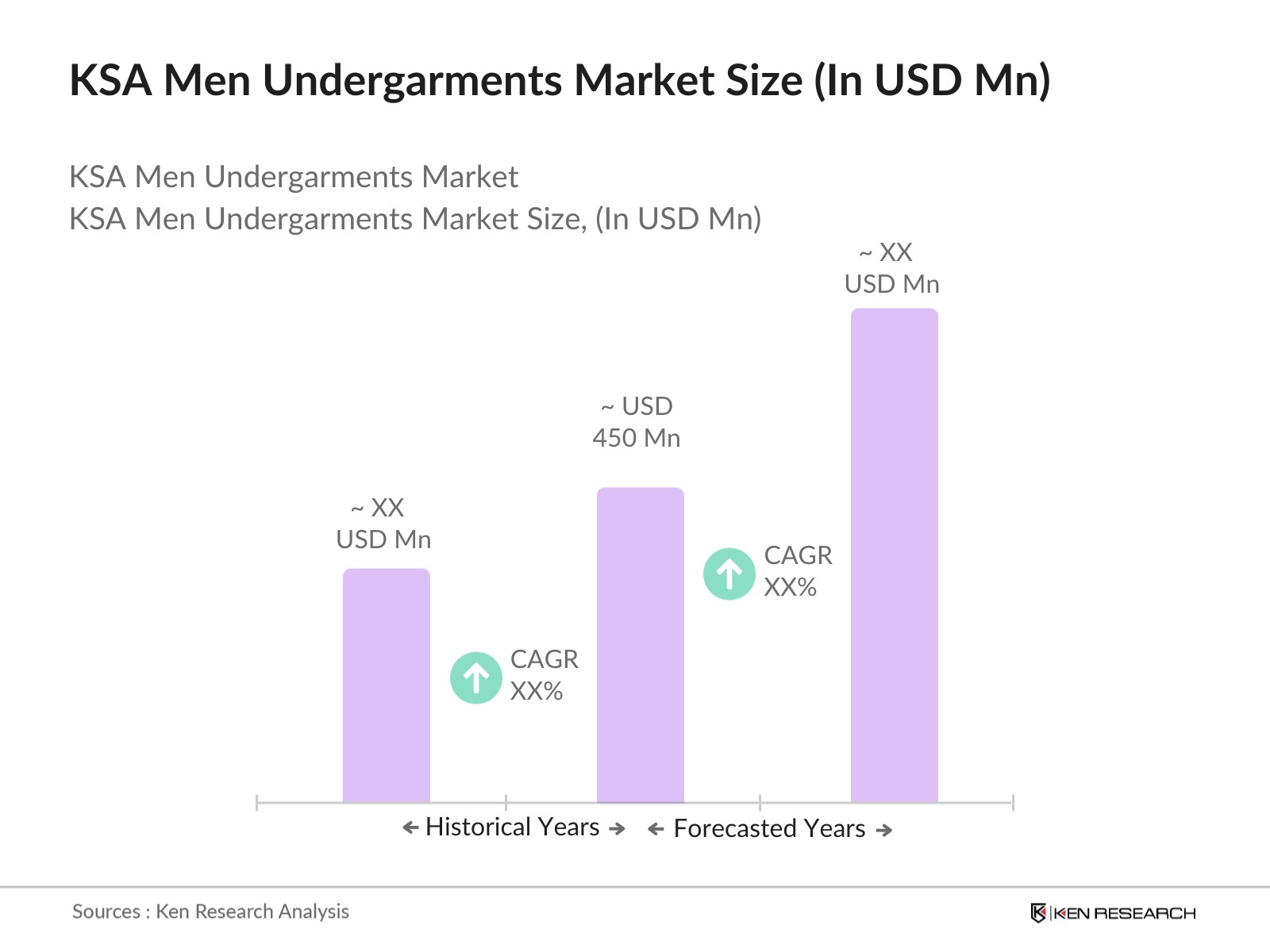
- The KSA Men Undergarments Market is valued at USD 450 million, based on a five-year historical analysis. The market is primarily driven by the growing focus on personal hygiene, rising disposable incomes, and an increasing shift toward branded products. This shift is supported by the evolving consumer lifestyle, where comfort and style are becoming equally important factors. Additionally, advancements in fabric technology, such as moisture-wicking materials and antimicrobial finishes, are enhancing product functionality, further boosting market demand.
- Riyadh and Jeddah are dominant regions in the KSA Men Undergarments Market. These cities serve as commercial hubs, with a high concentration of middle- and high-income consumers who are more inclined toward premium and designer brands. Moreover, the presence of modern retail outlets and e-commerce platforms in these cities facilitates the availability of a wide range of products, catering to the diverse preferences of consumers. The high purchasing power in these regions also contributes to their dominance.
- Saudi Arabias regulatory framework around textile imports influences the market, as undergarments largely depend on imports. SASO regulations mandate strict quality controls on imported textile products to ensure consumer safety and compliance with health standards. This regulatory environment aims to protect local consumers and encourage quality, impacting product sourcing and pricing strategies for imported undergarments
KSA Men Undergarments Market Segmentation
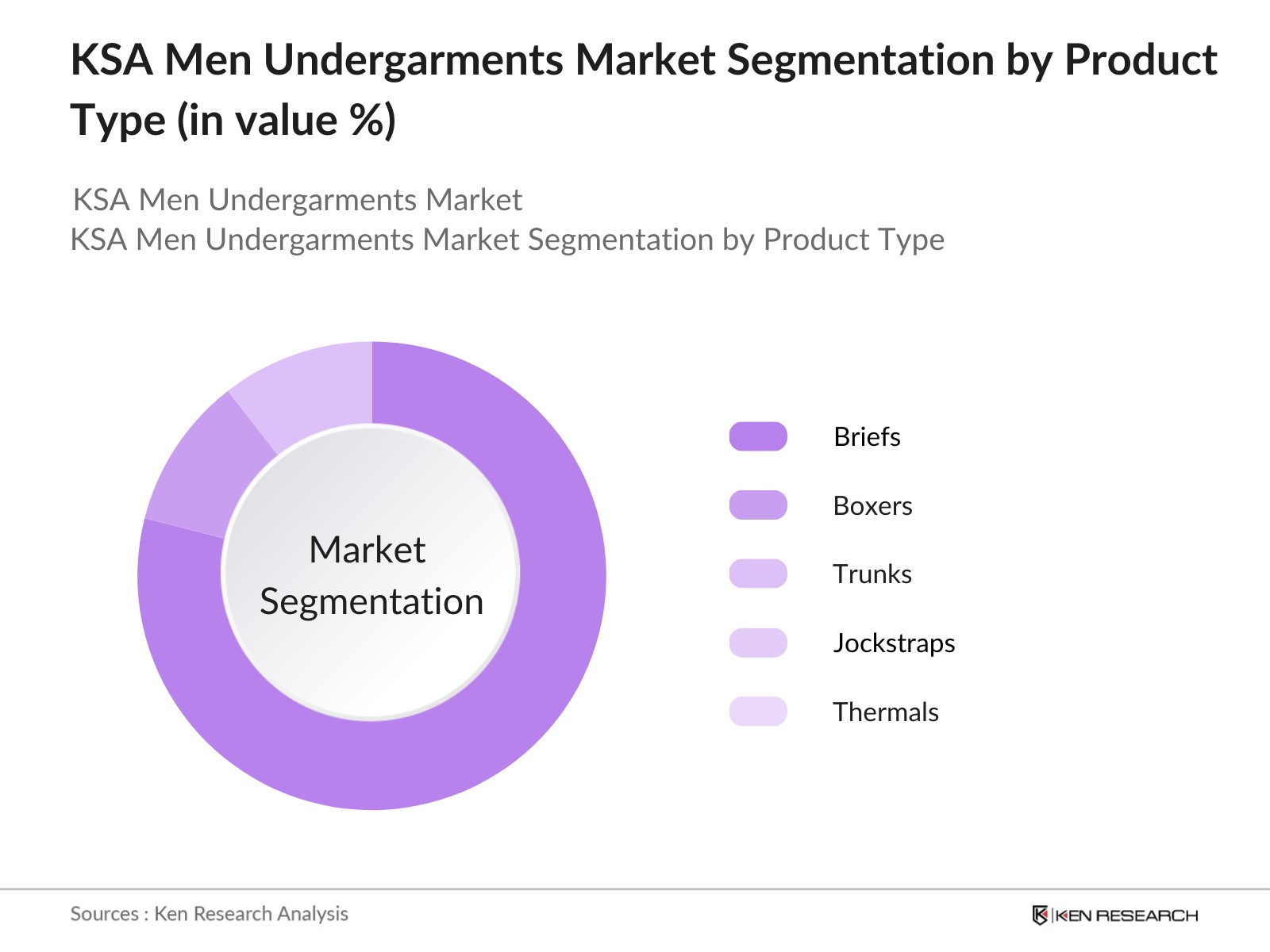
- By Product Type: The KSA Men Undergarments market is segmented by product type into briefs, boxers, trunks, jockstraps, and thermals. Recently, briefs have gained a dominant market share within the product type segmentation, attributed to their comfort and wide availability in various materials. Briefs provide better support, which is a key consideration for men during physical activities and sports. Additionally, brands are focusing on innovative designs and premium materials to attract consumers in this segment, further driving the growth of briefs over other product types.
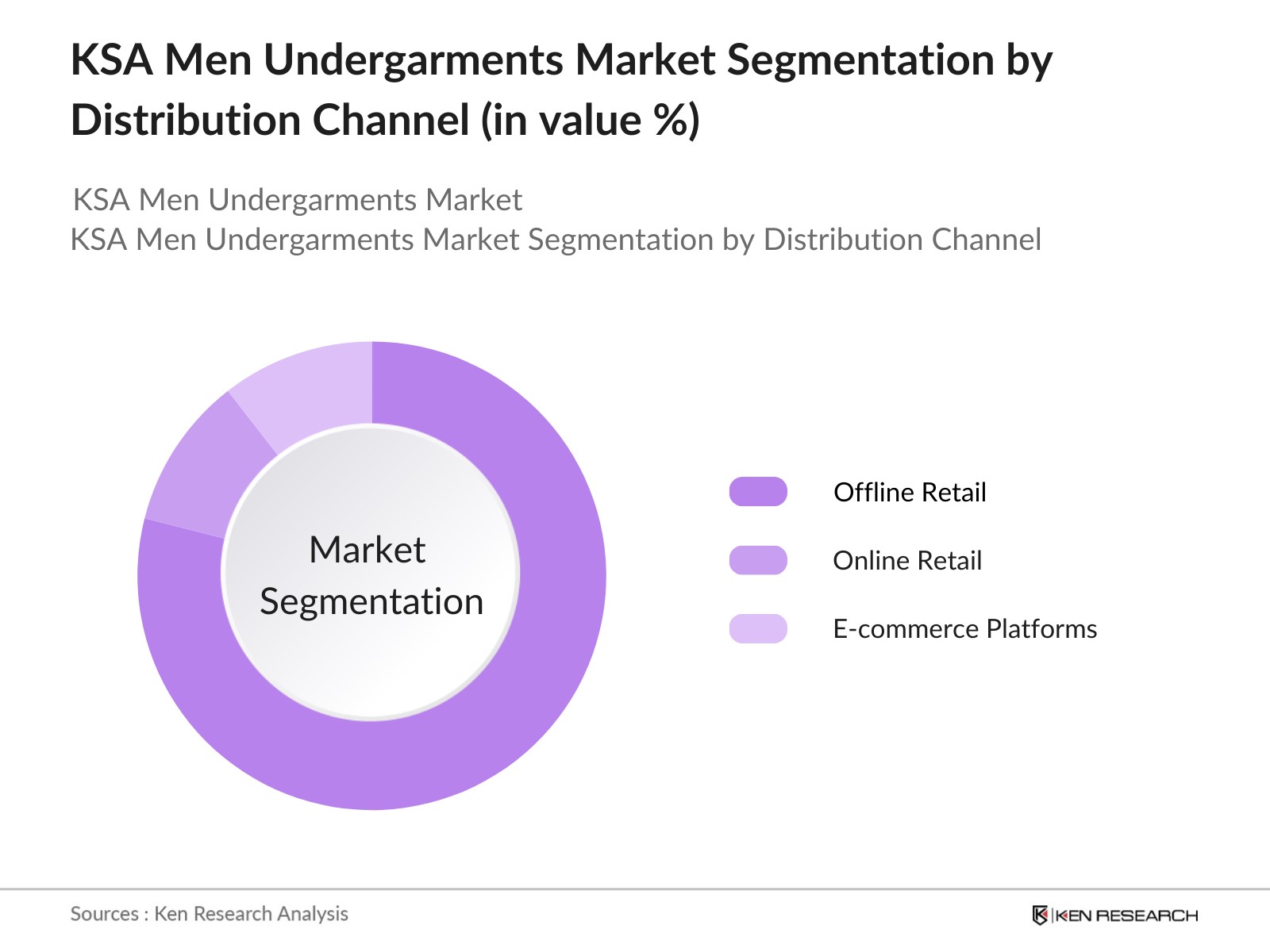
- By Distribution Channel: The KSA Men Undergarments market is also segmented by distribution channel into online retail, offline retail (supermarkets/hypermarkets, specialty stores), and e-commerce platforms. Offline retail, specifically supermarkets and specialty stores, holds a dominant market share due to the tactile nature of the product, where customers prefer to feel the fabric and assess fit before purchasing. However, e-commerce is rapidly growing, fueled by the convenience it offers and the increasing number of young consumers who are comfortable with online shopping.
KSA Men Undergarments Market Competitive Landscape
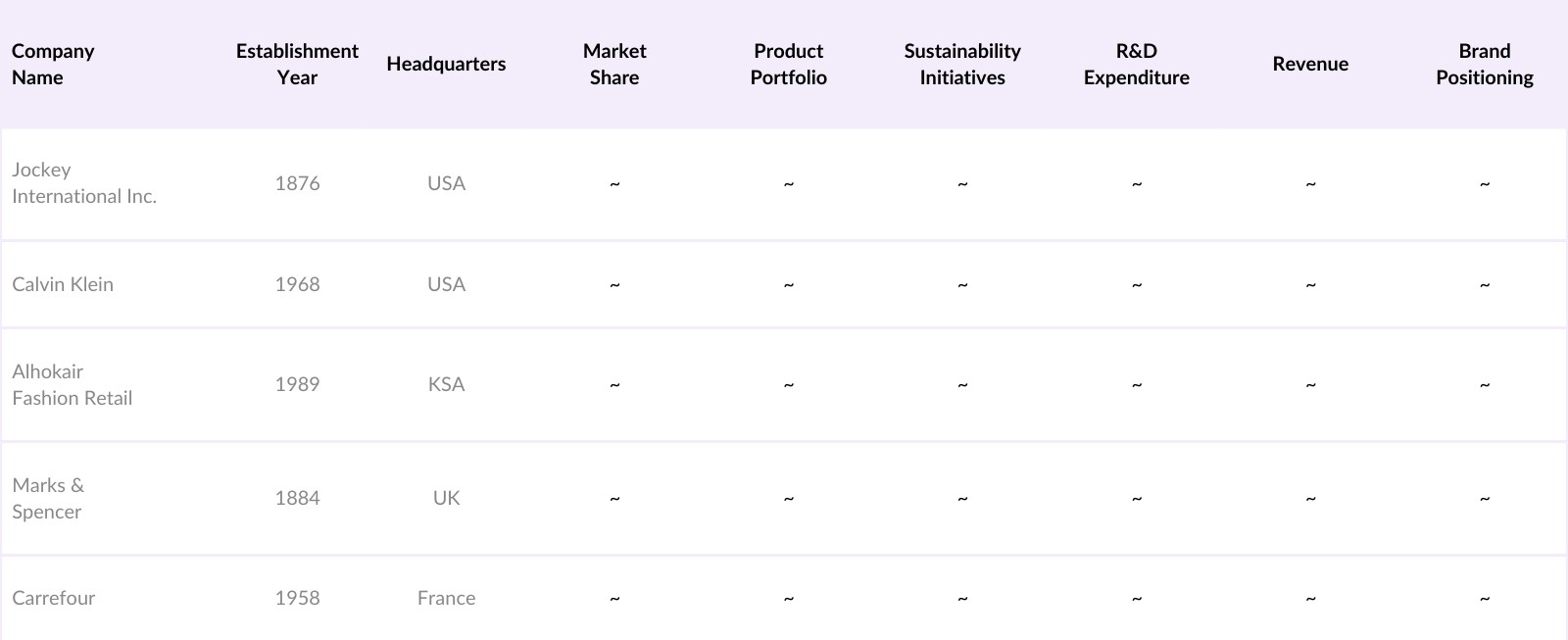
The KSA Men Undergarments Market is highly competitive, with both global and local players contributing to market dynamics. Companies like Jockey and Calvin Klein have established themselves through premium positioning and strong brand loyalty. At the same time, local players such as Alhokair Fashion Retail and Carrefour offer competitively priced products, catering to the mass market. The competition is primarily driven by product differentiation, pricing strategies, and marketing campaigns. The focus on sustainability, such as the use of eco-friendly fabrics, is also becoming a key factor in competition.
KSA Men Undergarments Market Analysis
Growth Drivers
- Rise in Disposable Income: Disposable income in Saudi Arabia has shown a positive trajectory due to the governments strategic policies under Vision 2030, which have expanded the non-oil sector and increased household earnings. With per capita disposable income at approximately USD 13,860 in 2024, up from USD 13,300 in 2023, the added purchasing power is enabling more consumer spending in non-essential categories, including fashion and undergarments. Government initiatives to cap fuel prices and provide social protection have preserved household purchasing power, further driving market demand
- Increasing Influence of Western Fashion Trends: The Saudi fashion industry has seen a shift toward Western styles, supported by increased social openness and youths interest in global fashion. With around 40% of the population under 25, demand for Western-influenced apparel is high, influencing trends in undergarments, especially within urban areas. Additionally, the expansion of international fashion retailers and the easing of cultural restrictions have enabled greater acceptance and popularity of Western-style clothing, including premium and designer undergarments
- E-commerce Penetration: E-commerce in Saudi Arabia has been growing at an accelerated pace, with the sector recording transactions worth SAR 18 billion in 2023. The increased internet penetration (over 95% of the population) and high smartphone usage facilitate online shopping, enabling consumers to access a broader range of products. This growth provides an essential channel for the undergarments market, as consumers prefer the convenience and variety available through online platforms
Market Challenges
- Price Sensitivity: Price sensitivity remains a challenge due to varying disposable income levels across regions. While metropolitan areas like Riyadh and Jeddah exhibit strong spending power, rural regions display cautious spending patterns due to limited disposable income growth. This variation in consumer behavior across regions creates challenges for undergarment brands looking to penetrate the entire market
- Supply Chain Disruptions: Supply chain disruptions have impacted apparel imports, influenced by global uncertainties and rising logistics costs. Import dependency on textiles has raised challenges, with transportation costs increasing up to 10% in the past year, affecting product availability and pricing. These supply chain issues particularly impact the availability of high-quality imported fabrics, vital for premium undergarment brands
KSA Men Undergarments Market Future Outlook
Over the next five years, the KSA Men Undergarments market is expected to experience moderate growth, driven by increasing consumer awareness of premium products, rising disposable incomes, and the expansion of e-commerce. The market is anticipated to benefit from the introduction of technologically advanced fabrics and the growing emphasis on eco-friendly materials. The shift towards online shopping is also expected to continue, with brands increasingly leveraging digital platforms for sales and marketing. Furthermore, product customization and personalization are predicted to play a significant role in differentiating brands in the future.
Market Opportunities
- Technological Advancements in Fabrics: Recent advancements in textile technology, such as odor-resistant, quick-dry, and breathable fabrics, have gained traction in Saudi Arabia. The Saudi Standards, Metrology and Quality Organization (SASO) has increasingly adopted quality standards for functional fabrics, supporting the introduction of high-performance materials in the local market. This trend creates opportunities for companies offering innovative fabric technologies to cater to the demand for health-focused undergarments
- Customization and Personalization of Undergarments: Customization options in clothing are gaining popularity globally, and the Saudi market is showing interest in personalized products, including tailored fits and unique designs in undergarments. This trend aligns with consumers' desire for individual expression and comfortable fitting options. Companies that provide customization features are well-positioned to capture a niche yet growing segment of consumers seeking differentiated products
Scope of the Report
|
Segment |
Sub-segments |
|
Product Type |
Briefs Boxers Trunks Jockstraps Thermals |
|
Fabric Type |
Cotton Polyester Blends Modal Bamboo Microfiber |
|
Distribution Channel |
Online Retail Offline Retail E-commerce Platforms |
|
Price Range |
Low Range Mid-Range, Premium |
|
Region |
Central Region Western Region Eastern Region Northern Region Southern Region |
Products
Key Target Audience
Investors and Venture Capitalist Firms
Textile Manufacturers
Mens Fashion Brands
E-commerce Platforms
Government and Regulatory Bodies (SASO, Ministry of Commerce)
Retailers and Distributors
Import and Export Companies
Premium and Designer Brands
Companies
Players mentioned in the report
Jockey International Inc.
Calvin Klein
Hanesbrands Inc.
Fruit of the Loom
Adidas AG
Nike Inc.
Tommy Hilfiger
Alhokair Fashion Retail
Marks & Spencer
Etam Group
Victorias Secret (Limited Brands)
Carrefour (Majid Al Futtaim)
La Perla
Al Haramain Group
Debenhams
Table of Contents
1. KSA Men Undergarments Market Overview
1.1 Definition and Scope
1.2 Market Taxonomy
1.3 Market Growth Drivers (Urbanization, Changing Fashion Preferences, Health & Hygiene Awareness)
1.4 Market Segmentation Overview
2. KSA Men Undergarments Market Size (In USD Mn)
2.1 Historical Market Size
2.2 Year-On-Year Growth Analysis
2.3 Key Market Developments and Milestones
3. KSA Men Undergarments Market Analysis
3.1 Growth Drivers
3.1.1 Rise in Disposable Income
3.1.2 Increasing Influence of Western Fashion Trends
3.1.3 E-commerce Penetration
3.1.4 Health & Comfort Consciousness
3.2 Market Challenges
3.2.1 Price Sensitivity
3.2.2 Supply Chain Disruptions
3.2.3 Local Market Saturation
3.3 Opportunities
3.3.1 Technological Advancements in Fabrics
3.3.2 Customization and Personalization of Undergarments
3.3.3 Growth in Sustainable and Eco-Friendly Products
3.4 Trends
3.4.1 Use of Performance-Based Fabrics
3.4.2 Increasing Demand for Premium and Designer Undergarments
3.4.3 Shift towards Online Sales Channels
3.5 Government Regulations
3.5.1 Textile Import/Export Policies
3.5.2 Quality and Safety Standards (SASO Regulations)
3.5.3 Labor Regulations in the Textile Industry
3.6 SWOT Analysis
3.7 Stakeholder Ecosystem
3.8 Porters Five Forces Analysis
3.9 Competitive Landscape
4. KSA Men Undergarments Market Segmentation
4.1 By Product Type (In Value %)
4.1.1 Briefs
4.1.2 Boxers
4.1.3 Trunks
4.1.4 Jockstraps
4.1.5 Thermals
4.2 By Fabric Type (In Value %)
4.2.1 Cotton
4.2.2 Polyester Blends
4.2.3 Modal
4.2.4 Bamboo
4.2.5 Microfiber
4.3 By Distribution Channel (In Value %)
4.3.1 Online Retail
4.3.2 Offline Retail (Supermarkets/Hypermarkets, Specialty Stores)
4.3.3 E-commerce Platforms
4.4 By Price Range (In Value %)
4.4.1 Low Range
4.4.2 Mid-Range
4.4.3 Premium
4.5 By Region (In Value %)
4.5.1 Central Region
4.5.2 Western Region
4.5.3 Eastern Region
4.5.4 Northern Region
4.5.5 Southern Region
5. KSA Men Undergarments Market Competitive Analysis
5.1 Detailed Profiles of Major Competitors
5.1.1 Jockey International Inc.
5.1.2 Calvin Klein
5.1.3 Hanesbrands Inc.
5.1.4 Fruit of the Loom
5.1.5 Adidas AG
5.1.6 Nike Inc.
5.1.7 Tommy Hilfiger
5.1.8 Alhokair Fashion Retail
5.1.9 Marks & Spencer
5.1.10 Etam Group
5.1.11 Victorias Secret (Limited Brands)
5.1.12 Carrefour (Majid Al Futtaim)
5.1.13 La Perla
5.1.14 Al Haramain Group
5.1.15 Debenhams
5.2 Cross Comparison Parameters (Market Share, Product Portfolio, Distribution Network, Customer Base, Revenue, R&D Spending, Brand Positioning, Sustainability Initiatives)
5.3 Strategic Initiatives
5.4 Mergers and Acquisitions
5.5 Investment and Expansion Strategies
5.6 Retail Partnerships
5.7 Marketing and Advertising Campaigns
6. KSA Men Undergarments Market Regulatory Framework
6.1 Quality Standards for Textiles (SASO)
6.2 Labeling and Branding Requirements
6.3 Import Tariffs and Duties on Garments
7. KSA Men Undergarments Future Market Size (In USD Mn)
7.1 Future Market Size Projections
7.2 Key Factors Driving Future Growth
8. KSA Men Undergarments Market Analyst's Recommendations
8.1 TAM/SAM/SOM Analysis
8.2 Marketing and Positioning Strategies
8.3 Retail Expansion Opportunities
8.4 Niche Market Opportunities
Disclaimer Contact UsResearch Methodology
Step 1: Identification of Key Variables
The first step involved the identification of major factors influencing the KSA Men Undergarments market, including consumer behavior, fashion trends, and regulatory policies. Desk research was conducted to gather insights from government sources and proprietary databases.
Step 2: Market Analysis and Construction
We analyzed historical data related to the markets growth trajectory, identifying key growth drivers and evaluating the impact of emerging trends such as sustainability and e-commerce expansion. The revenue generation data were scrutinized to ensure accuracy.
Step 3: Hypothesis Validation and Expert Consultation
We conducted interviews with industry experts, including manufacturers and retailers, to validate the research findings. Their insights were instrumental in refining our understanding of market dynamics, especially in terms of pricing and consumer preferences.
Step 4: Research Synthesis and Final Output
The final step involved synthesizing the data gathered from desk research and expert consultations to create a comprehensive report. This phase also included cross-verifying statistics through multiple sources to ensure the reliability of the findings.
Frequently Asked Questions
01. How big is the KSA Men Undergarments Market?
The KSA Men Undergarments Market is valued at USD 450 million, driven by increasing consumer awareness of hygiene, comfort, and style, as well as the growing preference for premium products.
02. What are the challenges in the KSA Men Undergarments Market?
Challenges include price sensitivity among consumers, supply chain disruptions, and the competitive landscape, which creates pressure on smaller local brands to differentiate themselves.
03. Who are the major players in the KSA Men Undergarments Market?
Major players in the market include Jockey International Inc., Calvin Klein, Hanesbrands Inc., Fruit of the Loom, and Adidas AG, all of which have established a strong brand presence and wide product portfolio.
04. What are the growth drivers of the KSA Men Undergarments Market?
Growth is driven by factors such as rising disposable incomes, e-commerce expansion, advancements in fabric technology, and the growing trend toward sustainable and performance-based fabrics.
05. Which cities dominate the KSA Men Undergarments Market?
Riyadh and Jeddah dominate the market due to their high concentration of middle- and high-income consumers, strong retail infrastructure, and the growing popularity of e-commerce platforms.
Why Buy From Us?

What makes us stand out is that our consultants follows Robust, Refine and Result (RRR) methodology. i.e. Robust for clear definitions, approaches and sanity checking, Refine for differentiating respondents facts and opinions and Result for presenting data with story

We have set a benchmark in the industry by offering our clients with syndicated and customized market research reports featuring coverage of entire market as well as meticulous research and analyst insights.

While we don't replace traditional research, we flip the method upside down. Our dual approach of Top Bottom & Bottom Top ensures quality deliverable by not just verifying company fundamentals but also looking at the sector and macroeconomic factors.

With one step in the future, our research team constantly tries to show you the bigger picture. We help with some of the tough questions you may encounter along the way: How is the industry positioned? Best marketing channel? KPI's of competitors? By aligning every element, we help maximize success.

Our report gives you instant access to the answers and sources that other companies might choose to hide. We elaborate each steps of research methodology we have used and showcase you the sample size to earn your trust.

If you need any support, we are here! We pride ourselves on universe strength, data quality, and quick, friendly, and professional service.