















KSA Renewable Energy Market Outlook to 2030
Region:Middle East
Author(s):Sanjana
Product Code:KROD2691
October 2024
91
About the Report
KSA Renewable Energy Market Overview
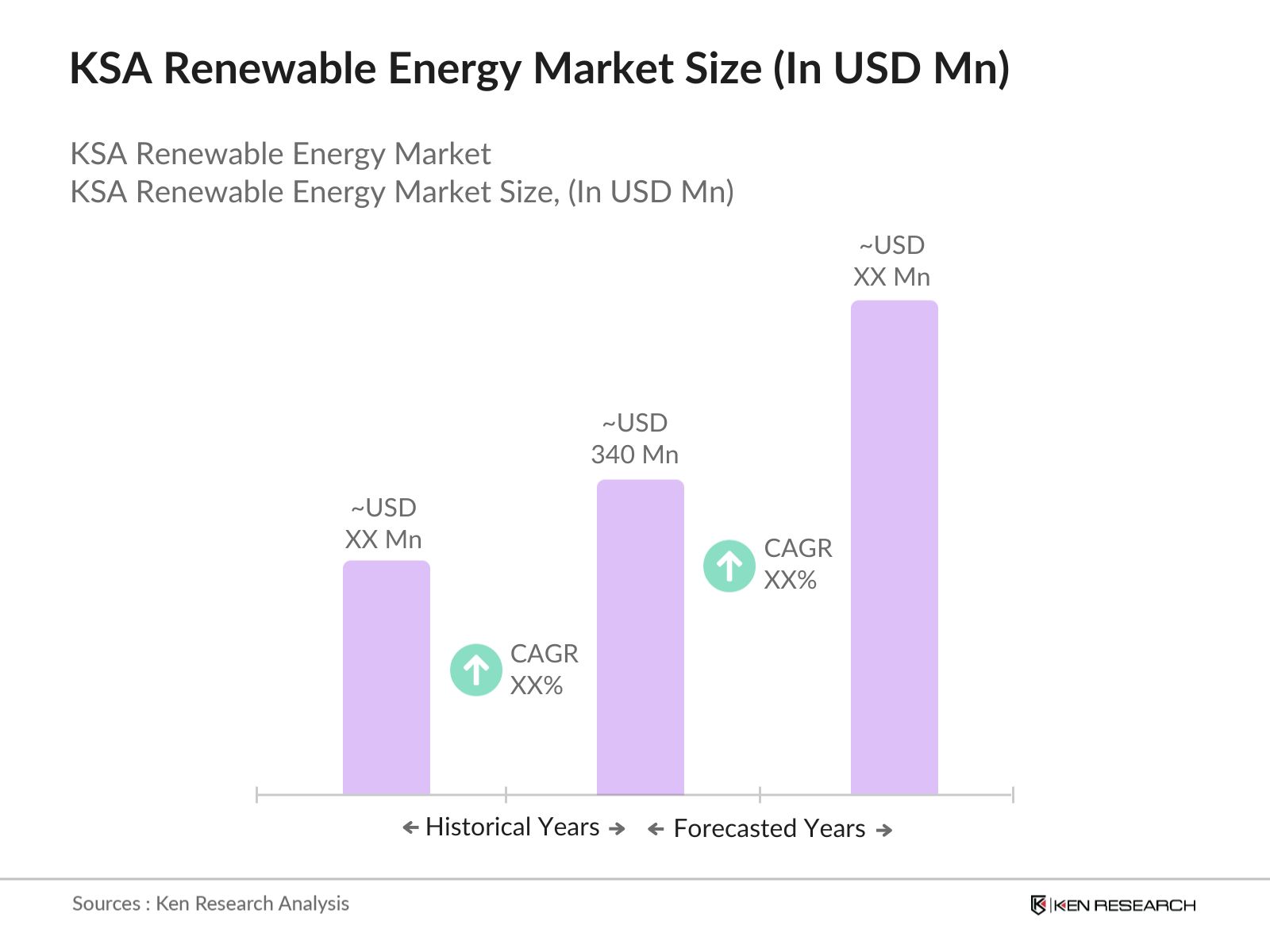
- KSA Renewable Energy Market was valued at USD 340 million, driven primarily by the government's ambitious vision for diversifying energy sources. This expansion is attributed to investments in solar and wind energy, as part of the Saudi Vision 2030 initiative. The growth is driven by both public and private sector investments, particularly in large-scale renewable projects.
- Major players in the KSA Renewable Energy Market include ACWA Power, Masdar, First Solar, Engie, and EDF Renewables. These companies have been pivotal in shaping the market landscape by participating in large-scale solar and wind power projects. ACWA Power, in particular, leads with significant investments in solar photovoltaic (PV) projects, while Engie is advancing wind energy projects across key regions.
- In 2022, ENGIE signed a memorandum of understanding (MoU) with the Saudi Arabian Public Investment Fund (PIF) to jointly develop green hydrogen projects and derivatives in Saudi Arabia. The partnership aims to explore opportunities that contribute to enhancing the energy transition as per the objectives of the Saudi Vision 2030.
- The dominant cities in the KSA Renewable Energy Market include Riyadh, Jeddah, and Dumat Al Jandal. Riyadh leads due to its significant solar energy projects and strategic investments in clean energy infrastructure. Jeddah plays a crucial role with large-scale solar farms like the Al Shuaibah project. Dumat Al Jandal is pivotal for wind energy projects, such as the Dumat Al Jandal Wind Farm, which is the largest in the region.
KSA Renewable Energy Market Segmentation
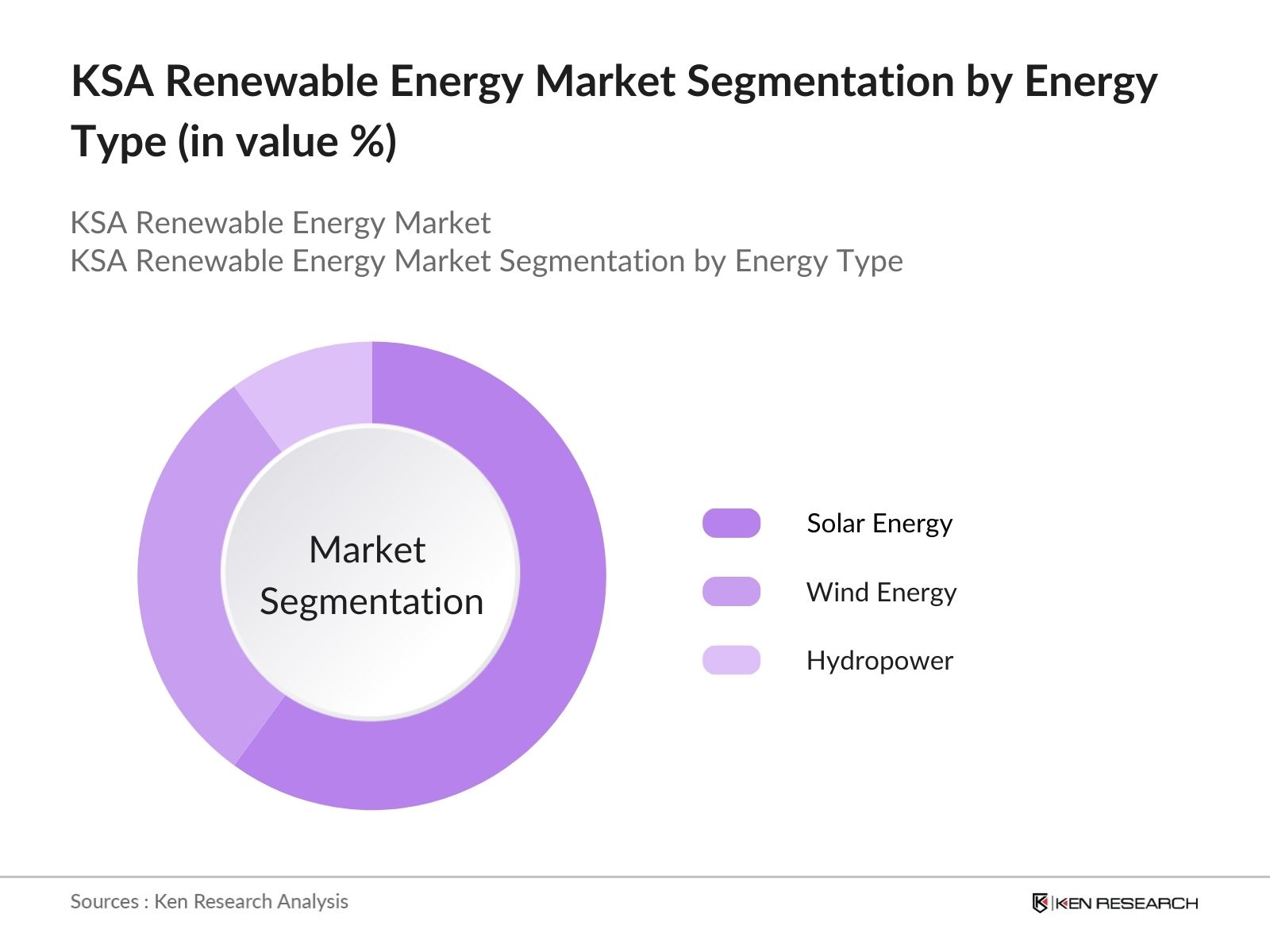
By Energy Type: KSA Renewable Energy Market is segmented by energy type into solar energy, wind energy, and hydropower. In 2023, solar energy dominated the market share, driven by the Kingdoms extensive investment in solar photovoltaic (PV) projects. The favorable climatic conditions, such as high solar irradiation, make solar energy the preferred choice. Solar projects like the Sakaka Solar Power Plant have paved the way for sustained dominance of this segment.
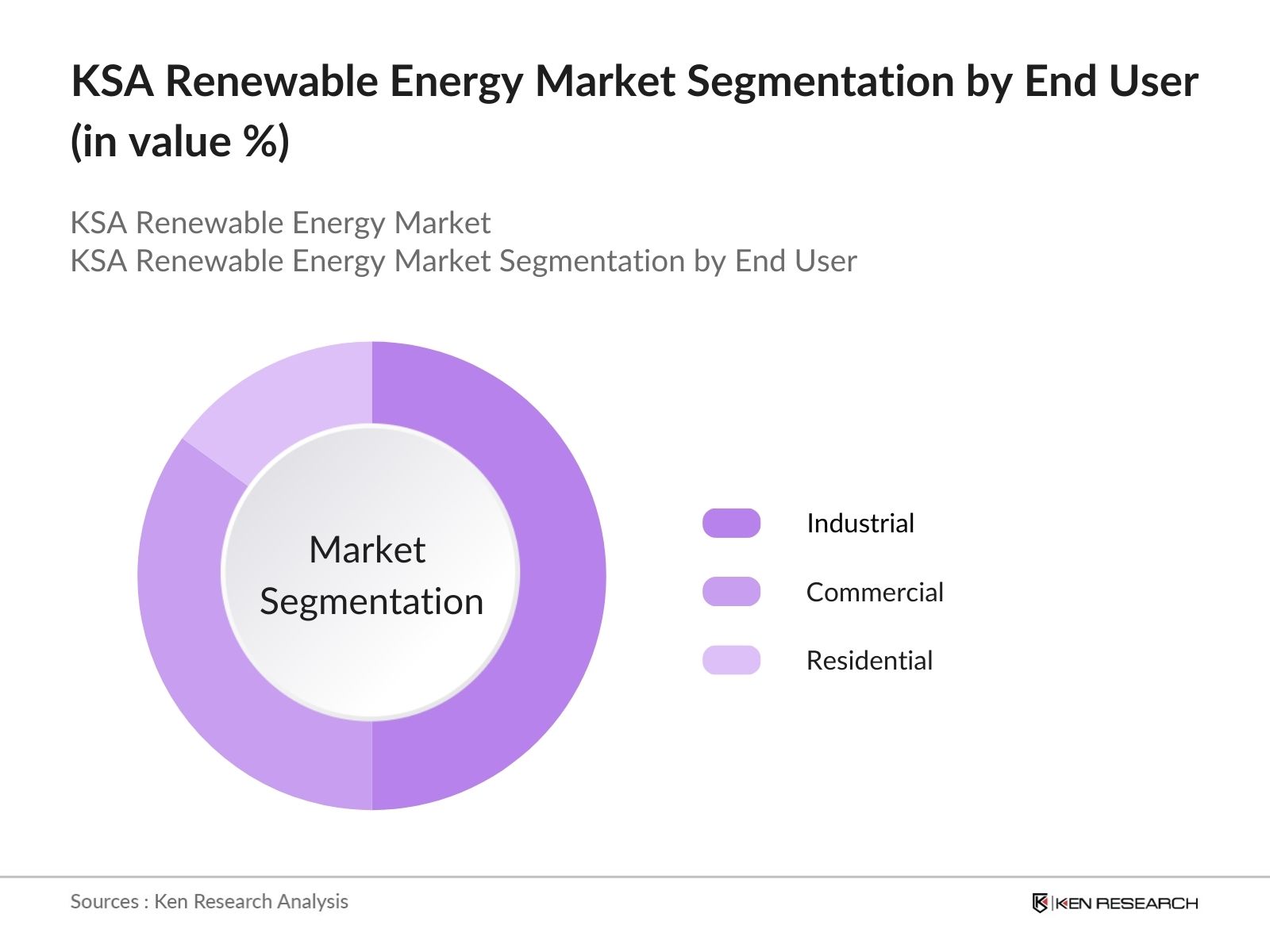
By End-User: The market is further segmented by end-users into residential, commercial, and industrial sectors. The industrial sector accounted for the largest share in 2023 due to the high demand for renewable energy in powering manufacturing facilities and industrial complexes. Industrial users prefer renewable energy to lower operational costs and align with corporate sustainability goals.
By Region: KSA Renewable Energy Market is segmented into the Western, Central, Eastern, and Northern regions. In 2023, the Western region led the market due to its large-scale solar projects and infrastructure. The government's focus on developing renewable energy infrastructure in this region, including partnerships with international companies, contributes to its dominance. High solar insolation and the availability of vast, unused land also boost growth.
KSA Renewable Energy Market Competitive Landscape
|
Company Name |
Establishment Year |
Headquarters |
|
ACWA Power |
2004 |
Riyadh, KSA |
|
Masdar |
2006 |
Abu Dhabi, UAE |
|
First Solar |
1999 |
Tempe, USA |
|
Engie |
2008 |
La Dfense, France |
|
EDF Renewables |
1987 |
Paris, France |
- ACWA Power: In 2024, ACWA Power signed power purchase agreements for new solar PV facilities with a combined value of USD 3.3 billion, contributing an additional 5,500 MW of renewable energy capacity in Saudi Arabia. This marks a significant step forward in the country's goal to diversify its energy mix and increase the share of renewable energy in its power generation capacity.
- EDF Renewables: In 2023, EDF Renewables, in partnership with Masdar and Nesma Company, won the bid to develop the 1,100 MW Al Henakiyah Solar Plant in Saudi Arabia's Al Madinah province. This project, expected to reach financial close in early 2024 and connect to the grid in 2025, will be one of the world's largest single-site solar plants. Once operational, it is expected to power over 190,000 homes per year and displace more than 1.8 million tonnes of CO2 annually.
KSA Renewable Energy Industry Analysis
Growth Drivers:
- Increased Government Spending on Renewable Projects: The Saudi government has allocated billion for renewable energy projects, primarily solar and wind, under its Vision 2030 plan. As of now, Saudi Arabia has around 5 GW of renewable energy capacity, with recent reports indicating that this figure could rise to approximately 31.5 GW if current development rates continue. The government has set a goal of achieving 50% of its electricity generation from renewable sources by 2030, significantly shifting away from its reliance on fossil fuels.
- Expansion of Public-Private Partnerships: The KSA Renewable Energy Market has seen a rise in public-private partnerships (PPPs), with major deals signed in 2023. In 2023, ACWA Power announced the successful financial closure of the Al Shuaibah solar PV projects, which will collectively generate over 2.6 GW of clean electricity. This project is indicative of the growing collaboration between public and private sectors to enhance renewable energy infrastructure.
- Growing Domestic Demand for Clean Energy: Saudi Arabia's rapid industrialization, combined with its commitment to environmental sustainability, has led to a substantial increase in the demand for clean energy. In 2021, the total energy supply was approximately 10,960,948 TJ, with renewable energy contributing 11,618 TJ, marking a 2005.9% increase in renewable energy supply from 2016 to 2021. This growing demand is a significant market driver, particularly for solar and wind energy.
KSA Renewable Energy Market Challenges:
- High Initial Investment and Infrastructure Costs: Renewable energy projects in Saudi Arabia face challenges related to high upfront costs for infrastructure development. Corporate funding reached a record high of $34.3 billion across various deals, reflecting a 42% increase year-on-year, making it financially burdensome for smaller developers to enter the market. These high costs often limit participation from smaller entities, who struggle to compete with larger, established players in securing contracts and financing for projects.
- Regulatory Barriers and Bureaucratic Delays: Although the Saudi government has initiated various renewable energy policies, bureaucratic processes often delay project approvals. These procedural challenges slow down the speed of market expansion, making it difficult to meet renewable energy targets within the expected timelines. Additionally, complex regulatory frameworks and multiple approval layers create further bottlenecks, discouraging foreign investment.
KSA Renewable Energy Market Government Initiatives:
- Saudi Arabia National Hydrogen Strategy: In 2020, Saudi Arabia's National Hydrogen Strategy was initiated in 2020. This strategy aims to position the country as a leading producer and exporter of hydrogen, particularly green hydrogen, by leveraging its renewable energy resources and existing infrastructure. The National Hydrogen Strategy aims to attract USD 36 billion in investments by 2030. The strategy focuses on developing large-scale hydrogen production facilities, backed by collaborations with global partners.
- Vision 2030 and National Renewable Energy Program (NREP): Launched in 2016, Vision 2030 aims to transform various sectors, including energy. The NREP targets the installation of 58.7 GW of renewable energy capacity by 2030, with a focus on solar and wind projects. This includes 40 GW of solar photovoltaic (PV) capacity, 16 GW of wind power, and 2.7 GW of concentrated solar power (CSP).
KSA Renewable Energy Future Market Outlook
The future of the KSA Renewable Energy Market looks promising, with significant growth anticipated over the next five years. Driven by the government's Vision 2030, the market is set to witness increased investments in solar and wind energy, further supported by favorable policies that encourage private sector participation.
Future Trends
- Increased Investment in Solar Energy: Solar energy will continue to dominate the renewable energy market in Saudi Arabia. Investments in large-scale solar farms, such as the Sakaka Solar Plant, are expected to grow, with the government prioritizing solar power due to its vast desert landscapes and high solar irradiation levels. Solar energy will continue to dominate the renewable energy market in Saudi Arabia.
- Expansion of Wind Energy Projects: The wind energy sector is projected to expand, with new projects in the northern regions of the Kingdom. In the next five years, more wind farms will be developed, focusing on diversifying the energy mix and reducing reliance on fossil fuels. Wind projects like the Dumat Al Jandal Wind Farm will become critical components of the countrys renewable energy portfolio.
Scope of the Report
Products
Key Target Audience Organizations and Entities who can benefit by Subscribing This Report:
Power Generation Companies
Industrial Sector Companies
Equipment Manufacturers
Utility Companies
Renewable Energy Project Developers
Residential and Commercial Real Estate Developers
Investors and Venture Capitalist Firms
Government and Regulatory Bodies (Saudi Ministry of Energy, Saudi Electricity Company)
Time Period Captured in the Report
Historical Period: 2018-2023
Base Year: 2023
Forecast Period: 2023-2028
Table of Contents
1. KSA Renewable Energy Market Overview
1.1. Definition and Scope
1.2. Market Taxonomy (Solar, Wind, Hydropower)
1.3. Energy Transition Strategy (Vision 2030 goals, Public-Private Partnerships)
1.4. Market Segmentation Overview
2. KSA Renewable Energy Market Size
2.1. Market Value (USD Mn)
2.2. Year-on-Year Growth Analysis
2.3. Installed Capacity Growth (MW)
2.4. Renewable Energy Generation (GW)
2.5. Key Market Milestones and Developments (Public and Private Sector Investments)
3. KSA Renewable Energy Market Drivers and Opportunities
3.1. Increased Government Spending (Vision 2030, National Renewable Energy Program)
3.2. Expansion of Public-Private Partnerships
3.3. Growing Domestic Demand for Clean Energy (Industrial and Residential sectors)
3.4. Advancements in Renewable Energy Technology
3.5. International Collaborations and Investments
4. KSA Renewable Energy Market Challenges
4.1. High Initial Investment and Infrastructure Costs
4.2. Regulatory Barriers and Bureaucratic Delays
4.3. Limited Grid Infrastructure for Renewable Integration
4.4. Resource Allocation and Competition with Conventional Energy Projects
5. KSA Renewable Energy Market Segmentation
5.1. By Energy Type (Value in %)
5.1.1. Solar Energy
5.1.2. Wind Energy
5.1.3. Hydropower
5.2. By End-User (Value in %)
5.2.1. Industrial Sector
5.2.2. Commercial Sector
5.2.3. Residential Sector
5.3. By Region
5.3.1. Central Region
5.3.2. Western Region
5.3.3. Eastern Region
5.3.4. Northern Region
6. Competitive Landscape
6.1. Market Share Analysis
6.2. Key Market Players Overview (ACWA Power, Masdar, First Solar, Engie, EDF Renewables, and 10 others)
6.3. Recent Developments and Strategic Initiatives (New Projects, Joint Ventures)
6.4. Investment Analysis (Private Equity, Public Funding, Corporate Financing)
6.5. Mergers, Acquisitions, and Partnerships
7. Government Initiatives and Regulatory Framework
7.1. Vision 2030 and National Renewable Energy Program (NREP)
7.2. Saudi Arabia National Hydrogen Strategy
7.3. Environmental and Energy Regulations
7.4. Incentives for Renewable Energy Projects
7.5. Public-Private Partnerships and International Collaborations
8. KSA Renewable Energy Market Trends
8.1. Shift towards Solar Energy Dominance
8.2. Increasing Wind Energy Investments (Focus on Northern Region)
8.3. Technological Advancements in Renewable Energy Storage Solutions
8.4. Integration of Smart Grid Technology
8.5. Adoption of Hybrid Renewable Energy Solutions
9. KSA Renewable Energy Future Market Outlook
9.1. Projected Market Size (USD mn, Installed Capacity)
9.2. Projected Market Segmentation by Energy Type (Solar, Wind, Hydropower)
9.3. Renewable Energy Contribution to National Energy Mix
9.4. Factors Driving Future Growth (Favorable Policies, Investment Opportunities)
10. KSA Renewable Energy Market Analyst Recommendations
10.1. Total Addressable Market (TAM), Serviceable Addressable Market (SAM), and Serviceable Obtainable Market (SOM) Analysis
10.2. Strategic Recommendations for New Market Entrants
10.3. Investment Prioritization (Key Regions, Energy Types)
10.4. White Space Opportunity Analysis
11. Profiles of Major Competitors (15 Players)
11.1. ACWA Power
11.2. Masdar
11.3. First Solar
11.4. Engie
11.5. EDF Renewables
11.6. Marubeni Corporation
11.7. JinkoSolar
11.8. SunPower Corporation
11.9. GE Renewable Energy
11.10. Siemens Gamesa Renewable Energy
11.11. Trina Solar
11.12. Canadian Solar
11.13. Enel Green Power
11.14. Hanwha Q Cells
11.15. TotalEnergies
12. KSA Renewable Energy Cross-Comparison
12.1. Cross-Comparison of Market Players (Revenue, No. of Projects, MW Capacity)
12.2. Financial and Operational Metrics (Revenue Growth, CAPEX, OPEX)
12.3. Regional and Global Positioning of KSA Players
13. KSA Renewable Energy Market Future Segmentation
13.1. By Energy Type (Projected Market Share)
13.2. By End-User (Projected Market Share)
13.3. By Region (Projected Market Share)
14. Conclusion and Analyst Insights
14.1. Key Takeaways for Investors
14.2. Potential Risks and Mitigations
14.3. Long-Term Market Projections
Research Methodology
Step 1: Identifying Key Variables:
Ecosystem creation for all the major entities and referring to multiple secondary and proprietary databases to perform desk research around market to collate industry level information.
Step 2: Market Building:
Collating statistics on KSA Renewable Energy Market over the years, penetration of marketplaces and service providers ratio to compute revenue generated for KSA Renewable Energy Market. We will also review service quality statistics to understand revenue generated which can ensure accuracy behind the data points shared.
Step 3: Validating and Finalizing:
Building market hypothesis and conducting CATIs with industry experts belonging to different companies to validate statistics and seek operational and financial information from company representatives.
Step 4: Research output:
Our team will approach multiple Renewable Energy suppliers and distributors companies and understand nature of product segments and sales, consumer preference and other parameters, which will support us validate statistics derived through bottom to top approach from Renewable Energy suppliers and distributors companies.
Frequently Asked Questions
01 How big is KSA Renewable Energy Market?
KSA Renewable Energy Market was valued at USD 340 million, driven primarily by the government's ambitious vision for diversifying energy sources. This expansion is attributed to investments in solar and wind energy, as part of the Saudi Vision 2030 initiative.
02 What are the growth drivers of the KSA Renewable Energy Market?
KSA Renewable Energy Market is driven by the government's Vision 2030 initiative, increased public-private partnerships, and growing domestic demand for clean energy, especially in the industrial and commercial sectors.
03 What are challenges in KSA Renewable Energy Market?
Challenges in the KSA Renewable Energy Market include high initial investment costs, regulatory delays in project approvals, and a shortage of skilled labor, which increases reliance on foreign expertise for advanced renewable energy projects.
04 Who are major players in the KSA Renewable Energy Market?
Key players in the KSA Renewable Energy Market include ACWA Power, Masdar, First Solar, Engie, and EDF Renewables. These companies have established dominance through large-scale solar and wind projects across various regions of Saudi Arabia.
Why Buy From Us?

What makes us stand out is that our consultants follows Robust, Refine and Result (RRR) methodology. i.e. Robust for clear definitions, approaches and sanity checking, Refine for differentiating respondents facts and opinions and Result for presenting data with story

We have set a benchmark in the industry by offering our clients with syndicated and customized market research reports featuring coverage of entire market as well as meticulous research and analyst insights.

While we don't replace traditional research, we flip the method upside down. Our dual approach of Top Bottom & Bottom Top ensures quality deliverable by not just verifying company fundamentals but also looking at the sector and macroeconomic factors.

With one step in the future, our research team constantly tries to show you the bigger picture. We help with some of the tough questions you may encounter along the way: How is the industry positioned? Best marketing channel? KPI's of competitors? By aligning every element, we help maximize success.

Our report gives you instant access to the answers and sources that other companies might choose to hide. We elaborate each steps of research methodology we have used and showcase you the sample size to earn your trust.

If you need any support, we are here! We pride ourselves on universe strength, data quality, and quick, friendly, and professional service.