
KSA Robotics Market Outlook to 2030
Region:Middle East
Author(s):Yogita Sahu
Product Code:KROD7108
November 2024
94
About the Report
KSA Robotics Market Overview
- The KSA robotics market is valued at USD 450 million. This market is driven by the rapid adoption of automation across various industries, particularly in manufacturing and healthcare. A growing need for efficiency, combined with labor shortages and government initiatives under Vision 2030, has fueled the demand for robotics in the country.
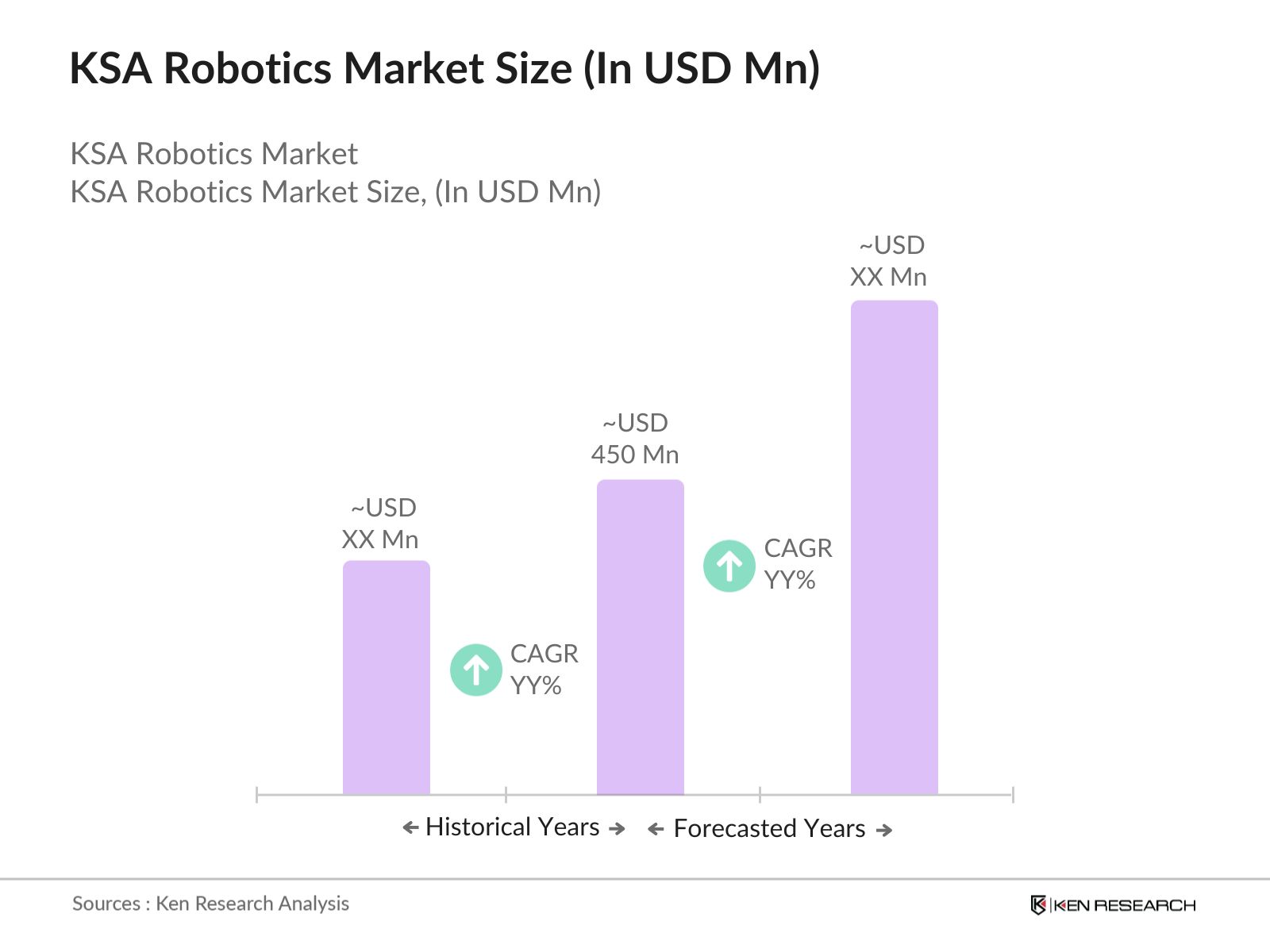
- The dominant regions in the market include Riyadh and the Eastern Province. Riyadh, being the capital and economic hub, hosts many industrial facilities that are investing heavily in automation to improve operational efficiency. The Eastern Province dominates due to its established oil and gas industry, where robotics play a critical role in pipeline maintenance, inspection, and automation of various hazardous tasks.
- The Saudi government expanded the NIDLP in 2024 to include more funding and incentives for robotics and AI development. With SAR 75 billion dedicated to R&D in emerging technologies, the initiative is focused on fostering local innovation and reducing reliance on imported robotics. The NIDLP is also promoting collaborative projects between universities and private companies to develop industry-specific robotics solutions.
KSA Robotics Market Segmentation
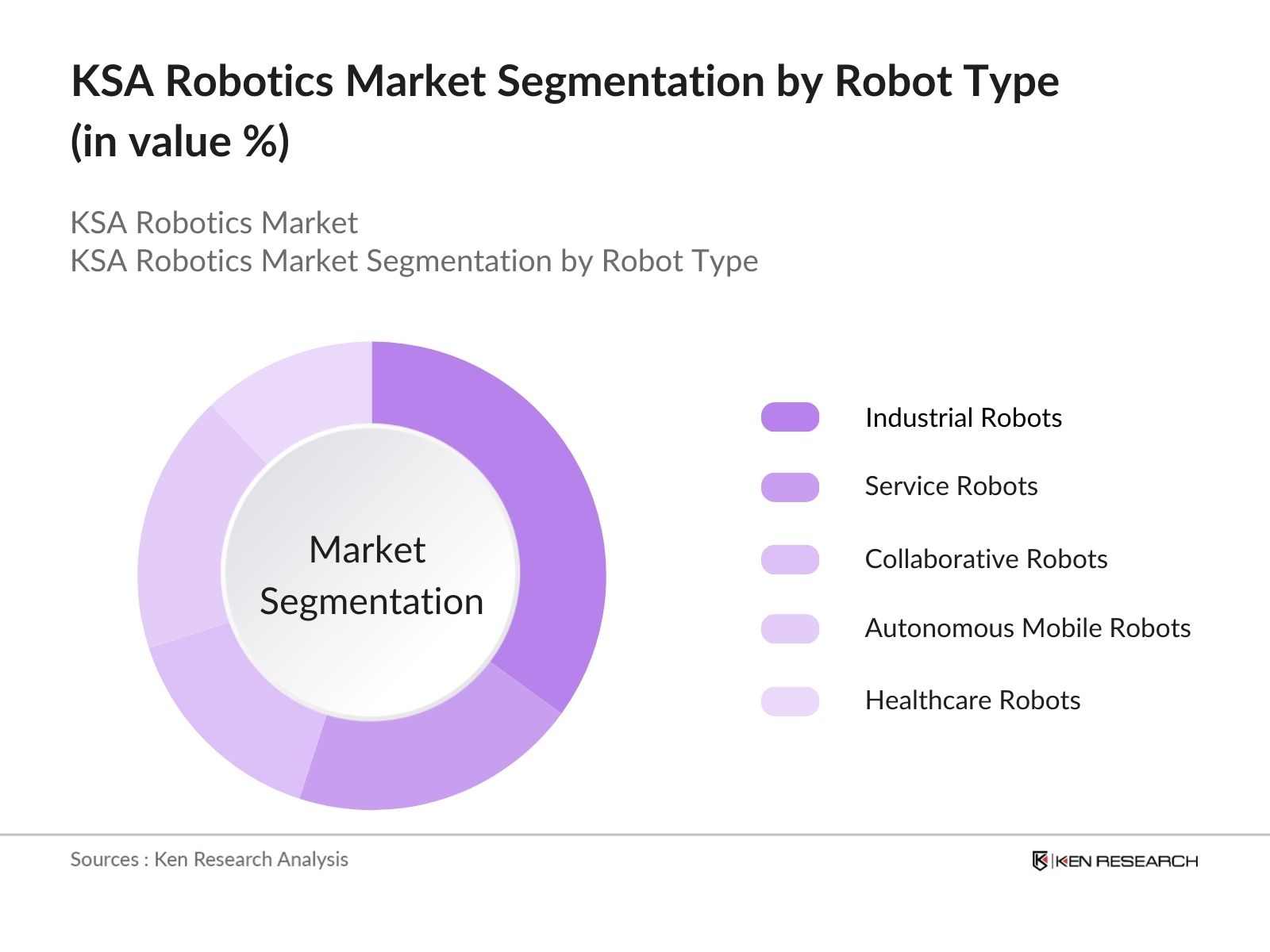
By Robot Type: The market is segmented by robot type into industrial robots, service robots, collaborative robots (cobots), autonomous mobile robots (AMRs), and healthcare robots. Recently, industrial robots have dominated the market due to their widespread use in sectors like manufacturing and oil & gas. The need to optimize production, reduce labor costs, and increase efficiency in industrial operations has driven the adoption of industrial robots.
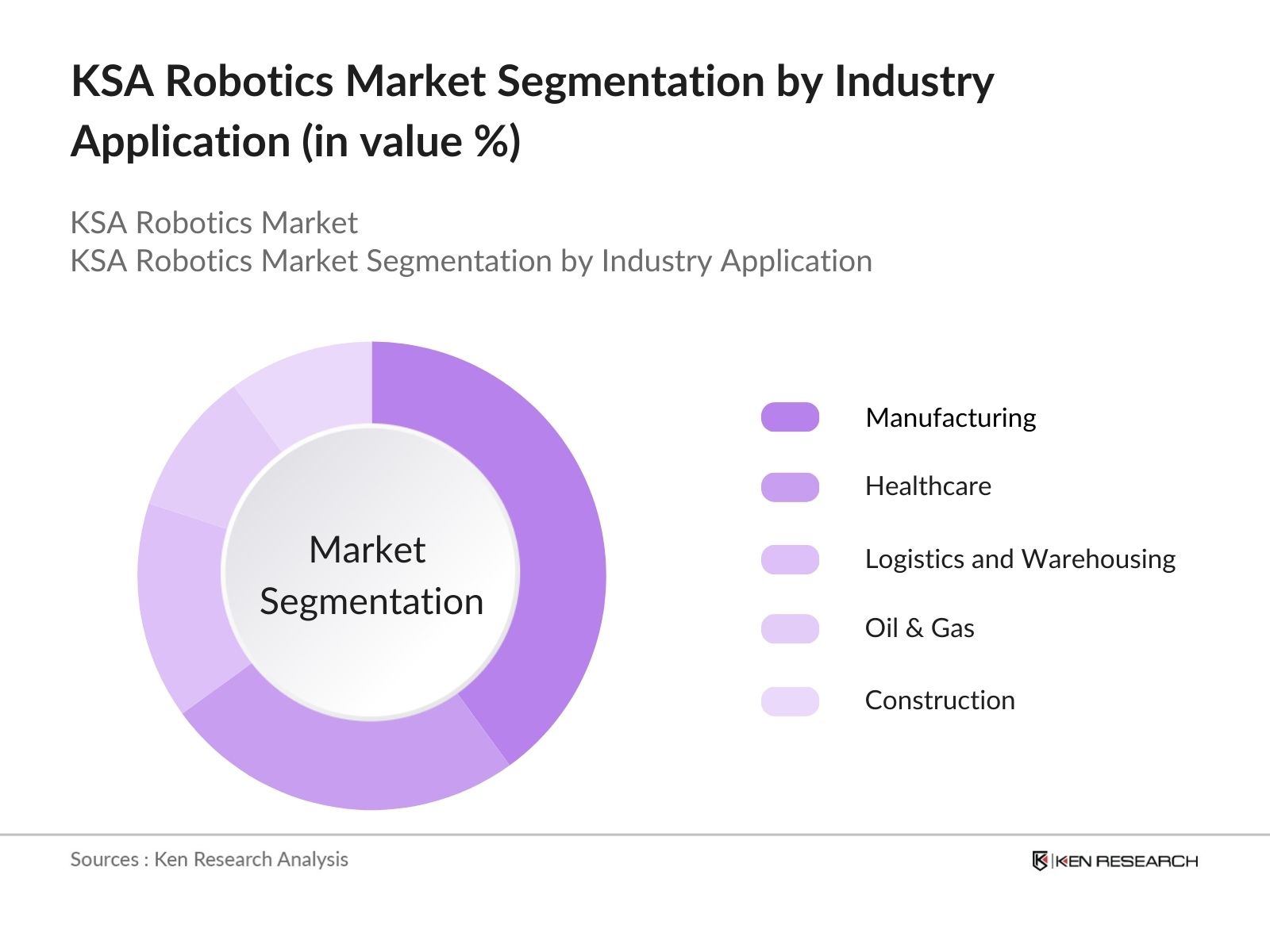
By Industry Application: The market is also segmented by industry application into manufacturing, healthcare, logistics and warehousing, oil & gas, and construction. Manufacturing holds the dominant share due to the high demand for automation in the automotive and electronics industries, which are seeking to modernize and enhance production processes. The push for lean manufacturing and increased productivity has made the adoption of robotics indispensable for large-scale manufacturers.
KSA Robotics Market Competitive Landscape
The market is primarily dominated by a mix of global and local players who have a presence in various industries, including manufacturing, oil & gas, and healthcare. Major global players have partnered with local entities to cater to the region-specific demand, focusing on integrating advanced technologies like AI, IoT, and machine learning into robotic systems.
|
Company |
Establishment Year |
Headquarters |
Number of Employees |
Revenue (2023) |
Product Portfolio |
Regional Presence |
Partnerships |
R&D Investment |
Innovation Index |
|
ABB Ltd. |
1883 |
Zurich, Switzerland |
|||||||
|
Fanuc Corporation |
1956 |
Yamanashi, Japan |
|||||||
|
KUKA AG |
1898 |
Augsburg, Germany |
|||||||
|
Yaskawa Electric Corporation |
1915 |
Kitakyushu, Japan |
|||||||
|
Universal Robots |
2005 |
Odense, Denmark |
KSA Robotics Market Analysis
Market Growth Drivers
- Increased Focus on Industrial Automation in Oil & Gas Sector: The Kingdom of Saudi Arabias oil & gas industry is undergoing significant automation, with robotics playing a critical role in enhancing operational efficiency, especially in tasks involving inspection and maintenance in hazardous environments. The Saudi government has allocated substantial funds in 2024 to modernize the oil and gas sector, which will stimulate the demand for industrial robotics.
- Saudi Vision 2030s Push for Manufacturing Sector Diversification: As part of Saudi Arabia's Vision 2030 plan, the government aims to reduce the kingdom's reliance on oil by diversifying into other sectors, such as manufacturing. In 2024, the Saudi government has announced further investments into the Kingdoms manufacturing sector to boost robotics integration. The push toward smart manufacturing is expected to drive demand for robotics to enhance productivity, efficiency, and output in industries like automotive and electronics manufacturing.
- Rising Demand for Robotics in the Healthcare Sector: The healthcare sector in Saudi Arabia is investing in robotic-assisted surgeries, diagnostic robotics, and rehabilitation robots, as part of the ongoing healthcare reforms. In 2024, the kingdom saw an allocation of SAR 190 billion to the healthcare sector, with a portion earmarked for modern technologies, including robotics. The rise in chronic diseases and the aging population, estimated to reach over 10% of the population by 2030, is driving the need for more efficient healthcare solutions, including surgical robots, to handle the increasing patient load.
Market Challenges
- High Initial Capital Investment in Robotics Technology: While robotics technology brings long-term savings, the initial capital required for deployment is substantial. This is particularly challenging for small and medium-sized enterprises (SMEs) in Saudi Arabia, where the adoption rate of robotics has been slower due to high upfront costs. In 2024, it is estimated that over 70% of Saudi Arabia's manufacturing base comprises SMEs, many of which struggle to justify the high costs of robotics integration without significant financial incentives or subsidies.
- Lack of Skilled Workforce in Robotics and AI: Despite the growing interest in robotics, Saudi Arabia faces a shortage of skilled professionals in robotics engineering, AI integration, and automation. In 2024, the unemployment rate for specialized technical fields remains at 12%, with a gap in the availability of local talent required to operate and maintain robotic systems. This shortage poses a barrier to the wider adoption of robotics, especially in high-precision industries such as manufacturing and healthcare, where expertise is essential for successful implementation.
KSA Robotics Market Future Outlook
Over the next five years, the KSA robotics industry is expected to experience robust growth driven by government support under Vision 2030, industry-wide adoption of advanced technologies, and a growing emphasis on automating industrial processes.
Future Market Opportunities
- Widespread Adoption of Robotics in Agriculture: In the coming five years, the Saudi agricultural sector is projected to see increased integration of robotics for tasks such as crop monitoring, harvesting, and soil analysis. The government, through its Vision 2030 initiative, has earmarked SAR 15 billion toward modernizing agriculture, and robotics will play a pivotal role in enhancing productivity and addressing labor shortages in this sector.
- Increased Deployment of Robots in Saudi Retail and Hospitality: By 2029, robots are expected to become a common sight in Saudi Arabias retail and hospitality sectors, performing tasks such as customer service, inventory management, and concierge services. With SAR 8 billion allocated for retail automation in 2024, the next five years will see substantial growth in service robots aimed at enhancing customer experience in malls, hotels, and restaurants across the kingdom.
Scope of the Report
|
Robot Type |
Industrial Robots Service Robots Collaborative Robots (Cobots) Autonomous Mobile Robots (AMRs) Healthcare Robots |
|
Industry Application |
Manufacturing Healthcare Logistics and Warehousing Oil & Gas Construction |
|
Technology |
Artificial Intelligence (AI) Machine Learning (ML) Edge Computing Internet of Things (IoT) Machine Vision |
|
Payload Capacity |
Less than 10kg 10kg - 50kg 50kg - 200kg Above 200kg |
|
End-User |
SMEs Large Enterprises Public Sector |
|
Region |
North East West South |
Products
Key Target Audience Organizations and Entities Who Can Benefit by Subscribing This Report:
Manufacturing Firms
Oil & Gas Companies
Healthcare Companies
Banks and Financial Institution
Construction Companies
Government & Regulatory Bodies (Ministry of Industry and Mineral Resources, Saudi Vision 2030 Office)
Investor and Venture Capitalist Firms
Robotics and Automation Solution Providers
Companies
Players Mentioned in the Report:
ABB Ltd.
Fanuc Corporation
KUKA AG
Yaskawa Electric Corporation
Mitsubishi Electric Corporation
Universal Robots
Kawasaki Robotics
Omron Corporation
Hyundai Robotics
Denso Corporation
Table of Contents
1. KSA Robotics Market Overview
1.1. Definition and Scope
1.2. Market Taxonomy
1.3. Market Growth Rate
1.4. Market Segmentation Overview
2. KSA Robotics Market Size (In USD Mn)
2.1. Historical Market Size
2.2. Year-On-Year Growth Analysis
2.3. Key Market Developments and Milestones
3. KSA Robotics Market Analysis
3.1. Growth Drivers (Automation adoption, Labor shortages, Industry 4.0, Government Vision 2030)
3.2. Market Challenges (High Initial Investment, Infrastructure Limitations, Regulatory Hurdles, Data Privacy)
3.3. Opportunities (AI Integration, Robotics-as-a-Service, Localization Strategies, Custom Robotics)
3.4. Trends (Collaborative Robots, Autonomous Mobile Robots, Robotic Process Automation, Advanced Robotics in Manufacturing)
3.5. Government Regulation (Vision 2030 Alignment, Robotics Standards, National Industry Initiatives, Government Support Programs)
3.6. SWOT Analysis
3.7. Stake Ecosystem
3.8. Porters Five Forces Analysis
3.9. Competition Ecosystem
4. KSA Robotics Market Segmentation
4.1. By Robot Type (In Value %)
4.1.1. Industrial Robots
4.1.2. Service Robots
4.1.3. Collaborative Robots (Cobots)
4.1.4. Autonomous Mobile Robots (AMRs)
4.1.5. Healthcare Robots
4.2. By Industry Application (In Value %)
4.2.1. Manufacturing
4.2.2. Healthcare
4.2.3. Logistics and Warehousing
4.2.4. Oil & Gas
4.2.5. Construction
4.3. By Technology (In Value %)
4.3.1. Artificial Intelligence (AI)
4.3.2. Machine Learning (ML)
4.3.3. Edge Computing
4.3.4. Internet of Things (IoT)
4.3.5. Machine Vision
4.4. By Payload Capacity (In Value %)
4.4.1. Less than 10kg
4.4.2. 10kg - 50kg
4.4.3. 50kg - 200kg
4.4.4. Above 200kg
4.5. By End-User (In Value %)
4.5.1. SMEs
4.5.2. Large Enterprises
4.5.3. Public Sector
4.6. By Region (In Value %)
4.6.1. North
4.6.2. East
4.6.3. West
4.6.4. South
5. KSA Robotics Market Competitive Analysis
5.1. Detailed Profiles of Major Companies
5.1.1. ABB Ltd.
5.1.2. Fanuc Corporation
5.1.3. KUKA AG
5.1.4. Yaskawa Electric Corporation
5.1.5. Mitsubishi Electric Corporation
5.1.6. Universal Robots
5.1.7. Kawasaki Robotics
5.1.8. Omron Corporation
5.1.9. Hyundai Robotics
5.1.10. Denso Corporation
5.1.11. Siemens AG
5.1.12. Staubli Robotics
5.1.13. Siasun Robotics
5.1.14. Techman Robot Inc.
5.1.15. Boston Dynamics
5.2. Cross Comparison Parameters (Revenue, Market Share, Robotics Innovation Index, Installed Base, Geographic Presence, Robotics Solutions Portfolio, Number of Patents, Strategic Collaborations)
5.3. Market Share Analysis
5.4. Strategic Initiatives
5.5. Mergers and Acquisitions
5.6. Investment Analysis
5.7. Venture Capital Funding
5.8. Government Grants
5.9. Private Equity Investments
6. KSA Robotics Market Regulatory Framework
6.1. Robotics Regulatory Standards
6.2. Compliance Requirements
6.3. Certification Processes
6.4. Government Incentives for Robotics
7. KSA Robotics Market Future Market Size (In USD Mn)
7.1. Future Market Size Projections
7.2. Key Factors Driving Future Market Growth
8. KSA Robotics Market Future Market Segmentation
8.1. By Robot Type (In Value %)
8.2. By Industry Application (In Value %)
8.3. By Technology (In Value %)
8.4. By Payload Capacity (In Value %)
8.5. By End-User (In Value %)
8.6. By Region (In Value %)
9. KSA Robotics Market Analysts Recommendations
9.1. TAM/SAM/SOM Analysis
9.2. Customer Cohort Analysis
9.3. Marketing Initiatives
9.4. White Space Opportunity Analysis
Research Methodology
Step 1: Identification of Key Variables
The first step in our research involves identifying the core variables influencing the KSA Robotics Market, such as market drivers, challenges, and opportunities. We utilized proprietary databases, industry reports, and government data to map out the key stakeholders in this market.
Step 2: Market Analysis and Construction
This phase involved analyzing historical market data and identifying key trends shaping the robotics market in KSA. We also assessed the deployment rates of robotics in specific industries, focusing on demand patterns in manufacturing and healthcare.
Step 3: Hypothesis Validation and Expert Consultation
Market hypotheses regarding growth projections and segmentation were validated through consultations with industry experts and company representatives. These consultations provided insights into market dynamics, financial data, and operational trends.
Step 4: Research Synthesis and Final Output
In the final phase, detailed data was compiled from direct interviews with robotics manufacturers and end-users. This data was cross-verified with government reports to ensure accuracy and completeness, providing a comprehensive understanding of the KSA robotics market.
Frequently Asked Questions
01. How big is the KSA Robotics Market?
The KSA Robotics Market, valued at USD 450 million, is driven by automation across key industries such as manufacturing, healthcare, and oil & gas.
02. What are the major challenges in the KSA Robotics Market?
Key challenges in the KSA Robotics Market include high initial costs, a lack of skilled workforce, regulatory barriers, and the integration of robotics into traditional systems, especially in the oil & gas sector.
03. Who are the leading players in the KSA Robotics Market?
Major players in the KSA Robotics Market include ABB Ltd., Fanuc Corporation, KUKA AG, Yaskawa Electric Corporation, and Mitsubishi Electric Corporation.
04. What are the growth drivers of the KSA Robotics Market?
The KSA Robotics Market is driven by the governments Vision 2030 initiative, industrial automation, advancements in AI and machine learning, and a growing need for operational efficiency in industries like manufacturing and healthcare.
05. What industries are adopting robotics in KSA?
Key industries adopting robotics in KSA include manufacturing, oil & gas, healthcare, logistics, and construction, with manufacturing leading the adoption due to the push for Industry 4.0 technologies.
Why Buy From Us?

What makes us stand out is that our consultants follows Robust, Refine and Result (RRR) methodology. i.e. Robust for clear definitions, approaches and sanity checking, Refine for differentiating respondents facts and opinions and Result for presenting data with story

We have set a benchmark in the industry by offering our clients with syndicated and customized market research reports featuring coverage of entire market as well as meticulous research and analyst insights.

While we don't replace traditional research, we flip the method upside down. Our dual approach of Top Bottom & Bottom Top ensures quality deliverable by not just verifying company fundamentals but also looking at the sector and macroeconomic factors.

With one step in the future, our research team constantly tries to show you the bigger picture. We help with some of the tough questions you may encounter along the way: How is the industry positioned? Best marketing channel? KPI's of competitors? By aligning every element, we help maximize success.

Our report gives you instant access to the answers and sources that other companies might choose to hide. We elaborate each steps of research methodology we have used and showcase you the sample size to earn your trust.

If you need any support, we are here! We pride ourselves on universe strength, data quality, and quick, friendly, and professional service.