















MEA Power Tool Market Outlook to 2030
Region:Middle East
Author(s):Meenakshi Bisht
Product Code:KROD7483
November 2024
90
About the Report
MEA Power Tool Market Overview
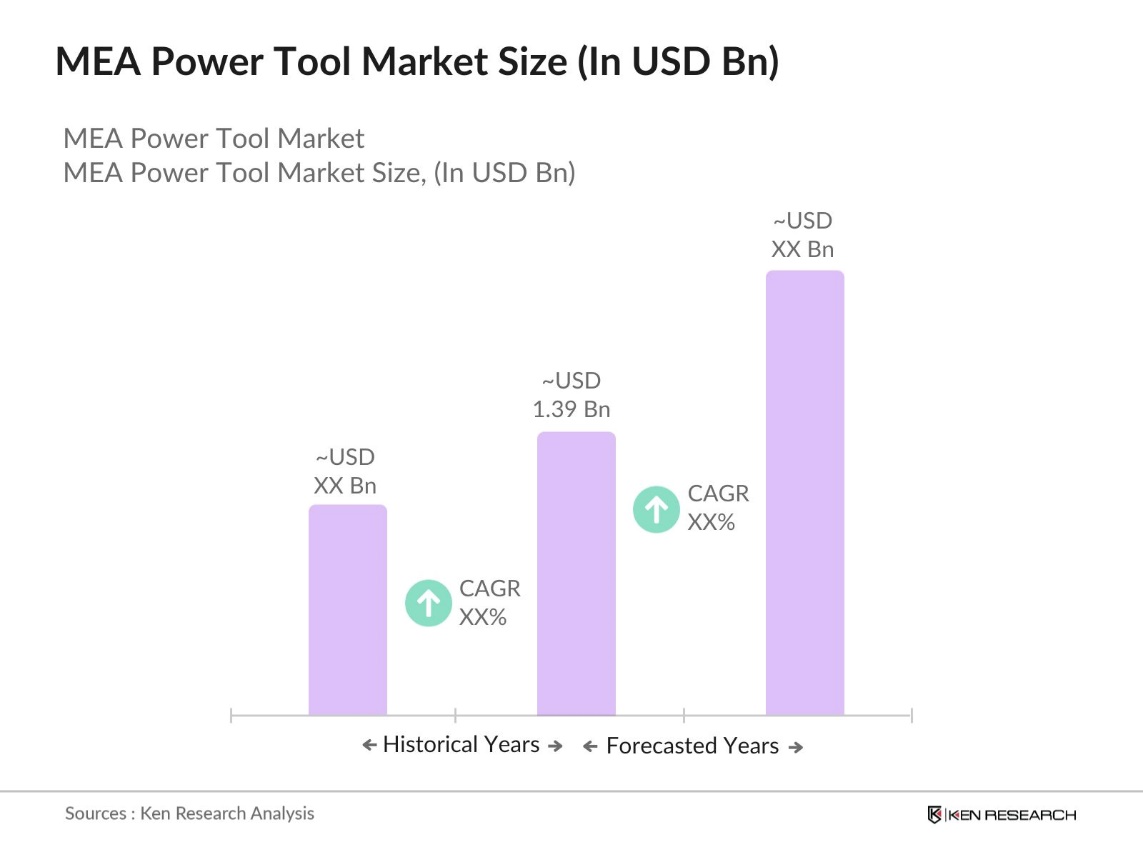
- The MEA Power Tool Market is valued at USD 1.39 billion based on a five-year historical analysis. This market is primarily driven by the construction and manufacturing industries, as well as the growing demand for home improvement tools among DIY enthusiasts. The adoption of advanced technology, such as cordless tools powered by lithium-ion batteries, has played a significant role in expanding the power tool market. Additionally, large infrastructure projects across the region, such as airport expansions and high-rise developments, further drive the demand for power tools.
- The MEA Power Tool market sees dominance from the Gulf Cooperation Council (GCC) countries, particularly Saudi Arabia and the United Arab Emirates. These nations lead due to their rapid industrial growth, significant investments in infrastructure, and government support for large-scale construction projects. Urbanization and increased residential construction also contribute to the high consumption of power tools in these regions. Moreover, countries like Egypt are catching up, driven by their manufacturing and automotive sectors, further solidifying their position in the market.
- Governments in the MEA region are enforcing stricter safety standards for power tools in construction and manufacturing. By 2023, 71% of establishments complied with health and safety regulations, driven by efforts from bodies like the Ministry of Human Resources and Social Development. This has increased demand for tools meeting international safety certifications such as CE and ISO, pushing manufacturers to innovate and comply with the latest requirements for market access.
MEA Power Tool Market Segmentation
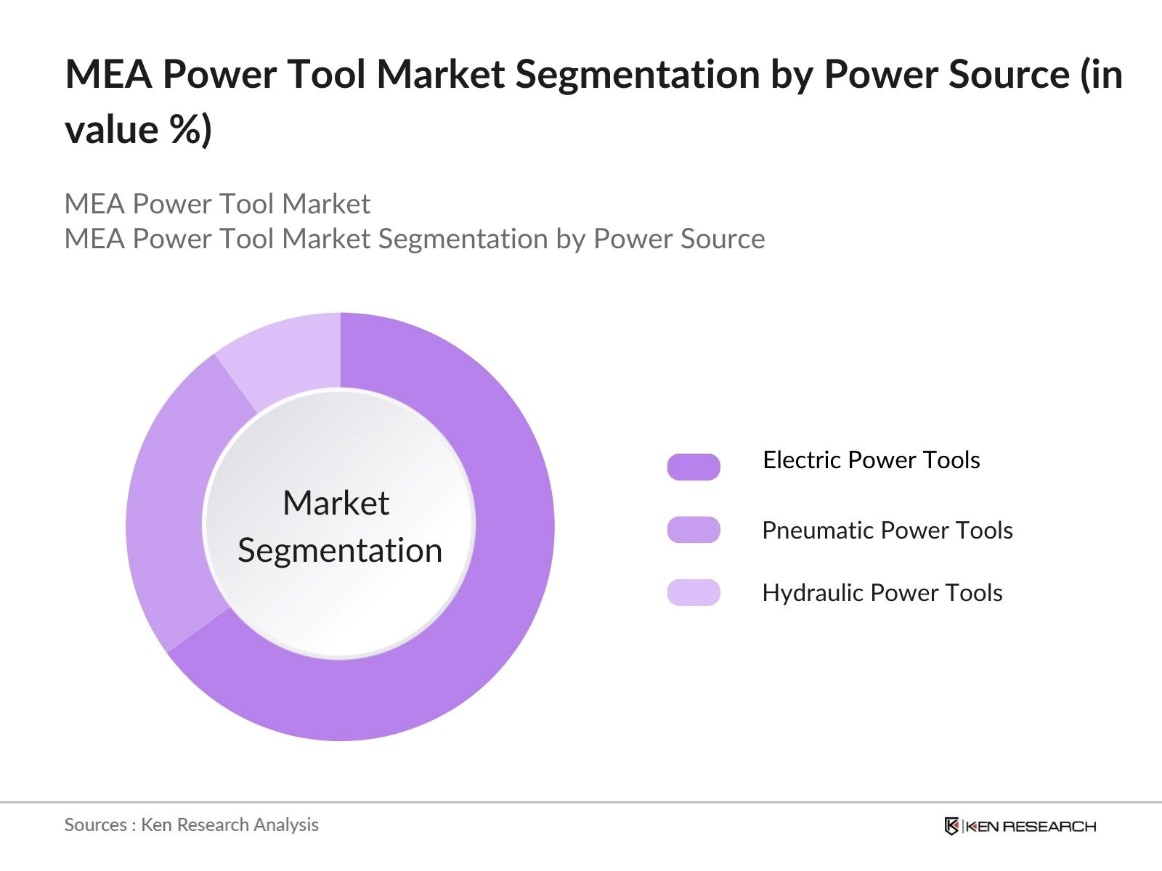
By Power Source: The MEA Power Tool market is segmented by power source into Electric Power Tools, Pneumatic Power Tools, and Hydraulic Power Tools. Electric power tools, which include corded and cordless variants, hold a dominant market share due to their ease of use, portability, and widespread application in construction, automotive, and industrial sectors. Cordless tools, in particular, have gained popularity because of advancements in battery technology, making them a preferred choice for both professionals and DIY users. In contrast, pneumatic tools are mostly used in specialized industrial settings due to their high durability and efficiency in heavy-duty tasks.
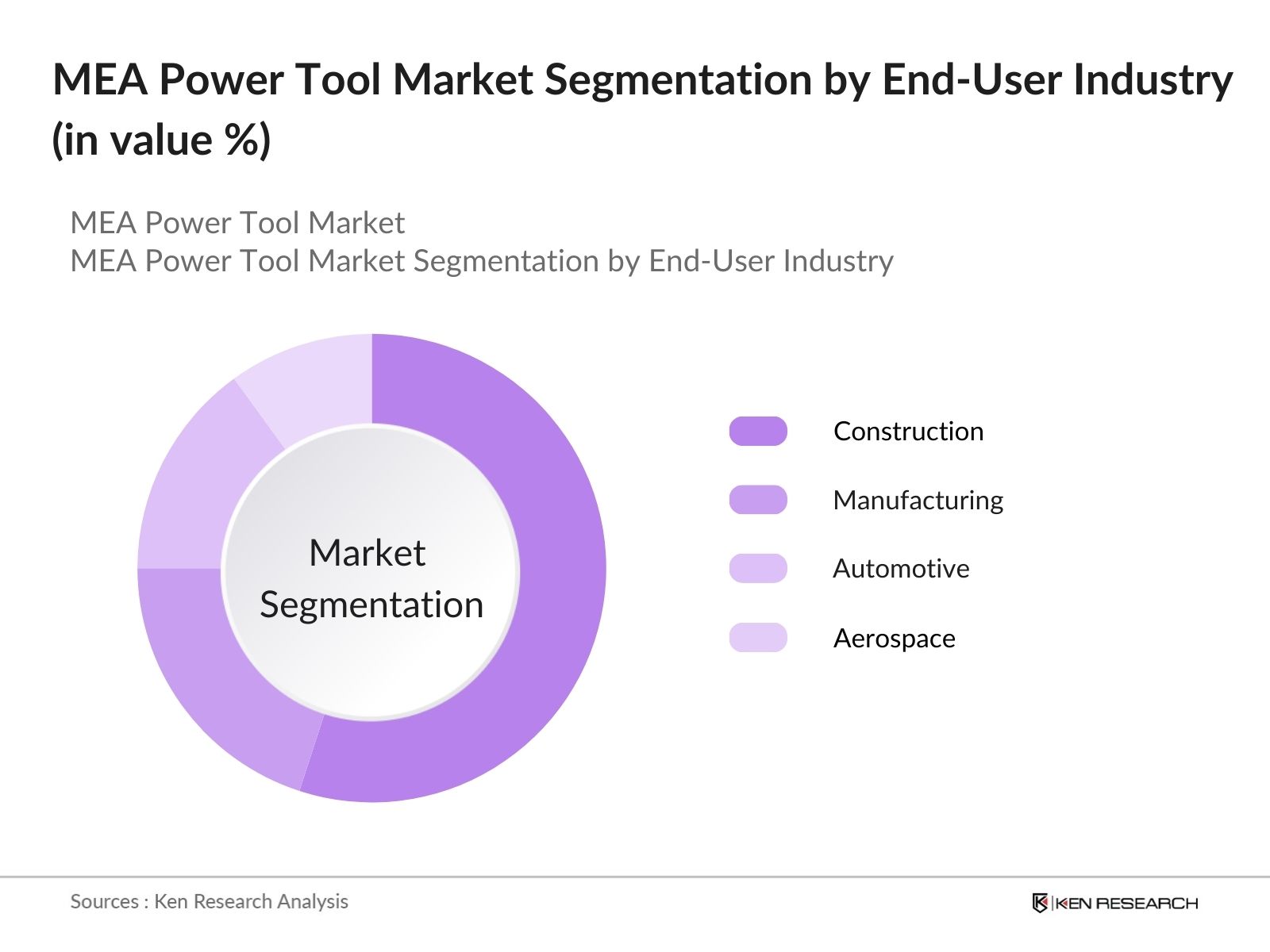
By End-User Industry: The MEA Power Tool market is further segmented by end-user industries, including Construction, Manufacturing, Automotive, and Aerospace. The construction sector is the largest consumer of power tools in the region, driven by large-scale infrastructure projects. Major public and private investments in residential, commercial, and industrial developments across Saudi Arabia, UAE, and Egypt boost the demand for these tools. The automotive sector is also seeing a steady rise in power tool usage due to increased vehicle production and repair needs, further contributing to the markets growth.
MEA Power Tool Market Competitive Landscape
The market is highly consolidated, with major global and regional players dominating the landscape. The competition revolves around product innovation, brand strength, and distribution networks. Bosch Power Tools, Makita, and Hilti are key global players, while local manufacturers like Al-Futtaim Engineering also have a significant presence. The rise of e-commerce platforms is increasing competition among companies, especially in the DIY segment.
|
Company Name |
Establishment Year |
Headquarters |
Product Portfolio |
Market Reach |
Innovation Strength |
Revenue |
R&D Investments |
Global Presence |
|
Bosch Power Tools |
1886 |
Gerlingen, Germany |
||||||
|
Makita Corporation |
1915 |
Anjo, Japan |
||||||
|
Hilti Corporation |
1941 |
Schaan, Liechtenstein |
||||||
|
Techtronic Industries |
1985 |
Hong Kong, China |
||||||
|
Al-Futtaim Engineering |
1974 |
Dubai, UAE |
MEA Power Tool Industry Analysis
Growth Drivers
- Construction Boom in GCC: The power tools market in the Middle East and Africa (MEA) is witnessing significant growth due to the ongoing construction boom in GCC countries like Saudi Arabia and the UAE. Saudi Arabias construction sector, driven by Vision 2030, is valued at USD 1.3 trillion. These large-scale projects, including NEOM and Red Sea developments, require an increasing demand for power tools. The rise in construction activity is spurred by government infrastructure investment, resulting in a higher demand for construction-related tools.
- Rise in DIY Activities: There is a noticeable rise in DIY (Do-It-Yourself) activities in the Middle East, especially in markets like the UAE, driven by cultural shifts and home improvement trends. A growing number of consumers are undertaking household repairs and renovations, fueling demand for home-use power tools. The UAE has been positive, with consumer spending increasing by13%year-on-year in 2023. Power tools, such as drills and saws, are becoming household essentials in this evolving DIY landscape.
- Industrial Automation Demand: The market is also benefiting from the growing demand for industrial automation. Automation efforts in sectors like manufacturing and oil and gas are driving the need for advanced power tools tailored to automated systems. Countries such as Saudi Arabia and the UAE are increasingly focused on reducing dependency on labor while enhancing productivity through the adoption of automated technologies. This industrial shift is a key driver for high-tech power tool adoption, allowing businesses to improve operational efficiency and reduce downtime in various sectors.
Market Challenges
- High Initial Cost: Despite the growing demand for power tools in the MEA region, high initial acquisition costs for advanced tools remain a challenge for small and medium enterprises (SMEs). Many SMEs in the construction and manufacturing sectors face financial constraints, which restrict their ability to invest in technologically advanced power tools. Limited access to credit further exacerbates this issue, preventing businesses from adopting the latest power tools necessary for efficient operations. This financial barrier slows growth opportunities for power tool providers, especially when targeting price-sensitive segments like SMEs.
- Limited Workforce Skills: The market is the lack of skilled labor capable of operating advanced machinery. The adoption of complex, automated power tools is limited due to a shortage of technically skilled workers. Additionally, the absence of adequate vocational training programs in several countries within the region has contributed to this skills gap. Businesses in the industrial and construction sectors often struggle to fully utilize advanced tools, leading to underutilization and reduced efficiency, thereby impacting overall market growth.
MEA Power Tool Market Future Outlook
Over the next few years, the MEA Power Tool market is expected to show substantial growth, driven by technological advancements, such as the integration of IoT in power tools, and a rise in smart construction techniques. The increasing demand for energy-efficient and eco-friendly tools will also boost market growth. Additionally, the market will benefit from ongoing and planned mega-construction projects, especially in countries like Saudi Arabia, where Vision 2030 initiatives prioritize infrastructure development.
Market Opportunities
- Renewable Energy Expansion: The rise of renewable energy projects in the MEA region is creating new opportunities for the power tools market. The construction and maintenance of renewable energy infrastructure, such as solar and wind farms, require specialized power tools designed for durability and precision. As the demand for renewable energy continues to grow, the need for renewable-energy-specific power tools is also expected to increase. This expansion offers a promising avenue for power tool manufacturers to meet the specialized requirements of the renewable energy sector.
- E-Commerce Growth: E-commerce platforms are becoming increasingly vital sales channels for power tools in the MEA region. The shift towards online shopping has provided consumers with easy access to a broad range of power tools, including specialized equipment that may not be readily available in physical stores. The growing trend of e-commerce is offering significant growth opportunities for manufacturers and retailers, allowing them to expand their market reach and cater to the increasing demand for power tools through convenient online platforms.
Scope of the Report
|
Power Source |
Electric Power Tools Pneumatic Power Tools Hydraulic Power Tools |
|
End-User Industry |
Construction Manufacturing Automotive Aerospace |
|
Tool Type |
Drills Saws Grinders Sanders |
|
Distribution Channel |
Online Offline |
|
Region |
GCC North Africa Sub-Saharan Africa |
Products
Key Target Audience
Power Tool Manufacturers
Construction Companies
Automotive Manufacturers
Energy and Utility Companies
Government and Regulatory Bodies (e.g., Ministry of Industry and Mineral Resources - KSA, Dubai Municipality)
Investors and venture capital Firms
Banks and Financial Institutions
Companies
Players Mentioned in the Report
Bosch Power Tools
Makita Corporation
Stanley Black & Decker
Hilti Corporation
Techtronic Industries
Dewalt
Festool
Metabo
Ryobi Limited
Ingersoll Rand
Table of Contents
1. MEA Power Tool Market Overview
1.1. Definition and Scope
1.2. Market Taxonomy
1.3. Market Growth Rate
1.4. Market Segmentation Overview
2. MEA Power Tool Market Size (In USD Bn)
2.1. Historical Market Size
2.2. Year-On-Year Growth Analysis
2.3. Key Market Developments and Milestones
3. MEA Power Tool Market Analysis
3.1. Growth Drivers
3.1.1. Construction Boom in GCC [Economic Impact]
3.1.2. Industrial Automation Demand [Technological Advancements]
3.1.3. Rise in DIY Activities [Consumer Behavior]
3.1.4. Government Infrastructure Initiatives [Policy Influence]
3.2. Market Challenges
3.2.1. High Initial Costs [Pricing Impact]
3.2.2. Limited Workforce Skills [Labor Challenges]
3.2.3. Economic Fluctuations [Macroeconomic Indicators]
3.3. Opportunities
3.3.1. Renewable Energy Expansion [Energy Demand]
3.3.2. E-Commerce Growth [Sales Channels]
3.3.3. Technological Innovations [Product Development]
3.4. Trends
3.4.1. Cordless Power Tools Adoption [Product Preferences]
3.4.2. Smart Tools Integration [IoT Integration]
3.4.3. Eco-friendly Power Tools [Sustainability]
3.5. Government Regulations
3.5.1. Safety Standards [Regulatory Compliance]
3.5.2. Import-Export Regulations [Trade Policies]
3.5.3. Environmental Laws [Sustainability Regulations]
3.6. SWOT Analysis
3.7. Stakeholder Ecosystem
3.8. Porters Five Forces
3.9. Competition Ecosystem
4. MEA Power Tool Market Segmentation
4.1. By Power Source (In Value %)
4.1.1. Electric Power Tools
4.1.2. Pneumatic Power Tools
4.1.3. Hydraulic Power Tools
4.2. By End-User Industry (In Value %)
4.2.1. Construction
4.2.2. Manufacturing
4.2.3. Automotive
4.2.4. Aerospace
4.3. By Tool Type (In Value %)
4.3.1. Drills
4.3.2. Saws
4.3.3. Grinders
4.3.4. Sanders
4.4. By Distribution Channel (In Value %)
4.4.1. Online
4.4.2. Offline
4.5. By Region (In Value %)
4.5.1. GCC
4.5.2. North Africa
4.5.3. Sub-Saharan Africa
5. MEA Power Tool Market Competitive Analysis
5.1. Detailed Profiles of Major Companies
5.1.1. Bosch Power Tools
5.1.2. Makita Corporation
5.1.3. Stanley Black & Decker
5.1.4. Hilti Corporation
5.1.5. Techtronic Industries
5.1.6. Hitachi Koki Co. Ltd.
5.1.7. Dewalt
5.1.8. Festool
5.1.9. Metabo
5.1.10. Ryobi Limited
5.1.11. Ingersoll Rand
5.1.12. Emerson Electric Co.
5.1.13. Panasonic Corporation
5.1.14. Apex Tool Group
5.1.15. Snap-On Incorporated
5.2. Cross Comparison Parameters (Revenue, Market Share, Product Portfolio, R&D Investments)
5.3. Market Share Analysis
5.4. Strategic Initiatives
5.5. Mergers And Acquisitions
5.6. Investment Analysis
5.7. Venture Capital Funding
5.8. Government Grants
5.9. Private Equity Investments
6. MEA Power Tool Market Regulatory Framework
6.1. Safety Standards [Health & Safety]
6.2. Compliance Requirements [Industry Regulations]
6.3. Certification Processes [Product Certification]
7. MEA Power Tool Future Market Size (In USD Bn)
7.1. Future Market Size Projections
7.2. Key Factors Driving Future Market Growth
8. MEA Power Tool Future Market Segmentation
8.1. By Power Source (In Value %)
8.2. By End-User Industry (In Value %)
8.3. By Tool Type (In Value %)
8.4. By Distribution Channel (In Value %)
8.5. By Region (In Value %)
9. MEA Power Tool Market Analysts Recommendations
9.1. TAM/SAM/SOM Analysis
9.2. Customer Cohort Analysis
9.3. Marketing Initiatives
9.4. White Space Opportunity Analysis
Disclaimer Contact UsResearch Methodology
Step 1: Identification of Key Variables
The initial step involved mapping out the ecosystem of the MEA Power Tool Market, identifying all relevant stakeholders such as manufacturers, distributors, and end-users. Data was gathered from industry reports, government databases, and proprietary sources to define key market dynamics.
Step 2: Market Analysis and Construction
Historical data related to market performance was compiled and analyzed. This included examining sales figures, penetration rates, and industry growth indicators. Comprehensive analysis of the power tool distribution networks across the MEA region was also conducted.
Step 3: Hypothesis Validation and Expert Consultation
Interviews were conducted with power tool manufacturers and industry experts to validate market assumptions. These consultations helped provide operational insights and informed revenue forecasts.
Step 4: Research Synthesis and Final Output
Data from secondary and primary research sources was synthesized to ensure a robust and validated market outlook. The research outputs were finalized, including insights into consumer preferences, technological trends, and competitive strategies.
Frequently Asked Questions
01. How big is the MEA Power Tool Market?
The MEA Power Tool Market is valued at USD 1.39 billion, driven by significant investments in infrastructure and the rise of DIY culture across the region.
02. What are the challenges in the MEA Power Tool Market?
Challenges in MEA Power Tool Market include high initial costs of advanced tools, economic fluctuations affecting investments, and the lack of skilled labor for handling specialized power tools in some regions.
03. Who are the major players in the MEA Power Tool Market?
Key players in MEA Power Tool Market include Bosch Power Tools, Makita Corporation, Hilti Corporation, Techtronic Industries, and Al-Futtaim Engineering. These companies dominate through their extensive product portfolios and strong market presence.
04. What are the growth drivers of the MEA Power Tool Market?
The MEA Power Tool Market growth is driven by the booming construction sector, increased consumer spending on home improvement tools, and technological advancements such as cordless and smart power tools.
Why Buy From Us?

What makes us stand out is that our consultants follows Robust, Refine and Result (RRR) methodology. i.e. Robust for clear definitions, approaches and sanity checking, Refine for differentiating respondents facts and opinions and Result for presenting data with story

We have set a benchmark in the industry by offering our clients with syndicated and customized market research reports featuring coverage of entire market as well as meticulous research and analyst insights.

While we don't replace traditional research, we flip the method upside down. Our dual approach of Top Bottom & Bottom Top ensures quality deliverable by not just verifying company fundamentals but also looking at the sector and macroeconomic factors.

With one step in the future, our research team constantly tries to show you the bigger picture. We help with some of the tough questions you may encounter along the way: How is the industry positioned? Best marketing channel? KPI's of competitors? By aligning every element, we help maximize success.

Our report gives you instant access to the answers and sources that other companies might choose to hide. We elaborate each steps of research methodology we have used and showcase you the sample size to earn your trust.

If you need any support, we are here! We pride ourselves on universe strength, data quality, and quick, friendly, and professional service.